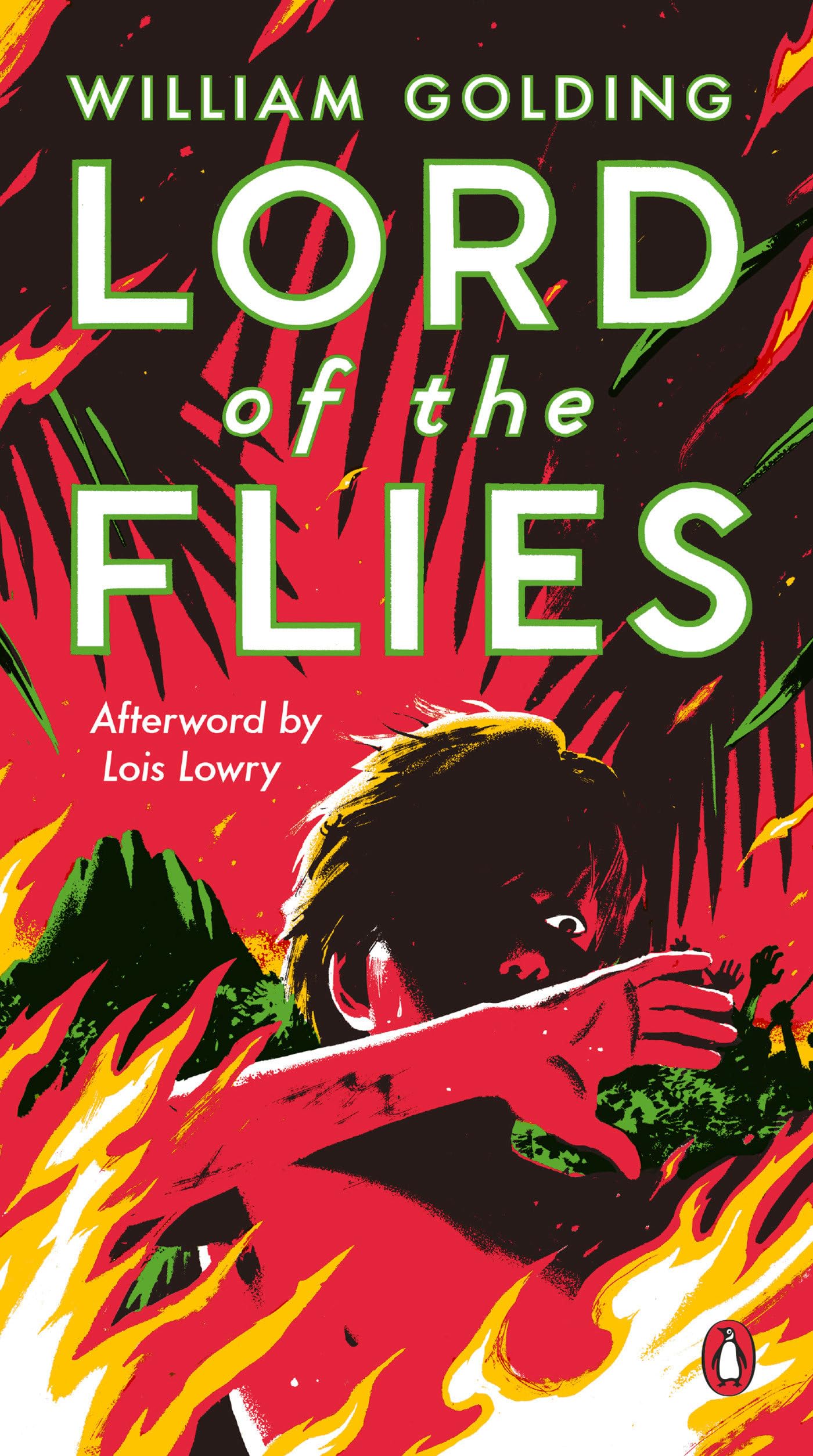
📖 Unlock the classic everyone’s reading before school starts!
Lord of the Flies by William Golding is a critically acclaimed classic ranked #2 in Teen & Young Adult Classic Literature, boasting a 4.5-star rating from nearly 53,000 readers. A must-have for students and literary enthusiasts alike, this timeless novel combines gripping storytelling with profound themes, making it an essential addition to your collection.


| Best Sellers Rank | #200 in Books ( See Top 100 in Books ) #2 in Teen & Young Adult Classic Literature #18 in Classic Literature & Fiction #60 in Literary Fiction (Books) |
| Customer Reviews | 4.5 out of 5 stars 52,998 Reviews |
M**Y
Good book.
My son had to read this for school. He tells me that it is one of his favorites this year.
R**E
Great book, even if a bit dated
This story is so well known, I won't recap it. However I was unprepared for how much I really did like it. I would recommend reading it, even if you've seen the movie(s) and know the story.
B**N
Great Book, (Spoilers! I wrote a whole review).
SPOILERS! Lord of the Flies is a fairly interesting and fast-paced book. It sets a great example of how easy it is for a sophisticated society to become a collection of savage animals and leaves the reader with a lot to think about. First, the characters Ralph, Jack, Piggy, and Simon are introduced and become some of the most important symbols in the book. The characters are all unique and have different effects on each other throughout the plot. Ralph can be counted as the protagonist in this book and is a fair-haired chef representing civility. Jack is a power-hungry antagonist who symbolizes anarchy. Piggy is fat, has asthma, and acts as a scapegoat, but is smarter than anyone else; he symbolizes intelligence. Simon is a boy who volunteers to the point that it gets him killed, he is a symbol of human goodness. These characters become great contributors to the plot and theme. Speaking of the plot and theme, William Golding did an excellent job of reminding people how easily human nature can put society in danger of collapsing. It begins with the male middle school group stranded on an island with no adult supervision, it’s a thing to celebrate at first, but the group under Ralph’s attempts to raise a functioning society becomes more defiant of logic. Made-up creatures from nightmares and increasing arguments led to a downfall in the productivity and unity of the group. They then stop listening to Ralph entirely because they are deprived of fun feelings under Ralph’s logical perspective of island survival. Jack believes that they should have fun hunting pigs and chanting in circles until the day they die, with no hope of rescue in sight. The kids, being the middle school group they are, answer to Jack, except for the smart Piggy and twins Sam and Eric, who are captured or killed even by the other tribe. Simon was one of the few who did his best work under Ralph, even to where his work beat him down. Simon is killed around this time by the group, as they thought he was the fake beast they feared, even when he worked for the good of the group until he died. Ralph is left to survive with the savage group hunting him for the rest of the book until the island is set on fire, catching the attention of a ship that rescues them. When they meet the officer who descended to see what was going on, he asks if they are playing at war, and they agree, even with the mentioned two deaths from this savagery. It becomes clear that the members of a functioning society are ignorant of how easily life becomes a fight for survival when all else is lost. A good theme for the book goes something like the following sentence. Society’s flaws come from the flaws of human nature. This book shows that the human’s nature is to have fun, be lazy, and do what it wants. Society only functions when people mature. Maturing means doing stuff that you don’t want, helping others, and being aware of your mistakes. The middle schoolers in Golding’s book are not mature enough, except for Simon, Ralph, Piggy, and the twins Sam and Eric. They do their part in society but are crushed by the overbearing weight of the savages who let human nature control their every move. These savages blamed others for their mistakes, which led to increasing arguments and aggression towards others. These savages let laziness get the best of their civility, and the group suffered because of it. Other examples clearly show this message as well. In the grand scheme of things, this book is extremely cool and I would recommend it to anyone who wants more than a bad summary of it from me, and anyone who hasn’t read it at all. Just don’t tell them all the spoilers.
J**F
Lord of the Flies 50th Anniversary Edition
THIS EDITION: "Lord of the Flies" 50th Anniversary Edition, by William Golding (winner of the 1983 Nobel Prize in Literature), boasts a beautiful hard-bound cover and includes an introduction from E.M. Forster, biographical and critical notes by E.L. Epstein, and illustrations from Ben Gibson. Golding, William, 1911-1993-- -----Lord of the flies/William Golding--1st Perigee hardcover ed., 50th anniversary ed., p. cm. "A Perigee book." ISBN: 978-0-399-52920-7 OVERVIEW: Author William Golding's debut novel, "Lord of the Flies," was first published in 1954. It follows R.M. Ballantyne's "The Coral Island" and further delves into the fundamentals of human nature by depicting the `what-would-happen?' of a group of young boys who have become stranded on an island--one previously untainted by man. One of the central themes of the novel concerns two opposing ideas about society, i.e.: democracy versus autocracy. Other phenomena explored exist as struggles over morality, rational thought, and individuality, contrasted by immorality, emotional thought, and group-think, respectively. When I was young and first read this book, I was embarrassed to say it was among my top five favorite novels. I thought that admitting how captivated I was by "Lord of the Flies" would make me sound sadistic; I didn't have a good explanation for what I liked about it. As an adult, I've come to realize that what I appreciated so highly was this novel's impeccable use of allegories and seemingly innocuous symbolism. Even today, this is a book that, in my opinion, tells a highly valuable story--not only for young adults, but old adults as well. NOTABLE ACHIEVEMENTS: Following its premiere printing, "Lord of the Flies" managed to sell a meager 3,000 copies. Almost a decade later, the novel saw a resurrection and quickly gained notoriety in schools and on best-seller lists. ▪ 1963: Film-adaptation by Peter Brook ▪ 1990: Film-adaptation by Harry Hook ▪ 1990-1999: American Library Association's "100 Most Frequently Challenged Books"--#68 ▪ 2003: BBC's Survey "The Big Read"--#70 ▪ ----: Modern Library's "100 Best Novels: Editor's List"--#41 ▪ ----: Modern Library's "100 Best Novels: Reader's List"--#25 ▪ 2005: TIME Magazine's "100 Best English-Language Novels from 1923-2005." SUMMARY: Amid a worldwide nuclear war, a British evacuation aircraft crashes into the Pacific Ocean; the only survivors are a group of like-aged school and choir boys between the ages (presumably) of six and twelve. On the deserted and unspoiled island, two of the children, Ralph and Piggy, come upon a conch shell which, when blown, permits Ralph to gather the remainder of the marooned party to one central location. When the strayed survivors see that it is Ralph who summoned them all together, they naturally cling to this occurrence as the first action which remotely resembles stability and, thus, leads to the group's naming of Ralph as their chief. Ralph's only opposition comes from the choir group which prefers Jack Merridew as chief. All of the boys, from both the school and choir groups, note the conch as the tool which has bestowed upon Ralph his rank; the conch quickly becomes a symbol of power for he who possesses it. In his first order of business, Ralph declares two primary objectives: (1.) have fun, and (2.) alert passing ships to the boys' position by smoke signal. In order to spread some of the responsibility, Ralph creates a `cabinet' of sorts; in this analogy: Jack, who leads the choir group in search of food, is the secretary of war; Simon, who is responsible for overseeing the shelter provisions (and who takes to caring for the younger boys, aka. "littleuns") is the secretary of homeland security; and Piggy--and overweight, glasses-wearing, and continuously mocked outcast--becomes Ralph's confidant and right-hand-man. Without any rules or repercussions for failing to keep order, the tribe deteriorates; most of the boys prefer to spend their time not on constructive measures, but rather on developing a new island religion which revolves around an imaginary beast. Perhaps subconsciously, Jack seizes the widespread fear of the beast as an opportunity to gain followers; he makes a vow to slay the beast responsible for tormenting the islanders and, thus, free his people of their woes. Ralph, who is more concerned with necessities for survival, loses ground to Jack, the usurper. Because the "society" members in charge of maintaining the smoke signal have given into the blood-lust promised by the beast hunt, the entire island misses the chance to be rescued by a passing vessel. Despite the recent deterioration of the chain-of-command (and Ralph's constant deflection of personal insecurities onto Piggy), Piggy convinces Ralph that he must retain leadership for the good of the tribe. In the middle of the night, Sam and Eric--a set of twins now tasked to feed the smoke signal--mistake the body of a downed fighter pilot for the beast, leading them to abandon their post in order to recoup with the others. The new confirmation of the beast's existence causes a complete dissolution of Ralph's position as chief; Jack forms his own tribe and celebrates by sacrificing a boar and leaving the head as offering to the beast. In the wake of the turmoil, Simon wanders off by himself and comes across the boar-head-offering. The decomposing head is now swarmed with flies. [It is not entirely clear, but likely that Simon experiences a seizure while looking upon the "Lord of the Flies."] He hallucinates that the fly-covered head is alive, smiling, and speaking to him; it tells him that the "beast" is nothing more than a manifestation of the evil inside them all. Simon goes on to investigate the downed parachutist mistaken by Sam and Eric for the beast; even though Simon knows his discovery of the truth about the beast will mean trouble for him, he hurries back to the feast to alert them all of their foolishness and, hopefully, shed proper light on the situation. Dark and in the middle of ritual feast and dance, the savagery of Jack's tribe becomes evident as the boys willingly mistake Simon for the beast and kill him. For Ralph, Piggy, Sam, and Eric, the realization that they have murdered a friend--one who wanted only to show them "the way"--brings them to their senses; they sever ties with Jack's tribe. Since Piggy's glasses are the only means the boys have of sparking fire, Jack feels that their absence from his camp on Castle Rock (a mountainous area of the island) poses a threat to his command; under cover of darkness, Jack and his followers steal the spectacles. Piggy, perhaps the only `adult-like' character, believes what Jack really wants is the conch because, to Piggy, a tool which provides means of gathering everyone together is far more important that one which only serves to burn. Angered by Jack's immaturity, Ralph, Piggy (carrying the conch), Sam, and Eric journey to Castle Rock to retrieve Piggy's glasses. Not willing to be challenged, Jack orders Sam and Eric to be taken hostage and tortured. Roger, Jack's henchman, thrives in the society which allows him to act unbounded; he kills Piggy by smashing him with a boulder, destroying the conch--the last symbol of civility--in the process. Ralph barely escapes the slaughter, but is soon hunted by Jack and his tribe. In an attempt to `smoke him out,' Jack and his followers set fire to the island. As Ralph begins to consider his eminent death, readers can't help but be reminded of an earlier point in the book when Simon calmly, and almost prophetically, spoke to Ralph "You'll get back to where you came from.... I just think you'll get back all right (p.154)." The once pure island has now become an inferno; the billows of smoke have managed to signal a passing naval vessel just in the nick of time, as Jack's tribe is hot on Ralph's tail. Ralph--tired, frightened, beaten, and hopeless--encounters the naval officer who has come to his rescue. At the sight of the adult's presence, Ralph is finally relieved of his `responsibility to humanity;' Jack and his tribe are paralyzed as if they had been playing characters in some other-worldly video game, with the officer representing `Game Over.' A sense of shame hits each of the boys when the officer suggests that, being British, the boys should have known how to conduct a proper society... "Ralph looked at him dumbly. For a moment he had a fleeting picture of the strange glamour that had once invested the beaches. But the island was scorched up like dead wood--Simon was dead.... Ralph wept for the end of innocence, the darkness of man's heart, and the fall through the air of the true, wise friend called Piggy (p.286)."
J**O
Lord of the Flies Review
William Goldberg’s novel Lord of Flies tells the story of a group of British boys who are involved in a plane crash and find themselves deserted on a stranded island during World War II. The boys rejoice in their new-found freedom since no adults survived the crash; however, they soon realize that chaos is never a good thing. Without order or civility, the true colors of the boys begin to show, and they realize that social order is crucial to their survival. Needing a sense of structure, the boys elect one of the boys, Ralph, as the chief of the group. Ralph then assigns roles and duties to each of the other boys to survive until they can be rescued. This seems like a good solution to their problem until rumors begin that a monster is residing on the island with the boys. The boys decide to give a sacrifice to the monster in the form of a bloody boar’s head, which in time decays becoming “Lord of the Flies.” This unknown monster “fear” ultimately lives inside each of the boys causing it to consume every moment of the boys’ days and nights turning the boys against one another. Their make-shift society quickly begins to unravel creating a conflict between the need for order and the savage nature of human beings. The novel delves deep into the four main characters showing how chaos can truly change a person and make one do things that he never imagined he could do. The first character is Ralph, who is elected chief of the group. Ralph is determined to maintain order within the group. When the boys first arrive on the island, Ralph blows a conch shell like a make-shift horn signaling all the lost boys from the island to descend upon the group. The second character is Piggy, who is smart and insightful. Piggy becomes the most mature of the group; however, he is soon mocked by the other boys due to his physique. Another character Jack is the hunter of the group and delights in hunting for wild pigs on the island. Jack slowly develops a following of other boys who want to hunt, and this leads to a power struggle between Ralph’s followers and Jack’s group. The last of the boys is Simon, the quiet type who likes to venture into the jungle to find solitude away from the others. However, Simon’s solitude becomes his downfall when he starts to become crazy leading to the other boys killing Simon thinking he is the monster of their dreams. The climax of the novel begins after Piggy is killed, and Ralph, Jack, and one of the island’s lost boys named Roger set fire to the entire island. Knowing he is the next to be killed by the group of savages, Ralph runs away and straight into the arms of a British naval officer signaling the end of the haunting journey for the remaining boys. When the boys realize that they have been rescued, they burst into tears realizing what the evil that they have become. Human nature, the struggle between good and evil, and the ultimate darkness of man are central themes throughout the story detailing how even good people can be savage if it means survival. The haunting story is a scary reminder that human depravity makes people do things unimaginable. The struggle between savagery and civilization is something our own society has dealt with since the beginning of time. The novel is a classic story that bleeds over into our world today and details how fear can be used as a weapon when needed to achieve a desired outcome. Goldberg’s novel Lord of the Flies is dark and disturbing at times, but it opens the reader’s eyes to how human nature ultimately controls us all.
H**I
Very Small Print, 9 pt
Print is very small, roughly 9 pt. Story is wonderful.
M**D
Classic!
Lord of the Flies is one of those books everyone should read no matter what kind of books you like. The story will stick with you for a long time and there is a timeless message hidden within the pages. Even though I never read this in high school, this is defiantly a high school level book. The reading is quick and easy once you get into it, just the plot might slow you down. Everyone should read though if you want to understand great usage of motifs, foreshadowing, allusions to mythology, and get certain references from several books, movies, and television shows. The main reason I started this book now was one I never read it before and two I have read all the Hunger Games. Yes, Hunger Games is like Battle Royale, but they are both extremely close to Lord of the Flies as well. Another reason I read this was that I heard Fables refers to it in the Animal Farm story arch, not just the pigs head on a stick, but the fact only one person can hear the “Lord of the Flies” talk to them. So, I went all Fables Fangirl at that part of the book. I must say I also was constantly thinking about the Simpsons’ episode were the kids are stranded on a disserted island. Overall, I really liked the book. It was somewhat predictable at times, but I think that was mainly due to the fact the book has been referenced so many times. Not to give anything away but there is a lot of talk about Piggy’s glasses and how if he ever lost them. At times, the dialogue was a little difficult to follow, but I just had to figure out who was talking when. This is more of a personal issue, but authors need to stop stereotyping twins so much. We are not the same person and makes it hard for me to follow books when they make them Samneric all the time. I think my favorite character in the book was Piggy. Right away, you just get a sense of feeling for him and you just want him to stand up for himself. Ralph you get the feeling he is a complete jerk and you know he is going to be the main villain of the story. I mean he calls Piggy by his nickname, when Piggy tell him not to call him that. Although, Piggy was stupid for even trusting Ralph in the first place, as most innocent kids when they meet bad friends. Clearly, Piggy just wanted a friend. This is the type of book I could go on and on with in my review, but I’m not going to or I know I give away spoilers to those who are living under a rock and never even heard about this book. As I previously said before, this is a book everyone should rad no matter what types of books you like to read. I very much recommend it to those who read Battle Royale and Hunger Games though. This is a great book too for a horror aspect of bullying and the flaws a government with too much authority. You don’t just read this book, this book makes you experience!
J**S
Good book
Very good quality book. Everything was exactly how it was supposed to be.
Trustpilot
Hace 1 mes
Hace 1 mes