Some deliveries may take a little longer than usual due to regional shipping conditions.

Descargar la aplicación


Servicios al cliente
Sobre nosotros
Copyright © 2025 Desertcart Holdings Limited
Descargar la aplicación
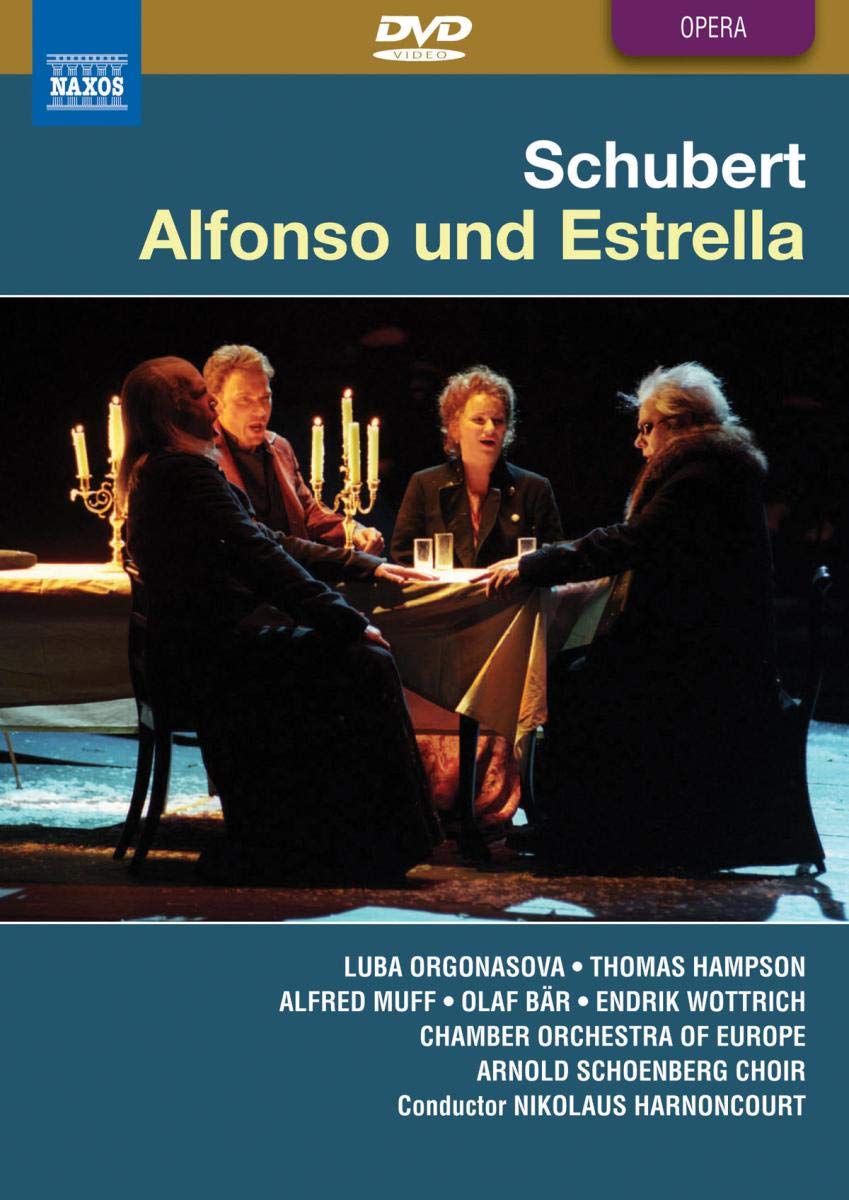
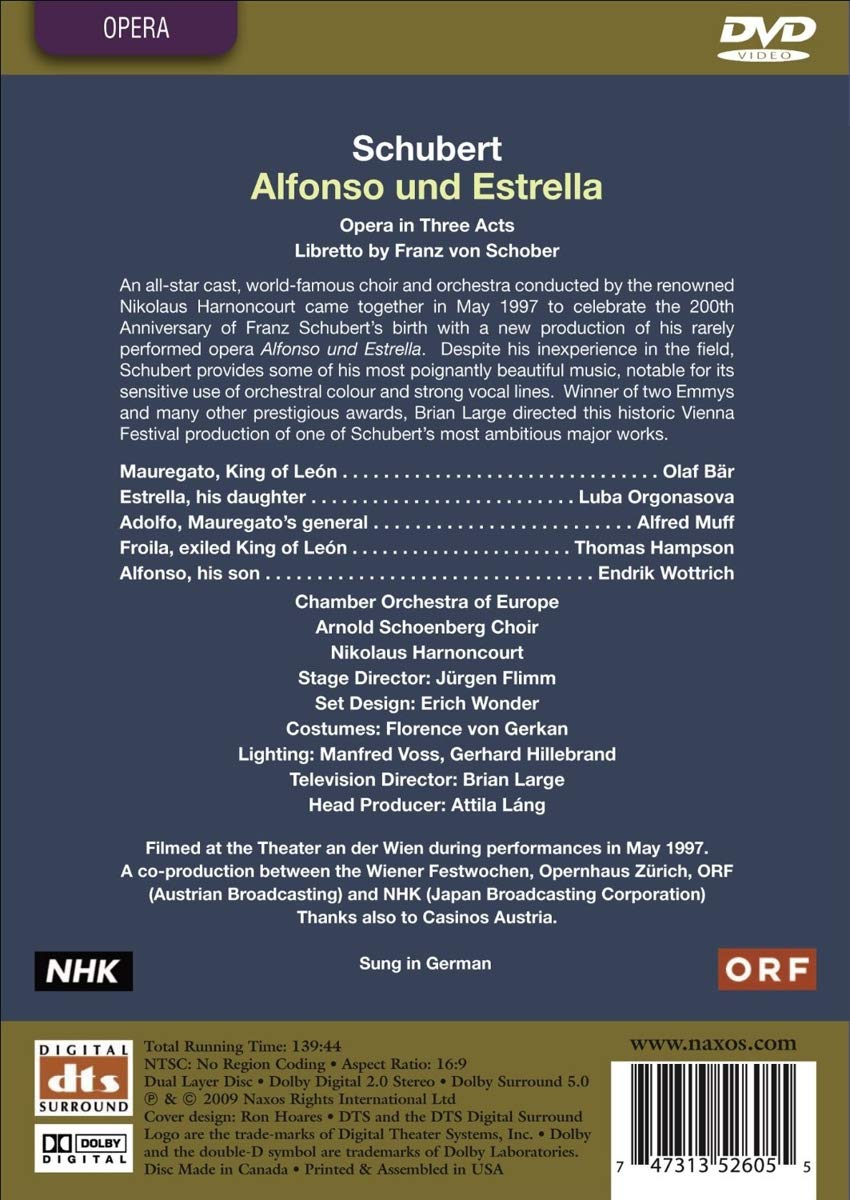
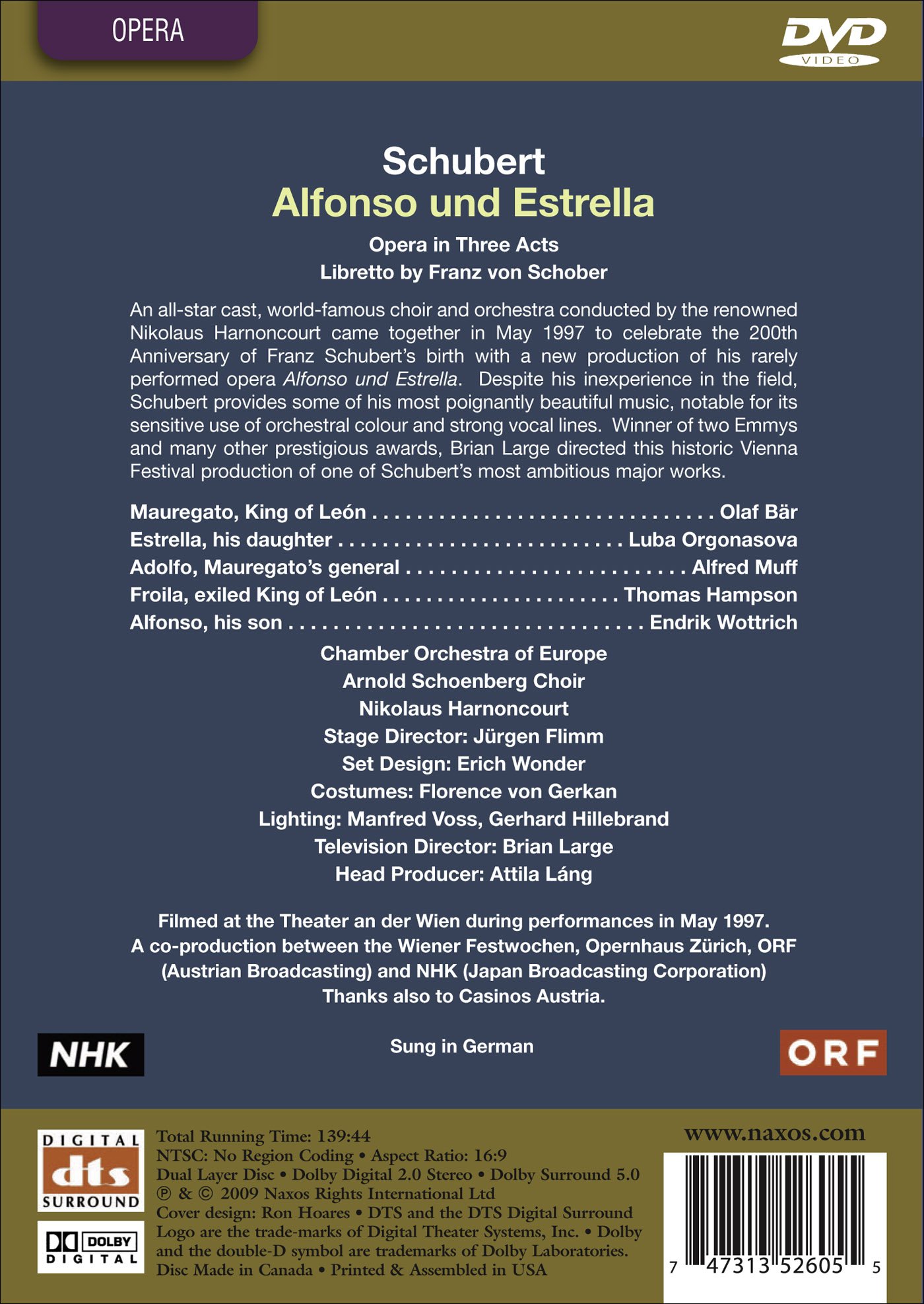
Product Description Olaf Baer, Luba Orgonasova, Alfred Muff, Thomas Hampson, and Endrik Wottrich star in this Schubert opera with Nikolaus Harnoncourt conducting the Chamber Orchestra of Europe and Arnold Schoenberg Choir at the Theater an der Wein, May 1997. Review Just in case you haven't ever read the libretto, much less seen a production of Alfonso und Estrella--and that defines a lot of operagoers--yes, it really is as naively untheatrical as people have noted over the years. Franz von Schober's text is a mess in terms of plot, character definition, timing, consistency, and structure. Schubert's music sometimes has little to do with the emotions being expressed, and occasionally (as in an important act I concertato) provides the same melodic line successively without changes to people giving vent to contradictory feelings. But the opera is still full of Schubert's music. It is occasionally appropriate to the situation, always lyrical, and invariably touched with the magic he possessed. Much of the credit belongs here to stage director Jürgen Flimm. He imposes coherence on the libretto by turning its stereotyped characters into archetypes through a mix of realistic costuming and stage props set against expressionistic, almost Turneresque backdrops. (It helps that the plot, during the last 15 minutes of the opera, becomes Son of "The Magic Flute.") Making King Mauregato of León physically blind instead of only internally so was clever, as a reflection on both his paranoia and zeal for war. Flimm is also to be thanked for his relatively low-keyed (at least, through most of the performance) pressing of war's futility, mainly seen through the poverty of the two courts--Mauregato's, and that of his vanquished predecessor, Froila. None of this is specifically mentioned in the libretto, though it certainly lies within its spirit. Kudos, too, to both Florence von Gerkan for her costumes, and Erich Wonder for his set design--especially act II's sepia-toned backdrop of a middleclass living room that clearly represented some idealized memory from the past in Mauregato's mind. The cast, for the most part, is excellent. Hampson is magnificent as the aging Froila, his abilities as a Lieder singer very much to the fore, without losing the larger sound required by the orchestral accompaniment. Nearly as much can be said for Orgonasova, who has strong control of a refined sound throughout her extended range. Bär, too, sings well, and Muff is both forceful and dramatic, despite some rough patches in the upper range of his voice. Wottrich suffers from the opposite problem: his tone has a worn edge except when the voice rises towards its upper range. The acting throughout is effective from all parties. Harnoncourt conducts a vital yet sensitive reading, with great attention paid to his soloists. It is nice for a change to watch his stickless, two-handed conducting method during introductory passages, instead of observing audience members, outdoor fountains, ticket takers, busts of composers, etc. That brings us to the excellent camerawork. There are more moderately long shots than one is used to, emphasizing both the subdivided stage and the active groupings on it. Facial expressions aren't lost, thanks to a generous amount of close-ups, but they aren't the sole focus of attention, as in so many poorly filmed operatic stage productions. Sound is available in Dolby Digital and Digital DTS surround, with a 16:9 aspect ratio. Subtitles are in English and German. The production is complete, save for part of one scene that brings back the villain and explains a plot detail that still remains unclear afterwards. There are no added features, but what do you need? You are either open to Schubert, or you aren't. If you are, get this DVD. -- Barry Brenesal, Fanfare, Jan-Feb 2010
G**O
His "Time" Has Come?
Amazingly, there are now two DVDs available of an opera that was never staged, or even given a full concert performance, in the lifetime of its composer! Nor in the century after his death! Plus several recordings of it on CDs. Was wird es doch des Wunders noch! Well, friends, it's not such a bad opera after all; critics have panned it for its unwieldy involuted narrative, but honestly the libretto by Franz von Schober is no more embarrassing than that of any Verdi opera before Simon Bocanegra. Why, there's even a moment of some 'universal' significance in it, when the humanist notion of tolerance between nations is celebrated. This staging (I haven't seen the competitor) is short of visual splendor but suitably fluid and stageworthy. The dramatic action, originally conceived as occurring in Medieval Spain, has been time-machined to early 20th C, but the anachronism is not at all jarring. Anything more of a pageant in armor would merely distract us from the only thing that really matters here; the Music.And musically, it would be hard to do a better rendition. Thomas Hampson is magnificent in the role of the aged embittered deposed King Froila. Endrick Wootrich, as Alfonso the son of Froila, struggles in his first scene with a baritone tessitura that doesn't accomodate his best notes, but then he redeems his voice and his character with a youthful heroic bari-tenor. This is music in which baritones dominate, and Olaf Bär is perfect vocally and dramatically in the smaller role of the usurper Mauregato, now blind and conscience-stricken. Baritone Alfred Muff is convincingly odious as the traitor Adolfo, who aspires to seize the Princess Estrella through his coup d'etat, and he sings his roll with musically eloquent harshness. Estrella, sung by Luba Orgonasova, has the only important female role in the drama and in the music. Orgonasova sings quite well, but her stage presence is the only serious weakness of this production; she's noticeably too old for the role and she completely lacks the "affect" of a lovely princess. Instead she's an anxious biddy with a solid vocal technique. The 'Chamber Orchestra of Europe". conducted by Nikolaus Harnoncourt, turns out to be a mixture of modern and historical instruments; the horns are 20th C, for instance, while the trumpets are 18th C. However, the performance is decidedly of the "historically informed" variety, in tempi and articulations, and the overtures and symphonic interludes are very satisfying.But I'm hard pressed to decide whether I'm satisfied with "Alfonso und Estrella" in toto. Schubert composed it in 1821-22, exactly at the time of the premiere of Weber's opera "Der Freischütz". It was promptly rejected in Vienna, and later efforts to get it staged in Berlin or Dresden were equally unsuccessful. I have a sneaking suspicion that "we" have reason to be glad that Schubert's career as an opera composer was thwarted, since all of his greatest music was composed after he'd 'failed' with "Alfonso und Estrella". I'm inclined to think the moment wasn't ripe for the sort of opera he attempted to write. Remember, please, that Spohr, Schumann, and Mendelssohn all made the same attempt -- to compose an opera in the musical language of Romanticism, in the German language of poetic drama learned from Schiller and Goethe, a 'through-composed' opera eschewing both recitativo and spoken words -- and all 'failed' to capture an audience. Dare I say that Beethoven hadn't done much better? "Fidelio" has its merits and has held a place in the repertoire, but no one in his right mind would call it one of Beethoven's greatest works, or one of the very greatest operas.The Nineteenth Century was hardly a great era of dramaturgy anyway. The poetic dramas of Schiller and Goethe, superb as they are for reading, certainly didn't inspire a 'language of the theater' that carried other dramatists toward genius. It was the century of stilted melodrama and exaggerated acting. In English, it was the century of the novel, not the stage. The operas based on Schiller and Goethe, by and large, bowdlerized their sources into the broadest sort of spread-armed melodrama. Not until Ibsen on the spoken stage and Hofmannstal on the musical stage did any dramatist/librettist succeed in producing language worthy of the music it was set to. Franz von Schober's libretto for "Alfonso und Estrella" is no more fustian than most, but it's not truly worthy of its music.I wonder also if there was really any hope for the attempt to set strophic poetry to the symphonic language of "through-composition". In "Alfonso und Estrella", Schubert essentially tried to incorporate the musical idiom of his Lieder into a symphonic and stagey Mega-Lied. He aimed at a kind of 'verismo' before his forms could accommodate it. The operas of Mozart, Paisiello, Cherubini, and Rossini made no such awkward mistake. Berlioz strove mightily to formulate a revolutionary Romantic genre of opera, but even he, in "Les Troyens" resorted to presenting his finest formal arias through the gimmick of having minor characters sing 'ballads' outside the dramatic action. Opera was originated and theorized as a convergence of words, music, and scenery into a supremely affective Unity of art. Schubert's "Alfonso und Estrella" frankly doesn't achieve that ideal. His cycles of Lieder, in fact, seem to me more emotionally affective -- more dramatic -- than his opera.I've also viewed/heard the DVD of Schubert's opera "Fierrabras", composed a year later. That production is far more 'innovative' and post-modernist than this one. Take a look at my review of it, if you're interested. It may be, after all, that Schubert's "time" has come on the opera stage.
Z**P
5 stars, but barely
We can be deeply grateful for any recording of Schubert’s operas, especially his greatest, Alfonso und Estrella. As Schubert’s biographer, Maurice J. E. Brown testifies, “The score contains as much fine and outstanding music as any other full length opera ever written, if we judge the score purely as music.” Furthermore, this is a fine performance by prominent musicians, in the grand old Theater an der Wien, no less. Thomas Hampson (Froila) sings magnificently.The dilemma is that there is another, even better recording, but without video: the audio CDs with Hermann Prey and Dietrich Fischer-Dieskau, conducted by Otmar Suitner, in Berlin, 1978. If your budget has room for only one, do you choose this DVD or the CDs? I recommend the audio CDs with Prey et al.On this DVD, scenery, props, costumes, and choreography are all rather austere. That’s not necessarily a flaw, but it’s basically one step up from “opera in concert,” and you still have to use your imagination when you watch it.Furthermore, there are some idiosyncrasies here that undermine Franz von Schober’s libretto. He wrote a message of forgiveness, repentance, and reconciliation. However, these people are not repenting and forgiving one another out of weakness or fear of punishment. Instead, they have soberly examined their souls and resolved to become better people. It is a noble idea that perhaps contributed to Schubert’s writing such sublime music.It is inconsistent with Schober’s message that this DVD: (1) makes Froila so old he has difficulty walking (when the libretto describes a strenuous regimen of good works); (2) makes Mauregato blind (not in the libretto); and (3) simply deletes the important lines where Mauregato forgives Adolfo, who vows to stop being a narcissist and start being a team player.Thus, I recommend you first acquire the CD version of Alfonso and Estrella with Hermann Prey, Dietrich Fischer-Dieskau, and Otmar Suitner. If you decide you love the opera and desire to see a visualization, by all means also acquire the DVD reviewed here.
E**R
Four Stars
Beautiful music, good voices, anachronistic (19th century) costumes, low-budget staging
T**L
Five Stars
The Guy who acts the role of Alfonso looks like Arnold Schwarzenegger.
H**N
Immerse Yourself in Schubert's Glorious Music.
When thinking of opera the name of Franz Schubert is not one that comes readily to mind. Although he did attempt to compose opera a few times during his short life (1797-1828), few experts seemed to think he was much good at it. So maybe I'm wrong to be so delighted with this production of his opera entitled Alfonso und Estella. For me it was as if his lieder style music had been translated into expressing the everyday interaction of human emotions, enhancing how people relate to each other in all kinds of ways. It's as if everyone involved in producing this performance loves being involved and want as many viewers as possibly to be as enthusiastic about it all as they are. Well, this certainly works for me, because I love just sitting there, allowing the special sound of Schubert's beautiful music envelop me.The Slovakian lyric soprano, Luba Orgonasova, is just perfect for the role of Estrella, realistically expressing the character's torn emotions. In fact, there isn't a below par performance anywhere in this presentation. Although it's true that not all little known operas are worth resurrecting, this one certainly is, not least in how it provides the perfect setting for creating an outstanding role for a top grade prima donna. As with Luba, so with the rest of the cast. There are short biographies of most of them in the very helpful accompanying booklet, which makes interesting reading in both German and English. Unfortunately, no other languages are available. If you like Schubert's music, you will certainly enjoy this recording.Although it doesn't seem to be available in Blu-Ray, this recording is, nevertheless, very good, which causes one to wonder sometimes if Blu-Ray is always as great as it's cracked up to be. As with most things, I expect it all depends on the how, when, why and where of the making of the recording. Anyway, I'm very pleased I bought this recording and hope that many other viewers will enjoy it as much as I do. If you are a fan of Schubert's music, I'm sure you will enjoy watching it many times.
P**M
Another triumph in Naxos' collection of rarely performed operas on DVD
Why is this opera so rarely performed ? I really do not know. The music is marvellous and the story, though episodic, is no more ridiculous or difficult to stage than many operas - indeed it is rather better than most. In fact it often reminded me of early Verdi with the big set piece choruses for peasants and soldiers and the star arias, of course, for the principal characters. There was even an odd presage of Wagner here and there.The cast here is fantastic, vocally and dramatically they are of the highest order. It would be hard to conceive of a better cast today. Thomas Hampson is outstanding as the deposed King Froila but there are many moments of absolutely beautiful singing from all of the principals. Lovely singing from Olaf Bar as the King of Leon too. My only slight quibble is that Luba Organosova is clearly too old as the princess Estrella, especially as she is partnered by the very handsome and suitably young Endrik Wottrich in the role of Alfonso, son of King Froila. However, her vocal qualities are more than ample reward for the slight suspension of disbelief required due to her age and vocally the two young lovers sound great together.The Chamber Orchestra of Europe play wonderfully well under the direction of Nikolaus Harnoncourt and Schubert's fabulous music blooms and glows in their hands to complement the truly marvellous singing.What a find this opera is and for me an emotionally enjoyable experience upon hearing it for the first time as I did when viewing this DVD.
C**W
Unknown but enchanting Schubert
Schubert's operas are generally considered to lack dramatic interest. However, Alfonso und Estrella surpassed my expectations, especially since this production works well and takes the opera seriously. The production is slightly updated but fairly traditional. The sets are disappointing, failing to match the mountainous locations of the plot.The cast is excellent with Thomas Hampson and Luba Orgonasova acting well and singing beautifully. The rest of the cast are almost equally good. The Chamber Orchestra of Europe play superbly and Harnoncourt's conducting is sympathetic and dramatic.For any Schubert admirer this DVD is a must since the music is beautiful throughout. There are several highlights but track 12 "O sing mir, Vater" is a typically glorious piece of Schubertian lyricism (although the song seems irrelevant to the plot).The sound quality was my biggest disappointment. On my system at least, it was no more than adequate.In summary, a beautiful and welcome addition to Schubert on DVD.
A**N
Sehr romantisch - aber schön!
Ich bekam letztlich einen Mitschnitt der Uraufführung des "Fierrabras" geschenkt und fand die Oper - abgesehen vom überspannt-romantischen Libretto - wunderschön. Sie weckte die Neugier auf "Alfonso und Estrella". Ich war sehr gespannt und wurde nicht enttäuscht. Zum einen ist das Libretto deutlich weniger romantisch und die Musik gefällt mir hier auch besser. Die Handlung ist logischer aufgebaut - Romantik gibt es immer noch mehr als genug, aber im Gegensatz zum Fierrabras wirkt hier nichts wie "an den Haaren herbeigezogen". Und was mir besonders gut gefällt ist, dass hier in der Oper ein Schubertlied gesungen wird. Das Lied vom Wolkenmädchen. Und wunderbar mit seiner Liederfahrung gesungen von Thomas Hampson.Auch wenn die Libretti seiner Opern Mängel haben - sicher ist das auch dem Geschmack seiner Zeit geschuldet - sind Schuberts Opern melodiös und schön und absolut wert, dass sich Opernliebhaber daran erfreuen.
G**R
A Labour of Love
This Naxos DVD brings the 1997 performance of Alfonso und Estrella from the Theater an der Wien to commemorate Schubert's birth in 1797.Schubert and his amateur librettist Schober created this opera in 1822; the revised opera had its premiere in 1854. For the commemoration performance in Vienna, Nikolaus Harnoncourt modified the opera further: to tighten the dramatic structure [as stated in the Naxos booklet]. It was a labour of love.The opera is a succession of melodious music -- arias, duets, and chorus pieces -- sung by artists of renown. Even after having watched the opera four times, I still have the impression of attending a Liederabend with an operatic outline.As it is Naxos' recommendable habit, the DVD comes with a good booklet which brings the synopsis, a short essay about the history of this opera, and biographies of the singers.Any serious collector of rare operas should have a copy of this DVD.
Trustpilot
Hace 1 mes
Hace 3 semanas