We remain fully operational. Our teams are working around the clock to ensure your deliveries continue safely.

Descargar la aplicación


Servicios al cliente
Sobre nosotros
Copyright © 2025 Desertcart Holdings Limited
Descargar la aplicación
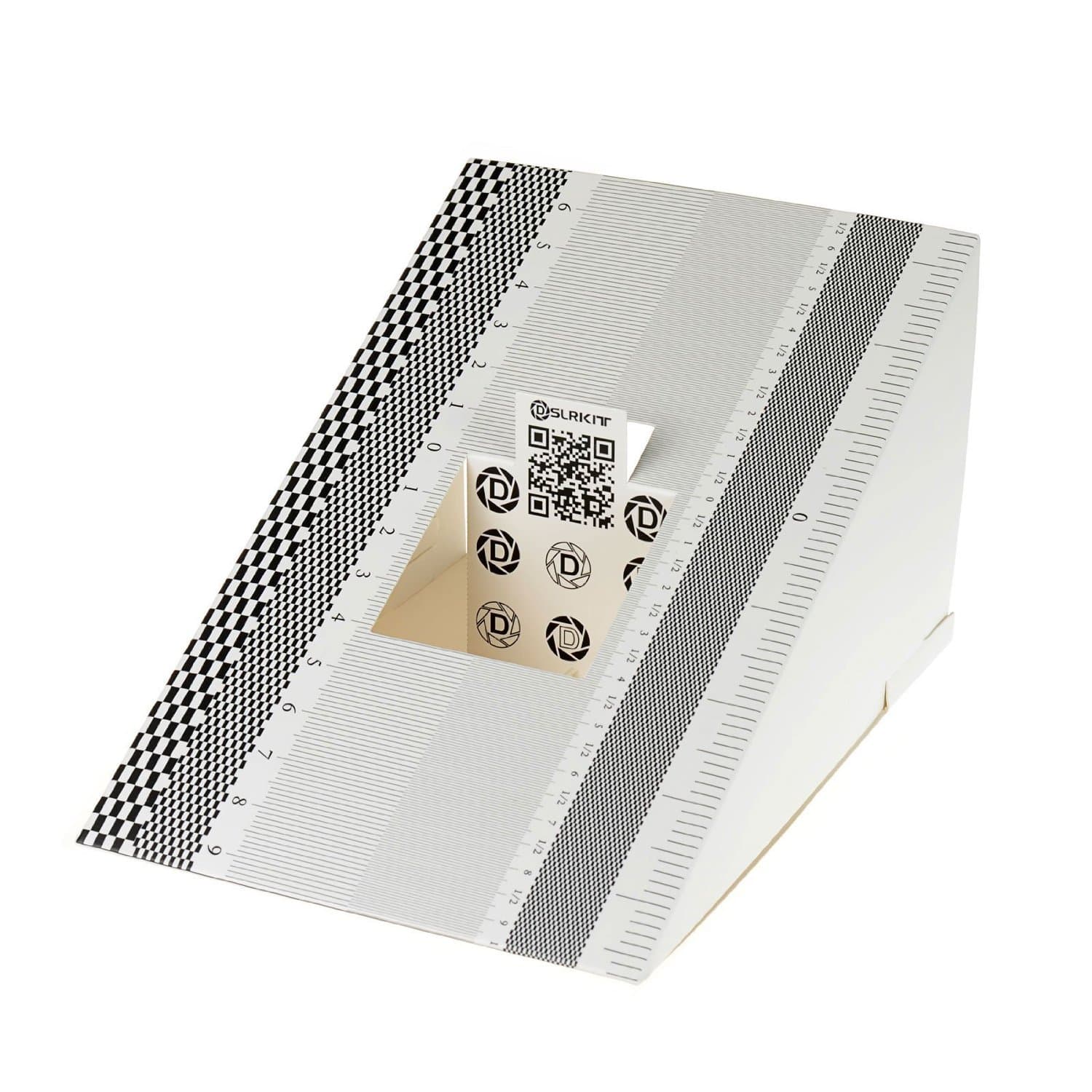
🎯 Nail your focus every time — because sharp shots don’t wait!
The DSLRKIT Lens Focus Calibration Tool is a compact, foldable ruler (19x12.3cm) designed to help photographers precisely test and adjust autofocus accuracy on Nikon, Canon, and Sony cameras. Ideal for lenses with shallow depth-of-field, it enables users to identify front- or back-focusing issues and fine-tune autofocus settings via camera-specific micro-adjustment features. Sold as a pack of two, this essential accessory offers professional-grade calibration at an unbeatable value, empowering millennial pros to capture razor-sharp images with confidence.
| ASIN | B012F8G1DO |
| Brand | DSLRKIT |
| Camera Lens | 4 |
| Camera Lens Description | 4 |
| Color | Black, White |
| Compatible Camera Models | [Nikon, Canon, Sony] |
| Compatible Camera Mount | Canon EF, Nikon F, Sony E |
| Compatible Mountings | Canon EF, Nikon F, Sony E |
| Customer Reviews | 4.3 out of 5 stars 2,949 Reviews |
| Exposure Control Type | Automatic |
| Focal Length Description | 35 millimeters |
| Focus Type | Auto Focus |
| Image stabilization | No image stabilization |
| Item Weight | 0.01 Ounces |
| Lens | Standard |
| Lens Design | Prime |
| Lens Fixed Focal Length | 190 Millimeters |
| Lens Mount | Canon EF, Nikon F, Sony E |
| Lens Type | Standard |
| Manufacturer | DSLRKIT |
| Maximum Aperture | 5.6 Millimeters |
| Media Type | PhysicalProduct |
| Minimum Aperture | 93 Millimeters |
| Minimum Focal Length | 190 Millimeters |
| Model Name | LFCT2 |
| Screen Size | 19 Centimeters |
| UPC | 745227400324 |
| Unit Count | 2 Count |
| Viewfinder Type | LCD screen |
| Water Resistance Level | Water Repellent |
H**R
Works great...
...and a great value, but note: first be sure your camera allows microadjustments to calibrate autofocus, because not all inexpensive or older camera bodies do. Look in your manual or search online to see if your camera offers this feature. Normally you can do this, if possible, at the MENU button and in Canon camera bodies that allow it, in a Custom Function submenu for Autofocus. If your camera can't adjust calibration, you can still use this to test, but you'd have to send equipment in for repair to get any problem corrected, and don't be surprised if the mfr. tests your gear and sends it right back unadjusted, saying it's within tolerance limits (happened to me). With adjustable gear that works properly, you can dial it right in, at least at your tested setting. Also even if your camera body allows adjusting the calibration of autofocus, if you just have inexpensive f/4+ kit lenses, you may not get much benefit from calibrating, whatever tool you use, because the depth-of-field on those lenses is usually close enough for autofocus jazz. These tools are most helpful for calibrating lenses that will be shooting wide open at f/2.8 or wider (smaller f/ number) which work with a very narrow depth-of-field, making autofocus often seem to just miss. You will get NO benefit in calibration accuracy buying a more expensive calibration tool than this one. All these tools just show you whether your lens is back- or front-focusing or dialed in. If it's off, you guesstimate a correction and try again, until it's right. (No tool can tell you exactly what correction is right. It's trial and error.) It's your *setup,* not the cost of a calibration tool, that is key to good results. There is at this writing a competing product that costs over 13 times as much as this one on amazon, and this one will perform just as well as that one. Yikes. You can even build a free one with materials around your house instead that will work just as well, but at this price, it was easier for me to just get this. You do need to learn how to use the tool. This one doesn't come with instructions, it's not intuitive, and if you try to wing it, some gotchas will probably getcha. Other reviews here go into the how-to, and there are a number of good free videos on YouTube demonstrating this product and others that helped me a lot. Just be aware, calibration tools are not plug'n'play; setup is critical, as I said; there are about a dozen guidelines to follow. But once you have it figured out, it goes pretty quickly, taking maybe ten minutes to calibrate a lens' autofocus. No calibration tool can fix photographer technique that is not optimal. Look for some YouTube videos on autofocusing to make sure you're doing it right. One important thing I learned watching one: my old-school technique of holding the shutter release halfway down to prefocus and then recomposing is a poor technique to use with a large-aperture lens wide open, because when you recompose, you change the focal plane just enough to frequently throw your "locked-in" subject out-of-focus. You're better off using Live View, or manually focusing, or at least dialing in one autofocus point on the subject and not recomposing after prefocusing through the viewfinder... or even better, try to avoid shooting wide open (but sometimes you need the extra light).
A**R
Works great and good price
Works great and good price. You could do as well with a sheet of newspaper and some sort of focus target (a playing card propped up facing straight towards your camera lens, for example) placed in the middle of it. But this is more convenient. Similar products (those with just a slanted scale and a focus target) that cost a lot more (some are a lot more) are kind of a rip-off. Some of the expensive alternatives include software, but I don't see where software would save any work or provide more accurate results unless maybe your computer monitor is too pathetic to show better detail than the tiny screen on the back of your camera. You need to view the focus test photos you take on the larger screen of your computer, and you already have software that does that, right? No instructions included which is OK. You are really better off doing some research online to learn and understand how to do "AF Fine Tune" (that's Nikon speak. Canon, Sony, etc. each use a different name for the same thing). Just following some instruction list without understanding would be frustrating and error prone. It's really a pretty simple process after you understand it. Basically, you let your camera auto-focus on the little vertical card in the middle of the tool, and your test photo will show where on the slanted scale is in-focus or blurry and hopefully the in-focus part is right next to the little vertical card. If not, then adjust AF Fine Tune in the camera & take another shot. I was at first concerned this tool might be too small, but it's really just the right size to show where your camera is actually focused. You don't do this procedure at 50 yards range (that would require huge targets).
W**E
Cheap but functional and all round good value
The most importance thing is that it works. I was able to calibrate some of my portrait lenses and prove that calibration correct empirically, in subsequent photo shoots. I was also able to confirm some front-focus issues with a teleconverter I have, which I'd previously tried to prove without a purpose-built calibration target, but couldn't get nearly as unambiguous (and damning) results as with this target. I haven't compared it with other (and much more expensive) focus calibration tools. It is just cardboard, and not particularly stiff cardboard at that, so it does bulge and flex and requires a bit of coercion to set up such that the centre target is actually perfectly vertical. More expensive targets are made of stiffer cardboard, or plastic, and will surely be much quicker to set up and use confidently as a result. It also doesn't have any of the alignment aids that some of the competing calibration targets have, which puts the onus on the user to give proper care to alignment. Presumably this limits its precision somewhat, though I found it was at least as precise as the random focus error in various Nikon lenses & camera bodies, so I deem it sufficient whether or not it's ideal. One other limitation to note - and this is true of the majority of these sorts of focus targets - is that it doesn't suite all focal lengths or focus distances. It's not a particular big target, and seems intended for roughly 'mid-range' focal lengths - perhaps 35 - 100 in 35mm terms. e.g. for telephoto lenses, your working distance is perhaps going to be tens of metres, and even with the long focal lengths (and consequent 'magnification') this target is too small at those distances - e.g. with a 300mm on a DX sensor (1.5x crop) it doesn't really work beyond about six or seven metres. Since lenses can have different amounts (and directions) of systematic focus error at different focus distances, this can be limiting. Likewise it's useless for macro lenses at their nominal working distances (<1m), or for wide angle lenses.
A**R
Cheap Sharpening Stones for Your Glass
These are extremely useful and invaluable to have over time. They're cheap enough to toss into your camera bag for extended trips/shoots as backups for a better built focus card (like Datacolor's), but for the price it can't be beat. I purchased a set of 2 for my Sigma lenses (particularly the 18-35 f/1.8) as they have been known to have auto focusing issues. This was extremely useful in correcting my 18-35 with the Sigma/Canon usb dock, which had front focusing issues and took maxing out all focus settings at every focus range and focal length to correct (sending my lens and body in as it shouldn't be this consistently off). A note to those with older or extremely high end lenses: When you start to go lower than f/1.4 maximum aperture lenses I DO NOT RECOMMEND THIS PRODUCT. It is exceptional for aperture settings about f/1.4+, but if you were testing something like the Canon 50mm f1.2 L, or a lens attached to a Metabones Speed Booster, the focusing card will likely be more inaccurate then the lens making it unreliable. The center focusing part simply folds down and is "held" in place by another slice of paper/cardboard that folds up from the bottom, perpendicular to the focusing part, with a slit in it for the focusing part to slid into. This means that the center piece is not guaranteed to be flat towards the lens when the camera is balanced. It can be off by just a few degrees of rotation which is too inaccurate as a reference of sharpness for short focusing distances and extremely wide apertures.
R**Y
Be ready to use Google
The product may work, but there are absolutely no instructions. Had to go online and do some searching to figure it out. Having said that, I came way out ahead of friend of mine who spent $75 for his. He has to jump through hoops for setup and testing. Me, I can check all my lenses in the length of time it takes him to set up and test one.
D**T
Worth every penny.
An amazing value for $5.00. There are many versions of this kind of thing, for anywhere from $30 to $120. Yes, most of the other versions are made from some sort of plastic and will last longer, but this works very, very well. Especially when you consider it's only $5. This is simply a heavy card stock, but when put together, it's actually quite sturdy. I would prefer it to be a bit bigger, and maybe the company will make a larger version for $8.00. <g> I would buy one in a heartbeat. Don't get me wrong, this works as is, I think it would be even better if it was larger only because it would then be better for wider lenses. With anything under 50mm lens, the target is a bit small, which puts the actual part of the calibration section too close to the target area. It still works, but you have to be careful to get the focus point perfect. Having said all that, it did show up a problem with the calibration on my camera that i was not aware of. After calibrating 4 different lenese, I ended up with a -9 adjustment of the MFA on my 70D. That's pretty consistent. Makes me happy that my lenes all seem to be good, and the camera was slightly out, and correctable. Honestly, this was the best 5 bucks I've spent in the last few years. I was close to dropping $85 on a different product that should be even better since it's slightly larger and a sturdy plastic, but I probably won't bother now. I would love to know someone locally that has one I could compare myself to see if more money really means a better product in this case. So, bottom line is I would highly recommend this focus target. If your camera can be adjusted by you, get one, you won't regret it. (oh yea, forgot - you get two of them for the $5 in case your dog eats one)
L**S
Good product, great price
You can shell out another $1500 for a new body...or several thousand for new lenses.. or you could spend five bucks and an afternoon getting the very best out of what you already have. I have seven or eight low to mid-grade lenses and a Nikon D300s. Two of the eight were dead on. The others needed 2 to 4 degrees of tuning to hit the sweet spot. Not major changes, certainly, but just enough to be worth the effort. I don't make a living doing this, so a hundred dollar tool really wasn't really an option, but five bucks, yeah, I'm in. It worked very well. Not sturdy by any means, but can be re-used several different times if you take just a little care. Another buyer suggested adding a couple of pieces of tape to hold everything in place, and that definitely helps. Given the number of times an average or enthusiast photographer will use one of these, five bucks for two is a bargain. They do make a larger size, which would be nice, but I didn't really have any trouble focusing on the target using a center spot focus. It does help to use a good tripod, timer mode, and the on-camera flash to eliminate all the other variables when deciding between the fine tune settings.
D**1
READ: HOW TO USE THIS SUCCESSFULLY WITH ALL LENSES - From Wide Angle to Telephoto!
So I bought this knowing that it had a really small 0 focus target, meaning that it only REALLY works well if you're really close to it, enough to where your entire center focus point on your camera can cover the focus target. And that is this products biggest downfall in my opinion. Other than that, it's great. Especially for the price. I mean, comparable focus tools are 12+ TIMES THE PRICE - some magical how. Idk how that's even possible for them to cost that much, I mean... they're all just plastic and paper o_o ANYWAY: Here's how I got around that and turned this thing into a very useful focus tool that works for ALL of my lenses, ranging from 14mm all the way up to 1,200mm!!! 1. Print out a lens focus target - just google image search "lens focus target" and you'll find a ton of them. Print any of them out but try to cover the entire paper. I like the ones that have lost of stuff on the target so there is a lot to focus on (see the pictures attached for the target I used). 2. Cut out that target to exclude any extra bits of blank paper. 3. Cut out a piece of cardboard that has a long "stem" at the bottom. Make sure that this "stem" fits into the hole in the paper focus calibration tool (see photos attached). You'll want it to be long enough to where you can tuck it into the hole and then fold it, so it can be taped to the inner base of the focus calibration tool. I included rulers in the picture so you can kind of get an idea of lengths. Make sure to leave one side empty! This way you can still see the "ruler" on at least one side of the focus calibration tool. 4. Stick your target onto the cardboard using tape, glue or basically anything that works (and is light in weight). 5. Slide the "stem" of the cardboard into the hole of the focus calibration tool and bend it in an "L" shape towards the bottom. Tape the borrom of the "L" shape of the cardboard to the inner base of the focus calibration tool and tape the upright part of the "L" shape to the "target" of the focus calibration tool (see photos of the inner part of the calibration tool. 6. MAKE SURE that the part of the cardboard with the large target on it is pointed straight up and roughly in line with the "0" point of the focus calibration tool. NOTE: Due to the thickness of the cardboard, the new, larger target will be slightly pushed forward. But for the most part, this is negligeable. Just keep it in mind. Especially if you're using thicker cardboard. That's it! Now you can get even 30-50' away from the focus calibration tool and STILL get a good idea of where your focus point is hitting thanks to the larger focusing target! :) Is this the absolute best focusing tool ever after the modifications? No... But it's inexpensive and it seems to work really well. One of my lenses in particular was way off, this helped me get my subjects in the peak focusing point very quickly :) Hope this helps others out there! If you found it helpful, click the "Yes" buttons where it says: "Was this review helpful to you?" If not, leave a comment explaining why and I'll try to make it better :) I'd like to help people out there in any way I can :D Other notes, possibly to manufacturer: I really think you could make this tool a lot better by making the target a lot larger. It seems like you could include a second hard piece of paper to attach to this tool OR even have the "cutout" use a larger piece of the tool itself. It seems like there's a lot of space you could work with to achieve that. Also wouldn't mind if the tool itself was a little larger.
Trustpilot
Hace 2 meses
Hace 1 mes