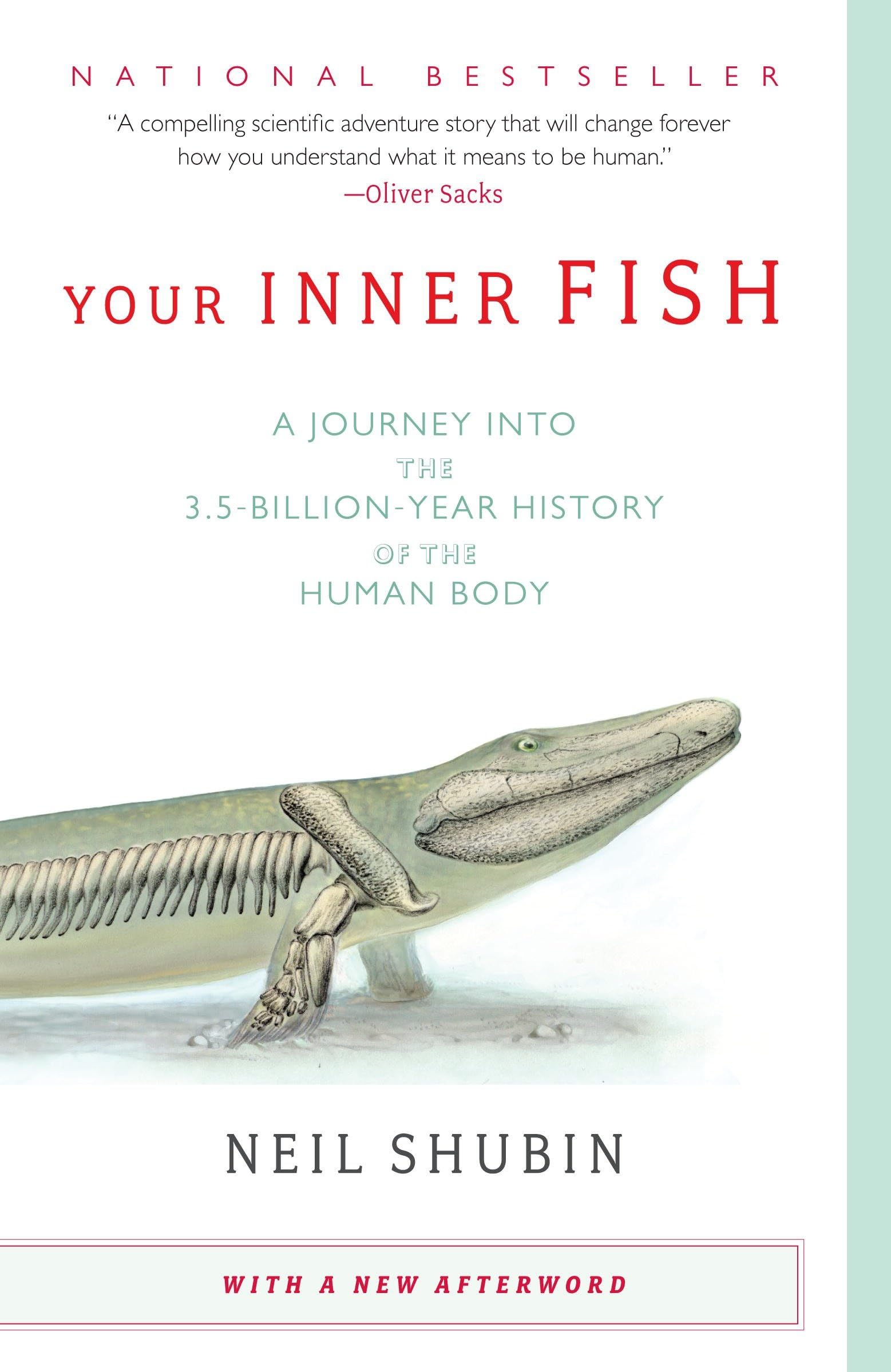
Buy Your Inner Fish: A Journey Into the 3.5-Billion-Year History of the Human Body Revised ed. by Shubin, Neil (ISBN: 9780307277459) from desertcart's Book Store. Everyday low prices and free delivery on eligible orders. Review: the legacy inside us - I found this book fascinating. It began slowly: but as I read further, each chapter revealed insights into a scientific world that I had been previously unaware of. Although a scientific book, it has been written in a manner that I could follow, and also learn at the same time. Once I got into it, I found myself constantly looking forward to my next chance to read a bit more. I couldn't help thinking afterwards that this "unravelling" of the mysteries of nature might appeal equally to both atheists and religious alike. Atheists will surely delight at the notion that science is beginning to explain the details of the creation of all organisms including ourselves; while the devout among us can regard the astronomical unlikelihood of our being as proof positive of the hand of the Almighty. Nonetheless reading this book made me appreciate a bit more how lucky we humans are. So perhaps we shouldn't waste the opportunities that we now have, for the sake of short time gains. We have it would seem, a long history. Review: Thanks Neil, a giant leap for mankind - Having read quite a number of other reviews here, I feel I have to give my take on this book. Yes it is "lightweight" in the sense that the reader is not overburdened with detail, methodology, scientific rigour and analysis. But readability - and it is highly readable - doesn't diminish even slightly the monumental significance of the book's content. This book is NOT a treatise on vertebrate paleontology, or on evolution, or on anything. Essentially it is edited highlights of Shubin's career, mostly looking for and studying fossil fish-like creatures, and the scientific context thereof. Shubin and his colleagues are fortunate to have contributed to great leaps forward in mankind's understanding of his biological inheritance. In that sense I would compare Shubin's book with George Smoot's Wrinkles In Time, an equally slim, readable account of an even bigger scientific quest (NOT however a treatise on cosmology). As for the author's supposed leanings toward intelligent design as opposed to Darwinian evolution, I don't think Shubin makes any telling statement on the subject. For his purposes he probably doesn't need to. In any case, God doesn't make it into the index.
| Best Sellers Rank | 1,577,220 in Books ( See Top 100 in Books ) 218 in Basic Medical Science (Books) 267 in Animal Physiology 308 in Biology (Books) |
| Customer reviews | 4.6 4.6 out of 5 stars (2,650) |
| Dimensions | 12.95 x 1.85 x 20.12 cm |
| Edition | Revised ed. |
| ISBN-10 | 0307277453 |
| ISBN-13 | 978-0307277459 |
| Item weight | 1.05 kg |
| Language | English |
| Print length | 256 pages |
| Publication date | 6 Jan. 2009 |
| Publisher | Vintage |
R**D
the legacy inside us
I found this book fascinating. It began slowly: but as I read further, each chapter revealed insights into a scientific world that I had been previously unaware of. Although a scientific book, it has been written in a manner that I could follow, and also learn at the same time. Once I got into it, I found myself constantly looking forward to my next chance to read a bit more. I couldn't help thinking afterwards that this "unravelling" of the mysteries of nature might appeal equally to both atheists and religious alike. Atheists will surely delight at the notion that science is beginning to explain the details of the creation of all organisms including ourselves; while the devout among us can regard the astronomical unlikelihood of our being as proof positive of the hand of the Almighty. Nonetheless reading this book made me appreciate a bit more how lucky we humans are. So perhaps we shouldn't waste the opportunities that we now have, for the sake of short time gains. We have it would seem, a long history.
J**E
Thanks Neil, a giant leap for mankind
Having read quite a number of other reviews here, I feel I have to give my take on this book. Yes it is "lightweight" in the sense that the reader is not overburdened with detail, methodology, scientific rigour and analysis. But readability - and it is highly readable - doesn't diminish even slightly the monumental significance of the book's content. This book is NOT a treatise on vertebrate paleontology, or on evolution, or on anything. Essentially it is edited highlights of Shubin's career, mostly looking for and studying fossil fish-like creatures, and the scientific context thereof. Shubin and his colleagues are fortunate to have contributed to great leaps forward in mankind's understanding of his biological inheritance. In that sense I would compare Shubin's book with George Smoot's Wrinkles In Time, an equally slim, readable account of an even bigger scientific quest (NOT however a treatise on cosmology). As for the author's supposed leanings toward intelligent design as opposed to Darwinian evolution, I don't think Shubin makes any telling statement on the subject. For his purposes he probably doesn't need to. In any case, God doesn't make it into the index.
T**S
Lightweight but worthwhile
Whilst always very readable, there's something just a little unsatisfying about Neil Shubin's exploration of the evolution of the body up to the one currently occupied by homo sapiens. I think ultimately because it comes over as a little too lightweight, even though the subject is overwhelmingly big. Nevertheless, there is no denying, ultimately, the level of fascination in the material. It is, of course, not always comforting to find that, once analysed, human beings are based on the same blueprint as any other animal with a head (and anus, as it happens - Shubin seems to take delight in repeating the word) and some without, where mouth and anus (there it is again!) combine, as in the sea anemone. Through words and pictures the author demonstrates the similarities between your nearest and dearest and sharks, salamanders, flies and all sorts of other creatures you normally wouldn't be inviting to a family reunion. There's an inevitable quantity of technical vocabulary, but it's never in torrents so it never overwhelms. So whilst a trifle unsatisfactory as heavyweight Natural History, the book has more than enough going for it to recommend it to the general reader. Post Script Some way through the book I will admit to reflecting on first its potential as a treatise on evolution, but then second on the potential it holds for the Intelligent Design lobby - basic blueprint, materials reuse, continuous development. Shubin doesn't tackle this, which is a shame; I'm reminded of the misuse of Nietzsche under different circumstances and wonder at the naïveté of it all. The ID myth is, of course, nothing more than that, but why give it a potential scientific credence? A brief check confirms that Shubin is in the evolutionary camp, but that does not dispel some of the ambiguity of Inner Fish, with mentions of the Creator (his capital), no small amount of teleology (suggesting on a number of occasions that species determined for themselves in what direction to develop), and the suggestion that a basic "design" "arose" rather than that a pattern evolved - incredibly there is not much mention of the word "evolution". In a period during which the forces of reaction are trying their best to roll back the gains of evolutionary science in dispelling superstition, it seems irresponsible to provide them with an open goal.
A**G
Great book
Great value, nice quick read, very informative and easy to understand.
B**S
READ THIS BOOK
If you have the slightest interest in humanity and life. Fascinating, informative, and beautifully written. So much explanation of the steps of evolution in such an accessible read.
L**A
Excellent Read
Thoroughly enjoyed this book!! An excellently written and concise introduction to evolutionary biology and the framework we use to study it.
M**R
Easy to understand book about evolution.
Great book for explaining evolution. It is easy to understand. There is a little bit about how palaeontologist work and make discoveries to set the scene. The subject of how we evolved from fish and the necessary embryology that explains it was interesting. For me though, once the point about how we developed from fish to human had been made, the novelty wore off and I got a bit bored with it. It is, however, a really good book for myth busting creationism. But Creationists are too set in stone to realise this. There are much newer books about evolution but what makes this book a classic is its straightforwardness and clarity. Though I said it would bust the Creationist myth, there is no hint of atheist or religious axe grinding involved and this makes it a pleasure to read. It is just a book about the facts and it has facts to back that fact up!
F**A
Your Inner Fish est le best seller de Neil Shubin, le livre qui l'a fait connaître au grand public. Et pour cause : c'est un très bon ouvrage de vulgarisation sur la théorie de l'évolution. A partir de la découverte d'un fossil, Tiktaalik, Neil Shubin nous emmène dans un voyage à travers les âges pour nous montrer comment notre corps est l'héritier de millions d'années d'évolution. Cet ouvrage est facile à lire et propose la synthèse de nombreux domaines des sciences, de l'anatomie à la paléontologie, en passant par la génétique, tout en rendant accessible au lecteur non scientifique les derniers développements autour de cette fameuse théorie. C'est un excellent livre pour aborder l'évolution. Je précise que la lecture de ce livre en anglais est relativement simple et ne demande pas énormément d'efforts pour qui connait un peu l'anglais.
A**E
Faaaahk yeah dude! Si ud busca callarle la boca a su amigo/a, conocido/a o familiar sobre su absurdas creencias nacas religiosas creacionistas, utilice a Hitchens, Dawkins o este libro. Muy recomendable!
M**7
Muy interesante para saber uno de los pasos de nuestra evolución con los fósiles encontrados en forma de pez.
A**K
This book is a fascinating view on the evolutionary legacy of the human body. How much we (and other related animals) owe our current body design to ancestors in the past. Evolution works by modifying what already exists, so one can usually trace the evolutionary history of species by tracing their body plans. Animals that share similar body plans tend to be related to each other. That doesn't mean similar forms (that's convergent evolution), it means they're built out of the same materials, using the same methods. The latter point is quite important, as that relates to DNA, giving us a second method for examining evolutionary history- compare the DNA of the organisms, with an eye towards the building genes. Overall, this is a fascinating book and a good example of solid science. I enjoyed reading the book, and found that it was suited to academics and general audiences. Shubin has done a very good job in making a fossil fish from the arctic turn into a fascinating story that's well worth the read. If you ever want to give a skeptic evidence on human origins and the evolution of species, this book also does that very nicely. Well done Dr. Shubin.
D**O
A well written, highly interesting and appealing description of life as we have never read before. Thanks to Neil Shubin I have understood a lot of things about the anatomy of human body and especially about the links between us and the other forms of life - ancient and recent. Though I expected to read more about Tiktaalik rosaeae, I found this book a 'must' in the literature about evolution.
Trustpilot
Hace 1 mes
Hace 1 semana