We remain fully operational. Our teams are working around the clock to ensure your deliveries continue safely.

Descargar la aplicación


Servicios al cliente
Sobre nosotros
Copyright © 2025 Desertcart Holdings Limited
Descargar la aplicación


Buy anything from 5,000+ international stores. One checkout price. No surprise fees. Join 2M+ shoppers on Desertcart.
Desertcart purchases this item on your behalf and handles shipping, customs, and support to Uruguay.
📊 Elevate your food science game with pinpoint pH precision!
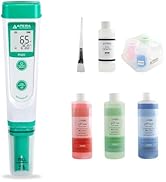
The Apera Instruments PH60S is a professional-grade pocket pH tester featuring Swiss LabSen spear sensor technology with ±0.01 pH accuracy and a broad -2.00 to 16.00 pH range. Designed for solid and semi-solid foods like cheese, sushi rice, and yogurt, it offers 3-point auto calibration, auto temperature compensation, and a unique high/low alarm with red backlight. Packaged as a complete kit with calibration solutions and accessories, it’s CE and RoHS certified and built for durability and ease of use.




| ASIN | B01ENFOIK0 |
| Best Sellers Rank | #5,119 in Industrial & Scientific ( See Top 100 in Industrial & Scientific ) #8 in Lab pH Meters |
| Date First Available | April 22, 2016 |
| Item Weight | 5.1 ounces |
| Item model number | AI313 |
| Manufacturer | Apera Instruments |
| Product Dimensions | 7 x 1.6 x 1.6 inches |
L**A
Nice pH probe at good price, works with NiMH rechargeable batteries
Apera makes a good PH60 pH probe that has a nice display, good accuracy and good repeatability. Kit comes with calibration standards for 4.00, 7.00 and 10.01 pH as well as some KCl probe storage solution so you can use it right away. Overfill the storage cap a bit to keep probe tip covered when storing probe horizontally. This probe seems to work fine on 4 x AAA NiMH rechargeable batteries.
S**Z
Accurate & well made pH testing instrument
Bough the pH tester for use in making probiotics fermented fruit juice. The included instructions were detailed & clear and calibrating the device before first use with the included calibration solutions was quick & easy. The device is easy to use and well made. Would highly recommend it anyone who is serious about testing food samples quickly & accurately.
N**K
Top notch!
This is the second PH60 that I have purchased recently, one direct from Apera and one via Amazon. To address some concerns some have had of receiving returned, or outdated product this does not at all seem to be the case. This one was dated within several months of the unit that I purchased direct (both later half of 2025) with no signs of being a return. The unit arrived with the typical amount of moisture droplets in the cap, was near perfectly calibrated after an overnight soak in KCL solution and performs equally to the other that I received approximately one month ago. My only complaint is that on the new unit, the storage cap does not fit quite as securely. I checked with my other cap and it fits better so this must be a manufacturing tolerance thing with the process used to make the caps. I do have minor concerns of the integrity of the seal connecting the sensor tip to the body. If the threaded part were to become at all loose, I see that as being a potential for moisture to seep in. I chose to wrap a thin layer of teflon thread tape starting just below the connection and continuing up the threaded area as an extra layer of confidence. So far, based on my experiences with both PH60's and excellent results with another product that I have ordered from Apera, as well as receiving outstanding support for when I had issues relating to international shipping, I am confident that Apera is an outstanding brand.
N**I
It works, and works well.
I wanted to check the accuracy of the pH sensor our pool had. I also hate using those tester strips which require identifying if the colour is light yellow or pale amber... I mean, really? Plus those strips are calibrated for a specific temperature, so any result you get with them will likely be wrong if your water temp is outside the norm. Anyhow, I hunted around and this seemed to be the one a lot of people recommended. It came in a neat little kit that included everything you needed in a hard shell case - although I'd recommend also buying some extra storage solution as the included amount will not last long. Use is super easy, and it automatically adjusts for temperature. You can also modify the settings so the backlight changes colour if the reading is outside the ideal numbers. I wondered why the case had an empty spot, then I realised that was so you could stand the tester up with the cap filled with storage solution. A really nice touch. If you want to keep it in the case with the lid closed, you just need to remember to store it on the side so there is less chance of leakage from the cap. Keep in mind that if you store it in tap, pool, or distilled water that could damage and permanently impact the accuracy of the tester. They do say that if it is stored dry, then that will also impact the accuracy of the sensor, but this can be fixed by soaking it in storage solution for a few days. Personally, I'd just get the storage solution - it's not expensive, the cap only requires a small amount, and you don't have to replace it after every use so a bottle will last a while. As for accuracy - I don't have a lab quality reference device to test it against, but it definitely appears to be more than accurate enough at least for testing a pool at home. I can't say anything about longevity as I've only had it now for a few weeks, but the sensor is replaceable plus it appears to be well made - so I think it should last well if treated with the care something like this deserves. They do have a newer version of this that has bluetooth and a "new improved sensor". For me this is more than good enough I think, I don't really have any need to track the readings over time, and as much as I am a geek the additional cost didn't really seem to justify it. Overall, very happy with this tester.
C**B
Decent, mostly well built pH meter.
I've had this meter for about 3 months. It's a high quality pH pen that's mostly easy to use and read. The calibration process is *relatively* easy. Get in calibration mode, set in the pH 7 solution, wait for the check mark, then do the same with the 4 & 10.01. Once you have it calibrated, use is easy. I notice that the design of the tip allows air bubbles to get stuck, which can be frustrating when you're trying to get an accurate reading. I'm unsure if it affects the reading negatively at all. When I try to shake the bubbles out, I notice that sometimes the battery connection stops working for a moment, then I have to turn the meter back on. That happens somewhat regularly. I'm a bit disappointed that a $70 pen has finicky battery terminal integrity, but if you're careful with it you won't have the issue. I wish I bought the pH & TDS combo meter, but in the meantime this one works well. I would recommend it.
A**Y
Excellent tool
Awesome. It looks intimidating for me and my home canned tomato sauce but the instructions are super easy and it works perfectly. I’m glad I made the purchase of a quality tool for peace of mind. Accuracy is spot on! Worth the cost for me.
H**V
PH Tester
Easy to use. Easy to calibrate and use. Great product.
P**G
Vorweg: Das PH60 ist zu billig. Wenn man sich die meisten der negativen Rezensionen hier anschaut, weiß man, daß viele nicht in der Lage sind, mehr als einen Halbsatz in einer Bedienungsanleitung zu lesen. Für solche Leute gibt es doch Streifen- und Tröpfchentests, sie sollten dabei bleiben. Das reicht für die völlig aus. Ja, in der Abdeckkappe über der Sonde sind Feuchtigkeitsreste. Ja, das Gerät ist trotzdem neu und unbenutzt. Wie kommt's? Weil die Sonde feucht bleiben muß, wenn man sie sofort verwenden können will. Man kann die Glaselektrode auch trocken lagern, müßte sie dann aber vor der nächsten Messung 12 Stunden in Kaliumchloridlösung einweichen. Was sicher wieder etliche nicht lesen und folglich auch nicht beachten würden, nur um dann anschließend herumzuheulen, warum die Meßergebnisse nichts taugen ... Kopf -> Tisch Eine 1 vor den gegenwärtigen Preis würde das Problem vielleicht etwas lindern. Du liebe Güte. Zu meiner Bewertung: Das Gerät ist erstklassig und hochpräzise, hat aber Tücken: 1. Das Smiley im Display als Anzeige dafür, daß sich der Meßwert nun eingependelt habe, kommt zu früh. Insbesondere bei Flüssigkeiten mit einem relativ niedrigen Leitwert (unterhalb von 200 µS/cm etwa) dauert es länger, bis man ein zuverlässiges Ergebnis bekommt. Dafür kann das Gerät nichts, das sind Chemie und Physik, die das bedingen, aber für ein verfrühtes Smiley kann das Gerät dann sehrwohl. In solchen Fällen bitte Geduld mitbringen und das Smiley ignorieren, was auch mal 3 Minuten warten bedeuten kann, bis sich das Meßergebnis tatsächlich eingependelt hat. Beispiel von einer Messung heute: Der Leitwert beträgt 129 µS/cm, der pH-Wert nach 5 Minuten ist 7,92 Das Smiley kam aber schon nach 30 Sekunden bei einem angezeigten pH-Wert von 7,49. Man muß halt warten, wenn es präzise sein soll. Und genau dazu hat man das PH60 ja gekauft. 2. Damit zusammenhängend: Das Gerät schaltet zu früh ab. Das ist nicht weiter tragisch, dann muß man es, während es noch in die Meßflüssigkeit eingetaucht ist, nochmal einschalten und eben noch eine Minute länger warten. Aber ärgerlich ist es trotzdem. Leider ist diese automatische Abschaltung nicht deaktivierbar. Allgemein noch der Hinweis: Vor und nach jeder Messung, vor und nach jeder Kalibrierung, bei einer 3-Punkt-Kalibrierung auch nach jedem Zwischenschritt, dann noch bevor man das Gerät zurück in die Kaliumchloridlösung stellt sowie nachdem man es aus dieser wieder entnommen hat, bitte *immer* die Sonde mit destilliertem Wasser spülen und anschließend mit der Hand trockenschütteln/trockenschleudern. Niemals die Glas-Elektrode mit einem Tuch oder ähnlichem abwischen. Wirklich niemals. Das ruiniert die Glaselektrode. Das Gerät zeigt dann zwar noch Meßergebnisse an, das sind dann aber nur noch unbrauchbare Schätzwerte. Also Finger weg von der Elektrode. Destilliertes Wasser ist nicht im Lieferumpfang enthalten. Man sollte welches daheim haben oder hier bei amazon mitbestellen. Ich habe mir gleich einen 5-Liter-Kanister geordert, da ich es auch noch für andere Wassertests benötige. Wer sich von dem Gerät eine Zeitersparnis erhofft, ist hier falsch. Momentan sind echte Schnelltests nur mit Teststreifen und Tröpfchentest, also Indikatortests, realisierbar. Was entsprechend deutliche Verluste in puncto Genauigkeit zur Folge hat. Die oben genannten Punkte führen zu keinem Sterneabzug von mir. Wäre der Preis höher, wäre ich da pingeliger, so aber geht das trotzdem in Ordnung. Volle Punktzahl und Kaufempfehlung.
P**S
Bon produit, un peu lent a stabiliser. j'ai change pour le PC60, pour a peine plus cher qui fait la conductimetrie egalement.
P**A
Prodotto eccellente. Professionale.
J**E
I was looking for a ph meter for brewing and wanted something a little more accurate than the cheap Hanna one and all the really cheap Amazon ones. After some research I found this one. It’s exactly what I needed as it was just over $100 which was what I was looking for (trying not to get excessive and buy the Milwaukee) The accuracy is to .02 which is enough for my homebrew for sure. It worked excellent for the first brew I’ve done with it! The big thing that got this 5 stars is its an all in one kit. Comes with 3 point calibration fluids, little cups for them, and the instructions are laminated and are great. If you’re looking for a homebrew ph meter this is the one to consider for sure if you’re on a budget
A**G
Estupendo para controlar el PH de mis cosméticos caseros. Excelente calidad.
Trustpilot
Hace 2 semanas
Hace 2 semanas