We remain fully operational. Our teams are working around the clock to ensure your deliveries continue safely.

Descargar la aplicación


Servicios al cliente
Sobre nosotros
Copyright © 2025 Desertcart Holdings Limited
Descargar la aplicación

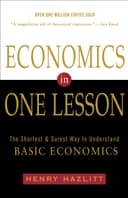
Economics in One Lesson: The Shortest and Surest Way to Understand Basic Economics [Hazlitt, Henry] on desertcart.com. *FREE* shipping on qualifying offers. Economics in One Lesson: The Shortest and Surest Way to Understand Basic Economics Review: Economics In One Lesson Review - The book Economics In One Lesson is about economic policies, and how these policies should take into account the effect they will have on everyone involved, not just one group. It also discusses and illustrates how economics should be focused on long term effects, rather than ignoring or overlooking the long term and only focusing on the short term. The author states that the most common fallacy in economics is to concentrate on the short-run effects of policies on special groups and to ignore or belittle the long-run effects on the community as a whole. Throughout the book, the chapters give lessons and examples that bring this one overriding lesson into focus. The author sums up economics in a single sentence: "The art of economics consists in looking not merely at the immediate but at the longer effects of any act or policy; it consists in tracing the consequences of that policy not merely for one group but for all groups." The author discusses the enormous faith many people have in government spending. He writes: "There is no more persistent and influential faith in the world today than the faith in government spending." But he quickly points out the fallacy of assuming that things can be fixed if the government just spends more money on a given problem or weakness. A current example of this fallacy in action is the public education system in the United States. In the book by Myths, Lies, and Downright Stupidity, the author, John Stossel, discusses the public education system in the United States. Many policy-makers and citizens alike have the notion that the best way to improve the public education system in our country is with more money. But time after time, studies and statistics have shown that children aren't getting a better education when more tax dollars are given to the school system. It's been proven that no direct correlation exists between the amount of money allocated to the public school system, and the quality of education a child receives. Yet the mantra is frequently repeated by many: "Give more money to our school system in order to improve it" as if this will automatically fix the problems. There are a host of problems with the public education system, one of which is not a lack of funds. The author states that "The economic goal of any nation, as of any individual, is to get the greatest results with the least efforts. The whole economic progress of mankind has consisted in getting more production with the same labor." He goes on to write: "Each of us is trying to save his own labor, to economize the means required to achieve his ends. Every employer, small as well as large, seeks constantly to gain his results more economically and efficiently - that is, by saving labor." America is a highly technological, highly productive society. America has the highest standard of living in the history of humanity. Technology and innovation is abundant. Unfortunately, a common economic delusion is that machines and technology destroy jobs. If this were true, it could be said then that civilization contributed to unemployment with the first efforts to improve efficiency through labor-saving inventions like the wheel. In a recent speech given by a politician, he suggested that "we go back to the days of living without ATM machines, because they have destroyed the jobs of many bank tellers." This illustrates the fallacy of concentrating on the short-run effects of something (implementing ATM machines) on a small group of people (bank tellers) and ignoring the long run positive effects on the community (business and consumers) as a whole. The short-run effect is that fewer bank tellers are needed now that ATM machines are widely implemented and used. However the long-run effects are advantageous to the economy. Who manufactures the ATM machines? Who creates and programs the software used in these machines? Who services them when they need calibration, software upgrades, or repair? ATM machines have created jobs, increased production, and raised the standard of living. They have lowered costs for banks by reducing the amount of wages paid out to bank tellers. In turn, banks have passed these savings onto the consumer. ATM's have also increased our quality of life by making the task of depositing and withdrawing money quicker, easier, and more efficient (fewer lines, no dependence on bank hours, and so forth). The ATM market has increased production and efficiency, and contributed to the expansion of the U.S. economy. In conclusion, I would highly recommend this book. It was very informative and clearly written. The author has a tremendous way of articulating tried and proven economic principles in a straightforward, understandable style. I'm thoroughly convinced that if more politicians and legislators would have followed the common sense economic fundamentals and lessons found in this book, the present state of the U.S. economy would be much healthier and robust. Review: Great place to start - Where does one begin a course on economics? There is no one right answer. But if you seek to set out to understand the topic from a classical or libertarian view a happy first step would be to read Harry Hazlitt’s “Economics in One Lesson.” Concise and well-written, he compels the reader to read to the next page, which is what Zinsser memorably said is the goal of any writer. Given the somewhat arid nature of the topic of economics, Hazlitt’s achievement is even-more notable. Hazlitt’s goals in his book are several but he accomplishes one with particular ability. Written in 1946 at the back end of the New Deal he wished to expose the folly of certain policies that, oddly enough, still are used today. To do this he seeks to widen the readers gaze to encompass the fuller consequences of a particular government action. Charles Graham Sumner, whom Hazlitt quotes towards the book’s end, best summarized the problem Hazlitt sought to draw light to when he wrote: “As soon as A observes something which seems to him to be wrong, from which X is suffering, A talks it over with B, and A and B then propose to get a law passed to remedy the evil and help X. Their law always proposes to determine what C shall do for X or, in the better case, What A, B, and C shall do for X…. What I want to do is to look up C…. I call him the Forgotten Man… He is the man who never is thought of. He is the victim of the reformer, social speculator and philanthropist, and I hope to show you before I get through that he deserves your notice both for his character and for the many burdens which are laid upon him.” Many of the policies of the New Deal (and today) do exactly as Sumner sets forth. Public works do benefit a certain class of worker and capital owner, but they require taxes and push away investment from the private sector. Unions drive up the wages for their members; but higher wages mean higher prices, leaving those firms with unionized laborers more vulnerable to low-cost competition. Tariffs protect and subsidize domestic industries, but that subsidy comes out of the pockets of consumers and other businesses. Thomas Sowell’s observation ever obtains: there are no solutions, only trade-offs. Hazlitt’s book is not immune from criticism. When he states that the real reason a country needs exports is to pay for its imports I found myself scratching my head. Certainly, it is a reason but this sounds a little too cute to be the whole truth. There are many reasons to export as China has shown us in the present age. Along those some lines, Hazlitt describes an example where in Americans buy English sweaters, allowing English customers to use US dollars to purchase US goods. Again, the Chinese economy today seems to give the lie to balances trade flows as he lays out. In an overall stellar book, my favorite paragraph comes from Chapter Eight where he expounds upon special interests. No one has given a better explanation of the Green Energy/Global Warming lobby than Hazlitt, whom I will quote to conclude this review: “Special interests, as the history of tariffs reminds us, can think of the most ingenious reasons why they should be the objects of special solicitude. Their spokesmen present a plan in their favor; and it seems at first so absurd that disinterested writers do not trouble to expose it. But the special interests keep on insisting on the scheme. Its enactment would make so much difference to their own immediate welfare that they can afford to hire trained economists and public relations experts to propagate it in their behalf. The public hears the argument so often repeated, and accompanied by such a wealth of imposing statistics, charts, curves, and pie-slices, that it is soon taken in. What at last disinterested writers recognize that the danger of the scheme’s enactment is real, they are usually too late. They cannot in a few weeks acquaint themselves with the subject as thoroughly as the hired brains who have been devoting their full time to it for years; they are accused of being uninformed, and they have the air of men to presume to dispute axioms.”
| Best Sellers Rank | #14,240 in Books ( See Top 100 in Books ) #3 in Free Enterprise & Capitalism #10 in International Economics (Books) #17 in Economic History (Books) |
| Customer Reviews | 4.6 4.6 out of 5 stars (4,887) |
| Dimensions | 5.2 x 0.59 x 7.99 inches |
| Edition | paperback |
| ISBN-10 | 0517548232 |
| ISBN-13 | 978-0517548233 |
| Item Weight | 6.4 ounces |
| Language | English |
| Print length | 218 pages |
| Publication date | December 14, 1988 |
| Publisher | Crown Currency |
J**E
Economics In One Lesson Review
The book Economics In One Lesson is about economic policies, and how these policies should take into account the effect they will have on everyone involved, not just one group. It also discusses and illustrates how economics should be focused on long term effects, rather than ignoring or overlooking the long term and only focusing on the short term. The author states that the most common fallacy in economics is to concentrate on the short-run effects of policies on special groups and to ignore or belittle the long-run effects on the community as a whole. Throughout the book, the chapters give lessons and examples that bring this one overriding lesson into focus. The author sums up economics in a single sentence: "The art of economics consists in looking not merely at the immediate but at the longer effects of any act or policy; it consists in tracing the consequences of that policy not merely for one group but for all groups." The author discusses the enormous faith many people have in government spending. He writes: "There is no more persistent and influential faith in the world today than the faith in government spending." But he quickly points out the fallacy of assuming that things can be fixed if the government just spends more money on a given problem or weakness. A current example of this fallacy in action is the public education system in the United States. In the book by Myths, Lies, and Downright Stupidity, the author, John Stossel, discusses the public education system in the United States. Many policy-makers and citizens alike have the notion that the best way to improve the public education system in our country is with more money. But time after time, studies and statistics have shown that children aren't getting a better education when more tax dollars are given to the school system. It's been proven that no direct correlation exists between the amount of money allocated to the public school system, and the quality of education a child receives. Yet the mantra is frequently repeated by many: "Give more money to our school system in order to improve it" as if this will automatically fix the problems. There are a host of problems with the public education system, one of which is not a lack of funds. The author states that "The economic goal of any nation, as of any individual, is to get the greatest results with the least efforts. The whole economic progress of mankind has consisted in getting more production with the same labor." He goes on to write: "Each of us is trying to save his own labor, to economize the means required to achieve his ends. Every employer, small as well as large, seeks constantly to gain his results more economically and efficiently - that is, by saving labor." America is a highly technological, highly productive society. America has the highest standard of living in the history of humanity. Technology and innovation is abundant. Unfortunately, a common economic delusion is that machines and technology destroy jobs. If this were true, it could be said then that civilization contributed to unemployment with the first efforts to improve efficiency through labor-saving inventions like the wheel. In a recent speech given by a politician, he suggested that "we go back to the days of living without ATM machines, because they have destroyed the jobs of many bank tellers." This illustrates the fallacy of concentrating on the short-run effects of something (implementing ATM machines) on a small group of people (bank tellers) and ignoring the long run positive effects on the community (business and consumers) as a whole. The short-run effect is that fewer bank tellers are needed now that ATM machines are widely implemented and used. However the long-run effects are advantageous to the economy. Who manufactures the ATM machines? Who creates and programs the software used in these machines? Who services them when they need calibration, software upgrades, or repair? ATM machines have created jobs, increased production, and raised the standard of living. They have lowered costs for banks by reducing the amount of wages paid out to bank tellers. In turn, banks have passed these savings onto the consumer. ATM's have also increased our quality of life by making the task of depositing and withdrawing money quicker, easier, and more efficient (fewer lines, no dependence on bank hours, and so forth). The ATM market has increased production and efficiency, and contributed to the expansion of the U.S. economy. In conclusion, I would highly recommend this book. It was very informative and clearly written. The author has a tremendous way of articulating tried and proven economic principles in a straightforward, understandable style. I'm thoroughly convinced that if more politicians and legislators would have followed the common sense economic fundamentals and lessons found in this book, the present state of the U.S. economy would be much healthier and robust.
F**N
Great place to start
Where does one begin a course on economics? There is no one right answer. But if you seek to set out to understand the topic from a classical or libertarian view a happy first step would be to read Harry Hazlitt’s “Economics in One Lesson.” Concise and well-written, he compels the reader to read to the next page, which is what Zinsser memorably said is the goal of any writer. Given the somewhat arid nature of the topic of economics, Hazlitt’s achievement is even-more notable. Hazlitt’s goals in his book are several but he accomplishes one with particular ability. Written in 1946 at the back end of the New Deal he wished to expose the folly of certain policies that, oddly enough, still are used today. To do this he seeks to widen the readers gaze to encompass the fuller consequences of a particular government action. Charles Graham Sumner, whom Hazlitt quotes towards the book’s end, best summarized the problem Hazlitt sought to draw light to when he wrote: “As soon as A observes something which seems to him to be wrong, from which X is suffering, A talks it over with B, and A and B then propose to get a law passed to remedy the evil and help X. Their law always proposes to determine what C shall do for X or, in the better case, What A, B, and C shall do for X…. What I want to do is to look up C…. I call him the Forgotten Man… He is the man who never is thought of. He is the victim of the reformer, social speculator and philanthropist, and I hope to show you before I get through that he deserves your notice both for his character and for the many burdens which are laid upon him.” Many of the policies of the New Deal (and today) do exactly as Sumner sets forth. Public works do benefit a certain class of worker and capital owner, but they require taxes and push away investment from the private sector. Unions drive up the wages for their members; but higher wages mean higher prices, leaving those firms with unionized laborers more vulnerable to low-cost competition. Tariffs protect and subsidize domestic industries, but that subsidy comes out of the pockets of consumers and other businesses. Thomas Sowell’s observation ever obtains: there are no solutions, only trade-offs. Hazlitt’s book is not immune from criticism. When he states that the real reason a country needs exports is to pay for its imports I found myself scratching my head. Certainly, it is a reason but this sounds a little too cute to be the whole truth. There are many reasons to export as China has shown us in the present age. Along those some lines, Hazlitt describes an example where in Americans buy English sweaters, allowing English customers to use US dollars to purchase US goods. Again, the Chinese economy today seems to give the lie to balances trade flows as he lays out. In an overall stellar book, my favorite paragraph comes from Chapter Eight where he expounds upon special interests. No one has given a better explanation of the Green Energy/Global Warming lobby than Hazlitt, whom I will quote to conclude this review: “Special interests, as the history of tariffs reminds us, can think of the most ingenious reasons why they should be the objects of special solicitude. Their spokesmen present a plan in their favor; and it seems at first so absurd that disinterested writers do not trouble to expose it. But the special interests keep on insisting on the scheme. Its enactment would make so much difference to their own immediate welfare that they can afford to hire trained economists and public relations experts to propagate it in their behalf. The public hears the argument so often repeated, and accompanied by such a wealth of imposing statistics, charts, curves, and pie-slices, that it is soon taken in. What at last disinterested writers recognize that the danger of the scheme’s enactment is real, they are usually too late. They cannot in a few weeks acquaint themselves with the subject as thoroughly as the hired brains who have been devoting their full time to it for years; they are accused of being uninformed, and they have the air of men to presume to dispute axioms.”
K**L
Good
M**S
If I had to recommend one introductory book about economics, it would definitely be Hazlitt's Economics in one lesson. This book does a wonderful job at explaining the most common economic fallacies, all of them stemming from two basic mistakes: 1) focusing on the short-term effects while ignoring the long-term effects of a given economic policy, and 2) focusing on the effects on a particular group of people while ignoring the effects on everyone else. As properly acknowledged by the author, this book draws largely on one of Frederic Bastiat's most wonderful essays : "Ce qu'on voit et ce qu'on ne voit pas".
L**S
Best most concise book for learning how economics really work. A bit of a eye opener in many topics, specially for people that have been wrong their whole lives, its a pill hard to swallow for them, that is why there are a few negative reviews, just don't get misled by them and read this gem.
M**U
Gran libro para conceptos generales. Muy recomendable para primeras tomas de contacto.
A**Z
in one chapter, the author argues against government intervention to save certain industries using agriculture as an example. he does make a good point which he explains with clear details such as “if you give something to someone, the selected one, someone else will be left with nothing” which is true to a certain extend. however, why not using the financial sector as an example? right, that’s the point I’m making here. it still remains a good read for any economics student. I still recommend it
Trustpilot
Hace 3 semanas
Hace 5 días