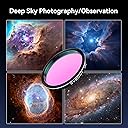
🌠 See the unseen, own the night sky.
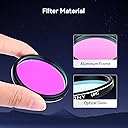
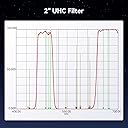
The SVBONY 2-inch UHC telescope filter is a must-have accessory for astronomy enthusiasts seeking sharper, higher-contrast views of deep-sky objects. Featuring a premium optical glass lens housed in a durable aluminum frame, it effectively reduces light pollution—ideal for city and suburban stargazing. Compatible with standard M48*0.75mm threaded eyepieces, this filter enhances faint nebulae visibility and supports astrophotography, making your night sky observations richer and more vivid.


| ASIN | B07R38KR1P |
| Best Sellers Rank | 2,016 in Telescope Accessories |
| Brand | SVBONY |
| Customer Reviews | 4.3 4.3 out of 5 stars (176) |
| Date First Available | 22 Mar. 2019 |
| Guaranteed software updates until | unknown |
| Item model number | FF9131B |
| Package Dimensions L x W x H | 18.1 x 11.6 x 2.6 centimetres |
| Package Weight | 0.05 Kilograms |
| Part number | FF9131B |
| Photo Filter Effect Type | Enhancing |
| Photo Filter Thread Size | 48 Millimetres |
| Product Dimensions L x W x H | 7.5 x 4.8 x 0.1 centimetres |
| Size | 5 cm |
| Water Resistance Level | Not Water Resistant |
Ž**O
I used the SVBONY 2-inch UHC filter for visual observation, and this is my first UHC filter. I was able to see the M94 galaxy, which I had never seen before against the bright sky background, with my 8-inch SCT. This filter makes the sky appear much darker while keeping most nebulae visible. I noticed significantly better contrast with the M17 Omega Nebula, though I feel that some fine details might have been filtered out and lost. I would not recommend it for visual observation of globular clusters like M3 and M5. The image was only slightly less sharp, and I thought I saw some reflections. The craftsmanship is excellent; the glass appears to be top quality and very clean. In my video, you can see that this filter gives an image with a slight violet tint. I can't compare it to a high-end UHC filter because I don't have one, but for its price, I think this filter is excellent. It will most definitely help you see faint deep-sky objects that you might have wondered if they were even there.
A**R
This filter is excellent for the price. The picture that I've attached was taken under bortle class 4 skies with an unmodified t5i. The filter helped me gather detail in the very faint nebulae details, and it did a decent job.
T**D
This is my second attempt at photographing the Orion Nebula (M42, "The Great Nebula In Orion"), and only the second deep sky photo I've ever taken. I'm happy with this. It is the result of 88 images stacked in Deep Sky Stacker, ranging from 1 second to 35 second exposures, ISO 3200. I used a few Dark Frames and Bias Frames, but no Flats, so I probably could have done better, and I would recommend ISO 1600 maximum. I used a Celestron Nexstar 6se on an Alt-Azimuth mount, 2-star alignment using Sirius and Polaris, f6.3 (Celestron Focal Reducer), approx. 1053 mm focal length, Canon T3i with SvBony UHC (light pollution) clip-in C-frame filter. I used a Bahtinov mask to confirm focus on Sirius prior to using "Bulb mode" on the camera with a cable release made by Apurture. Yes, I said Alt-az mount, no wedge, not polar aligned. With a wedge I could do 2 minute subs instead of the 30-second maximum I was boxed-in with. Seeing conditions were Bortle Class 6 with a street light directly in front of me, so think more like Bortle 7. Final image adjusted for levels, color correction, and contrast in Photoshop CS 2020. I'm blown away. Without this filter all I got was a yellow haze and a grainy image. I'm probably going to buy their CLS filter as well, even though the bandwidths are very similar. I also bought their 1.25 inch eyepiece UHC filter for visual astronomy. I'm sold on this company. Highly recommended.
J**K
The virtue of high contrast filter (or city light filter) is to coat some relevant materials on very flat glass, selectively transmitting wavelength that suits the filter's purpose. So ideally speaking if you live in Bortle class 1 area, you don't need it. But there are only a few places you will find near your city even in the western side of the US. Therefore this filter can do the right job for you, for most cases. Indeed, non-flat glass and uneven coating will mar your filter and in the end, it mars the quality of an optical image projected on your eyepiece or the camera sensor. For that, perhaps very high-end quality astrophotography might want something more expensive filters. As an amateur, this filter is just perfect. You may lose some lights as filters wouldn't have 100% transmittance for necessary wavelengths. Despite such light loss, transmitting only the necessary wavelengths is important as your camera sensor doesn't want to be saturated by unnecessary wavelengths hitting your sensor. One of the best representative unnecessary wavelength shall be city light. Longer you expose through one shot of the picture, more importance of the filter you fill find. Attached is Trifid nebula,stacked many images taken 30 seconds for each.
J**L
ease of use, Hobt pops straight into my camera and the performance was pretty great in my opinion and it’s not that expensive
Trustpilot
Hace 1 mes
Hace 1 día