
Descargar la aplicación


Servicios al cliente
Sobre nosotros
Copyright © 2025 Desertcart Holdings Limited
Descargar la aplicación

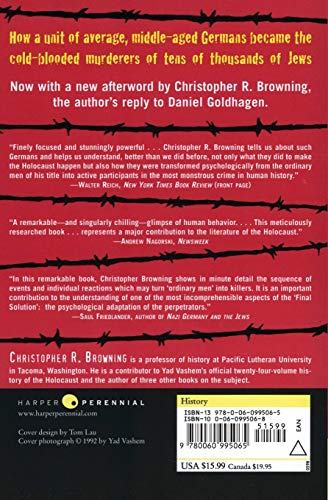


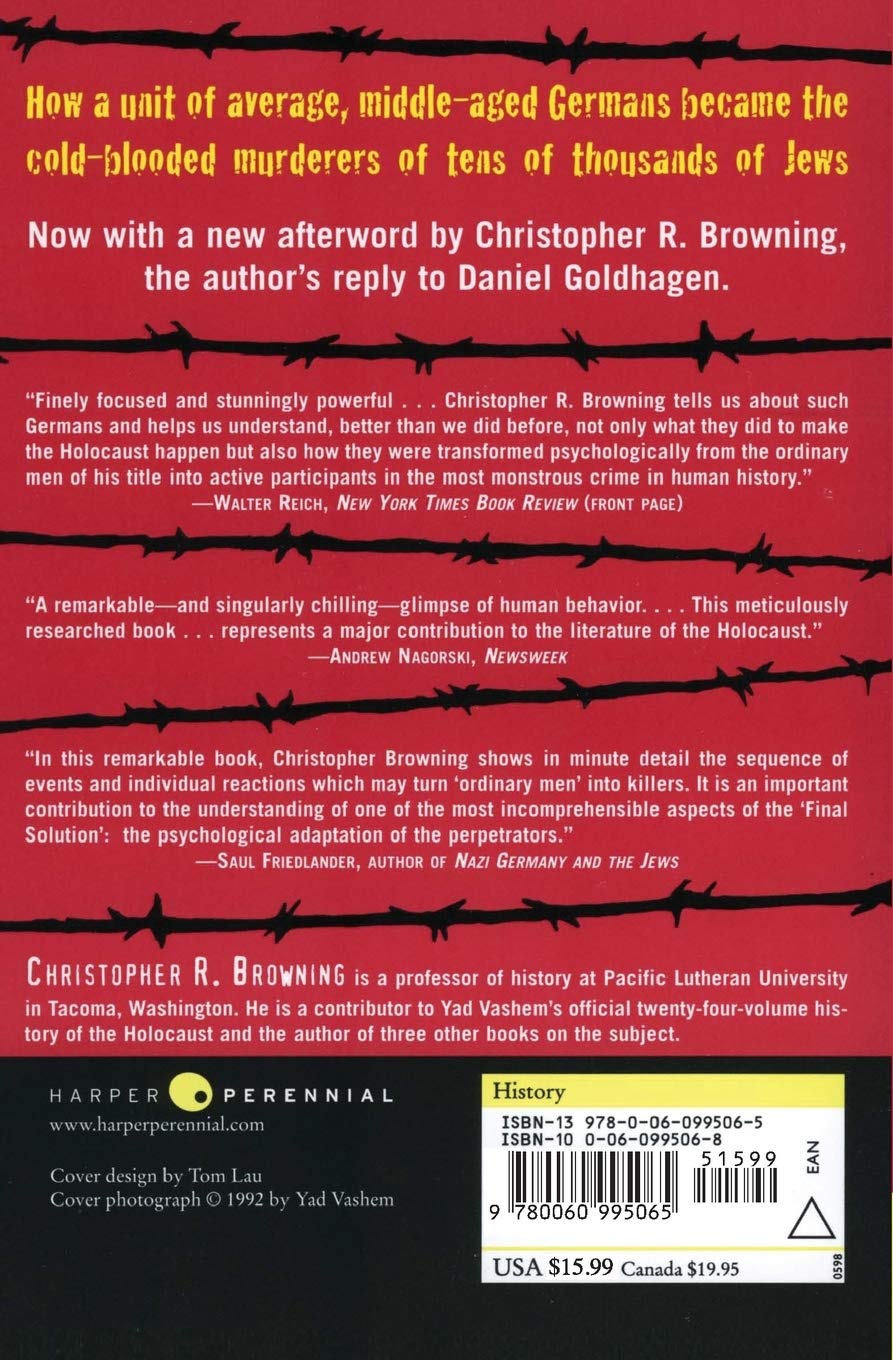
Ordinary Men: Reserve Police Battalion 101 and the Final Solution in Poland [Browning, Christopher R.] on desertcart.com. *FREE* shipping on qualifying offers. Ordinary Men: Reserve Police Battalion 101 and the Final Solution in Poland Review: Truly amazing book. A priviledged view on the Holocaust, an unsolved challenge for mankind. - I’d dare say that more is here to be learned for the average reader than any other book than I can figure out just now. I mean about human nature, the soul and the mind, the abstract aspects of human life, in contrast to its material aspects that are dealt appropriately enough with science and its body of knowledge. About the soul -which admittedly constitutes half of what we can ascertain as existing out there-, this is the richest source of available evidence open to scrutiny and debate. Yes, because while moral issues have been discussed and vivisected time and again for centuries, we lack as yet a sound, convincing conceptual framework to model it, to explore, to provide its foundations. So, considering that ethics is today essentially still an open problem, the most useful sources are those that confront us with the most radical, paradoxical, unsurmountable problems. And the problem of evil, as exemplified in the Holocaust is one of them, if not ‘the one’. In summary, the book provides a meticulously documented account of the works and crimes of a group of German reserve police officers, reccruited around the start of WWII in the area of Hamburg. They were essentially normal middle-to-low class workers who nobody would expect they could turn into cold-blooded mass murderers. The action is centered in 1941-1943 in the Lublin district of occupied Poland and their Bataillon was assigned to ‘routine’ tasks in the context of the Final Solution: The extermination of all jewish human beings in the newly occupied territories. Why did the Holocaust occur ? Can it happen again ? Under what conditions can it or can not ? What kind of responsibility are the perpetrators subject to ? Are we not -at least in part- responsible for them ? What responsibility, if any, confronts us as members of the society in which it happened? Until these questions are not adequately solved, we as human beings cannot even call ourselves masters of the world, and should continue to behave as we always did: as incidental bystanders, perplexed flesh and bones at the mercy of no-one knows what, or who, or where. The author discusses several theories and puts forward a tentative explanation in a long (35 pages) articulate and informative Afterword. The discussion is interesting, but IMHO still falls short of explicative power. Of course, he is an historian, and the strong point of the book is in his accurate, meticulous, balanced and heart-breaking account of the facts in this miniature laboratory of (in)human barbaric, devilish behavior. (If the devil exists, this is it). The fact that the perpetrators were modern ‘normal’ human beings, like you and me, is the crucial asset, which forces you to rule out easily most customary explanations. By the way, the author does not take advantage of this fact, and he argues that the most significant determinant of the criminal conduct was a combination ‘authority’ and ‘peer’ conformity, or the inability resist to both ! Of course this, being true factors, cannot provide the desired explicatory key mechanisms, since this is what we all do all the time to a large extent: accept authority and conform with the group. It would be tantamount to accepting that the Holocaust can happen again any time, anywhere. This might be true, but it remains unproven and, in the meanwhile, should be held back as a terrible, discouraging conclusion. Let me set it straight (and this is just my opinion): Most authors set out from the assumption that they could (never!) behave in such a way, and they then try to find out what was wrong with the people that committed the horrendous crimes. The root is in their brains, in their psychological constitution, as it were. Others, starting from the same assumption try to locate the seed of the evil in the social-economic environment to which these people were exposed at some previous time in their life, and they propose their theories. (BTW most of them them quite amusing and adequately dealt with in the book). The result are several frivolous discordant proposals, that invariably reflect the cultural/ideological standpoint but fall short of consistency with the data. How can it be that 80% of (willing executioner-) normal guys in a normal middle class society, with no background trauma nor obvious shortcomings could perform the actions ? Lets accept it: we do not know. But we need to. And the reason why we need to is simple: Unless we have a better grasp of what happened to these guys, the odds are that you, and me, and anybody else (Germans and Non-Germans!), somewhere, sometime, could be the perpetrators of these or even worse crimes. Review: If they could become killers, what group of men cannot? - This was the first book in a long time that riveted my attention in place for hours at a time. I read the book cover-to-cover in just under 24 hours. The novel held my attention so easily due partly to the detailed accounts of the shocking events of the Holocaust and partly to the nicely flowing structure of the novel. The recounting of Battalion 101's tasks and actions never felt too historically dry, since the description of each event was punctuated by the written testimonies of those involved and subsequent reflection by the author. Although the story is told chronologically, several intermittent chapters are wholly dedicated to reflection and discussion. This alternation of tone helped to break up the novel and kept me looking forward to the next chapter. The author's reflection on the events and written testimonies of those involved was clear and unbiased. As suggested in the forward, a possible objection to this kind of study is that attempting to understand the perpetrators is impossible without empathizing with them. Certainly, this book was not an attempt to minimize the actions of the final solution, but rather to understand why so many ordinary men could partake so willingly. The author's conclusion to this question is never clearly stated, although plenty of contributing factors are presented and discussed. He critiques many common conceptions - that the perpetrators compliance was due to strict chain of commands and the inability to disobey orders, or of mass ideological brainwashing - and offers some new ones. Ultimately, I thought his reflection and analysis was comprehensive and highly interesting.
| Best Sellers Rank | #104,895 in Books ( See Top 100 in Books ) #2 in German History (Books) #17 in World War II History (Books) #21 in Jewish Holocaust History |
| Customer Reviews | 4.6 4.6 out of 5 stars (6,216) |
| Dimensions | 0.75 x 5.5 x 8 inches |
| Edition | Reprint |
| ISBN-10 | 0060995068 |
| ISBN-13 | 978-0060995065 |
| Item Weight | 7.2 ounces |
| Language | English |
| Print length | 271 pages |
| Publication date | April 24, 1998 |
| Publisher | Harper Perennial |
A**S
Truly amazing book. A priviledged view on the Holocaust, an unsolved challenge for mankind.
I’d dare say that more is here to be learned for the average reader than any other book than I can figure out just now. I mean about human nature, the soul and the mind, the abstract aspects of human life, in contrast to its material aspects that are dealt appropriately enough with science and its body of knowledge. About the soul -which admittedly constitutes half of what we can ascertain as existing out there-, this is the richest source of available evidence open to scrutiny and debate. Yes, because while moral issues have been discussed and vivisected time and again for centuries, we lack as yet a sound, convincing conceptual framework to model it, to explore, to provide its foundations. So, considering that ethics is today essentially still an open problem, the most useful sources are those that confront us with the most radical, paradoxical, unsurmountable problems. And the problem of evil, as exemplified in the Holocaust is one of them, if not ‘the one’. In summary, the book provides a meticulously documented account of the works and crimes of a group of German reserve police officers, reccruited around the start of WWII in the area of Hamburg. They were essentially normal middle-to-low class workers who nobody would expect they could turn into cold-blooded mass murderers. The action is centered in 1941-1943 in the Lublin district of occupied Poland and their Bataillon was assigned to ‘routine’ tasks in the context of the Final Solution: The extermination of all jewish human beings in the newly occupied territories. Why did the Holocaust occur ? Can it happen again ? Under what conditions can it or can not ? What kind of responsibility are the perpetrators subject to ? Are we not -at least in part- responsible for them ? What responsibility, if any, confronts us as members of the society in which it happened? Until these questions are not adequately solved, we as human beings cannot even call ourselves masters of the world, and should continue to behave as we always did: as incidental bystanders, perplexed flesh and bones at the mercy of no-one knows what, or who, or where. The author discusses several theories and puts forward a tentative explanation in a long (35 pages) articulate and informative Afterword. The discussion is interesting, but IMHO still falls short of explicative power. Of course, he is an historian, and the strong point of the book is in his accurate, meticulous, balanced and heart-breaking account of the facts in this miniature laboratory of (in)human barbaric, devilish behavior. (If the devil exists, this is it). The fact that the perpetrators were modern ‘normal’ human beings, like you and me, is the crucial asset, which forces you to rule out easily most customary explanations. By the way, the author does not take advantage of this fact, and he argues that the most significant determinant of the criminal conduct was a combination ‘authority’ and ‘peer’ conformity, or the inability resist to both ! Of course this, being true factors, cannot provide the desired explicatory key mechanisms, since this is what we all do all the time to a large extent: accept authority and conform with the group. It would be tantamount to accepting that the Holocaust can happen again any time, anywhere. This might be true, but it remains unproven and, in the meanwhile, should be held back as a terrible, discouraging conclusion. Let me set it straight (and this is just my opinion): Most authors set out from the assumption that they could (never!) behave in such a way, and they then try to find out what was wrong with the people that committed the horrendous crimes. The root is in their brains, in their psychological constitution, as it were. Others, starting from the same assumption try to locate the seed of the evil in the social-economic environment to which these people were exposed at some previous time in their life, and they propose their theories. (BTW most of them them quite amusing and adequately dealt with in the book). The result are several frivolous discordant proposals, that invariably reflect the cultural/ideological standpoint but fall short of consistency with the data. How can it be that 80% of (willing executioner-) normal guys in a normal middle class society, with no background trauma nor obvious shortcomings could perform the actions ? Lets accept it: we do not know. But we need to. And the reason why we need to is simple: Unless we have a better grasp of what happened to these guys, the odds are that you, and me, and anybody else (Germans and Non-Germans!), somewhere, sometime, could be the perpetrators of these or even worse crimes.
E**C
If they could become killers, what group of men cannot?
This was the first book in a long time that riveted my attention in place for hours at a time. I read the book cover-to-cover in just under 24 hours. The novel held my attention so easily due partly to the detailed accounts of the shocking events of the Holocaust and partly to the nicely flowing structure of the novel. The recounting of Battalion 101's tasks and actions never felt too historically dry, since the description of each event was punctuated by the written testimonies of those involved and subsequent reflection by the author. Although the story is told chronologically, several intermittent chapters are wholly dedicated to reflection and discussion. This alternation of tone helped to break up the novel and kept me looking forward to the next chapter. The author's reflection on the events and written testimonies of those involved was clear and unbiased. As suggested in the forward, a possible objection to this kind of study is that attempting to understand the perpetrators is impossible without empathizing with them. Certainly, this book was not an attempt to minimize the actions of the final solution, but rather to understand why so many ordinary men could partake so willingly. The author's conclusion to this question is never clearly stated, although plenty of contributing factors are presented and discussed. He critiques many common conceptions - that the perpetrators compliance was due to strict chain of commands and the inability to disobey orders, or of mass ideological brainwashing - and offers some new ones. Ultimately, I thought his reflection and analysis was comprehensive and highly interesting.
H**E
A difficult read
The strongest sections of Christopher Browning’s book are when he is narrating the accounts of the men involved and how they went about their various tasks. It is here he draws out the frailties of the human condition and exposes the thinness of our social and moral belief systems. Concentrating on the how rather than the why makes these sections starkly real - and difficult to read. The cumulative effect is a growing disbelief and despair in the reader, especially as the numbers of men, women and children killed continues to rise unrelentingly. The final numbers stand to condemn these men for all time. Browning’s moderate functionalist approach exposes the flaws of the Nazi regime and the way it shifted and changed as it built towards the final solution. The idea that this unstable structure provided the main driving force behind the holocaust is less convincing. The bureaucratic efficiency and the techniques made available by modernity as explored by Zygmunt Bauman is a sturdier argument. Less convincing too is the reliance on Stanley Milgram and his early 1960’s experiments. Yes these men largely reported they were ‘just doing their jobs’ and took their responsibility lightly, but it is a painfully inadequate explanation for the scale and ferocity of the Holocaust, or indeed the multitude of innocent people the men of Reserve Police Battalion 101 killed in Poland. The historiographical argument he has with Daniel Goldhagen and his book Hitler’s Willing Executioners in the afterword is a productive read for anyone interested in how History is done.
P**K
As expected.
A**L
Interesante y dramático episodio de la espeluznante amplia historia del Holocausto.
R**.
Un libro necesario para nuestros tiempos. A veces veo comentarios en redes sociales de gente que etiqueta a otros como monstruos, por algo malo que han hecho, sin entender la multitud de factores que subyacen a un acto malvado. Somos muy rápidos para condenar y para pensar que los otros son los victimarios y nosotros las víctimas. Y creo que este libro ilustra que muchos podemos terminar siendo, con bastante facilidad, los monstruos que tanto decimos repudiar.
P**L
Avaliação pertinente tão somente ao livro como objeto. Sem comentários quanto ao conteúdo, pois ainda não o li. À primeira vista, se destaca a fragilidade da capa, feita de um papel de qualidade inferior e que, inclusive, veio rasgada em dois pontos (ver imagens). As páginas também são de um papel fino e frágil, além de serem coladas na capa, não costuradas. Pelo valor esperava pelo menos um acabamento mediano, mas esse se tornou o livro com pior acabamento que possuo. Amanhã levarei a alguma papelaria para plastificá-lo.
T**H
Found several interesting things in this book. The only negative thing is the writing style which is poor and makes it difficult to read at times. Meaning: not an engaging writing style.
Trustpilot
Hace 2 semanas
Hace 1 mes