We remain fully operational. Our teams are working around the clock to ensure your deliveries continue safely.

Descargar la aplicación


Servicios al cliente
Sobre nosotros
Copyright © 2025 Desertcart Holdings Limited
Descargar la aplicación
Buy anything from 5,000+ international stores. One checkout price. No surprise fees. Join 2M+ shoppers on Desertcart.
Desertcart purchases this item on your behalf and handles shipping, customs, and support to Uruguay.
🔪 Sharpen Smarter, Anywhere — Never Miss a Cut!
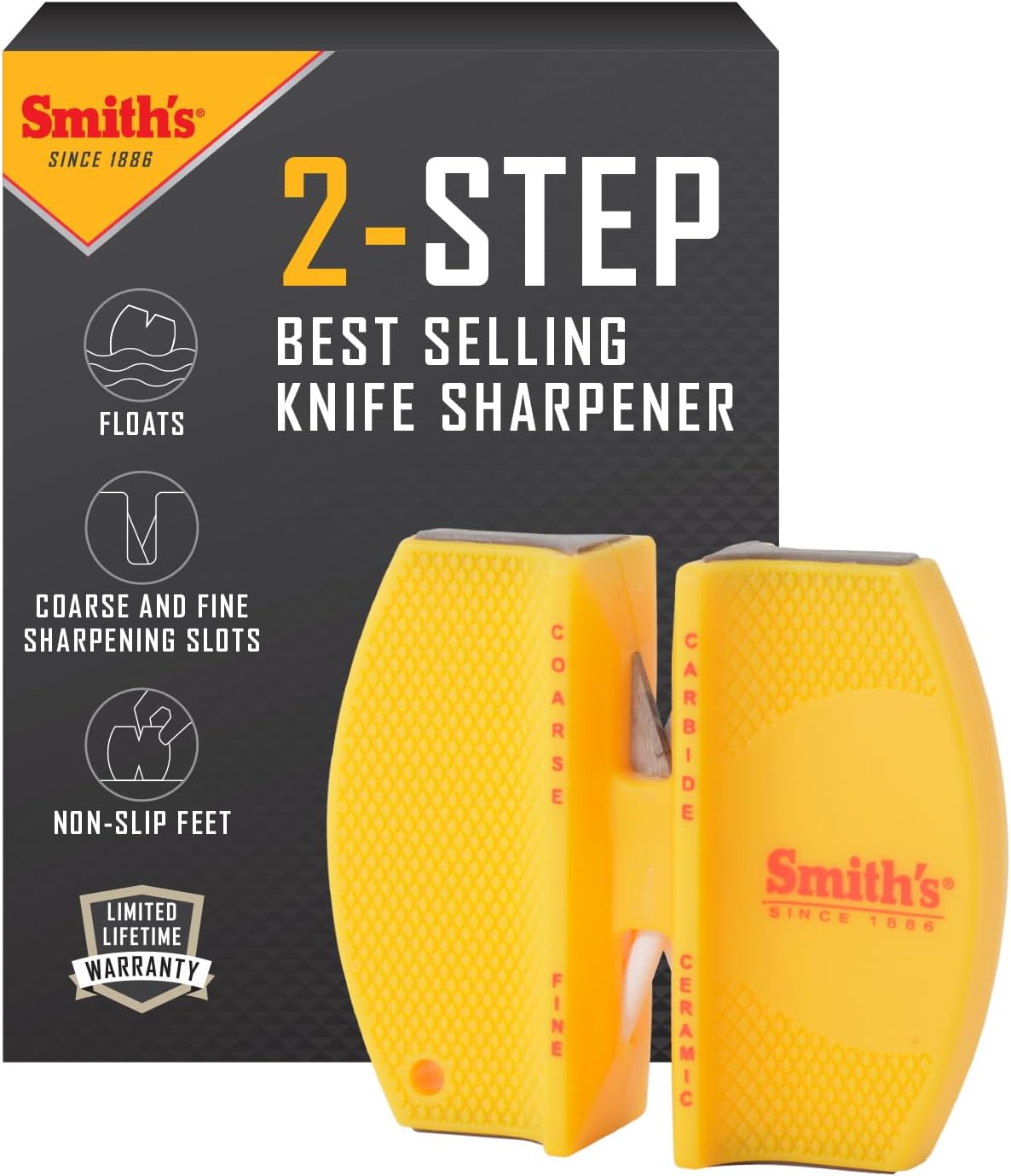
Smith's CCKS 2-Step Knife Sharpener is a compact, portable tool featuring preset tungsten carbide and ceramic sharpening slots that quickly restore and polish knife edges. Designed for outdoor enthusiasts and professionals alike, it floats on water, includes non-slip feet for safety, and fits easily on a keychain or pack, making it the ultimate on-the-go sharpening solution.


| ASIN | B00032S02K |
| Best Sellers Rank | #11,608 in Kitchen & Dining ( See Top 100 in Kitchen & Dining ) #46 in Knife Sharpeners #236 in Kitchen Knives & Accessories |
| Brand Name | Smith's |
| Color | Yellow |
| Customer Reviews | 4.5 4.5 out of 5 stars (16,799) |
| Global Trade Identification Number | 00027925190043 |
| Grit Type | Coarse,Fine |
| Included Components | 1 sharpener |
| Item Dimensions L x W x H | 2.71"L x 0.88"W x 2.33"H |
| Item Type Name | Smith's CCKS 2-Step Knife Sharpener - Yellow - 2-Step Preset Coarse & Fine Slots - Outdoor Handheld Knife Sharpener - Fishing, Hunting, Fillet, Pocket Knives - Compact Plastic Portable Keychain Tool |
| Manufacturer | Smith's |
| Manufacturer Warranty Description | See Manufacturer |
| Material Type | Synthetic |
| UPC | 343538775737 027925190043 703709422066 703570117351 |
| Unit Count | 1.0 Count |
J**S
Simple, Effective Knife Sharpener That Really Works
This 2-step knife sharpener is easy to use and delivers excellent results. The preset angle guides make it simple to get a consistent edge every time, even if you’re not experienced with sharpening. The coarse stage quickly restores dull blades, and the fine stage polishes them to a smooth, sharp finish. The yellow design is bright and easy to spot in the kitchen. It’s compact, sturdy, and works well for most standard knives. A reliable tool for keeping your knives razor-sharp with minimal effort.
T**0
Super portable and easy to use knife sharpener.
I own several of these, so that already tells you what I really think about them. They are inexpensive, portable and easy to use. They handle curved blades easily, even a reverse curve blade which is challenging to sharpen with a stone. This is not meant to be a replacement for a sophisticated sharpening system, but it's quick, requires no setup or waiting for stones to absorb water and does the job well enough. I use it for kitchen knives, as a quick touch up of the edge, using the ceramic side, and also for outdoors knives. Again, I use the ceramic side mostly, as I don't wait for the edge to get too blunt before sharpening. The carbide side works well on very dulled edges, but all carbide sharpeners remove a good amount of steel from the knife edge, so I try to use sparingly. Cons: A few minor limitations that I am willing to live with include: - Because of the compact size (which is a plus, in my mind) the handle is small and you can only use 2 fingers to hold it in place. - Edge angle is fixed and cannot be changed or effectively controlled. - The ceramic rods are hard to reach for cleaning purposes, so they do accumulate steel residue from the knife edge. I am not sure how much of a problem this is in reducing the effectiveness of the sharpener over time. I will try some other methods of cleaning them and I'll update this review. Overall, it does what it's designed to do with no fuss and meets my everyday needs quite well especially in a portable situation. For me, it's also one tool among several that I use, depending on what I want to achieve. I have other, more sophisticated (and much larger, heavier and/or more delicate/breakable) sharpeners, if I want to spend more time and give that "special" blade more attention or if I just want to control edge angle.
J**Y
Decent little thing
This knife sharpener is pretty easy to use and it works. When I say it works, dont expect it to get your knifes razor sharp like a stone can but expect it to be sharp enough to cut what you need, in a fraction of the time. Nice thing is you can cut and you can sharpen it again right after your done since its so small and convenient. I used this on my kitchen knives and my pocket knives, both with no problem. If you just need to make a already edged but dull blade sharp then use the ceramic only. If you do need to create a edge or remove nicks and spurs in your blade then use the carbide side first about 20 to 40 strokes then flip and use ceramic side 10 to 20 stokes. The worse the condition of your blade the more stokes it'll take (get your mind out of the gutter lol).
I**Z
Works well
Have had this for close to 2-3 years now and i love it. I'm not a chef or anything but i enjoy sharp knives when i cook at home and this keeps them good
M**Y
Great little sharpener!
Works as should,,nice little sharpener great quality, price, fast shipping, the no -slip pads are nice makes a sharp knife sharper! ,just post office screwed up by 3 days again,, after useing it I can cut paper for sharpness test . awesome.
L**N
Great knife sharpener
The knife gets very sharp after using it. However, the rubber feets started to fall off after a week of use.
S**Y
>>> DOES THE JOB
> The most convenient, compact, knife sharpener that I've found. > I use the ceramic side (with the little white cylinders) for sharpening kitchen knives (and my pocket knives). I hold the knives edge-up under running water in my sink with my left hand, and lightly move the sharpener with my right hand along the blade. About 10 very light strokes is usually enough to touch up an already fairly sharp knife. > I've nicked and scratched my kitchen countertop trying to sharpen long chef's knives using sharpeners that I have to place on a countertop and drag knives through. I appreciate that I don't have to set the Smith's sharpener on a countertop. > A few other reviewers claim that the ceramic rods broke when they were trying to sharpen knives --- if so, they were using WAY too much pressure. Use only a very light touch. > Generally speaking the carbide (metal) side should NEVER be used on chef's knives or other fine blades. The carbide takes off too much metal. In quality knives, only the very edge is treated to be hard enough to hold a very sharp edge --- grind that off (or scrape it off with a carbide sharpener), and all the sharpening in the world is a waste of time. Don't misunderstand, you can sharpen such a blade to razor sharpness --- but the blade will not hold the edge, it will quickly dull. A couple of other reviewers claim that the carbide chips fine blades -- in which case the blades are permanently ruined. > Use the carbide side for axes, machetes, and other utility blades made of comparatively softer steel. But even a utility blade can be damaged by using too much pressure with a carbide sharpener --- the edge of the blade becomes wavy and irregular. > You can touch up a utility blade, (that is, make it a little sharper) using the ceramic edge afterward --- but that extra step is usually a waste of time for utility blades, which will dull quickly in use anyway. > Maybe "medium quality" blades (such as an average quality hunting knife) might benefit from carbide followed by ceramic, but try the ceramic only, first. If, say 30, swipes with the ceramic side does not adequately sharpen the knife, then try 5 light swipes with the carbide sharpener, followed by 20 light swipes with the ceramic, and so on. > There is another option for truly fine blades -- a honer. If you see a chef "wiping" two chef's knives against each other, that's what he/she is doing -- honing. But it is better to use a honing rod (and follow the instructions which come with it, or watch a U-tube video). Honing straightens up microscopically bent or folded portions of the edge, and can dramatically "sharpen" a knife without removing any metal. If you use a honer, maybe once in 5 or 10 times that you hone the knife, you'll probably need to sharpen it with a ceramic sharpener -- albeit only a few strokes, 10 at most. > Caution, large rod-like ceramic sharpeners are sometimes described as (or sold as) "honers" -- maybe they hone and sharpen at the same time, but, if so, they are removing metal from your blade. The purpose of a honer (or a leather barber's strop) is to sharpen without removing metal. I recommend using a metal honer, followed (if necessary) by minimal sharpening with a ceramic sharpener. > How can you tell when a chef's knife is sharp? If (with a light sawing motion) the blade can cut a ripe tomato without depressing the skin, then it is sharp. I recommend that you forget about trying to sharpen blades sharp enough to shave the hair off your arms -- in the real world, there is no use for chef's knives, table knives, hunting knives, or pocket knives that sharp, and the weakened blade edges are more likely to chip, and will lose the 'edge' (become dull) much faster. I doubt that you could get a knife that sharp with a Smith CKK sharpener, anyway. That's not criticizing the Smith CKK sharpener -- it does what it needs to do quickly and easily. > Do NOT use on scissors, bypass garden shears, or grafting blades, or any other blades that are sharpened on only one side. Doing so will permanently ruin the blades.
W**T
It’s a great design, brilliantly product. Transformed my knives, I have used alternatives before but this is the best of the bunch and worth the money. Top marks 👍
M**O
Es un producto pequeño, y los cuchillos los afila muy bien
C**E
I like the fact that it is lightweight and it floats. A simple design makes knife sharpening easy with 2 hoaning tools and it is small enough to throw in a camping kit.
A**M
Really good one. It really sharpens the knife after 5-10 strocks. Though the price is pretty high but is worth it. I had a cheaper one earlier but is was of no use. Pretty crap. This one is handy and portable. But since this is imported delivery takes some time.
B**Q
The one they shipped me doesn't have the sharpening angle selector. It's still a good and simple knife sharpener. It works great, and puts a 20° edge according to the manufacturer.
Trustpilot
Hace 3 días
Hace 1 mes