
Descargar la aplicación


Servicios al cliente
Sobre nosotros
Copyright © 2025 Desertcart Holdings Limited
Descargar la aplicación

⚡ Unlock pro-level oscilloscope power without breaking the bank!
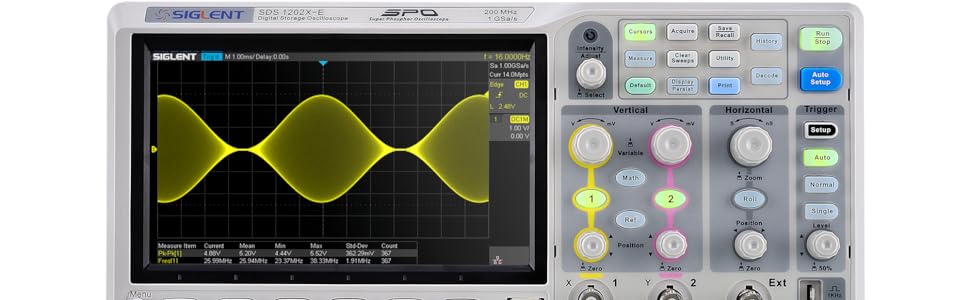
The Siglent SDS1202X-E is a high-performance 200 MHz bandwidth oscilloscope with a 1 GSa/s real-time sampling rate and an extensive 14 Mpts record length. It features advanced serial bus triggering and decoding for multiple protocols, a unique 256-level intensity grading display, and a hardware co-processor for fast, precise measurements. Designed for professionals and hobbyists alike, it offers exceptional signal fidelity and noise reduction at an unbeatable price point.


| ASIN | B06XZML6RD |
| Best Sellers Rank | #26,911 in Industrial & Scientific ( See Top 100 in Industrial & Scientific ) #10 in Lab Oscilloscopes |
| Date First Available | April 19, 2017 |
| Is Discontinued By Manufacturer | No |
| Item Weight | 5.5 pounds |
| Item model number | SDS1202X-E |
| Manufacturer | Siglent Technologies |
| Product Dimensions | 10 x 15 x 17 inches |
H**0
Best Value Oscilloscope for Beginners/Hobbyists
I'm quite familiar with old, bulky CRT Oscilloscopes back during my school days - However, I've recently integrated a Tektronics digital oscilloscope for my customer (I fabricate industrial test equipment for a living) and I've been itching to get one for my personal use. The SDS1202X-E , For the price point of 370+ USD has decent specs (200 Mhz, 2x channels , USB/ LAN, features) and a good contrast Screen. The package comes with 2x 200 Mhz (1x,10x attenuating ) probes, 1xUSBTypeA to USB type B cable, & a Calibration Certificate. It has a serial trigger feature (for CANBUS , RS232 & more ) and Math functions , but I've yet to test those out. I'm also not sure if this model has the serial decoding feature as well. Construction of the unit seems like what you'd normally find of similar range of Oscilloscopes - ABS/PVC injected body. The push-buttons are silicone and have LED backlights to indicate operation which I personally prefer compared to hard ABS buttons. The rotary knobs have notches? internally, so you have haptic feedback during rotation (like on old normal mousewheels - not the infinitely free spinning kind you see on gaming mice) For people concerned about calibration, there are no specific units mentioned on the calibration sheet. However, they have listed the calibration equipment used (e.g. Keysight B2901A - Precision Source/Measure unit and others) to validate the unit - and of course they have a certificate no. which is certified NIST / NIM/ NPL traceable. All-in-all, Would recommend this product for hobbyists and beginners!
M**R
Excellent Scope at an excellent price
The other reviews mention many great features ranging from the 1GSPS, 200MHz bandwidth, FFT, and range V/div starting at 0.5mV. So i won't repeat these for the Siglent SDS1202X-E that I purchase on July 31, 2021. This is an excellent scope for the price. Don't let people mislead you into thinking that it's only for beginners (it's not) but certainly beginners will be able to use it. Compared with my HP54111d from the 1990s costing $20k when new and having 500MHz Bandwidth and 2Gsps, the little Siglent does far more and better for far less price (but only 1Gsps and 200MHz bandwidth). Others mention concern over the serial numbers and the 'droop' related to probe calibration. My serial number is not the BA. However, I will mention that the 'quick start guide' accompanying the unit had an addendum page regarding calibration that indicated the unit was calibrated several years ago which appears to indicate the unit left the factor at that time. So the BA serial numbers must have been fixed by then. Other people have mentioned concern over high levels of noise on the 0.5 mV through 5 mV ... actually not a problem. But here's my story. When I first started the unit on Monday around 4pm, I shorted the probe tip to its ground and noted wildly varying 'noise' on the 0.5mV - 2mV scale and that would make the scale useless. I removed the probe and instead attached a banana-to-coax adapter and shorted the two inputs with a wire. Whoa still wildly varying noise. Bringing my hand closer to it increased the noise by a factor of two. I began to think there was a problem with scopes ground circuitry to the BNC and some how the noise was coupling through the ground in some type of common mode problem. The FFT showed a spike at the frequency of the FM station down the road at 98.3 ... very cool. Decided to wait till the next day (Tuesday morning) for further tests. The environmental noise levels had dropped by Tuesday morning ... an interesting fact in its own right but still enough for testing. This time, a 50 Ohm cap was placed on the SDS1202X-E input BNC and also placed a 50 Ohm cap on the BNC of my old HP54111D (2GSPS, 500MHz bandwidth). Comparing the two showed similar noise in both on the 1mV scales - here the noise refers to the 'thickness' of the baselines and both were well below 0.5 mV. As a matter of fact the HP unit has dying internal boards that produce a baseline that wavers over about 0.5 mV. With the caps on the Siglent unit, moving the hand closer the 50 Ohm Cap does not result in the wildly varying noise levels. However touching the ground on the cap does result in the scope picking up a small periodic spike maybe 0.25 mV. I'll need to investigate the probes more closely since grounding the tip does not appear to eliminate the nose very well. Anyway, the scope does not appear to have an internal noise problem contrary to some reports. Finally, I wish the power cord could be attached at the back rather than the side of the unit since that uses valuable shelf space or maybe provide a right angle connector for the power cord. Oh and be sure to download the full manual from either the sellers website or the manufacturers website since the unit only comes with the quick start guide.
K**E
Perfect for this hobbyist.
This is a review of the Siglent Technologies Digital Oscilloscope. I am a relative newbie to Arduino and electronics, building mostly stepper motor controllers, camera interfaces and experimenting with ESP8266 devices. For everything but the stepper motor controllers (joystick controller), I was getting by with multimeters and literally touching LEDs to different contacts to see what was hot. When I started building and facing issues getting the motors to run reliably, it was frustrating. Luckily, I caught a YouTube vid that explained how to use an oscilloscope to see what signal the Arduino was putting out (PCM to control the speed). I needed my own scope and not needing something fancy, bought a kit costing about $20. I built it, put it all together, then... nothing. Bought another one and was able to get it to work. Alas, it was glitchy. I did learn a lot about soldering and do recommend doing this, but it was unstable enough (my own fault) that I wanted a proper product. So I looked online and found a host of threads. Most pitted the Siglent against the Rigol, especially touting the number of channels in the latter. Other threads talked about the top-end frequency that each supported and how it affected the readings. It came down to the fact that a 4-channel high-frequency oscilloscope would cost about double what I was willing to spend. Though the Rigol and Siglent both had great reviews, I went with the Siglent as there would be easier calculations and adjustments for this newbie to make. The main things I like about this device was the high frequency support (200 MhZ) that would potentially allow me to troubleshoot more complex devices (e.g., video cards, radios, etc.). Two channels is one more than I'm using currently. Even for a newbie, the layout of the dials was easy to learn. Others have reported that the multiple button presses to get to math and other functions was annoying, but honestly, I use things like saving to USB and some of the math functions infrequently enough that it's not a concern. Display is easy to read. Calibrating the probes was easy using the included screwdriver and the built-in reference signal. I realize that $300 is on the high-side for a hobbyist (well, maybe :D), but after research this was most feature complete in that price range. I'm very happy with this purchase and hope to not soon outgrow it.
H**.
Zu der Lieferzeit, den technischen Daten, Bildschirm, Haptik, Lüftergeräuschen usw. wurde schon fast alles beschrieben. Hier noch einige persönliche Tests und Eindrücke die ggf. bei der Kaufentscheidung helfen können. Decodierung: In meiner alten Firma war es möglich das Decodieren verschiedener Protokolle unter Zuhilfenahme eines Testboards zu analysieren. Nach der Korrektur verschiedener Einstellungen war dies möglich. Die Decodierung ging sehr schnell. Wenn man etwas in Echtzeit haben möchte, muss man halt das mehrfache investieren. Die Funktion ist auf jeden Fall gegeben. Für den Hobbybereich sind die gegebenen Möglichkeiten auf jeden Fall ausreichend. Die CAN oder LIN Signale werden wohl kaum benötigt. Ich habe ein paar Screenshots beigefügt. FFT: Die Fast Fourier Transformation macht was sie soll. Alle notwendigen Parameter sind editierbar. Eine Vollbildanzeige ist möglich. Alles geht recht zügig. Die Signale im Screenshot sind sehr schwache UKW Sendesignale. Als Antenne habe ich nur zwei Kabel (ca. 200 und 500 mm) genommen. Für einen Keller im Betonbau sind die recht gut. Mobilempfang = 0, Radioempfang kaum möglich. Setups: Es lassen sich Einstellungen für das Setup, Referenzen, die Setup Taste und Screenshots speichern (Extern USB oder intern). Für mich sehr wichtig. Externe Steuerung:: Die Steuerung des Siglent kann über USB oder LAN zum Beispiel mit der Software EasyScopeX erfolgen. Diese kann man auch auf der Homepage von Siglent herunterladen. Siehe Screenshot. Die Installation ging problemlos. Die Bedienung geht natürlich nicht in Echtzeit ist aber sehr flott und alle Funktionalitäten sind gegeben. Echtzeit kostet halt echt viel Geld. Zum Service bei Siglent: Ich kann denen, die von einem schlechten Service sprechen nur widersprechen. Ich hatte wegen einer Frage angerufen (Deutsche Niederlassung) und wurde zunächst von einem kompetenten Mitarbeiter beraten, der mich sofort an einen weiteren Mitarbeiter der Fachabteilung weiterleitete. Alles ohne Warteschleifen. Nach Aufnahme des Problems habe ich innerhalb von zwei Stunden eine Antwort per Email erhalten. Das kenne ich so nicht. Gruß an Herrn R. und Herrn W. Negatives: Es gibt sehr viel Licht beim 1202X-E aber auch ein klein wenig Schatten. 1. Bei der Funktion Menü Off werden nicht alle Menüs ausgeblendet. Lediglich die Menüs am unteren Bildschirm verschwinden. Diese Lösung ist aber noch immer besser als bei bekannten Mitbewerbern. 2. Der externe Trigger ist nicht komplett freigeschaltet. Für meine Anwendungen jedoch vollkommen ausreichend. Fazit: Ich kenne kein Gerät mit diesen Leistungsmerkmalen das zu diesem Preis angeboten wird. Das letzte Firmwareupdate hat nochmals einiges verbessert. Ich kann das Gerät guten Gewissens empfehlen. Man macht nichts falsch. Daher volle 5 Punkte
E**Z
Tiene caracteristicas que la mayoria no tiene, como un delay de triger para ver la posición que te interesa, un zoom muy fácil de manejar con un preview que permite navegar en el zoom muy facilmente. El decodificador serial me sirvio para revisar el protocolo de una tarjeta viejita que no me acordaba a que frecuencia trabajaba. Al menos a mi me salio muy muy barato con MSI tuve suerte, ya no lo he encontrado a ese precio. Exceletne proveedor llego en tiempo y forma.
L**T
livré en 3 jours ; merci Amazon ! un superbe produit pour 400 euros. J'ai longuement hésité entre celui-ci et le modèle 4 voies. Mais pour le même prix j'ai préféré prendre le 200MHz à deux voies seulement. Pour faire de la "petite" électronique Arduino, audio, mesure basse fréquence ça devrait me suffire pour un moment. Facile d'utilisation, bien pensé. Boutons agréables au toucher, réponse rapide. Il y a un petit ventilateur mais il ne fait presque pas de bruit, et je suis très sensible à ce genre de détail. Pas encore eu le temps de tester la fonction de décodage des trames.
T**K
一応、自分は電子関係の技術者の端くれと思っています。オシロは長年テクトロばかりを使ってきましたが、 所有していたオシロが次々に壊れだしたので試しに当機を買ってみました。最近の低価格帯のテクトロのオシロと比べて遜色が無いと感じました。機能も豊富ですし操作性も悪くないです。現時点で分からないのは長期間壊れないかどうかという点だけです。10年位壊れなければ満点の評価を付けれるでしょうね。
R**O
L’aspetto è gradevole e i comandi (tasti e regolazioni) sono comodi e non presentano problemi durante l’uso. La compensazione delle sonde in dotazione è risultata quasi immediata. L’oscilloscopio è reattivo quasi come un analogico e la familiarizzazione con le funzioni è rapida. Buona la quantità di memoria a disposizione. Abbondanti e precise le misure disponibili. La funzione FFT mi ha stupito per la rapidità dell’aggiornamento e i dettagli ottenibili. Sembra quasi di avere un analizzatore di spettro! Ci sarebbe da dire un sacco di cose positive sulla miriade di funzioni disponibili ma la cosa che più mi è piaciuta è la presenza continua in un angolino dello schermo della misura di frequenza del segnale visualizzato, misura stabile e precisa all’hertz anche con segnali molto bassi! Buona la relativa documentazione disponibile sul sito SIGLENT e gli aggiornamenti software, in particolare ottimo e completo il manuale d’uso in inglese. Ho acquistato l’oscilloscopio per uso hobbistico ma nei miei 40 anni di attività lavorativa, ho utilizzato giornalmente oscilloscopi analogici e digitali di buon livello (HP, TEK e Lecroy) e dal costo pari a un’auto, e posso dire che questo si difende bene. Vale abbondantemente il suo prezzo !
Trustpilot
Hace 1 mes
Hace 3 días