We remain fully operational. Our teams are working around the clock to ensure your deliveries continue safely.

Descargar la aplicación


Servicios al cliente
Sobre nosotros
Copyright © 2025 Desertcart Holdings Limited
Descargar la aplicación


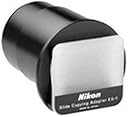
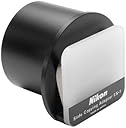

📸 Capture the Past, Share the Future!
The Nikon ES-1 52mm Slide Copy Adapter is a lightweight and compact solution for digitizing your favorite slides. With precise dimensions of 309.84 x 85.04 x 53.94 inches and a weight of just 0.05 kilograms, this adapter is designed for easy handling and storage. It operates on a 1.5V lithium-ion battery and is compatible with various household and office devices, making it a versatile tool for preserving your memories.
| Item Dimensions | 309.84 x 85.04 x 53.94 inches |
| Item Weight | 0.05 Kilograms |
| Unit Count | 1.0 Count |
| Battery Cell Type | Lithium Ion |
| Recommended Uses For Product | Camera |
| Reusability | Single Use |
| Voltage | 1.5 Volts |
| Compatible Phone Models | Household and Office Devices |
D**S
Works exactly as advertised (with the correct lens, of course)
I purchased the ES-1 and a Nikon AFS 40mm macro lens (Nikon calls it micro) together as a setup to scan old slides using my Nikon D3300 camera. The setup works exactly as advertised. In fact, I get really great slide scans, so much better than an expensive Minolta slide scanner I tried years ago and so very much better than the low cost slide scanners you can buy now, and I've bought a couple. Be aware, the ES-1 requires a compatible macro lens. I tried the ES-1 with a non-macro lens and the results are totally out of focus scans. But it's great with the 40mm macro lens.
K**R
Easy solution for transforming slides into digital files
Very straightforward to use: Screw the adapter on to the threads on the front of your macro lens (in my case, the Nikon 40mm micro). It'll go directly on to any lens with 52mm filter threads. Slide a 35mm mounted slide between the plastic "back" and the metal mounts, and take a picture of your slide.You could obviously use stepper adapters for lens with non-52mm filter sizes The adapter also telescopes out about 2 1/2 inches further out than at the minimum. WIth the 40mm on a cropped sensor dslr, having the adapter fully compressed provides 1:1 reproduction. If you use something with a longer focal length or a longer minimum focusing distance, you either telescope the adapter out, or, perhaps, will need additional tubes to put more space between the place where the slide is held and your camera, to get to a point where your lens can focus (hopefully, at 1:1 reproduction). The instructions say if you've got a full-sized sensor, use Nikon's 60mm micro lens.The adapter seems solid and secure, so it should last pretty much indefinitely, barring mistreatment.Because the slide is physically connected to the camera, camera shake is not an issue. The slide would move in concert with the sensor, so regardless of length of exposure, unless you bang the thing around to cause the slide to physically move while in the adapter, your shot will still come out sharp.. I guess that means turning off the vibration compensation / optical stabilization on your lens, if it has one.One problem I do have is getting the lens exactly level. Since the bottom of the adapter has a flat surface, you'd think it would be easy to keep it level relative to the camera sensor, yet I am often out of level. Not sure why. Probably operator error. If the lens is tilted, then your shot will also be tilted. You could, of course, tilt and crop in post-processing, but then you'd lose some of your image.Because you're taking a picture of a picture, you can adjust your exposure of the slide, if the original was slightly dark or overexposed. You can also vary the source light (sort of like using a warming or cooling filter as you shoot), and use split neutral density filters, if you want to adjust the brightness of different parts of the slide. Obviously, people proficient with photo software could also just do that in post-processing, but if you're old school enough to have slides, you may not have gotten around to buying any imaging software beyond what came preloaded on your computer. But because of how you're copying the slides, you can emulate some of what others would do with image processing software at the time your take a picture of your slide. If there's been color shift in your slide, however, you'd need to fix that in post production. Some of that can also be done with the basic imaging software. More complete fixes, you'd have to spend more on your software.Given the design, I suppose there's no reason why you couldn't also slide a negative strip into the adapter and take a picture of that, though you'd risk scratching your negative if you weren't careful. You'd also need photo editing software to reverse the negative into a positive image. No easy workaround for that.The ES-2 will have dedicated adapters for negatives or slides. The new Nikon 850 will have software (or firmware?) preloaded to process negatives into positives. But if you don't have want to splurge for the new camera or wait until they migrate the negative-to-positive software to their lower-end cameras (if that ever does happen), the ES-1 will at least let you get your slides converted into digital files, and only take as long as shooting a picture. For converting negatives to positives, you'd need this, plus more advanced processing skills.
F**1
SUPER PRODUCT
Paired with a D500 Nikon and a Nikon 40mm 2.8 micro lens I pretty quickly shot 2000 slides, a project I have been putting off for years. Took me about 3 weeks working on it a few hours a day. Compared to using a flatbed scanner this method is light years faster and the quality is superb…D500 is 20.9 megapixels.I also used the HSK A2 Artist light box for easy sorting of a batch of slides and then as a light source for photographing. Also a great product.Everything can be shot handheld at low speeds without blur since the camera and slides are mounted together.This method is much less expensive than sending your slides off and hoping they make it back home.
C**S
Works perfectly with Nikon 40mm f2.8 lens
Used to digitize a large number of 35mm slides with Nikon DSLR and Nikon 40mm f2.8 macro lens. Screws onto the front end of this lens (52mm). Easy to use and only need to adjust one time to get a full size image in the viewfinder. Two metal arms hold the slide in place and you must visually center and level the slide in the viewfinder. Able to digitize many slides quickly without camera blur - 3-4 per minute - with a small light pad providing the backlight. Can only be used with a Nikon macro lens.
M**X
Forshortened length means you must search for adapters
The concept is good but even after buying a set of extender rings about 30% of the slide area is cropped at proper focus. This product should be made long enough or adjustable to begin with.
V**X
Part of a system for excellent slide digitizing
I am using this adapter to digitize slides at much higher quality than typical slide scanners. To do this one needs a good macro lens on a digital camera. My approach uses a 55mm f2.8 micro-nikkor mounted to a Sony body by an adapter and a Nikon pk-3 extension ring. The total setup is: camera -> sony-to-nikon adapter -> pk-3 extension ring -> macro lens -> nikon k5 extension tube -> ES-1 adapter with slide. The extra k5 tube is needed in there because my sensor size and sony-to-nikon adapter create a telephoto effect greater than the extension of the ES-1 adapter. I'm using an inexpensive led tracing tablet as a light source. I'm not using step-up or step-down rings as others have mentioned, because all my items are 52-mm diameter.The (good) macro lens is the most costly part of a setup like this, and good old non-autofocus examples are available at quite reasonable prices. The most time-consuming part of the digitizing operation is pre-cleaning slides for dust, no matter what the digitizing method. Image processing for dust speck removal eats details too.
Trustpilot
Hace 3 semanas
Hace 1 mes