We remain fully operational. Our teams are working around the clock to ensure your deliveries continue safely.

Descargar la aplicación


Servicios al cliente
Sobre nosotros
Copyright © 2025 Desertcart Holdings Limited
Descargar la aplicación
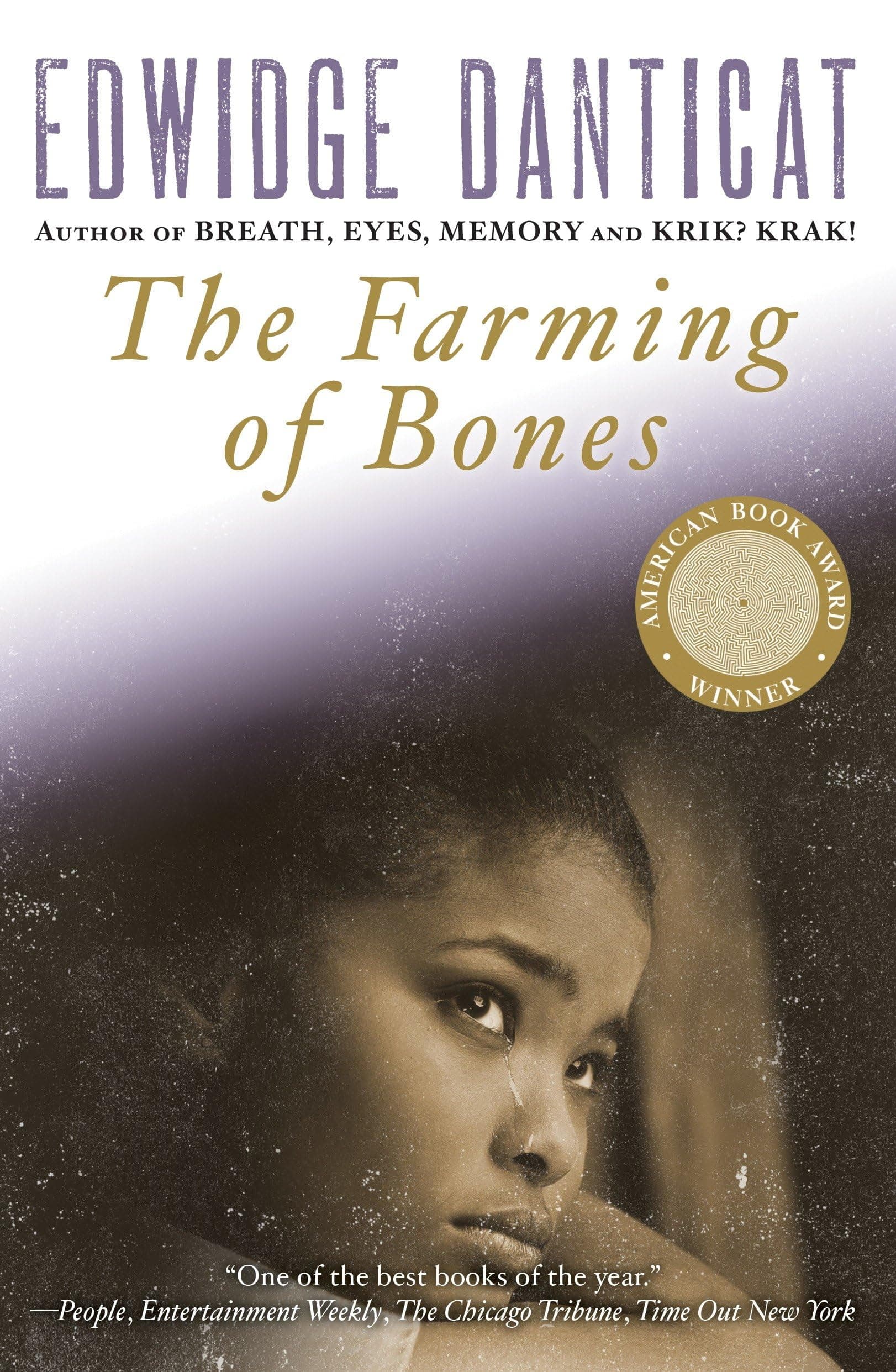
desertcart.com: The Farming of Bones: 9781616953492: Danticat, Edwidge: Books Review: Wonderful and heartbreaking - I think that Edwidge Danticat is a great writer, if not one of the best! I have been going to Haiti on medical missions for 17 years. The people and the stories will always be on my heart, along with Edwige's books. She captures the heart and soul of Haiti. Review: Breaking Bones..... - Sad, but stunningly beautiful, FARMING OF THE BONES is a powerfully written evocative account of the horror of the genocide committed in 1937 against poor Haitian cane workers and others by the Dominican General Rafael Trujillo. Through the voice of a young orphaned Haitian woman, Amabelle Desir, we follow the lives of desperate Haitian exiles working the Dominican cane fields in deplorable conditions with paltry wages and sparse living conditions. Danticat is a master storyteller and her prose lifts and carries, even as the atrocities of what she is telling unfold on the page. She travels a very painful path with humbling grace. She allows the reader to witness grave injustices while keeping them safely wrapped in her beautiful and poignant prose. . Dreaming... remembering...and family are strong elements which serve to enrich the story and draw the reader in as the reality of the despair becomes readily apparent. Trujillo wants to 'whiten' his populace and thus begins the recounting of an unimaginable and shocking ethnic cleansing. Towards the end of the novel, a man says "Famous men never truly die... It is only those nameless and faceless who vanish like smoke in the early morning air." ...on the island which Haiti and The Dominican Republic share. Through the eyes of the narrator, Amabelle working as a maid in the Dominican Republic, we see scores of Haitians cruely massacred. None of those killed is anyone famous, nearly all the slaughtered are poor Haitians working as cheap labor in the neighboring country, but Amabelle's story serves to refute those words spoken about the nameless and faceless of the earth. In this book, they are remembered, and in her story they do have names and faces.
| Best Sellers Rank | #91,813 in Books ( See Top 100 in Books ) #117 in Black & African American Historical Fiction (Books) #224 in Cultural Heritage Fiction #3,630 in Literary Fiction (Books) |
| Customer Reviews | 4.5 4.5 out of 5 stars (776) |
| Dimensions | 5.5 x 0.91 x 8.23 inches |
| Edition | Reprint |
| ISBN-10 | 1616953497 |
| ISBN-13 | 978-1616953492 |
| Item Weight | 2.31 pounds |
| Language | English |
| Print length | 336 pages |
| Publication date | May 7, 2013 |
| Publisher | Soho Press |
L**H
Wonderful and heartbreaking
I think that Edwidge Danticat is a great writer, if not one of the best! I have been going to Haiti on medical missions for 17 years. The people and the stories will always be on my heart, along with Edwige's books. She captures the heart and soul of Haiti.
S**Z
Breaking Bones.....
Sad, but stunningly beautiful, FARMING OF THE BONES is a powerfully written evocative account of the horror of the genocide committed in 1937 against poor Haitian cane workers and others by the Dominican General Rafael Trujillo. Through the voice of a young orphaned Haitian woman, Amabelle Desir, we follow the lives of desperate Haitian exiles working the Dominican cane fields in deplorable conditions with paltry wages and sparse living conditions. Danticat is a master storyteller and her prose lifts and carries, even as the atrocities of what she is telling unfold on the page. She travels a very painful path with humbling grace. She allows the reader to witness grave injustices while keeping them safely wrapped in her beautiful and poignant prose. . Dreaming... remembering...and family are strong elements which serve to enrich the story and draw the reader in as the reality of the despair becomes readily apparent. Trujillo wants to 'whiten' his populace and thus begins the recounting of an unimaginable and shocking ethnic cleansing. Towards the end of the novel, a man says "Famous men never truly die... It is only those nameless and faceless who vanish like smoke in the early morning air." ...on the island which Haiti and The Dominican Republic share. Through the eyes of the narrator, Amabelle working as a maid in the Dominican Republic, we see scores of Haitians cruely massacred. None of those killed is anyone famous, nearly all the slaughtered are poor Haitians working as cheap labor in the neighboring country, but Amabelle's story serves to refute those words spoken about the nameless and faceless of the earth. In this book, they are remembered, and in her story they do have names and faces.
M**L
Sad read
I like Edwidge Danticat's style of writing. The topic of this book is real while the characters are not. Still made it a very sad read. It also made me read me on the topic.
A**Z
Soy dominicana y es una buena historia, lo compré para mi clase de grado 10 en Estados Unidos y fue una linda historia, la cual aprender de los tiempos de Trujillo y cosas que llegaron a vivir la comunidad haitiana. Aunque también sé que no solamente los haitianos, también los dominicanos, sufrimos con la dictadura de Trujillo. pero es bueno verlo de los dos modos de cómo lo veían la comunidad haitiana y como lo veían la comunidad dominicana, no se enfoca tanto en la vida dominicana, sí, se enfoca más en la vida de los haitianos, pero es una buena historia
T**.
Insightful!
As someone who grew up with a Haitian father, he has told me of the tension between Haitians and Dominicans under President Trujillo. This book gave me a better insight into how cruel relations really were at the time and I hope that relations between the two countries eventually improve.
R**R
Haiti's long history of misery
I wanted a book on Haiti to learn more about the country, an interest stimulated by the recent earthquake. And I'd never heard of the 1937 Parsley Massacre, where Dominican dictator Rafael Trujillo ordered the execution of Haitians in the Dominican marches. Machetes were primarily used so the government could later plausibly deny that it was involved, claiming instead that Dominican peasants used machetes to defend themselves against rampaging Haitians. In an eerie echo of Judges 12:6, where the word "shibboleth" distinguished Gileadites from Ephraimites and the slaughter of 42,000 of the latter is celebrated, dark-skinned captives were ordered to say "perejil" ("parsley" in Spanish). Neither Haitian Creole nor French uses a trilled "r." If they couldn't correctly roll the "r", they were killed. However, while I enjoyed the book, the evoked emotions and sensations were muted; I think there was too much emphasis on symbolism and foreshadowing and not enough on conveying the foreboding and sheer terror of these events. (Although the scene where a Dominican officer rejects his newborn daughter because of her dark skin was exquisitely rendered.) And the ending is anticlimactic - a long way of saying you can't go home again.
P**L
Painfully beautiful historical fiction
The range of Haitian literature is considerably limited, and primarily consists of books by "outsiders" (those not of Haitian blood who have not lived there for any considerable length of time), and books by Haitian immigrants, with a smattering of poetry and transcribed stories and memoires preserved from Haiti proper. Danticat writes one of the most lovely portrayals of the dynamics between Haiti and the Dominican Republic, which share an island and have engaged in conflict since before the independence of Haiti. The author is able to paint a picture that does not seem to me to take sides, but simply states the reality of what happened through the fictional lives of the characters. I am interested in the way that the relationships between the Haitians and Dominicans are not always strained, and sometimes are extremely close, but those relationships are challenged in the middle of the political strains. I highly recommend this book for those who appreciate good historical fiction, and those who are interested in Haiti and relations in the Caribbean, as well as those interested in literary contributions from the minority and immigrant populations of the U.S.
A**B
Good read
Artistic style of story telling paints a grim picture, but leaves one with hope through remembrance of the lost souls.
K**R
Carefully plotting the life of a girl whose coming of age is set against the horrific backdrop of the 1937 Parsley Massacre, Edwidge Danticat has once again gifted us with a moving probing tale, this time of perhaps the Caribbean's most unreconciled tragedy of the 20th century, around which was cloaked a taboo-like silence until the 2013 echoes were evident. Through Amabelle Désir an orphaned girl semi-adopted by wealthy Dominicans in the 1920s, we glimpse the fates of her partner Sébastien, a scarred cane cutter determined to find a way to a better, happier life, his friends and co-workers Joel and Yves, Joel's father Kongo, Sébastien's sister Mimi, his mother Man Denise, and Yves' mother Man R. Their lives are all upturned and end as they've known them. The Dominicans with whom some of them live side by side are also deeply affected, sympathetic priests and doctors are destroyed, and those not actively engaging in the genocidal craze or against it are forced to hide their actions from those closest to them. The Farming of Bones is wonderfully respectful of the lives lost. It does not offer gratuitous violence, nor simplistic heroes and villains. Danticat slowly builds a chilling tension in a small village community in the Dominican Republic, where settled migrant workers of Haitian origin are accustomed to - if unhappy with - life as second class citizens whether Haitian-born or 3rd generation Dominicans who are monolingual Spanish speakers. She illustrates the nuance and life-saving imperative of ascertaining when widespread prejudice turns genocidal, and the impact of policy on everyday lives. Crucially, as the world does not stop turning when horror ends, the novel continues. We see the impact of the tragedy as people struggle to anticipate it, live through it, survive it, retain their sanity and humanity after it, rebuild their lives with or without loved ones, and mourn or try to find those lost. Skillfully, Danticat takes us decades into the future revealing both the immediate and longer term impact of the Massacre, and the myriad ways people recall and make meaning of it, and even the number of names given to the horror. It is a truly unusual gift to depict the worst of humanity with deep care, beauty and respect for those who suffered most, while reminding us that carnage always extends far beyond its intended targets. This is an incredible achievement of a novel, a wonderful read, and reparative historical fiction at its very best.
M**M
Was going to the Dominican Republic for the first time so wanted to read a novel which was appropriate to get a feel for the history of this country. Great book. Was intrigued from start to finish. Was disappointed it didn't have a happy ending! (Sorry!)
A**L
I read this book in preparation for mission trip to the Dominican Republic. It is a heart breaking, moving tale of the struggle to survive in a country ravaged by civil unrest. It helped me to understand the political situation of a beautiful country.
R**N
It is about events I knew nothing about, and although painful to read the author evokes the Caribbean very authentically
Trustpilot
Hace 5 días
Hace 1 mes