We remain fully operational. Our teams are working around the clock to ensure your deliveries continue safely.

Descargar la aplicación


Servicios al cliente
Sobre nosotros
Copyright © 2025 Desertcart Holdings Limited
Descargar la aplicación
Buy anything from 5,000+ international stores. One checkout price. No surprise fees. Join 2M+ shoppers on Desertcart.
Desertcart purchases this item on your behalf and handles shipping, customs, and support to Uruguay.
📰 Own the story behind the headlines — where power, purpose, and perseverance meet.
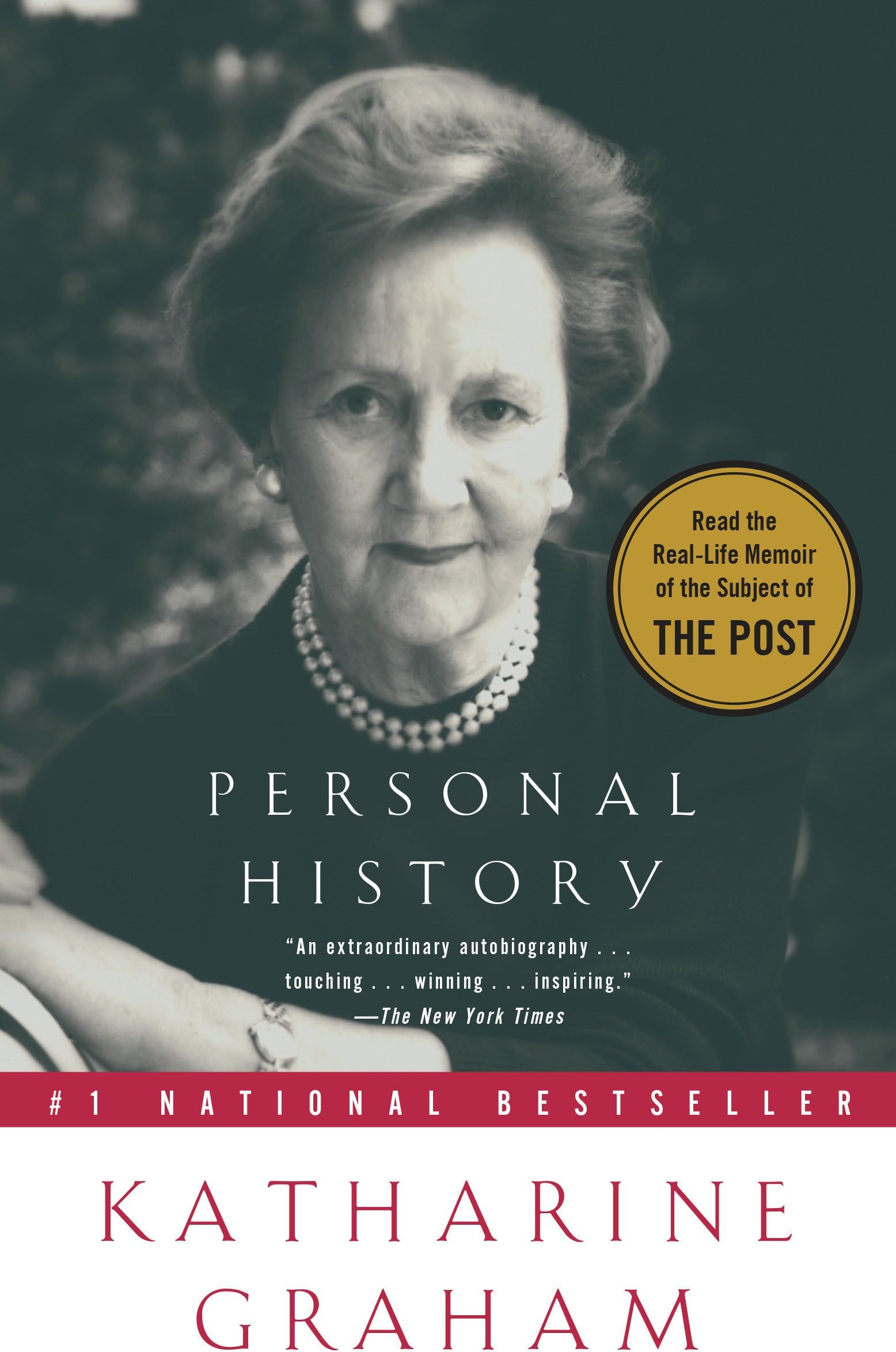
Personal History: A Memoir by Katharine Graham chronicles the extraordinary life of the first female CEO of The Washington Post. From inheriting a media empire amid personal tragedy to steering groundbreaking political investigations like Watergate, Graham’s story is a masterclass in leadership, integrity, and the vital role of a free press in democracy. This memoir offers a rare, candid glimpse into the corridors of power and the resilience required to lead with purpose in a turbulent world.

| Best Sellers Rank | #38,468 in Books ( See Top 100 in Books ) #27 in Journalist Biographies #62 in Biographies of Business & Industrial Professionals #1,089 in Memoirs (Books) |
| Customer Reviews | 4.4 out of 5 stars 2,237 Reviews |
C**N
Graham led a productive, meaningful, and impactful life
Born into privilege, Katharine Graham’s life was defined by and devoted to her family’s company, The Washington Post. While she could have taken it easy and led a life of leisure (she didn’t know how to fold her own clothes in college because “that was always done for me”) she instead took on the stress and challenges of operating a Fortune 500 company. She did this despite her obvious lack of experience and being the only women in the room, pretty much all the time. “Since I regarded myself as inferior,” she wrote, “I failed to distinguish between, on the one hand, male condescension because I was a woman and, on the other hand, a valid view that the only reason I had my job was the good luck of my birth and the bad luck of my husband’s death.” There was plenty of both, but Graham managed to find success through sheer determination and a deep desire to bring good journalism to the people. While her start at The Washington Post was rocky, her confidence grew over the years as she grew into the job and began to accumulate some successes. She covered many presidents (and knew a few personally) from JFK and LBJ to Nixon and eventually Reagan, Bush, and Clinton. Graham’s autobiography is also a biography of The Washington Post newspaper and company—the family owned Newsweek magazine for many years in addition to a few local television and radio stations in select cities around the country. The paper, originally founded in 1877, was sold to Graham’s father at auction in 1933. Keeping it in the family, he eventually passed ownership on to Katharine’s husband Philip in 1946. The burdens of the job (and an undiagnosed mental illness) would eventually lead Phil to take his own life in 1963, catapulting Katharine into the position of president and CEO, one which she held for nearly thirty years before eventually passing the family torch once again to her own son Donald. While ownership of the company passed from one generation to the next, Graham always did her best to maintain her integrity with her readership and insisted on impartial journalism. Today, much of journalism feels as though it is written with a specific ideology behind it, but that was not always the case in the United States. “People who may disagree on politics must still be able to communicate, and it’s crucial for all of us in the press to listen to all sides,” she writes of her time at the newspaper. “I consider it the role of the head of a newspaper to be bipartisan and to bring journalists together with people from government. I think that an easy relationship is constructive and useful for both sides: it helps the publication by opening doors, and provides those who are covered in the news with the knowledge of whom they can suggest ideas to, complain to, and generally deal with.” As a means of honoring their bipartisanship, The Post maintained a precedent of not endorsing political candidates for many years, until eventually breaking this pattern in the 1976 election when they officially endorsed Jimmy Carter. The relationship between government and press is a vital one to a free and open society, and as one of the most prominent news sources in the capital city of Washington D.C. Graham and her associates at The Post had an important job: keeping those in power in check. While her career spanned many important years, there are two distinct events that had massive impact on her tenure. The first was the publication of the Pentagon Papers—which revealed the US’s involvement in Vietnam to be much more vast and devastating than the public originally knew about—and the second was the Watergate Scandal. Watergate, which progressively unfolded from 1972-1974 and eventually culminated in President Nixon’s resignation from office, was a political scandal unlike any other. “Its sheer magnitude and reach put it on a scale altogether different from past political scandals,” Graham remembers, “in part because of the unparalleled involvement of so many men so close to the president and because of the large amounts of money raised, stashed, and spent in covert and illegal ways.” The story revealed the depths of corruption throughout the different branches of government and the lengths to which Nixon was willing to go to cover it all up. Graham herself spent much of her time during the scandal as one of the top names on Nixon’s list of public enemies. Despite the immense pressure to drop the investigation, Graham pushed her reporters to continue pulling at the strings until the entire sweater unravelled. “As astounding as Watergate was to the country and the government, it underscored the crucial role of a free, able, and energetic press.” In conclusion, I found two important take-aways from reading this entertaining and informative book: The importance of a free press in keeping those in power in check, and the importance of leading a life of purpose. Graham could have easily taken her family’s money and done whatever she wanted with her life, including nothing at all. Instead, her parents pushed her (and her four siblings) to live lives of fulfillment and productivity. She then passed these same sentiments on to her own children. Playing a central role in the production of news and the diagnosing of politics led Graham to live an extraordinary life, one of equal parts joy and hardship. Her mark on history was made in the face of gender-discrimination and is a shining example to us all of the importance of leading a life of purpose.
K**R
Good read, but book was used.
This is a good book, however, I was put off by the used condition. It was advertised as a new book in description. However, someone had used a “six flags” amusement park card as a book mark, which fell out as I opened the book. There was some sticky stuff of the book cover (back cover). Also found pen parks and underlined sentences inside. So I have deducted a star.
K**I
the trifecta of an excellent book: readable, entertaining, edifying
This book is phenomenal. I believe that I have found the inspiration for Forrest Gump. Born into very serious privilege, Katherine Graham's introspective autobiography spans the Gilded age to the 1980s, from her parents' childhoods, to how they met, to her childhood, marriage, and life beyond marriage and kids. Besides a jaw-dropping list of family friends ranging from Rodin to Kissinger (and all presidents between Roosevelt and Carter) and Curie to Buffet, Ms. Graham occupied a rarified strata where she didn't know how to fold her clothes in college "because that was always done for me." Despite her incredible privilege, Ms. Graham was a hard-working and earnest person who engaged in her marriage and motherhood enthusiastically, if not, according to her, somewhat less than completely adeptly. Her story is one of a woman born in the early 1900s, widowed in the 1960s and heading up an F500 company, her family's paper the Washington Post, at a time where she was the only female in the boardroom. Kind of ever. She relates interesting anecdotes about her insecurities in running a company, particularly in an age where women were encouraged to stay and home and raise children. In her memoir is a compelling story of a woman persisting in a man's world, relying upon her sensibilities and succeeding despite her propensity to "burst into tears" when confronted with aggressiveness or bad news. I thoroughly enjoyed this well-written and engaging memoir for its historical perspective, its insight into privilege and its trajectory of a very impressive person who was also a woman. I highly, highly recommend this book - it is readable, entertaining and edifying - the trifecta of an excellent book.
J**R
What a wonderful combination of substance and opportunity!
Since I grew up in a house where the "Washington Post" was devoured daily, I was always aware of Katherine Graham. I read this book shortly after she passed away, and I was knocked off my feet. She was blessed by the accident of her birth into a family of extreme wealth and ultimate social position. Her family's advantages - sadly compounded by her husband's untimely death - gave her inumerable opportunities. At the same time, she was brilliant, capable, focused, and a gifted communicator. This combination of traits and circumstances allowed her to live a most enthralling, significant life. Throughout, I marveled at her "realness." Her family had more money and servants and things than anyone I am ever likely to meet, but she describes her challenges, insecurities, and fears in a way that allow me to appreciate how she faced and succeeded in life. This is a compelling read despite its length and detailed content. It is well documented and beautifully written - without the aid of a ghostwriter. It does not suffer from spurious melodrama, myopia, or vanity to which so many autobiographers fall victim. I highly recommend both the form and substance of this book.
R**H
An interesting life... but not for 600+ pages!
The interesting life of an interesting woman that could hold the readers' interest better if it were half the length! Kay Graham manages to overcome many of her life's obstacles -- and privileges -- to become a powerful and effective leader. She doesn't always make sound choices; she clings to her corrosive and philandering husband through thick and thin, and she overturns her Republican father's desire to create an unbiased-newspaper by making The Post a mouthpiece for the Democrats. But it is her mistakes that make Graham most interesting and accessible to readers. Her journey is rich and varied, but not so much that it warrants more than 600 pages. Definitely, many chapters deserve only the lightest of skimming.
V**R
A life well lived
An interesting read. Lots of D.C. background.
A**A
Very candid account of changing times, very relevant today.
A very candid account of her life, packed with details of a different time to more current day issues. Particularly interesting reflections on the role of women over time, and how this intelligent and capable woman came to find her own strength. Lots of name dropping which annoys petty old me, but really the people in her life are interesting in themselves-- and interesting how all those paths crossed from early days when they weren't well known names. It is the story of the elite, and the great privilege that comes with wealth both inherited and earned, this can be irritating. But also refreshing in that these powerful folks were altruistic and idealistic, and acted on those ideals even at personal cost.
K**L
An excellent read
I loved reading the book. It gave much history about THE POST. Katherine told about the struggles she had feeling thrust into a position she felt unprepared for. The struggles she had as a woman in a powerful position (in. A Man’s world) in the ‘70s and later.
Trustpilot
Hace 2 meses
Hace 2 semanas