We remain fully operational. Our teams are working around the clock to ensure your deliveries continue safely.

Descargar la aplicación


Servicios al cliente
Sobre nosotros
Copyright © 2025 Desertcart Holdings Limited
Descargar la aplicación


Climate Change : Romm, Joseph: desertcart.co.uk: Books Review: Do we have a chance to save our planet - Brilliant and factual book on climate change. Fairly easy for the average reader contains global backed up research. A must read if you have children, grandchildren and want to help save our planet. Review: Too important, must read - Why sustainability is more important than your business by Ron Immink on November 8, 2016 in Blog Climate change will have a bigger impact on your family and friends and all of humanity than the Internet has had. This is from “Climate Change” by Joseph Romm. The scariest book I have ever read. Scarier than “Future crimes“. Scarier than “Overconnected“. This is existential and it involves our children. We are near tipping point At the dawn of the Industrial Revolution 250 years ago, CO2 levels in the atmosphere were approximately 280 parts per million (ppm). Emissions today are six times higher than they were in 1950. Moreover, CO2 levels have now hit 400 parts per million. As a result, the Earth has warmed 1.5°F (0.85°C) since 1900. Most of this warming, approximately 1°F, has occurred only since 1970. The delay effect This is important. With climate change, there is a delay effect. If CO2 levels stopped rising now, temperatures would keep rising for another few decades, albeit slowly. Put another way, the warming that we have had to date is due to CO2 levels from last century. It also has an amplifier effect. Which means the changes will become exponential, applying Moore’s law to climate change effects. The dark or negative version of Moore’s law. Some examples: In January 2010, the U.S. Southwest from California to Arizona was slammed by “The most powerful low-pressure system in 140 years of record keeping. That summer, Russia was hit by the most lethal heat wave in human history, killing at least 55,000 people. Russia lost 40% of its wheat crop and banned grain exports for 18 months, which contributed to soaring food prices globally. In 2010, both Columbia and Australia saw their worst floods in history, driven by record rainfall. In October 2010, Minnesota saw the strongest U.S. storm ever recorded that was not a coastal storm such as a hurricane. The superstorm generated 67 tornadoes over a period of 4 days. In 2010, the desertcart experienced its second 100-year drought in 5 years, On October 29, 2012, Hurricane Sandy devastated the Northeastern United States, killing more than 100 people, destroying entire communities, and inflicting more than $70 billion in damages. Last time The last time the Earth’s atmosphere was at 400 ppm of CO2 was a few million years ago, long before Homo sapiens roamed the Earth. Back then sea level was some 15–25 meters (50–80 feet) above modern levels. A 2009 analysis in Science found that when CO2 levels were approximately 400 ppm 15 to 20 million years ago, the Earth was 5°F to 10°F warmer globally and seas were also 75 to 120 feet higher. The future In future, hot summers occur twice as often as they did, and cool summers occur far less often than they did. Dangerous heat waves will see a 50-fold increase. By the middle of this century. Even the coolest summers will be hotter than the hottest summers of the past 50 years. By 2050, the United States will see wildfires twice as destructive as today, and some 20 million acres a year will burn. Storms will be bigger. Tropical diseases will spread. Fresh water will become more scarce. Feeding the global population will become very difficult, and we will have an increase in civic unrest. That is the good news. Mad Max and Waterworld If we go over the 4 degrees tipping point we are facing widespread drought and Dust-Bowlification, mass species loss on land (70% of all animal and plant life) and sea (90% of all marine life), increase in the most extreme type of weather events globally (including heat waves and superstorms), sea-level rise much greater than 6 feet by century’s end with seas rising to a foot a decade after that. The Great Dying It is called the “The Great Dying”. It will make our planet nearly uninhabitable. Armageddon. A combination of Mad Max and Water World. Possibly within the next 50-60 years. That is within the lifetime of our children. What we need to do To have a significant chance—greater than 50%—of keeping total warming below 2°C, we need to cut the emissions of carbon dioxide and other major GHG pollutants by more than 50% by mid-century, which in turn means that global GHG emissions must peak within a decade or so and start a rapid decline. That means that a third of oil reserves, half of gas reserves and over 80% of current coal reserves should remain unused from 2010 to 2050. Bigger than the internet That means we need to get cracking. Fast. And that is why climate change is bigger than the internet. You don’t need the internet anymore when you are fighting for survival.
| ASIN | 0190250178 |
| Best Sellers Rank | 2,602,842 in Books ( See Top 100 in Books ) 918 in Global Warming & Ecology 1,090 in Ecological Pollution 1,179 in Meteorology |
| Customer reviews | 4.4 4.4 out of 5 stars (448) |
| Dimensions | 20.83 x 3.05 x 13.97 cm |
| ISBN-10 | 9780190250171 |
| ISBN-13 | 978-0190250171 |
| Item weight | 340 g |
| Language | English |
| Part of series | What Everyone Needs To Know? |
| Print length | 328 pages |
| Publication date | 3 Dec. 2015 |
| Publisher | Oxford University Press |
S**E
Do we have a chance to save our planet
Brilliant and factual book on climate change. Fairly easy for the average reader contains global backed up research. A must read if you have children, grandchildren and want to help save our planet.
R**K
Too important, must read
Why sustainability is more important than your business by Ron Immink on November 8, 2016 in Blog Climate change will have a bigger impact on your family and friends and all of humanity than the Internet has had. This is from “Climate Change” by Joseph Romm. The scariest book I have ever read. Scarier than “Future crimes“. Scarier than “Overconnected“. This is existential and it involves our children. We are near tipping point At the dawn of the Industrial Revolution 250 years ago, CO2 levels in the atmosphere were approximately 280 parts per million (ppm). Emissions today are six times higher than they were in 1950. Moreover, CO2 levels have now hit 400 parts per million. As a result, the Earth has warmed 1.5°F (0.85°C) since 1900. Most of this warming, approximately 1°F, has occurred only since 1970. The delay effect This is important. With climate change, there is a delay effect. If CO2 levels stopped rising now, temperatures would keep rising for another few decades, albeit slowly. Put another way, the warming that we have had to date is due to CO2 levels from last century. It also has an amplifier effect. Which means the changes will become exponential, applying Moore’s law to climate change effects. The dark or negative version of Moore’s law. Some examples: In January 2010, the U.S. Southwest from California to Arizona was slammed by “The most powerful low-pressure system in 140 years of record keeping. That summer, Russia was hit by the most lethal heat wave in human history, killing at least 55,000 people. Russia lost 40% of its wheat crop and banned grain exports for 18 months, which contributed to soaring food prices globally. In 2010, both Columbia and Australia saw their worst floods in history, driven by record rainfall. In October 2010, Minnesota saw the strongest U.S. storm ever recorded that was not a coastal storm such as a hurricane. The superstorm generated 67 tornadoes over a period of 4 days. In 2010, the Amazon experienced its second 100-year drought in 5 years, On October 29, 2012, Hurricane Sandy devastated the Northeastern United States, killing more than 100 people, destroying entire communities, and inflicting more than $70 billion in damages. Last time The last time the Earth’s atmosphere was at 400 ppm of CO2 was a few million years ago, long before Homo sapiens roamed the Earth. Back then sea level was some 15–25 meters (50–80 feet) above modern levels. A 2009 analysis in Science found that when CO2 levels were approximately 400 ppm 15 to 20 million years ago, the Earth was 5°F to 10°F warmer globally and seas were also 75 to 120 feet higher. The future In future, hot summers occur twice as often as they did, and cool summers occur far less often than they did. Dangerous heat waves will see a 50-fold increase. By the middle of this century. Even the coolest summers will be hotter than the hottest summers of the past 50 years. By 2050, the United States will see wildfires twice as destructive as today, and some 20 million acres a year will burn. Storms will be bigger. Tropical diseases will spread. Fresh water will become more scarce. Feeding the global population will become very difficult, and we will have an increase in civic unrest. That is the good news. Mad Max and Waterworld If we go over the 4 degrees tipping point we are facing widespread drought and Dust-Bowlification, mass species loss on land (70% of all animal and plant life) and sea (90% of all marine life), increase in the most extreme type of weather events globally (including heat waves and superstorms), sea-level rise much greater than 6 feet by century’s end with seas rising to a foot a decade after that. The Great Dying It is called the “The Great Dying”. It will make our planet nearly uninhabitable. Armageddon. A combination of Mad Max and Water World. Possibly within the next 50-60 years. That is within the lifetime of our children. What we need to do To have a significant chance—greater than 50%—of keeping total warming below 2°C, we need to cut the emissions of carbon dioxide and other major GHG pollutants by more than 50% by mid-century, which in turn means that global GHG emissions must peak within a decade or so and start a rapid decline. That means that a third of oil reserves, half of gas reserves and over 80% of current coal reserves should remain unused from 2010 to 2050. Bigger than the internet That means we need to get cracking. Fast. And that is why climate change is bigger than the internet. You don’t need the internet anymore when you are fighting for survival.
D**P
Four Stars
Good read.
P**J
A truly excellent must-read. Alarming.
I found this a very readable and compelling summary. Anyone who is even remotely interested in climate change should ensure they read it or another one like it. I considered myself fairly well informed in general terms, but had never read one book that brought so many different angles together. It is alarming and I have questioned some of my long standing views and behaviours as a result.
C**A
Clear and Factual
A clear and concise presentation of the science, the theory and the ongoing debates regarding climate change. The book has a question and answer structure which is great if you are trying to focus on a particular aspect of this complex subject. Would highly recommend.
B**G
Lacks balance
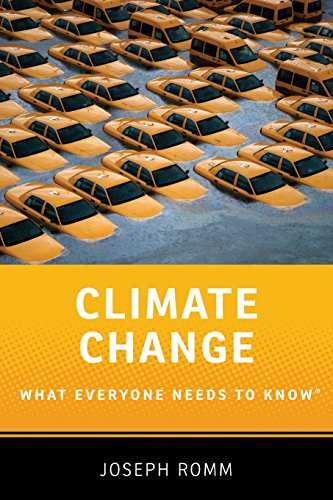
One thought is that its timing appears to have been designed to coincide with the Paris climate conference. The question-and-answer format, indeed, makes it appear to be a propaganda exercise rather than a serious scientific study. One initial criticism is that climate change due to increasing CO2 emissions is taken as an accepted fact (so no longer an hypothesis?) as certain as that smoking causes lung cancer. There are therefore numerous sections with questions such as: "How does climate change affect the chances of deluges or severe precipitation?" and "How does climate change affect storm surge?" The impression of propaganda is increased by the photo on the cover showing many apparently new same-colour cars and vans half submerged in, presumably, flood water. Any example of extreme weather is automatically assumed to be caused by greenhouse gases, as if that has been categorically proved. . I looked at the index to see if there were any entries for the climate change "deniers" and found none, but I did find one brief paragraph saying that one of them, Richard S. Lindzen , prefers to be known as a "denier" rather than a "skeptic". It is interesting that the author, Joseph Fromm, is not a climatologist. He has a PhD in physics from MIT. Lindzen, on the other hand, is a former professor of dynamic meteorology at Harvard and professor of meteorology at MIT. Make of this what you will: the index entry for "global warming" says "see climate change." One glaring omission from the index is the infamous "hockey stick" graph on which so much reliance was based in an effort to prove that there had been dramatic warming in the 20th century. There is also no reference to Karl Popper and his arguments about the falsification of scientific hypotheses and the awkward fact that they are undermined by contrary data, which should lead to either modification or rejection. In summary: quite impressive on the surface but closer inspection reveals a lack of balance. Can anyone recommend a book on climate change that is not biased one way or the other?
P**L
This is actually the best of many books on the subject
I have read most of the leading books on Climate Change. Some are unrealistic, some are over pessimistic, some provide partial information to promote their political or commercial cause. This book tells it as it is. An abridged version would be good for people with less time or inclination however.
J**N
Comprehensive overview of subject
Great book and well written in easily understandable language. Super coverage of the subject.
A**.
Don’t miss out on this book. It’s a very lucid piece of writing. It sails you along the course the future might probably take if the business-as-usual approach in carbon emission is not reigned over immediately. It sets the stage excellently for everyone, even for the persons not having the science background, to foresee the catestrophic impacts of climate change. Great work. Aj. S.
A**E
Der Autor Joseph Romm stellt in englischer Sprache klar und verständlich dar, wie der Klimawandel uns betreffen wird. Das Buch ist ansprechend, es übermittelt viel Fachwissen und gewährt einen großen Einblick in die bevorstehende Problematik.
A**R
Buen texto para una clase en profesional
M**Y
Very impressive. Much scarier than anything Stephen King has ever written. The only book a layman needs to read to get a handle on the causes, consequences and possible solutions to the global warming crisis.
J**R
From following Joe Romm's blog since 2010 I was aware that he is on top of the developing research on climate change and able to explain clearly not only the current scientific understanding of global warming but its implications in terms of our future lives. Since I have been following his blog, along with about fourteen other ones, when I had time, I wasn't sure how much I would get from reading the book. But I am impressed by how much ground he covers, backed by references to current research, and how clearly and methodically he answers the questions he poses. I found that, although I was familiar with much of the research in a general sense, it was not only helpful to have all of the information in one place, but that some of the specific details he mentions were new to me. Romm doesn't attempt to answer all of the questions about the history of climate change before humans overrode the natural cycle that moved us in and out of ice ages, a disruption reversing the gradual cooling over the last 7000 years until the Industrial Revolution--and particularly the last forty years--when human emissions of greenhouse gasses abruptly sent temperatures upward and presently are taking into global temperatures higher than any during the 11,000 years of remarkably stable temperatures that first permitted the creation of civilizations, industry, and agriculture. That's because his primary concern is to inform readers what is happening now, what will happen going forward, and what we can and should do about it. I believe this is the most informed book on the subject of climate change that is aimed at a general readership with the intent of presenting an accurate picture of what the scientific community presently knows about global warming and how the climate changes it is bringing about will affect them. Romm's take-home message is that we have a lot of work to do, and if we hope to preserve a world and a way of life that has anything like the stability and security that our present one offers, the time is getting short for us to act effectively and affordably. The good news is that while stopping global warming is a huge task that involves worldwide cooperation, it is very affordable; the bad news is that doing nothing will rapidly transform our world into one with more extreme climates where the dry regions got dryer and the wet ones wetter, all of them warmer, but with less predictable, more violent weather and abrupt shifts of hot and cold temperatures, changes that would increase social unrest and violence, endanger health, cause large extinctions of animal and plant life on land and seas, raise ocean levels that would put many cities at risk, increase crop failures in a world of a rapidly rising population, and on and on. Given the enormity of the changes our world is threatened with, it is essential that everyone becomes well informed of the situation and the choices we are offered.
Trustpilot
Hace 1 día
Hace 3 semanas