

Desert Online General Trading LLC
Dubai, United Arab Emirates
Desert Online General Trading LLC
Dubai, United Arab Emirates
Full description not available
L**N
very good.
Very, very good.
J**E
Great book, better than any other structured fin. book
My desk needed me to create a model to value/monitor our retained MSR portfolio. After quickly reading through 3 books(this one, the excel one, and the OOP one) I decided this book best suited our needs. Hands down this book delivered the best model by the end. But as the other reviewer said, this does take some time, even when using the example model he provided on the webpage.Needless to say, my boss seemed very impressed by the model I was able to produce with this book. Would recommend to anyone at any capacity.This was my first CF model. I have little prior knowledge of finance, and strong knowledge of VBA & Math. Took me roughly 8 weekends or so.
B**R
Structured Finance For The Rest Of Us
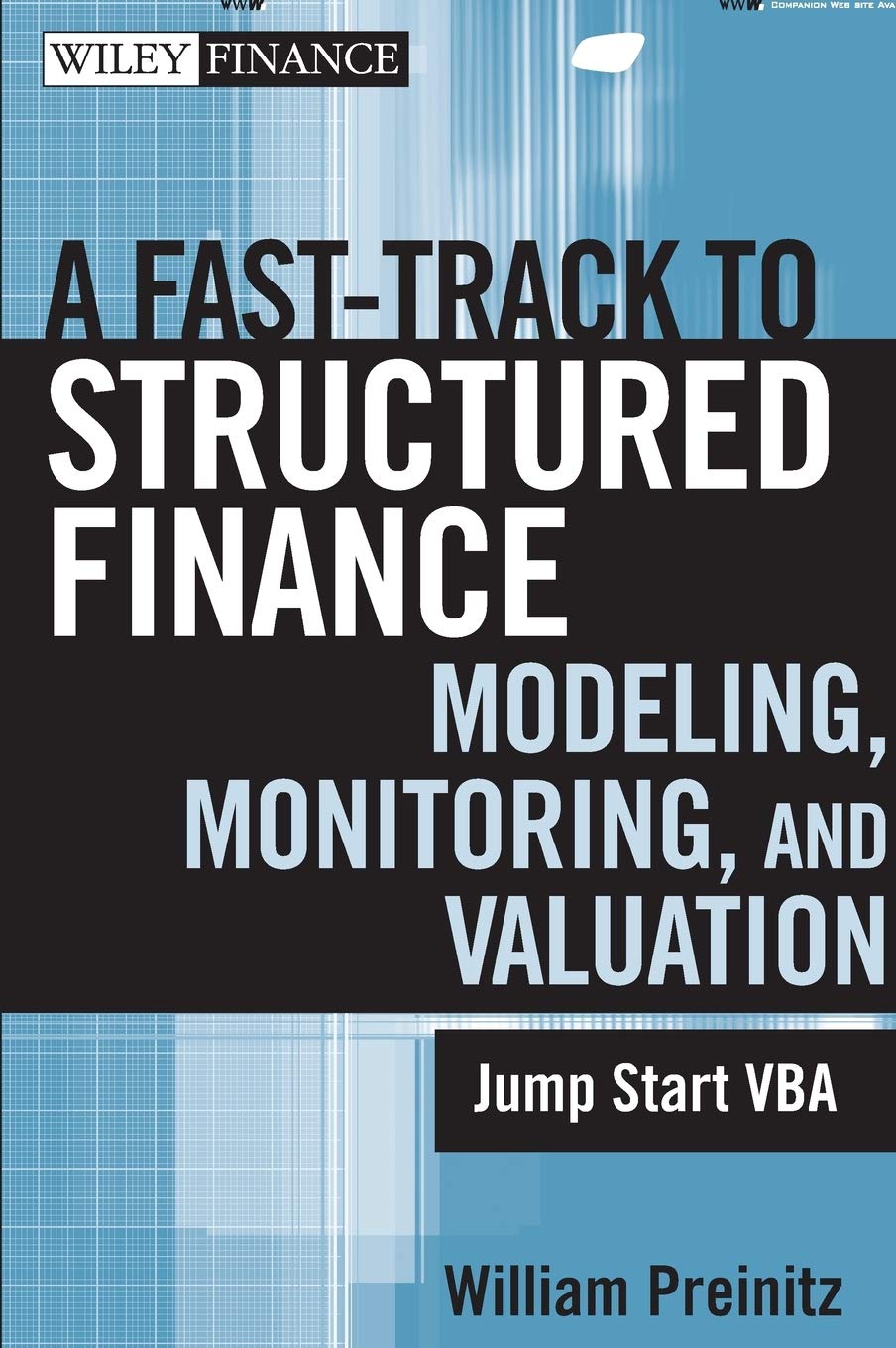
Whether you're a seasoned veteran of the financial markets or a curious student looking to find out what all the fuss is down on Wall Street, "A Fast Track to Structured Finance" has something for you.This book offers a very detailed approach to managing and analyzing the securitization process utilizing Excel and Visual Basic. What makes this book brilliant is its careful balance of the author's industry knowledge, well designed Excel templates and concise Visual Basic coding.Bill opens up the book with a discussion of the securitization process. Here we get our first glimpse at his expertise is this subject. During this discussion he details how the integration of VBA and Excel will help streamline the analyst and management of the deal. Interspersed throughout the book are tidbits of history, personal experiences and humor that add to a very entertaining read.Don't let the size of the book scare you. It's filled with numerous screen shots and code samples that add clarity. And as a bonus, the spreadsheet and code examples can be found on the Wiley website. The Visual Basic coding is incredibly well documented and is portable. You'll find yourself looking for opportunities to apply his unique strategies to your own projects. There are many tips he offers the novice programmer to help ensure that their code is easy to read and understand in the future. This is especially important when you come back to your code months later and wonder why you wrote that "if" statement.(For those advanced Excel VBA users, check out the code in chapter 13 where Bill discusses the "Ineligible Collateral Report". Very cool.)Bill also deserves credit for his integration of Excel spreadsheets with Visual Basic.No longer will you have the fear of, "there's too much data, I need a database".Bill proves it can all be done in Excel.Well written, detailed, filled with examples and fun to read. "Where can I find a book on Structured Finance like that?" Look no further...This is that book.
W**M
Good knowledge, though a bit misleading
I purchased this book having already a working knowledge of Visual Basic. I wanted basically what the title suggested, a fast track into the interconnected world of VBA and Finance. First, a note to those who are thinking about buying this: You will have to put time into this book. You cannot just sit on your bed and casually read it from cover to cover. The web site and this book go hand-in-hand together, and even if you ignore that portion (not recommended), you will need to have Excel open through some of the chapters or you will not get much out of it. Therefore, this book is for those who are dedicated to really learning how financial modeling works, and not just for people who want to read up on VBA code.Pros: What everyone is saying: This guy knows what he's doing and what he's talking about. He provides great background information in the first three chapters. As a person with programming background, the pace felt really slow in the first couple of chapters as he walks you through the concepts. He also provides information about the nature of the project you will be working on. Overall, the pacing feels off, but if you're patient you won't find this a problem.Cons: Those who fancy ourselves programmers remember our first lesson: the "Hello World" example. It was basically to introduce us to very elementary code. This is exactly what he does starting around chapter 7. He tells you to do something small and insignificant so you get a feel for how macros work and a glimpse at the resulting code. However, he then ramps up the difficulty by "cleaning" up the code. Here he starts slapping on and stripping syntax in such a way that someone who has little background in programming would get lost. This is by no means game-breaking but even I sometimes found myself staring at the "revised" code for a good 10-15 minutes trying to figure out what exactly he did. The statement he makes that this book was intended for those who know nothing of VBA is therefore misleading; he introduces a lot of syntax and code without truly explaining their nature. Again, to someone with some background in programming this is just a small nuisance you can work around. To someone that knows nothing, this is a serious hurdle. Another minor issue is that the book contains several typos. Not huge, but a lot of these typos are ridiculous mistakes that should easily have been caught by any editor.In conclusion, this is a great book if you have a working knowledge of programming. Otherwise, you may get lost in the moments where he just spits language at you without explaining them. Beginners can probably turn to Power Programming to start off.
G**R
Great Book for Learning VBA but Final Model Is Not Correct
I purchased this book a few years ago, so I am a little late to the review process. I did have a fair Excel/VBA knowledge base and an above average Structured Finance background, so this book provided good information for someone looking to upgrade their VBA skills. One word of warning though, make sure you read and execute all of the chapters and associated models and not just use the final model at the end as your own...there is an error in the code described in the book when calculating the floating rate bond principal and will give you an incorrect collateral amortization schedule. If used as a pure VBA learning tool this book is well above average.
B**A
great book
This is a great book. It is a wonderful reference to any novice or a experience investor.
Trustpilot
Hace 2 meses
Hace 2 meses