We remain fully operational. Our teams are working around the clock to ensure your deliveries continue safely.

Descargar la aplicación


Servicios al cliente
Sobre nosotros
Copyright © 2025 Desertcart Holdings Limited
Descargar la aplicación
Buy anything from 5,000+ international stores. One checkout price. No surprise fees. Join 2M+ shoppers on Desertcart.
Desertcart purchases this item on your behalf and handles shipping, customs, and support to Uruguay.
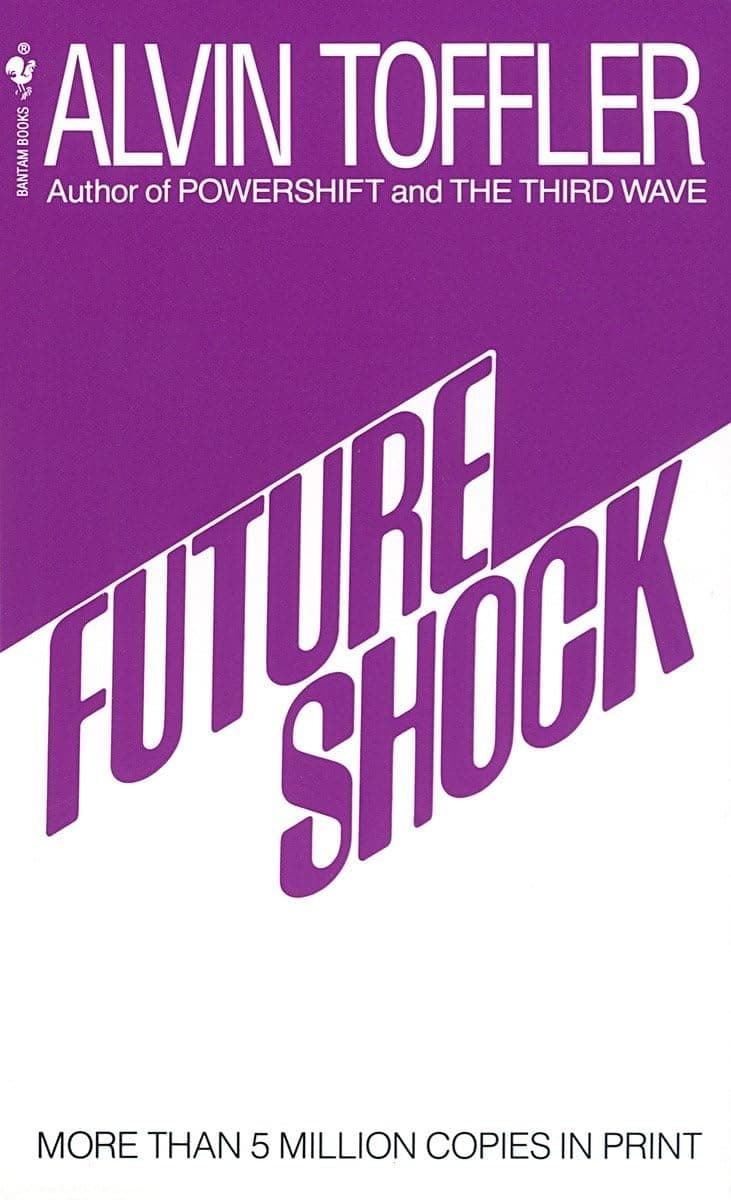
Future Shock [Toffler, Alvin] on desertcart.com. *FREE* shipping on qualifying offers. Future Shock Review: FUTURE SHOCK!!! - A 'GREAT", READ.. LOVE THIS BOOK!!!! Review: Great commentary, eminently readable - Hard to believe this was written 45 years ago. It was phenomenally prescient, and it still feels representative of the modern era and well-positioned to predict the future. Toffler's premise that the accelerating rate of social change (including ever-greater transcience, novelty, and diversity) is outpacing man's ability to cope comes with a dour imperative: adapt or die. We, as individuals and as a civilization, need to understand "the accelerative thrust triggered by man has become the key to the entire evolutionary process on the planet," and Toffler suggests we need to seize control over the rapid waves of change headed our way before they overtake us. Sadly, society does not yet seem to have heeded Toffler's calls to action, and much of our lives are filled with idle, ephemeral distraction while the ground shifts beneath our feet. Climate change science was not as abundant or conclusive in the early 1970s as it is today, so while they're no mention of it in the book (it's also a natural phenomenon, while Toffler focuses on the accelerative thrust of tech), it is a perfect example of how humans need to be more future-oriented and prepared for massive change. Toffler's writing is well-researched and fast-paced. It reads almost like an action thriller. His descriptions of the accelerative wave of change sweeping through society actually made me anxious as I read--today the force of change is almost tangible; you can feel its pressure everywhere you turn, with all of the complex decisions we're faced with and the new information we're required to process on a daily basis. I'm sure Toffler would find it ironic that I was speed-reading his book--with so much to keep up with, I feel there's no time to read at a leisurely pace anymore. I appreciated Toffler's self-criticism throughout. He acknowledges that no single idea is "omni-insightful" and that, while some of his suggestions for solutions may appear naive, such as transforming our economy to pay more attention to social and environmental welfare, they are also critical to the survival of the human race. Do not underestimate Future Shock. Its message is clearly a driving force behind Ray Kurzweil's "The Singularity Is Near"; billionaire Carlos Slim identified it as a key resource that helped him anticipate the future. If you're fascinated by culture and want to understand the strange, fast-paced compression of modern life, this book is essential.


| Best Sellers Rank | #61,703 in Books ( See Top 100 in Books ) #11 in Customs & Traditions Social Sciences #113 in Evolution (Books) |
| Customer Reviews | 4.6 out of 5 stars 836 Reviews |
E**R
FUTURE SHOCK!!!
A 'GREAT", READ.. LOVE THIS BOOK!!!!
A**G
Great commentary, eminently readable
Hard to believe this was written 45 years ago. It was phenomenally prescient, and it still feels representative of the modern era and well-positioned to predict the future. Toffler's premise that the accelerating rate of social change (including ever-greater transcience, novelty, and diversity) is outpacing man's ability to cope comes with a dour imperative: adapt or die. We, as individuals and as a civilization, need to understand "the accelerative thrust triggered by man has become the key to the entire evolutionary process on the planet," and Toffler suggests we need to seize control over the rapid waves of change headed our way before they overtake us. Sadly, society does not yet seem to have heeded Toffler's calls to action, and much of our lives are filled with idle, ephemeral distraction while the ground shifts beneath our feet. Climate change science was not as abundant or conclusive in the early 1970s as it is today, so while they're no mention of it in the book (it's also a natural phenomenon, while Toffler focuses on the accelerative thrust of tech), it is a perfect example of how humans need to be more future-oriented and prepared for massive change. Toffler's writing is well-researched and fast-paced. It reads almost like an action thriller. His descriptions of the accelerative wave of change sweeping through society actually made me anxious as I read--today the force of change is almost tangible; you can feel its pressure everywhere you turn, with all of the complex decisions we're faced with and the new information we're required to process on a daily basis. I'm sure Toffler would find it ironic that I was speed-reading his book--with so much to keep up with, I feel there's no time to read at a leisurely pace anymore. I appreciated Toffler's self-criticism throughout. He acknowledges that no single idea is "omni-insightful" and that, while some of his suggestions for solutions may appear naive, such as transforming our economy to pay more attention to social and environmental welfare, they are also critical to the survival of the human race. Do not underestimate Future Shock. Its message is clearly a driving force behind Ray Kurzweil's "The Singularity Is Near"; billionaire Carlos Slim identified it as a key resource that helped him anticipate the future. If you're fascinated by culture and want to understand the strange, fast-paced compression of modern life, this book is essential.
B**K
Must Reading For Any Concerned Citizen!
It is a pleasant surprise to see that this book has been reissued as a hardcover. In the thrity years since its original publication, the basic truths and awesome prognositications have largely come to pass. Of course, in the process Mr. Toffler has become something of a cottage industry himself, since publishing several sequels (The Third Wave, Power Shift, etc.). Yet nothing surpasses the sheer magnitude of the argument forwarded here. Toffler marshalls a virtual mountain of evidence illustrating his claim of a rising flood of techniological, social, and economic change, largely emanating from the increasing influence of science and technology into every area of contemporary life. Toffler's main concern is with the recognition that while a human being's capacity to adjust physically, psychologically, and socially to this torrent of change is finite and quite limited, the pace of change is increasing and expanding into more and more areas of individuals' lives. Moreover, no one is asking for these profound and endless changes; they stem more from the economic impulses of the marketplace than from any kind of consumer demand, and perhaps we should be asking to what extent this flood of innovations actually enhances our lives, and personal convenience associated with all these innovations and technological improvements are worth the social, economic, and political change that follows in its wake. The term "future shock" refers to what happens when people are no longer able to cope with the pace of change. All sorts of symptoms and maladies results, ranging from depression to bizarre behavior to increases in susceptability to disease to absolute emotional breakdown. Thus, Toffler accurately anticipated many of the sorts of psychological, social, and economic maldies and turbulence of the last thirty years. Yet, to date literally no one seems to pay much heed to his thesis, or to ask what it means for the quality of life in our own futures. This is an important book raising critical and fundamental questions about the social, economic, and political impacts of technologically-induced innovations within contemporary society and the way they are flooding uncontested and unhampered into our social environment. This is a must-read for any serious student of social science.
D**D
Interesting - but not sure the shock really ever happened
Interesting book. I remember my dad reading this book when I was little. I bought it at the recommendation of a colleague. There are some interesting theories in the book, especially looking back to see how some of them played out. I am not sure that the "shock, distress, and overload" that Toffler predicted has come about. His theory that there will be immense changes based on technological and other advancements was not a far reach. However, his prediction that society will ultimately not be able to adapt to, process, or manage al the new capabilities and the changes that they bring may not be wholly accurate. The shock seems to be more on the older generation (for example, not understanding how the younger generation will communicate by text rather than spoke word, even within direct proximity to each other) and the overload also seems to be on the older generation (watching some seniors try to program a GPS can be interesting), but the younger generation seems to be processing and adopting very well. In my generation, one was hard pressed to get to typing 60 words per minute in a typing class, focusing on one paragraph within one single subject - yet the technology of today has taught small children to type just as quickly while managing multiple conversations at one time. There are some good lessons to consider in this book, so it's not a waste of time to read.
C**A
Incredible Book, Incredible Ideas
This book is timeless. What Toffler said will happen, DID happen and it is still unfolding to this day. This book deals with what happens when we come face to face with the future that we thought was decades away, but was only years, months, and weeks away. Technology has made our world advance in a geometric progression, and our reaction to it is presented by Toffler. The book and its concepts are as true now as they were when the book first came out. I purchased it then, and thoroughly enjoyed it, but lost my copy of the book. I needed this for a research paper for grad school, so I bought it again. It was worth the money and the time spent on reading it all again. The concepts are as applicable today, if not more so, than when Toffler's book first came out because you can see how right he was about everything. It has tremendous implications for the future. Fantastically timeless book! You won't be disappointed.
G**G
The Shocking Future: Are you becoming Obsolete?
This is a visionary work of literature, that was written in 1970. What is amazing is the realities of today that this author has so accurately captured 40 years ago. The book anticipated what we are facing today, an accelerated rate of changes in technology. Every couple of months, as you may now be aware, CPU chip speeds in desktop and laptop computers keep increasing. Staying on the cutting edge of technology is almost a full-time job. Next we are faced with an ever-changing cellular phone and MP3 player product range. Now, even the way we read books is changing with things like the ipad and the kindle. Where will this all end? Do we have to keep running just to keep pace with what's happening? The Internet and the dramatic impact that this has made, may not even have been fully envisioned by this author, but it is here and evolving at its own rate, making the earth a global village. Mr. Toffler attacks this problem in Six Parts as follows: - The Death of Permanence - Transience - Novelty - Diversity - The Limits of Adaptability - Strategies for Survival In the end, each of us must formulate our own strategies for this rapidly and ever changing world that we now live in. This author, has given some clinical and effective methods that we can tailor to our own personal situation. We must all continue to adjust or run the risk of being left behind and becoming 'obsolete'.
J**N
Wide view, quite good
The author bridges at least 5 disciplines..modern history, sociology, consumer product development, personal stress management and critic (in this case, of schools). Plus those predictions. Too many for most readers, that said, he was one of the first to call out the school system and explained how we would learn in the future..and for these reasons alone, this book has merit. Still, could have cited the 'changes' as nothing more than (continued) modern stress, where we live in a slave-like state. Most people under 50 adapted pretty smoothly to the 'changes', it was the older folk who struggled in the post-1970 era. To hearing young-ins music, to new tech, to more traffic..
K**E
Upgrade!
I bought this edition for my brother as I lost the one I borrowed from him. He was super impressed with the quality of the binding and was really happy I lost his. Upgrade!
Trustpilot
Hace 5 días
Hace 2 días