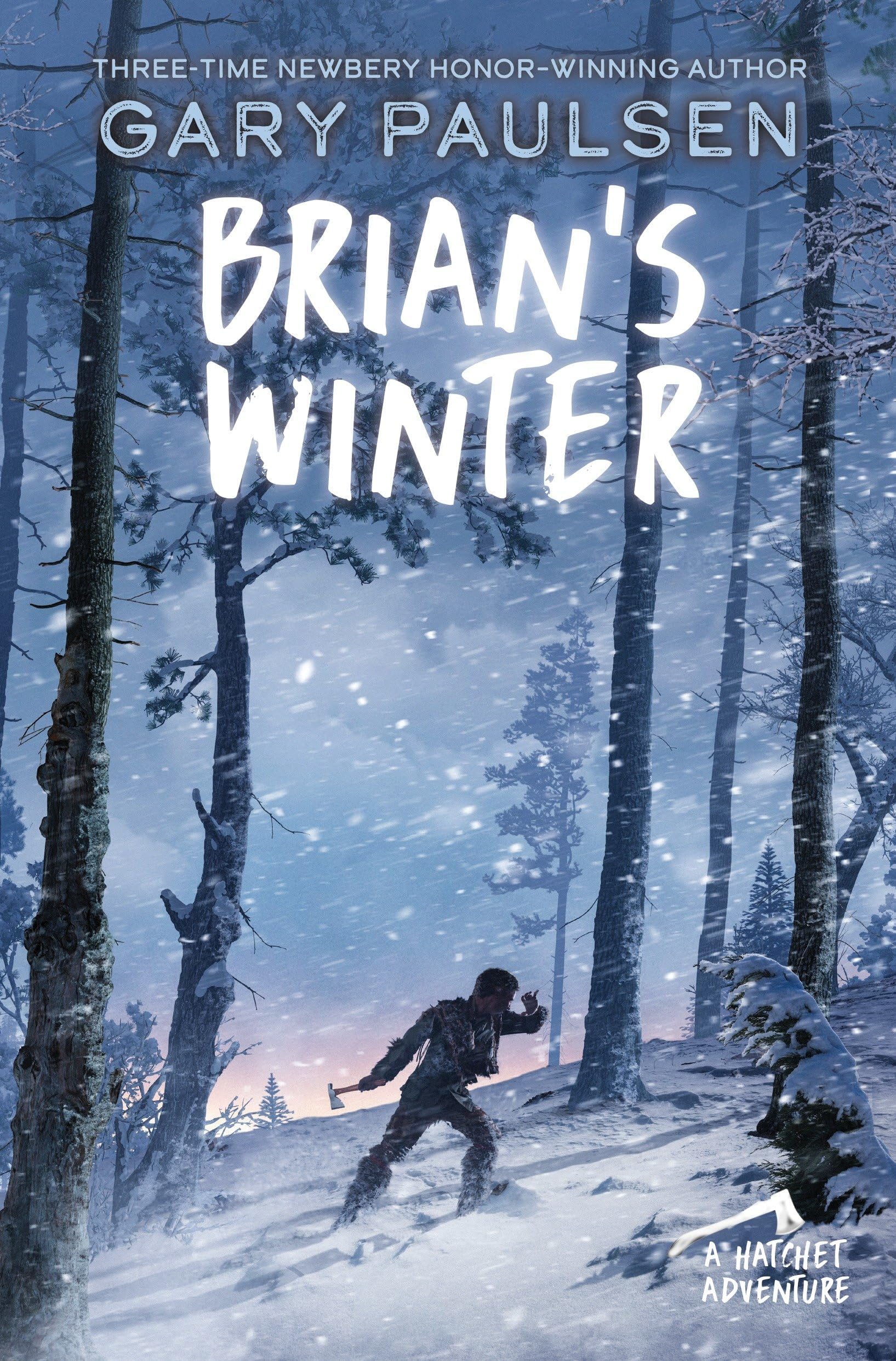
Brian's Winter
Product ID: 3683617
Buy anything from 5,000+ international stores. One checkout price. No surprise fees. Join 2M+ shoppers on Desertcart.
Desertcart purchases this item on your behalf and handles shipping, customs, and support to Uruguay.
From three-time Newbery Honor-winning author Gary Paulsen comes a beloved follow-up to his award-winning classic Hatchet that asks: What if Brian hadn't been rescued and had to face his deadliest enemy yet--winter? In the Newbery Honor-winning Hatchet , thirteen-year-old Brian Robeson learned to survive alone in the Canadian wilderness, armed only with his hatchet. As millions of readers know, he was rescued at the end of the summer. But what if that hadn't happened? What if Brian had been left to face his deadliest enemy--winter? Brian Paulsen raises the stakes for survival in this riveting and inspiring story as one boy confronts the ultimate adventure. “Paulsen picks Hatchet’s story up in midstream; read together, the two books make his finest tale of survival yet.” — Kirkus Reviews , Starred “Breathtaking descriptions of nature . . . Paulsen fans will not be disappointed.” — School Library Journal Read all the Hatchet Adventures! Brian's Winter The River Brian's Return Brian's Hunt Review: Outstanding woods lore and llfe lessons - Review - The Brain Sagas by Gary Paulsen I have now finished all five of the Brian Sage books - “Hatchet,” “The River,” “Brian’s Winter,” “Brian's Return” and “The Hunt.” and the epilogue “Guts” by Gary Paulsen. “The Hatchet” is one of three Newberry Awards that Gary Paulsen has earned. Basically the series is one story. The story of an teenage boy who at age 13 is left alone in the North Woods of Canada due to a pilot’s fatal heart attack and plane wreck. The first book, “The Hatchet” tells of the guts, intelligence, patience and luck of a 13 year old boy with little wilderness experience in learning how to live and survive in a remote wilderness. We get a marvelous set of instructions in wilderness lore and living, and a glimpse into an intelligent mind that problem solves, learns and masters a strange world. At the end of this book Brian retrieves a signal radio from the submerged plane and is rescued. In “Brian’s Winter” is an alternate ending. Brian is not rescued, but manages to learn more and survive into December. We see more of Brian’s talents and abilities and new found skills. Here, Brian stumbles into a family of Cree Native Americans manning a trap line, who take him in. Brian flies out on the next supply place. The Cree family consider him like one of the “old people” for Brian is dressed in skins he has captured and his arrows have stone points he has made himself. Yes, some of the story is very fortuitous for Brian, but that does not distract from the lessons of the wilderness and the lessons of life Brian has to learn to survive. “The River” is a book with Brian returning to the North Woods with a psychologist, Derek, of the military attempting to learn how to teach survival to the military. The man is not schooled in the wilderness at all, and Brian become “the adult” in charge of the adventure. Brian sends the 200 pounds of supplies back with the plane that flew them in, and commences to recreate the world he knew in the first two books. Half the book is a terrifying trip over 100 miles, 3+ days, down a river, its rapids, lakes and swamps, with Derek unconscious on a wilderness made raft. We get a first hand look at the guts necessary to achieve this. Again, the manage to make a trapper’s cabin and are rescued. In “Brian’s Return” we see Brian not fitting back into civilization, 15 - 16 year old’s school and society. Brian has adjusted to the Wilderness, and that is the reality he much prefers. Brian takes along a few supplies an d does very well. In “The Hunt” Brian is back in the North Woods learning more woods lore and ways. By now he is nearly a expert. Brian finds an old man, Billy, in his camp one evening. Billy and Brian share a mutual evening of silent communication and while few words are exchanged, Brian gains “medicine.”’ In respect, Billy, leaving camp very early before Brian is awake, leaves a amulet of white tail deer fur and crow’s feathers for Brian. Brian recognizes the significance of this and immediately hangs it around his neck. Shortly thereafter, Brian and a wounded dog find each other. It turns out the dog belonged to the Cree Family Brian had met in “Brian’s Winter.” Unfortunately, a bear had devastated the cabin and family of the Cree family , killing two members of that family. Brian rescues the wife, buries the dead, and deals with the stoic, bureaucratic officials. Once they leave, Brian hunts and in a wonderful scene - which I will not spoil - kills the bear. “Guts” is stories from Gary Paulsen’s life, rough childhood, adventures in Minnesota, Canada, the American South West, Colorado. These episodes Gary wove into Brian’s Story - a story beautifully and touchingly told. Gary’s knowledge and actual experiences gave him the insight to write the Brian Saga. Not only is the woods lore appropriately, accurately and well handled, but the changes that the North Woods induces in Brian are well followed. The books are at once a deep lesson in both survival and in life. We learn much about wilderness living. But we also are treated to the contrasts of life in the city and in the Wilderness. Due a few violent scenes, this series should not be read by youth under 13 or so. Death is a part of life, and life is an endless living with what is there. It takes “guts”, perseverance, and patience, to achieve what Brian achieved, and that is the real message of these books. Life takes Real Guts,lots of perseverance, and lots of patience. The books read very well. The stories are well told. The reading level is at least 8th grade. And for those with an interest in Nature and the Wilderness, be it North Woods, SW desert or ocean, the lessons apply. I found the reading to be extremely enjoyable, and the lessons deep and well taught without being preachy. A great series of books. Review: A superlative read! - The five novels that make up the "Hatchet" series by Gary Paulsen are among the most profoundly sad books I have ever read. Providing specific reasons why I think this would create spoilers, so I must tiptoe carefully through these woods. Hatchet: 20th Anniversary Edition was the first, but written as a single book. Reader response was so powerful that Paulsen wrote one, then two, and finally four more books about Brian Robeson and his multiple sojourns in the Canadian wilderness. In "Hatchet" Brian has no choice--the two-passenger airplane is crash-landed and Brian begins his terribly difficult first stay during which he learns how to survive whatever the wilderness brings "Brian's Winter" is the third book written in the series but second in chronology. Instead of being rescued (not a spoiler--surely the reader surmises a rescue if there are more books), Brian simply continues his unplanned stay with readers willingly, cheerfully going along with Paulsen's intent. After all, it was reader demand that caused Paulsen to write a continuation. Winter brings a whole new set of problems and life view for Brian, who learns to live by his brain, along with his brawn. How to create weapons for hunting--for Brian, the hunt for food is everything, the only thing for all animals--and how to listen and be aware of everything. His teacher is the wolf, who travels its territory, periodically stopping to take assessment of its surroundings, to listen to and learn everything about those surroundings and what's in them. Out of the events of the novel, I want to describe two, one utterly fascinating, the other utterly horrifying. The fascinating occurrence was the natural explosion of trees. The outside bark and sap freeze at a certain temperature, then as the temperature continues to drop, the interior freezing. With nowhere inside to expand, the tree must explode where it freezes. Brian learns this the hard way. The other occurrence was the attack by a huge male moose, which becomes Brian's food supply for several weeks--think of the wilderness as a giant freezer. Oh, you think I just gave a spoiler? Not with two more books to come in the series! "Brian's Winter" is mesmerizing, even addictive. The reader wants to go with Brian, but through the comfort of an armchair and cozy surroundings (speaking for myself). What makes this series so compelling? I've thought considerably about this topic and decided there is more to it then the adventure/thriller/true life aspect (for in truth Paulsen has done everything Brian does). The most serious component of Brian's "adventure" is its permanent draw. After living deeply and "sucking the marrow" out of life (Henry David Thoreau in Walden (Concord Library) , a book I'm considering rereading now), Brian finds city life stultifying. No, I won't say more. However, the series reminded me of two other writers: Jack London and Ernest Hemingway, London for his wilderness stories and Hemingway for his deliberate manner of writing about the things men do. An amusing footnote is that Paulsen calls London's understanding of the wilderness as "silliness." Each of the five novels treats the themes of survival, living deliberately, staying close to nature and learning from her, but also each introduces a separately different theme. In the last, Brian's Hunt , the author examines that tight bond between man and dog. Which book is best? I cannot choose. I enjoyed them all--immensely. So why did I call the books "profoundly sad"? Brian is forever changed because of those forced 54 days in the wilderness and finds that life lived outside the wilderness is not worth living. Paulsen's descriptions of both city life and wilderness life are compelling. Even though the reader may not (probably not) choose wilderness, he/she at least has a vague outsider's understanding of why someone would choose such a life. Paulsen himself did. A last comment: Technically, the books are classified as books for older children, but I find they have much to offer adults, thus defying classification (as with any great book). This series is a genuinely profound reading experience for all ages. Note: The books in published order are: Hatchet: 20th Anniversary Edition "The River" (not found on desertcart reasonably priced) Brian's Winter Brian's Return Brian's Hunt



| Best Sellers Rank | #5,101 in Books ( See Top 100 in Books ) #4 in Teen & Young Adult Fiction about Self Esteem & Reliance #13 in Science & Technology for Teens (Books) #20 in Teen & Young Adult Survival Stories |
| Customer Reviews | 4.8 out of 5 stars 4,354 Reviews |
G**R
Outstanding woods lore and llfe lessons
Review - The Brain Sagas by Gary Paulsen I have now finished all five of the Brian Sage books - “Hatchet,” “The River,” “Brian’s Winter,” “Brian's Return” and “The Hunt.” and the epilogue “Guts” by Gary Paulsen. “The Hatchet” is one of three Newberry Awards that Gary Paulsen has earned. Basically the series is one story. The story of an teenage boy who at age 13 is left alone in the North Woods of Canada due to a pilot’s fatal heart attack and plane wreck. The first book, “The Hatchet” tells of the guts, intelligence, patience and luck of a 13 year old boy with little wilderness experience in learning how to live and survive in a remote wilderness. We get a marvelous set of instructions in wilderness lore and living, and a glimpse into an intelligent mind that problem solves, learns and masters a strange world. At the end of this book Brian retrieves a signal radio from the submerged plane and is rescued. In “Brian’s Winter” is an alternate ending. Brian is not rescued, but manages to learn more and survive into December. We see more of Brian’s talents and abilities and new found skills. Here, Brian stumbles into a family of Cree Native Americans manning a trap line, who take him in. Brian flies out on the next supply place. The Cree family consider him like one of the “old people” for Brian is dressed in skins he has captured and his arrows have stone points he has made himself. Yes, some of the story is very fortuitous for Brian, but that does not distract from the lessons of the wilderness and the lessons of life Brian has to learn to survive. “The River” is a book with Brian returning to the North Woods with a psychologist, Derek, of the military attempting to learn how to teach survival to the military. The man is not schooled in the wilderness at all, and Brian become “the adult” in charge of the adventure. Brian sends the 200 pounds of supplies back with the plane that flew them in, and commences to recreate the world he knew in the first two books. Half the book is a terrifying trip over 100 miles, 3+ days, down a river, its rapids, lakes and swamps, with Derek unconscious on a wilderness made raft. We get a first hand look at the guts necessary to achieve this. Again, the manage to make a trapper’s cabin and are rescued. In “Brian’s Return” we see Brian not fitting back into civilization, 15 - 16 year old’s school and society. Brian has adjusted to the Wilderness, and that is the reality he much prefers. Brian takes along a few supplies an d does very well. In “The Hunt” Brian is back in the North Woods learning more woods lore and ways. By now he is nearly a expert. Brian finds an old man, Billy, in his camp one evening. Billy and Brian share a mutual evening of silent communication and while few words are exchanged, Brian gains “medicine.”’ In respect, Billy, leaving camp very early before Brian is awake, leaves a amulet of white tail deer fur and crow’s feathers for Brian. Brian recognizes the significance of this and immediately hangs it around his neck. Shortly thereafter, Brian and a wounded dog find each other. It turns out the dog belonged to the Cree Family Brian had met in “Brian’s Winter.” Unfortunately, a bear had devastated the cabin and family of the Cree family , killing two members of that family. Brian rescues the wife, buries the dead, and deals with the stoic, bureaucratic officials. Once they leave, Brian hunts and in a wonderful scene - which I will not spoil - kills the bear. “Guts” is stories from Gary Paulsen’s life, rough childhood, adventures in Minnesota, Canada, the American South West, Colorado. These episodes Gary wove into Brian’s Story - a story beautifully and touchingly told. Gary’s knowledge and actual experiences gave him the insight to write the Brian Saga. Not only is the woods lore appropriately, accurately and well handled, but the changes that the North Woods induces in Brian are well followed. The books are at once a deep lesson in both survival and in life. We learn much about wilderness living. But we also are treated to the contrasts of life in the city and in the Wilderness. Due a few violent scenes, this series should not be read by youth under 13 or so. Death is a part of life, and life is an endless living with what is there. It takes “guts”, perseverance, and patience, to achieve what Brian achieved, and that is the real message of these books. Life takes Real Guts,lots of perseverance, and lots of patience. The books read very well. The stories are well told. The reading level is at least 8th grade. And for those with an interest in Nature and the Wilderness, be it North Woods, SW desert or ocean, the lessons apply. I found the reading to be extremely enjoyable, and the lessons deep and well taught without being preachy. A great series of books.
J**S
A superlative read!
The five novels that make up the "Hatchet" series by Gary Paulsen are among the most profoundly sad books I have ever read. Providing specific reasons why I think this would create spoilers, so I must tiptoe carefully through these woods. Hatchet: 20th Anniversary Edition was the first, but written as a single book. Reader response was so powerful that Paulsen wrote one, then two, and finally four more books about Brian Robeson and his multiple sojourns in the Canadian wilderness. In "Hatchet" Brian has no choice--the two-passenger airplane is crash-landed and Brian begins his terribly difficult first stay during which he learns how to survive whatever the wilderness brings "Brian's Winter" is the third book written in the series but second in chronology. Instead of being rescued (not a spoiler--surely the reader surmises a rescue if there are more books), Brian simply continues his unplanned stay with readers willingly, cheerfully going along with Paulsen's intent. After all, it was reader demand that caused Paulsen to write a continuation. Winter brings a whole new set of problems and life view for Brian, who learns to live by his brain, along with his brawn. How to create weapons for hunting--for Brian, the hunt for food is everything, the only thing for all animals--and how to listen and be aware of everything. His teacher is the wolf, who travels its territory, periodically stopping to take assessment of its surroundings, to listen to and learn everything about those surroundings and what's in them. Out of the events of the novel, I want to describe two, one utterly fascinating, the other utterly horrifying. The fascinating occurrence was the natural explosion of trees. The outside bark and sap freeze at a certain temperature, then as the temperature continues to drop, the interior freezing. With nowhere inside to expand, the tree must explode where it freezes. Brian learns this the hard way. The other occurrence was the attack by a huge male moose, which becomes Brian's food supply for several weeks--think of the wilderness as a giant freezer. Oh, you think I just gave a spoiler? Not with two more books to come in the series! "Brian's Winter" is mesmerizing, even addictive. The reader wants to go with Brian, but through the comfort of an armchair and cozy surroundings (speaking for myself). What makes this series so compelling? I've thought considerably about this topic and decided there is more to it then the adventure/thriller/true life aspect (for in truth Paulsen has done everything Brian does). The most serious component of Brian's "adventure" is its permanent draw. After living deeply and "sucking the marrow" out of life (Henry David Thoreau in Walden (Concord Library) , a book I'm considering rereading now), Brian finds city life stultifying. No, I won't say more. However, the series reminded me of two other writers: Jack London and Ernest Hemingway, London for his wilderness stories and Hemingway for his deliberate manner of writing about the things men do. An amusing footnote is that Paulsen calls London's understanding of the wilderness as "silliness." Each of the five novels treats the themes of survival, living deliberately, staying close to nature and learning from her, but also each introduces a separately different theme. In the last, Brian's Hunt , the author examines that tight bond between man and dog. Which book is best? I cannot choose. I enjoyed them all--immensely. So why did I call the books "profoundly sad"? Brian is forever changed because of those forced 54 days in the wilderness and finds that life lived outside the wilderness is not worth living. Paulsen's descriptions of both city life and wilderness life are compelling. Even though the reader may not (probably not) choose wilderness, he/she at least has a vague outsider's understanding of why someone would choose such a life. Paulsen himself did. A last comment: Technically, the books are classified as books for older children, but I find they have much to offer adults, thus defying classification (as with any great book). This series is a genuinely profound reading experience for all ages. Note: The books in published order are: Hatchet: 20th Anniversary Edition "The River" (not found on Amazon reasonably priced) Brian's Winter Brian's Return Brian's Hunt
C**H
Very good read about a young person surviving in the wilderness during extremely cold winter.
I really enjoyed this book as a 50 something adult reader. While I didn’t grow up literally in the woods (thank goodness) I did grow up in a place where we used wood stoves to heat our home, and my dad (and my mom) hunted (and later prepped) deer annually for extra meat for winter. I can tell the author knows his stuff and that really makes the whole book more believable.. I understand a lot of his descriptions and they are based on understanding rather than just imagination. Great writer. There was only one page I had a hard time with and that was regarding a wolf packs surprise attack on a moose. That was hard to read. That was later in book and parents might want to read it first ? But I really like this author and plan to continue to read his work.
J**H
Winter Wilderness That Keeps Him Turning Pages
Brian’s Winter was another home run in our house. My son, who’s never been a big reader, has completely latched onto this series—and this book in particular pulled him in even deeper. The survival story takes a colder, harsher turn, and somehow that made it even more gripping for him. The pacing is tight, the challenges feel real, and Brian’s resilience in the face of brutal winter conditions kept my son glued to the pages. He was fascinated by how Brian adapts, learns, and survives in a world that’s unforgiving. It’s not just a story—it’s a lesson in grit and resourcefulness. What’s amazing is that my son, who usually avoids books, actually asked to read this one again. That’s never happened before. If you’ve got a boy who struggles to find joy in reading, this book might be the spark that changes everything. It’s exciting, relatable, and written in a way that makes even reluctant readers feel like they’re part of the adventure. Brian’s Winter isn’t just a continuation—it’s a deeper dive into what makes this series so special. Highly recommended for any young reader who needs a reason to fall in love with books.
J**L
Loved this writer
Bought this book for my daughter because she loves reading books by this author, especially within this series of books.
J**N
Great
Really good book
X**T
That aurafarmers are the true rizzlers of the sigma alpha chads.
This book is goated bruh. I like how Brian eats, it makes me hungry too.
U**R
Good, engaging and realistic survival story suitable for younger readers
My 10 year old son was reading this series. I am a Jack London fan and had heard this author compared to him so I thought I would read it, out of curiosity for the story and also to make sure I thought it was suitable for my kid to read. The setting and story are indeed similar to many of London's stories, set in the arctic north with the protagonist fighting the elements to eke out survival. The story is aimed at 10-14 year old readers and that is the age of the protagonist. I thought it was realistic and gritty enough to be believable but without being too violent, sort of a "Jack London lite". The story moves along well and without any spoilers let's just say that the ending wasn't as brutally uncompromising as many of London's stories which I think is good for young readers. The story touches briefly on some difficult topics such as the boy witnessing death, the boy's parents being separated due to an affair and the boy briefly considering suicide. I thought it appropriate to include these topics in the story, and it was done tastefully and without undue violence (drastically less violence than kids see in a typical movie or tv show). Children of this age face these topics in real life, and putting them in a story allows them to think about them and discuss them with parents and teachers.
K**C
Great book for boys and girls both my brother and me are reading Gary Paulson books!!!!!
I really don't know what to say but I would say keep make more books of the hatchet series!! Thanks!
だ**ち
多読に最適
Hachetのシリーズを3冊読みましたが、どれもほとんどブライアン独りの活動なのでわかりやすく読みやすいです。多読でとにかくどんどん読むんだという人にはお勧めです。 ストーリーはもう少し冬の寒さや餓えに耐える描写があるのかと思っていたのですが、すんなりと越冬してしまいます。話の展開や面白さは、hachet やriver の方がよかったと思います。
L**N
Amazing!!!
These books are sooo goooood! 🤩 It's really hard to find good survival stories where I actually feel, really feel the longing to be part of nature despite dangers and hardships being present in the tale in a realistic manner. One of my favorite authors, none of the books in this series is bad!
D**.
Fue lo que pedí
Excelente
M**N
Brilliant writer, brilliant boiok
Brilliant writer, brilliant boiok. Coiuldn't put it down. It's being passed round the rest of my family and they are all enjoying it immensely.
Trustpilot
2 weeks ago
2 months ago