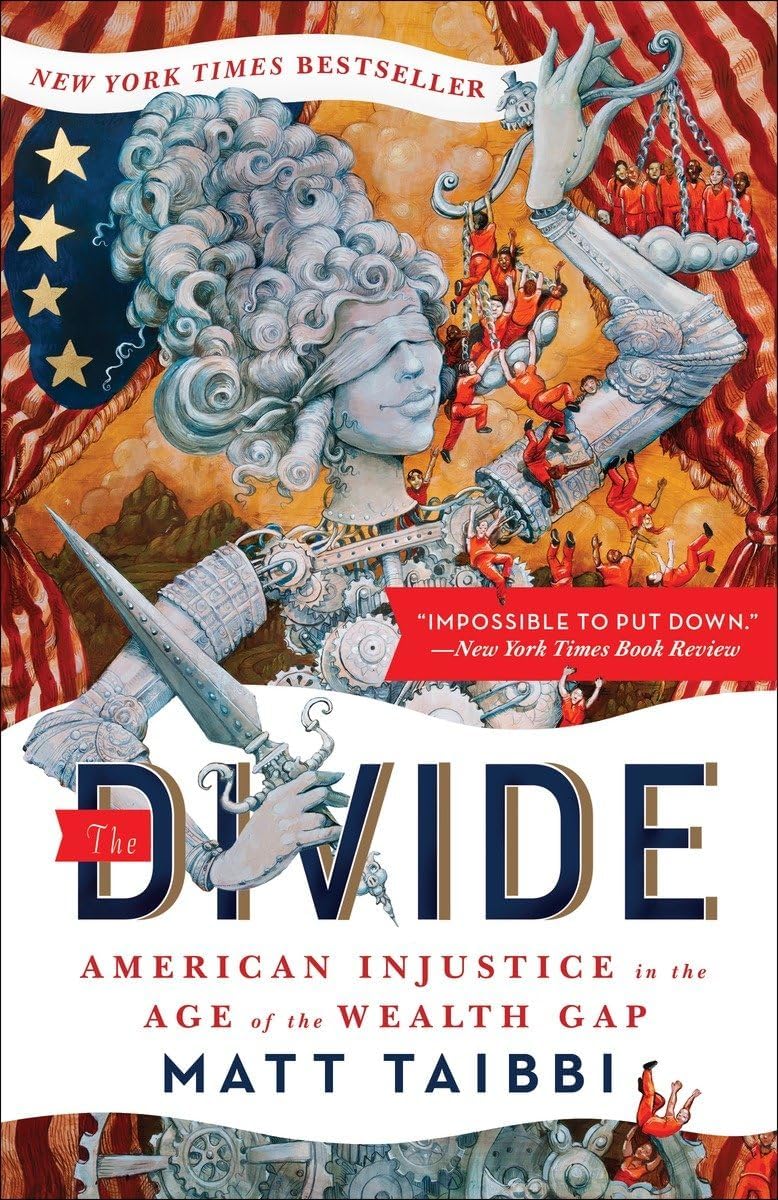
The Divide: American Injustice in the Age of the Wealth Gap
Product ID: 8144436
Buy anything from 5,000+ international stores. One checkout price. No surprise fees. Join 2M+ shoppers on Desertcart.
Desertcart purchases this item on your behalf and handles shipping, customs, and support to Uruguay.
NEW YORK TIMES BESTSELLER • NAMED ONE OF THE BEST BOOKS OF THE YEAR BY THE WASHINGTON POST, NPR, AND KIRKUS REVIEWS A scathing portrait of an urgent new American crisis Over the last two decades, America has been falling deeper and deeper into a statistical mystery: Poverty goes up. Crime goes down. The prison population doubles. Fraud by the rich wipes out 40 percent of the world’s wealth. The rich get massively richer. No one goes to jail. In search of a solution, journalist Matt Taibbi discovered the Divide, the seam in American life where our two most troubling trends—growing wealth inequality and mass incarceration—come together, driven by a dramatic shift in American citizenship: Our basic rights are now determined by our wealth or poverty. The Divide is what allows massively destructive fraud by the hyperwealthy to go unpunished, while turning poverty itself into a crime—but it’s impossible to see until you look at these two alarming trends side by side. In The Divide, Matt Taibbi takes readers on a galvanizing journey through both sides of our new system of justice—the fun-house-mirror worlds of the untouchably wealthy and the criminalized poor. He uncovers the startling looting that preceded the financial collapse; a wild conspiracy of billionaire hedge fund managers to destroy a company through dirty tricks; and the story of a whistleblower who gets in the way of the largest banks in America, only to find herself in the crosshairs. On the other side of the Divide, Taibbi takes us to the front lines of the immigrant dragnet; into the newly punitive welfare system which treats its beneficiaries as thieves; and deep inside the stop-and-frisk world, where standing in front of your own home has become an arrestable offense. As he narrates these incredible stories, he draws out and analyzes their common source: a perverse new standard of justice, based on a radical, disturbing new vision of civil rights. Through astonishing—and enraging—accounts of the high-stakes capers of the wealthy and nightmare stories of regular people caught in the Divide’s punishing logic, Taibbi lays bare one of the greatest challenges we face in contemporary American life: surviving a system that devours the lives of the poor, turns a blind eye to the destructive crimes of the wealthy, and implicates us all. Praise for The Divide “Ambitious . . . deeply reported, highly compelling . . . impossible to put down.” —The New York Times Book Review “These are the stories that will keep you up at night. . . . The Divide is not just a report from the new America; it is advocacy journalism at its finest.” —Los Angeles Times “Taibbi is a relentless investigative reporter. He takes readers inside not only investment banks, hedge funds and the blood sport of short-sellers, but into the lives of the needy, minorities, street drifters and illegal immigrants. . . . The Divide is an important book. Its documentation is powerful and shocking.” —The Washington Post “Captivating . . . The Divide enshrines its author’s position as one of the most important voices in contemporary American journalism.” — The Independent (UK) “Taibbi [is] perhaps the greatest reporter on Wall Street’s crimes in the modern era.” — Salon Review: It Will Take Your Breath Away - I have always believed in moral outrage at the injustice of being treated unfairly or unequally, that in the United States of America justice would always prevail, that forces of good would always win and the criminal would be punished. But what if it isn't true? How do you reconcile what you've always believed when it runs counter to reality? If anyone is capable of putting a reader into such cognitive turmoil it is author Mike Taibbi in his book, "Divide," where he reveals how the wealthy have gotten away with criminal behavior on a global scale, while the poor are punished for essentially being poor or a minority. Out of the greatest malfeasance in the history of the country, banks brought a global economy to its knees with its avarice. Yet not one of them were tried, or even charged, or even arrested. It marked a new wave of our criminal justice system pursuing expediency rather than justice. It was based on corporate and media appeal to save jobs that would have been destroyed through criminal indictment or conviction. Prosecutors rationalized their acquiescence through penalties that allowed the criminals to remain in charge and fines that did nothing to curb the criminal behavior of such banks as HSBC that actually laundered money for drug cartels. On the other hand, prosecutors strutted as politicians usually do when they brought to trial a family owned bank, Abacus FSB that actually acted within the law. There's also the other side of the coin. You're black and you're in New York City. You come to your home in Brooklyn from work at 1:00 a.m. and you are immediately arrested after you get out of the cab at your front door. The charge? Obstructing pedestrian traffic. Or, you are in your own Land Rover with a friend, and you are stopped at a red light on a major thoroughfare in the Bronx when you are suddenly yanked from your vehicle, handcuffed, and thrown into the back of a van that doesn't return to the precinct until it is filled with other suspects. You experience moral outrage. You are determined to prove your innocence, but your court-appointed attorney cannot comprehend that you want to plead not guilty. after all, didn't the judge enter the chamber announcing "We take Master Card, Visa and American Express"? The bail is set high enough that you cannot afford it and low enough that no bail bondsman will pay it. So you take off work and go back four or five times until the arresting cop finally shows up or doesn't show up at all and it is tossed out. The arrest may also prevent you from getting that job because you now have a record. You could also be on welfare living in San Diego where the welfare police can demand access to go through your drawers to see if there is underwear of someone from the opposite sex so they can accuse you of living with someone and take away your benefits. Maybe you will only have to explain why you own sexy panties when he lifts from the drawer with a pencil and questions who you're wearing this for. Taibbi's book is riveting. He reveals in stunning detail why we now have 6 million people in prison or on parole, a population larger than was ever imprisoned in Stalin's gulags. He illustrates how our justice system has become utterly contemptuous of the poor and terrified of the wealthy. If you are white and wealthy or even middle class, you cannot believe that this is actually the new United States of America. For you there is no outrage. This book will take your breath away. Review: Whatever your viewpoint, this book likely will change it. - You could bookend this with Christa Freeland's "Plutocrats." But where that recounts a lot of dry history and statistics interspersed with its revealing interviews, Taibbi isn't afraid to roll up his sleeves and go to the story. This is a book written with a wry sense of the absurd situations it details. Corruption at both the top and the bottom of our society. But to very, very different ends. Remember: this is the guy that went to the Florida "rocket docket" court, recording how thousands of people were stripped of their homes under the flimsiest pretexts, often with outright fabricated evidence. In "Divide" he goes again where the stories are: to Bed-Sty, the outer NYC boroughs, and the courts. And documents how miserably the system treats the disadvantaged. What you think you know from "Law And Order", believe it: you don't. Kafka himself couldn't improve on some of this. At one point Taibbi refers to all this as a "descent into madness." And after reading it, it's hard to argue with that. The "Divide" of course is cash. But this is no screed against "the rich." If that's what you think you've not read the book, or completely missed the point. To wit: if you commit a massive, white-collar crime, but you've got enough (i.e. near-infinite) cash, you're now too much trouble and risk to even indict, let alone prosecute. And if -- like me - you've wondered why none of the people who committed these global frauds on a massive scale have ever been prosecuted for any of it, this book gives you a detailed, compelling, and depressing answer. Taibbi points out most of us will never see any of this. Out of sight, out of mind. The poor are segregated away. And the corrupt wealthy never have to interact with any of the people who are so profoundly impacted by their frauds. These are the guys who ripped off us off, burned down our 401Ks, rigged Libor rates to line their own pockets with our mortgages. And then moved on to other cushy positions, presumably doing much the same. One review here (by someone who claims to have read all of 3 pages) complains about Taibbi's assertion of "a miserable few hundred bucks" collected by welfare cheats in San Diego. But let's be clear: Taibbi never suggests these people should be let off. But he does spend considerable ink contemplating for example, about the corrupt execs at institutions like HSBC. Execs who brazenly laundered money for the Iranians and the Sinaloa cartel. (They actually opened a special teller window to fit the boxes of cash that were brought in!) About how these guys got off scot-free with a fine paid by HSBC. And never even saw the inside of a courtroom. While people who buy those street dime bags that HSBC so thoughtfully enabled can spend years, or a lifetime, in prison. Lose their kids. Their right to vote. And then even if they do get out can't get a job. "A billion dollars or a billion days." Does that seem like "equal justice for all?" Not to me. Not to Taibbi. And it won't to you after you read this. Taibbi suggests a larger, deeper, and more sinister subtext. About what we claim to profess as a nation: due process, equal justice, simple fairness. Money and power have always had their sway of course. But the inescapable takeaway from this is that we've simply given up on these ideals; they're now just too much trouble. As a nation we no longer give a damn. That's the real divide. And the real outrage.
| Best Sellers Rank | #894,587 in Books ( See Top 100 in Books ) #323 in United States National Government #422 in Economic Conditions (Books) #686 in Sociology of Class |
| Customer Reviews | 4.6 out of 5 stars 1,675 Reviews |
E**R
It Will Take Your Breath Away
I have always believed in moral outrage at the injustice of being treated unfairly or unequally, that in the United States of America justice would always prevail, that forces of good would always win and the criminal would be punished. But what if it isn't true? How do you reconcile what you've always believed when it runs counter to reality? If anyone is capable of putting a reader into such cognitive turmoil it is author Mike Taibbi in his book, "Divide," where he reveals how the wealthy have gotten away with criminal behavior on a global scale, while the poor are punished for essentially being poor or a minority. Out of the greatest malfeasance in the history of the country, banks brought a global economy to its knees with its avarice. Yet not one of them were tried, or even charged, or even arrested. It marked a new wave of our criminal justice system pursuing expediency rather than justice. It was based on corporate and media appeal to save jobs that would have been destroyed through criminal indictment or conviction. Prosecutors rationalized their acquiescence through penalties that allowed the criminals to remain in charge and fines that did nothing to curb the criminal behavior of such banks as HSBC that actually laundered money for drug cartels. On the other hand, prosecutors strutted as politicians usually do when they brought to trial a family owned bank, Abacus FSB that actually acted within the law. There's also the other side of the coin. You're black and you're in New York City. You come to your home in Brooklyn from work at 1:00 a.m. and you are immediately arrested after you get out of the cab at your front door. The charge? Obstructing pedestrian traffic. Or, you are in your own Land Rover with a friend, and you are stopped at a red light on a major thoroughfare in the Bronx when you are suddenly yanked from your vehicle, handcuffed, and thrown into the back of a van that doesn't return to the precinct until it is filled with other suspects. You experience moral outrage. You are determined to prove your innocence, but your court-appointed attorney cannot comprehend that you want to plead not guilty. after all, didn't the judge enter the chamber announcing "We take Master Card, Visa and American Express"? The bail is set high enough that you cannot afford it and low enough that no bail bondsman will pay it. So you take off work and go back four or five times until the arresting cop finally shows up or doesn't show up at all and it is tossed out. The arrest may also prevent you from getting that job because you now have a record. You could also be on welfare living in San Diego where the welfare police can demand access to go through your drawers to see if there is underwear of someone from the opposite sex so they can accuse you of living with someone and take away your benefits. Maybe you will only have to explain why you own sexy panties when he lifts from the drawer with a pencil and questions who you're wearing this for. Taibbi's book is riveting. He reveals in stunning detail why we now have 6 million people in prison or on parole, a population larger than was ever imprisoned in Stalin's gulags. He illustrates how our justice system has become utterly contemptuous of the poor and terrified of the wealthy. If you are white and wealthy or even middle class, you cannot believe that this is actually the new United States of America. For you there is no outrage. This book will take your breath away.
S**F
Whatever your viewpoint, this book likely will change it.
You could bookend this with Christa Freeland's "Plutocrats." But where that recounts a lot of dry history and statistics interspersed with its revealing interviews, Taibbi isn't afraid to roll up his sleeves and go to the story. This is a book written with a wry sense of the absurd situations it details. Corruption at both the top and the bottom of our society. But to very, very different ends. Remember: this is the guy that went to the Florida "rocket docket" court, recording how thousands of people were stripped of their homes under the flimsiest pretexts, often with outright fabricated evidence. In "Divide" he goes again where the stories are: to Bed-Sty, the outer NYC boroughs, and the courts. And documents how miserably the system treats the disadvantaged. What you think you know from "Law And Order", believe it: you don't. Kafka himself couldn't improve on some of this. At one point Taibbi refers to all this as a "descent into madness." And after reading it, it's hard to argue with that. The "Divide" of course is cash. But this is no screed against "the rich." If that's what you think you've not read the book, or completely missed the point. To wit: if you commit a massive, white-collar crime, but you've got enough (i.e. near-infinite) cash, you're now too much trouble and risk to even indict, let alone prosecute. And if -- like me - you've wondered why none of the people who committed these global frauds on a massive scale have ever been prosecuted for any of it, this book gives you a detailed, compelling, and depressing answer. Taibbi points out most of us will never see any of this. Out of sight, out of mind. The poor are segregated away. And the corrupt wealthy never have to interact with any of the people who are so profoundly impacted by their frauds. These are the guys who ripped off us off, burned down our 401Ks, rigged Libor rates to line their own pockets with our mortgages. And then moved on to other cushy positions, presumably doing much the same. One review here (by someone who claims to have read all of 3 pages) complains about Taibbi's assertion of "a miserable few hundred bucks" collected by welfare cheats in San Diego. But let's be clear: Taibbi never suggests these people should be let off. But he does spend considerable ink contemplating for example, about the corrupt execs at institutions like HSBC. Execs who brazenly laundered money for the Iranians and the Sinaloa cartel. (They actually opened a special teller window to fit the boxes of cash that were brought in!) About how these guys got off scot-free with a fine paid by HSBC. And never even saw the inside of a courtroom. While people who buy those street dime bags that HSBC so thoughtfully enabled can spend years, or a lifetime, in prison. Lose their kids. Their right to vote. And then even if they do get out can't get a job. "A billion dollars or a billion days." Does that seem like "equal justice for all?" Not to me. Not to Taibbi. And it won't to you after you read this. Taibbi suggests a larger, deeper, and more sinister subtext. About what we claim to profess as a nation: due process, equal justice, simple fairness. Money and power have always had their sway of course. But the inescapable takeaway from this is that we've simply given up on these ideals; they're now just too much trouble. As a nation we no longer give a damn. That's the real divide. And the real outrage.
B**K
Eye-Opening
The Divide: American Injustice in the Age of the Wealth Gap by Matt Taibbi “The Divide” is an eye-opening book that paints a clear picture of what is the biggest divide in our society, the wealth gap. Investigative journalist Matt Taibbi takes the reader on a journey of social injustice. Through a series of heartbreaking stories, Taibbi clearly shows the impact that this divide has on our citizens from each perspective. This troubling 448-page book includes the following nine chapters: 1. Unintended Consequences, 2. Frisk and Stop, 3. The Man Who Couldn’t Stand Up, 4. The Greatest Bank Robbery You Never Heard Of, 5. Border Trouble, Part 1, 6. Border Trouble, Part 2, 7. Little Frauds, 8. Big Frauds, and 9. Collateral Consequences. Positives: 1. Engaging, well-written, well-researched book that is accessible to the masses. 2. Even handed, equal-opportunity critique. Taibbi has his style of writing that consists of passion, sharp tone, and very descriptive. His interviewees take center stage and help him tell a compelling story of social injustice. 3. An excellent and an important topic, inequality and how it is manifested. “We still have real jury trials, honest judges, and free elections, all the superficial characteristics of a functional, free democracy. But underneath that surface is a florid and malevolent bureaucracy that mostly (not absolutely, but mostly) keeps the rich and the poor separate through thousands of tiny, scarcely visible inequities.” 4. This book is about inequality shown through a series of real-life examples. Taibbi removes the fog and shows what is really happening. “We’re creating a dystopia, where the mania of the state isn’t secrecy or censorship but unfairness. Obsessed with success and wealth and despising failure and poverty, our society is systematically dividing the population into winners and losers, using institutions like the courts to speed the process. Winners get rich and get off. Losers go broke and go to jail. It isn’t just that some clever crook on Wall Street can steal a billion dollars and never see the inside of a courtroom; it’s that, plus the fact that some black teenager a few miles away can go to jail just for standing on a street corner, that makes the whole picture complete.” 5. The consequences of legislation. “Moreover, even within the United States there had been intentional, lobbied-for changes in corporate structure: the repeal of the Glass-Steagall Act, which had prevented the mergers of commercial banks, investment banks, and insurance companies (this repeal led to the creation of megafirms like Citigroup), and Supreme Court decisions rolling back bans on interstate banking (which led to a string of mergers, resulting in the formation of giant national banks like Wachovia and Bank of America). In the finance sector at least, these changes allowed companies to be more enormous and difficult to regulate than they ever had been before.” 6. Doesn’t mince words about financial fraud. “Specifically, this was a massive criminal fraud scheme, something akin to a giant counterfeiting operation, in which banks mass-produced extremely risky, low-quality subprime mortgages and with lightning-quick efficiency sold them off to institutional sucker-investors as highly rated AAA bonds. The hot potato game targeted unions, pension funds, and government-backed mortgage companies like Fannie Mae on the secondary market.” 7. A look at the infuriating stop-and-frisk abuse. “In 2011, the year before Tory got arrested, another year when exactly nobody on Wall Street was arrested for crimes connected to the financial crisis, New York City police stopped and searched a record 684,724 people. Out of those, 88 percent were black or Hispanic.” 8. An interesting and troubling look at the legal system in practice and how it applies to the poor. “Prosecutors won’t say so openly, but privately, they will admit that when their cases are weak, they drive their cases through this Lincoln Tunnel of a procedural loophole, dragging things out as long as possible to force a plea. It usually works.” 9. How the legal system applies to banks. “Big banks get caught committing crimes, at worst they pay a big fine. Instead of going to jail, a check gets written, and it comes out of the pockets of shareholders, not the individuals responsible.” 10. Taibbi makes a compelling argument that the most outrageous and damning behaviors are conducted in such a way that it’s too complex to define. “The real issue wasn’t legal or illegal? But seen or unseen? While some of the most dangerous behaviors in American big business were indeed against the law, they were often, more importantly, outside the law, executed in an undefined legal space, in darkness.” “You can’t police what you can’t see, and you can’t see in the dark.” 11. One of the best examples of outrageous, irresponsible behaviors of banks is illustrated through the Lehman story. “The creditors were thrust face-first into the immovable principle that underlies everything modern that Wall Street does: if a crime is complicated enough, and sanctified by enough “reputable” attorneys and accountants, then American law enforcement will inevitably be too slow or too weak to stop it.” 12. The compelling argument for a permanent oligarchical bailout state. “The deals the government and Wall Street worked out that weekend to save the likes of AIG, Goldman, Deutsche Bank, Morgan Stanley, and Merrill Lynch were unprecedented in their reach and political consequence, transforming America into a permanent oligarchical bailout state. This was, essentially, a formal merger of Wall Street and the U.S. government.” 13. A look at immigration. “(Gainesville) This small Georgia city is ground zero for enforcement of a ferocious federal immigration rule called 287(g) that essentially deputizes any and all state and local law enforcement officials to arrest undocumented aliens on behalf of the U.S. Immigration and Customs Enforcement agency (ICE).” “So the undocumented alien who kills a room full of Rotarians with an ax has a right to counsel, a phone call, and protection against improper searches. The alien caught crossing the street on his way to work has no rights at all.” 14. A look at the corrections industry. “The jailing-Hispanics business is the perfect mix of politics and profit. Companies like CCA donate generously to politicians everywhere, particularly at the state level. The firm has spent as much as $3.4 million lobbying in a single year and on average spends between $1 million and $2 million a year. Its lobbyists are everywhere, and in every major anti-immigrant bill, you can usually find a current or former CCA lobbyist lurking in the weeds somewhere. Arizona governor Jan Brewer, for instance, had two ex–CCA lobbyists on her staff helping write the legislation when she pushed through her notorious 1070 law, which essentially legalized racial profiling in the cause of catching illegal immigrants.” 15. One of the most disturbing tales in the annals of Wall Street, the Fairfax story. “The Fairfax fiasco is a tale of harassment on a grand scale, in which the cream of America’s corporate culture followed executives, burgled information from private bank accounts, researched the Canadians’ sexual preferences for blackmail purposes, broke into hotel rooms and left threatening messages, prank-called a cancer-stricken woman in the middle of the night, and even harassed the pastor of the staid Anglican church where the Canadian CEO worshipped on Sundays.” 16. Startling facts. “There are no real regulatory audits of hedge funds, and no government body checks hedge funds’ trades or verifies their claims. It even came out, in the famous Bernie Madoff case, that despite numerous complaints to the SEC over the years from reputable sources, nobody in the government even checked to make sure Madoff’s hedge fund even made trades at all. Madoff actually went more than thirteen years without making a single stock purchase and yet somehow survived several SEC investigations—that’s how flimsy government regulation of hedge funds has been and still is.” 17. A look at programs such as Project 100% (P100) that investigated welfare fraud cases. “P100 generates, by the thousand, stories that sound like testimonials culled from refugees of some distant, low-rent, third-world despotate. The stories are terrible, humiliating, abusive.” “So the standard is, anyone who receives aid from taxpayers forgoes his rights, because the state has a “strong interest” in rooting out fraud.” “Twenty-six billion dollars of fraud: no felony cases. But when the stakes are in the hundreds of dollars, we kick in 26,000 doors a year, in just one county.” 18. Case involving GOP candidate John Kasich. “For instance, in 2011, the state of Ohio—the same state that lost tens of millions in the early 2000s when its pension fund bought severely overpriced mortgage-backed securities from a Lehman Brothers banker named John Kasich, who would later become governor—tried to recoup some of its losses by sending out 22,000 notices to Ohioans seeking “overpayments” in either welfare or food stamps.” 19. The whistleblower case of Linda Almonte. “In Riverside, California, you get a hundred bucks and a thank-you for bringing a fraud case to light. When you scratch the same civic itch at JPMorgan Chase, you lose everything you own and end up living the life of a financial fugitive. Linda and her kids, when I met them, seemed like a family on the run.” 20. Unequal justice. “The problem is, if the law is applied unequally enough over a long enough period of time, at some point, law enforcement becomes politically illegitimate. Whole classes of arrests become (circle one) illegal, improper, morally unenforceable.” Negatives: 1. At over 400 pages it requires a commitment of your time. 2. Some of Taibbi’s outrage may be overblown. “The attorney general of the United States had just admitted, in front of a room full of reporters, that he asks Wall Street for advice before he prosecutes Wall Street.” Is that really deserving of outrage? I consider it research, which by the way is what Taibbi does so well for his own books. 3. Taibbi does a fantastic job of describing the problems but no much delving into potential solutions. I would have added a chapter on solutions by the subject matter experts. 4. No formal bibliography and no notes. 5. Very few charts and visual material to complement the narrative. 6. It’s a very good book to help you understand through stories what’s at the heart of the divide, however, it’s not as good as a quick reference. In summary, this is a very good book on social injustice, inequality. Through a series of stories Taibbi illustrates clearly what’s at the heart of our social divide. It’s infuriating to see how this divide takes place in America; the rich get away with crimes that have far bigger ramifications on our society and in doing so causes the law in many respects to lose its legitimacy. My biggest complaint about the book is the lack of references and supplementary material. A very interesting read, I recommend it! Further suggestions: “Inequality” by Anthony B. Atkinson, “The Economics of Inequality” by Thomas Piketty, “The Great Divide” by Joseph Stiglitz, “Winner-Take All Politics” by Jacob S. Hacker, “The Great Escape” by Angus Deaton, “Screwed the Undeclared War Against the Middle Class” by Thom Hartmann, “The Monster: How a Gang of Predatory Lenders and Wall Street Bankers Fleeced America…” by Michael W. Hudson, “Perfectly Legal…” by David Cay Johnston, “The Looting of America” by Les Leopold and “The Great American Stickup” by Robert Scheer.
L**N
Understanding the Consequences of the Great Divide
Fantastic book! It help me understand the sometimes complicated devices of 'too big to fail' financial institutions and their often too cozy relations with their supposed regulators (SEC, etc) and the legal system (judges, lawyers, etc.). The failure of regulators and judges to hold individuals responsible for their offenses even when they are clear. The fact that these individuals are wealthy, powerful, and have access to a boatload of lawyers with questionable integrity and unquestionable greed make it easy to 'out gun' and therefore discourage the underfunded government regulators and judges from holding these wealthy and incredibly powerful individuals personally responsible for what are essentially criminal acts. So since they can not beat them in court ('It's too hard" , "We will loose"), the government simply accepts a monetary fine that is perhaps a half quarter profit of a mega- financial institution. This of course allows the whole thing to continue. The regulators essentially facilitate the crime by failing to punish the culprits and there is no deterrence. Mr. Taibbi is in my opinion a great investigative journalist with a special way of making complicated concepts accessible. But his real power lies in his ability to juxtapose two extremes: poverty and wealth. His emphasis here is on the very different manner the...indeed opposite manner the American justice system treats the two groups. An injustice in both cases. His stories of the daily struggles of the poor, including documented and undocumented immigrants, are heartbreaking .The inhumane ways they are treated by the police, ( including the welfare police) courts, banks, and credit card debt collectors for the same banks that stole billions from the nations economy (taxpayers and bank customers) is shameful. This is simply great embedded journalism. If you read the book you will be better educated. Knowledge, properly applied, can be powerful. Maybe I will be more careful. Maybe I will be a more informed voter. Maybe I will be angry or aroused. Certainly I will be more empathetic for the suffering of those whose shoes I have never tried on. Maybe you will think it is a powerful work of non-fiction too. "Corporations are people too, my friend". Well not in my book. But if you believe that, I highly recommend that you read the book. Maybe it will open your mind.
C**N
The real divide in America is between the wealthy and the poor
There are many ways to divide people; race, religion, location, gender, age, level of education, and more. What Matt Taibbi explores in his research is the divide in America between our wealthiest and our poorest, because, as he was shocked and saddened to discover, while the original sin of the Orwellian dystopia was thoughtcrime, “in our new corporate dystopia the secret inner crime is need, particularly financial need.” The more you need and the less you have, the fewer rights you also have. And, conversely, the more you have and the less you need, the more rights you are granted, even beyond what is actually written into the laws. “On the extreme ends of this spectrum it is literally a crime to be poor, while a person with enough money literally cannot be prosecuted for certain kinds of crimes.” This is epitomized by the poor black man from the projects who can get picked up and prosecuted for riding his bike on the sidewalk while the CEO’s on Wall Street violate insider trading laws ten times a day and are celebrated for savvy financial strategy. To most of us average citizens, this reality is very hard to understand, let alone even believe in. But let me ask you this: Have you ever been arrested by the police for standing on the sidewalk out front of your house? Andrew Brown of Bedford-Stuyvesant, Brooklyn has. Another victim of New York City’s notoriously terrible and racist Stop and Frisk policing policy, where the cops arrested first and asked questions later, Brown was standing on the sidewalk in front of his apartment building talking to a friend at one in the morning on a quiet night in November of 2012. The police approached, questioned them, and tossed the men in the back of separate vans to be brought to the station for the standard questioning, strip search, and court summons. His offense? Blocking pedestrian traffic. Blocking whom exactly is the million dollar question, one that cannot be answered, because it was one in the morning and there were no other people present. Brown was simply caught in the massive drag net the NYPD throws over the poor neighborhoods of the city. Thats the strategy anyways: catch all the fish, see who has guns or drugs, and throw the rest back, Amendment rights be damned. While the lower classes of Americans like Andrew Brown are penalized for ‘committing’ these types of petty crimes, there is an entire upper class of citizen that is above the law. This flip side is embodied by hedge funds and too-big-to-fail Wall Street banks who borrow money from the Federal Reserve at far below market interest rates, through the Fed’s emergency lending program, and turn around and make a profit off loaning it to people for mortgages, businesses, and credit cards. While they have been profiting off of insider trading for decades (revealed in recent Senate testimony), their most egregious behavior exploded in grand fashion in 2008, when the American housing market collapsed and the financial repercussions reverberated around the entire globe. In his book, Taibbi walks us through the backroom deals made at the time, when Lehman Brothers were staring down the barrel of bankruptcy, in addition to Washington Mutual, and others. The British banking behemoth Barclays acquired Lehman Brothers (and all of their assets) for a fraction of their worth. Likewise, Washington Mutual was bought out by Bank of America in a similar shotgun-style wedding. Why were these banks facing bankruptcy in the first place and forced to sell? Because they were knowingly accepting fraudulent loans for years. Loaning someone money to buy a house when they have no recognized source of income and have put zero money down on the initial purchase is incredibly irresponsible lending, but that is exactly what they all did, because they knew the Federal Reserve would bail them out with taxpayer money if anything went south. This is exactly what happened when the housing market blew up in 2008 and the Fed was forced to ‘rescue’ the banks for fear of what letting them fail might cost. What was the result of all of this? Not a single member of any hedge fund or Wall Street institution was indicted or seriously investigated. Nobody has seen a day in jail, and they won’t, because the crimes they committed were the ‘right’ kind. In the intro to his book, Taibbi asks his readers a very important question: “What deserves a bigger punishment—someone with a college education who knowingly helps a gangster or a terrorist open a bank account? Or a high school dropout who falls asleep on the F train?” In America, we believe it’s the latter, despite the fact that senior members of several of the largest banks in the world have been caught doing the former. (HSBC was found to have knowingly laundered money from the Sinaloa Drug Cartel, and while their executives got off scot-free, the people who bought the dime bags that HSBC so thoughtfully enabled the cartel to sell can spend years in prison.) In America, we punish those who are easily punishable, and let the big fish swim away. It has become baked into our cultural ethos. When people on welfare fill our their application wrong and ‘commit fraud’ by accepting $50 more in food stamp money than they should be allotted, the system penalizes them in the form of fines, community service, numerous court dates, and jail (as if being poor isn’t already bad enough). When the bankers and hedge fund managers commit fraud on a mass scale, forging signatures on court documents or accepting fraudulent loans because they know the Fed has their back, their members are never personally culpable and never have to admit fault. The details of these ‘white collar crimes’ are often much too arcane and the government is unable or unwilling to effectively investigate or prosecute. If anyone is prosecuted, they simply dance through a few legal loopholes, pay a laughably minimal fine, and continue on their merry way. It’s the regular people who suffer, as the city of Long Beach can attest too. A few weeks before Lehman Brothers collapsed, the Long Beach city council voted to invest $20 million with the bank in the hopes of growing the fund. Even now, years after the collapse of Lehman Brothers, Long Beach has been enacting sweeping budget cuts. “In the first year after Lehman’s collapse, the Long Beach school system cut summer school classes and bus routes for one thousand students. The city announced plans to lay off thirty-four policemen and close at least one fire station. The mayor asked the city council to cut all funding for the Long Beach Museum of Art. And the city continues to be way behind the financial eight ball. In fact, its projected deficit for 2013 almost exactly matches the Lehman shortfall—$20.3 million.” Almost ubiquitously, the higher ups on Wall Street walk away richer, often on the taxpayers dime. Similarly, it is always the regular people who suffer the consequences. Not just the Andrew Brown’s of the country, but also the Latin immigrants who get picked up by ICE on a daily basis and shipped off to rural Mexico, or the welfare mothers who ‘commit fraud’ by claiming money from the state just to feed their starving children. All while Wall Street continues to enrich itself by playing a rigged game. The scariest part about all of this is that the divide is growing and becoming more severe. It is no secret that the wealth in this country has been exponentially going to the top richest few, but the body of poor, lower-class citizens has also been exponentially increasing. As more and more people fall into poverty, the drag net for losers also increases in size and scope. “It all adds up to a system that has many of the features of a police state, right down to the nagging omnipresence of the police in the daily lives of the target community.” This is the real divide in America: that between those who are financially above the law and those who are beneath it. They are mostly out of sight of the general public, and entirely out of sight from one another, but they are both growing, and eventually one side will tip the scale.
T**2
Fast read ,with fluid stories.
These stories get your blood boiling that we live in a many different tier justice system. The stories that are presented are crazy and NewYork has the most F-Uped legal system.empty that summons book(for what).Banks get to pay a day/few hrs earnings for laundering drug money imagine if You set up a business like a a Convient Store to laundry money who would be behind bars? Hopefully one day they can correct themselves.new mayor new crime czar, some who cars as much as Elizabeth Warren and Tom Cobborn where these companies can't write off these fine on their taxes at the end of the year. And, Rand Pauls of the sector telling us we should apologize to these companies for their criminal activities.hes made the speech to congress we should be ashamed and should apologize to Apple for them hiding $$$. Rand Paul only cares about companies not people but the Supreme Court said they were people in the $$ they give for political speech. F Rand Paul. He should go play Southern up rising w/his friends.poodle. Reading this book flies by so quick. And Taibbi makes it so it's easy to understand. I highly recommend it. Keep a glass of wine of beer or 2 near by to calm your nerves because, man can this make you angry. One thing I learned guy gets bogus charge, the DA try to plead him all the way down to 25$ he still says no they finally drop the BS charge. Good for him. If it takes a year and your innocent don't take deals. That's what their in it it for but keep saying no till they diss miss. But, Do Not Diss Miss this Book great read gift and many people will enjoy this book to see what comes out Right!
S**L
Insightful and Inconclusive
Matt Taibbi's narrative of the currently growing disparities between two extreme ends of the American Social spectrum is eye opening. We all had an idea that what happened between the closed doors of Wall Street board meetings and corporate legal settlements wasn't without some moral and ethical grayness however this book pulls into the light the complete and utter disregard for ethics and morality that exists in the United States financial industry. I say Inconclusive because although a journalist he is not a philosopher nor is he an economist and as such offers no real course of action for society. I am not saying that he should have but if you're looking for answers this book will not have them it will simply highlight the widespread corruption and disparity between members living at times only miles from each other within the same "freedom" loving United States. Good read over all, the narrative flows smoothly and it is easy to follow if you have moderate understanding of financial and legal markets. I also purchased the audible version of this book to listen to while driving and I highly recommend that as well. Whispersync should automatically update your position in both versions.
R**I
Truth in Advertising
HSBC, one of the world's leading banks, admits to laundering nearly $1 billion for one of the most violent drug cartels in the world, yet not one single person spent so much as a day in prison or had to pay a dime in fines. Conversely, a NYC man gets stopped, frisked, and caught with a joint in his pocket and does 40+ days in Riker's Island prison. A more common than advertised truth, the people at the very top of the illegal drug-trade pyramid get no jail time whatsoever while the person at the bottom gets a much more severe punishment. Once again, Matt Taibbi shows us that he is one the country's foremost journalistic talents as he takes readers into the most complex and intricate schemes of America’s uber wealthy in his book The Divide: American Injustice in the Age of the Wealth Gap. Entertaining, factual and concise, Taibbi expertly explains highly convoluted subjects such as credit default swaps, mortgage-backed securities and the results of Eric Holder's memo. The result is a terrifying account of the current state of institutionalized oppression in the United States. Taibbi’s The Divide approaches this heightened subject matter with a style that straddles both academic and human interest as he unpacks how the system has been skewed to devour the poor in order to benefit the most affluent. In an era when we are overloaded with information, yet severely lacking in truth, Matt Taibbi’s The Divide: American Injustice in the Age of the Wealth Gap provides an essential portrait of the American Justice system as it exists today. Honestly, T.i.A Truth in Advertising
K**A
Njet!
ich bewerte keine Bücher mehr. Nachdem ich zahllose Rezensionen hier auf Amazon gelesen habe, weiß ich, dass sie alle so subjektiv sind, dass sie nicht als objektive Bewertung taugen. Lest und bildet Euch Eure Meinung selbst!
B**K
A great discussion of privilege and discrimination in US law enforcement.
An interesting discussion on the current state of the financial laxness in US financial systems. Not surprising the SVB went broke - just surprised they let it go. I feel sorry for the poor in the US as they struggle to live with police dragnet. Great research provides an interesting exposee of the unfairness in the US.
A**A
a must
Amazing. Matt really knows how to explain difficult especialized transactions in a way anyone can understand. In addition, the book describes transactions well known to any of us who have lived through these various financial crisis.
A**R
In the USA today, all animals are equal - but some are more equal than others
Following-up on `The Great Derangement' and `Griftopia', Matt Taibbi in `The Divide' examines the processes which have led to the development of a two-tier criminal justice system in the USA. George Orwell's proclamation (by the pigs) in `Animal Farm' sums it up: "All animals are equal, but some are more equal than others." Taibbi's essay focuses on two groups of people at opposite ends of the social spectrum: at one end the poor and disadvantaged, routinely harassed and arrested, put through the meat grinder of the justice system, sent to jail and given criminal records for the most trivial infractions; at the other the rich - especially the super-rich Wall Street class of financiers - effectively exempt from prosecution regardless of the enormity of criminal fraud, embezzlement and theft. Taibbi shows us that not only do most people now unconsciously acknowledge this divide as de facto, but we've come to subliminally agree that some people are just more entitled to civil rights than others (i.e. in Orwellian-speak some are "more equal"), depending on their wealth, status and position in society. Taibbi's thesis demonstrates that those guilty of `white-collar crime' whose resources can finance armies of highly-paid lawyers are basically too much trouble to indict, that a successful prosecution is a task beyond the energies of all but the most determined prosecutor due to the complexity and arcane detail of the evidence. More often the Wall Street firm admits to `mistakes' and pays a wad of cash into the Federal budget as a fine, admitting no wrongdoing: the fine doesn't dent the firm's profits much, the Government gets US$ millions/billions into its coffers; an expensive protracted court case with a less-than-evens prospect of success is avoided and the perpetrators go scot free to commit the same felony again. It looks like everybody wins but in the long run, everybody loses as society becomes more unequal, more divided along the lines of class and wealth. If you've ever been puzzled/outraged as to why none of those who virtually bankrupted the global economy in 2008 have ever faced justice, let alone seen the inside of a jail cell, Taibbi demonstrates exactly how and why this has happened in astounding detail. Juxtaposed with tales of Wall Street financiers effectively immune from prosecution, Taibbi journeys to Bedford-Stuyvesant in Brooklyn and to the stifling and miserable NYC courts to document how the poor and disadvantaged are treated by the criminal justice system, and the zealous big-fishing-net approach of the NYPD: scoop up enough people off the streets and you can be confident of finding a small percentage to indict for some infraction, it's just the law of averages. He also spends time with Latino and Vietnamese immigrants working low-paid jobs in a chicken factory-town in Georgia, and shows us the desperate conditions endured by welfare claimants in California (many poor immigrant single mothers) who wait in line all day to be assessed for welfare and can at any time be subject to intrusive domestic search by Gestapo-like officials, or be prosecuted and jailed for unintentionally defrauding the state even where the fault clearly lies with administrators, not with the claimant. Most of these people at the lower end of society are invisible to the wealthy, who have no contact with and little knowledge of their daily struggles for survival. It's important to emphasise that Taibbi doesn't advocate that genuine criminal activity or welfare fraud at the low end of society should be excused; he's a champion of equal justice for all and merely shows us that the playing field is not level, that the deck is stacked in your favour if you're rich. It's always been that way (to some degree) in all human societies for time out of mind, but Taibbi argues persuasively that we're now in a new phase where systemic injustice is being institutionalised, and we're in danger of accepting this is Just The Way Things Are And Ought To Be. Matt Taibbi has matured into a perceptive and intelligent writer and is becoming one of the most important social commentators on the US political scene. He's moreover a hardworking investigator of the old fashioned kind, guiding the reader through complex, arcane pieces of legislation and case histories with great thoroughness which a less diligent journalist might shortcut or avoid (for example, the 54-pages of Chapter 4 contain the most complete, insightful and forensically detailed analysis of the collapse of the Lehman Brothers investment bank you'll ever read - laced with biting humour). He spends days sitting in the public galleries of municipal court rooms, countless hours poring over the minutiae of legal verdicts; looks up obscure congressional memos, visits the oppressed underclass in their pitiful housing projects or in jail, exposes the reality of what it's like at the rough end of the system. Moreover he delivers his essay in a lively and entertaining writing style, engaging the reader with humour, irony and poignancy. He is that rare commodity in the 21st century: a courageous and original campaigner for societal change possessed of an impassioned sense of fairness and natural justice.
S**O
"We don't do it often enough"
This is a good book, perhaps even a very good book. It certainly provides a service to society by not only exposing the wrongdoing on a grand scale of the cleverest of corporate con artists. More importantly, it raises the question of our response as individual citizens to our own exploitation by those who rob us not only of our money, but also of the legitimate and lawful allegiance owed to us by our elected representatives. Ultimately we, as a society are responsible for permitting this veritable army of corporate parasites to drain our veins of life, liberty and the attainment of happiness.
Trustpilot
3 days ago
1 day ago