Desert Online General Trading LLC
Dubai, United Arab Emirates
Desert Online General Trading LLC
Dubai, United Arab Emirates


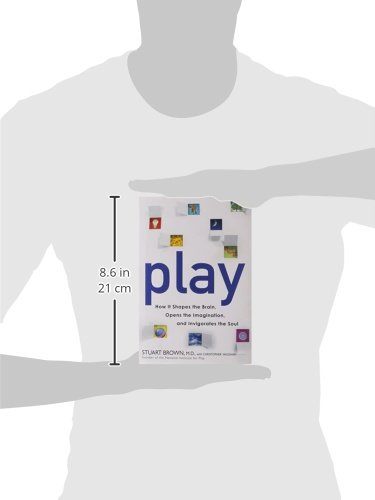
Full description not available
N**Z
AN ESSENTIAL READ for: Young (Adults) and Old, Parents, Teachers, School Administrators, Legislators, ALL peoples!
This is a book to be taken seriously--SERIOUSLY! I bought it because I had the opportunity to hear Dr. Brown speak at an Early Learners Conference. As an educator for 38 years and continuing, I have paid attention to what I see children learning through their play. The total expanse of play, from noticing one's fingers & toes to blocks and dolls and beyond to playground equipment and running wildly about as well as interacting in group games develops our minds and our bodies (and souls)! I have first-hand witnessed the benefits educationally but Dr. Brown brought out the important influences play has on life and living a happy, well-adjusted, meaningful life. His extensive research into those deprived of play is compelling enough to make you call someone for a "playdate"! This book should be a required read for ALL LEGISLATORS who pass laws about education, SCHOOL ADMINISTRATORS who disband recess or diminish playtime to bathroom-time, and TEACHERS who feel the pressure put on us to "hit the paper, pencils and books". PARENTS would learn more about their children and would make some changes to include play in their own living routines!
T**N
Wonderful Read
This is a wonderful book. Stuart Brown points out something that the modern world desperately needs to hear: to play is to be human. Brown, drawing on a fair bit of recent scientific research, argues that approaching life with a playful attitude is not only important for being a happy person, but it's also important for being a creative person. Children lose the desire to learn when they are placed in kindergarten- where "work" and "play" are very strictly separated- and where play itself is sometimes removed entirely, with recess being cancelled to attend to more "serious" things. Brown's discussion of what constitutes play is especially fascinating. One point that he makes again and again is that true play requires a person to let go of pride. A game of Twister would be horrible if everybody were concerned about what others thought of them. A brainstorming session fails when people are afraid of being criticized for silly ideas. In short, play requires humility. Developing a humble spirit around others allows one to truly play with others- and since play is that which fosters creativity, a culture where humility is the rule is a far healthier culture, economically and socially.There are a couple of minor gripes I had with the book. The first is the personalization of the brain. Brown sometimes speaks of the brain "doing" this and that, or "accomplishing" an activity. But the brain doesn't act- persons do. The notion that one can "program" the brain is based on the reification of a rather poor analogy (between brains and computers) and it needs to go. I don't know what Brown's philosophy is, but this is based on an outdated scientific materialism. Related to this is the occasional use of evolutionary psychology. These are all just-so stories- and a little thought usually dissolves them. We aren't just machines programmed to play- we are whole persons, designed to rejoice in this wonderful and beautiful world. Regardless, this element really doesn't take much value out of the book, which is chock-full of wonderful insights and practical applications.We need to be deadly serious about play.
M**E
Brilliant overview of the topic
[...] I fell upon Stuart's book with great eagerness. I'm happy to report that this is one of the best overviews of the relevance of play's biological, evolutionary and psychological dimensions that I've ever read - extremely fluently and accessibly written, and with much practical advice arising from its researches.My only problem with the book is the negative attitude it takes towards what Stuart calls 'screen play' - ie, play with networked or simulatory devices like computers, smartphones or video games. There's quite a contradiction in Stuart's complaint that these play experiences go against the 'embodied' and physical root of play - when he happily celebrates elsewhere in the book the playful power of storytelling and explorative imagination.Yes, there is a technology that reduces children to muteness, stillness, even entrancement; is so compelling that it could keep them in their room - or stop them interacting with their mates - for hours; and which wraps them up in an abstract system of representation that reduces the sensuous world to a series of marks and iterations. Ban The Book! My point being that electronic entertainments are as much tools of our poiesis, our creative mark-making, as sticks and old fashioned toys and climbable trees. And with the growing mobility of these devices, surely there's actually the possibility of the re-enchantment of our lives and cities, the extension of games and playfulness into wider areas of life, rather than less [...].Apart from this digital-age blindspot, Stuart has written is an important book in the growing legitimation of play as an input into the good society. I recommend it thoroughly to all readers interested in the topic.
Trustpilot
Hace 1 mes
Hace 1 semana
Hace 3 semanas
Hace 2 días