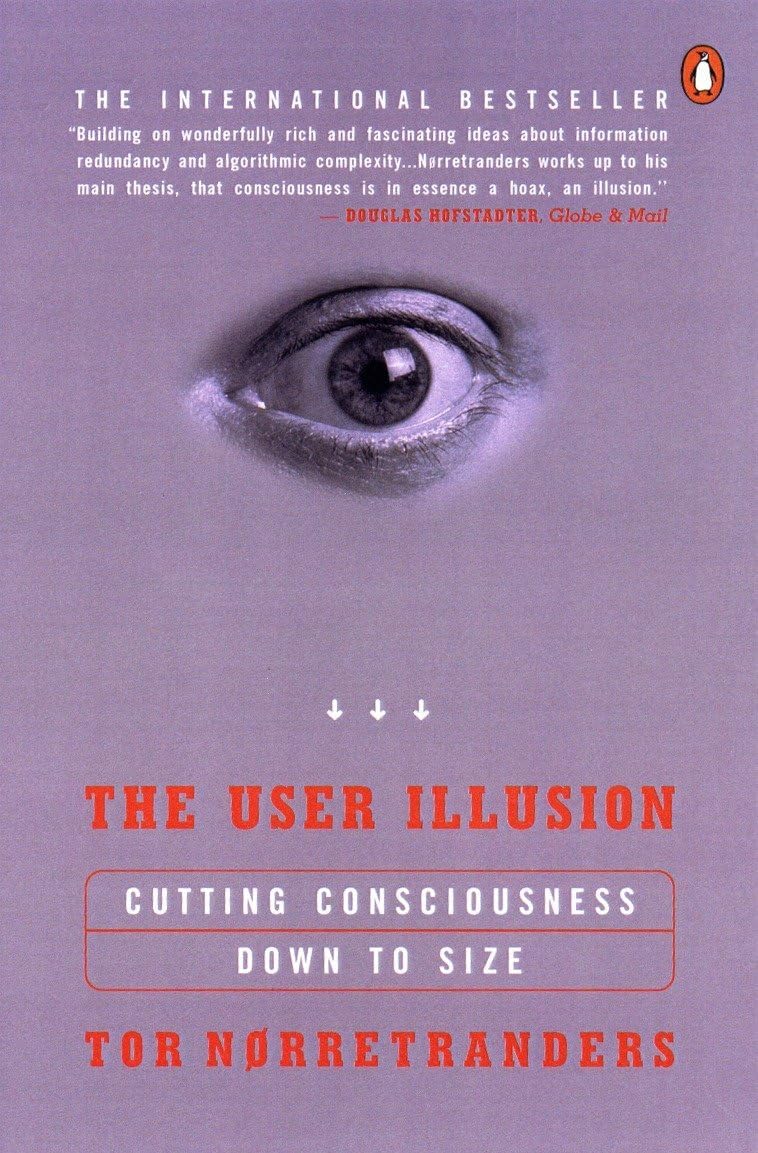
The User Illusion: Cutting Consciousness Down to Size
Product ID: 10044157
Desertcart purchases this item on your behalf and handles shipping, customs, and support to Uruguay.
The User Illusion: Cutting Consciousness Down to Size [Norretranders, Tor] on desertcart.com. *FREE* shipping on qualifying offers. The User Illusion: Cutting Consciousness Down to Size Review: I LOVE this book, the User Illusion. - So much so that my original, with passages highlighted and underlined, paragraphs circled, etc…, has become nearly illegible and I had to buy another one! The story he tells of James Clerk Maxwell on his deathbed is written so poignantly; last time I reread it, which was yesterday, it ‘almost’ made me cry. I only wish I could tell him in person of the impact and importance of this book in my life, but thus far I have been unsuccessful. Perhaps this review will suffice. Review: Just brilliant - An incredible insight into a book that waited years and years for the recognition it deserved… At times perhaps too heavy on references, but at its core, truly powerful.
| Best Sellers Rank | #49,286 in Books ( See Top 100 in Books ) #49 in Medical Neuropsychology #72 in Consciousness & Thought Philosophy #75 in Popular Neuropsychology |
| Customer Reviews | 4.5 4.5 out of 5 stars (298) |
| Dimensions | 7.9 x 5.1 x 1.05 inches |
| Edition | New edition |
| Grade level | 12 and up |
| ISBN-10 | 0140230122 |
| ISBN-13 | 978-0140230123 |
| Item Weight | 12 ounces |
| Language | English |
| Print length | 480 pages |
| Publication date | August 1, 1999 |
| Publisher | Penguin Books |
| Reading age | 18 years and up |
K**D
I LOVE this book, the User Illusion.
So much so that my original, with passages highlighted and underlined, paragraphs circled, etc…, has become nearly illegible and I had to buy another one! The story he tells of James Clerk Maxwell on his deathbed is written so poignantly; last time I reread it, which was yesterday, it ‘almost’ made me cry. I only wish I could tell him in person of the impact and importance of this book in my life, but thus far I have been unsuccessful. Perhaps this review will suffice.
V**A
Just brilliant
An incredible insight into a book that waited years and years for the recognition it deserved… At times perhaps too heavy on references, but at its core, truly powerful.
B**W
Very Satisfying
Sure, the author takes a while to get onto the subject of consciousness, but I found the early detour on thermodynamics and information theory to be interesting in its own right. The author a has a penchant for being scrupulously thorough in his discussion of a subject, whatever subject that may be, and I therefore found the book to be extremely satisfying. Eventually, he does find his way to the subject of consciousness, and the thorough discussion of Benjamin Libet's brain stimulation experiments was much appreciated. These experiments had been referenced in other books I've read, but here the experiments and their implications were discussed in detail. Overall, this was a great read. (Hardcopy Edition)
T**Y
An outstanding presentation....
This book should be used as educational resource material as early as it can be appreciated.... I'm almost certain that very few that have this kind of responsibility would agree with me, since it would overturn so much of the current mythology of the "I/Me".. As a species that has adopted a sort of self destructive brinkmanship as its culture, based on a simple misunderstanding of the nature of our cognitive processes, we could stand a little help with a reassessment of both where our strengths and weaknesses lie in how what we call the "I/Me" actually works... The author has done an excellent job bringing to our attention both the miraculous and deceptive nature of perception and shows many examples of how to begin an examination of these issues for ones self, if so inclined...
J**O
An old gem timely once more?
I recently bought and read this book convinced it was a recent work. As it turns out it is a recent translation of an original published in the early nineties and my notion was surely enforced by the number of recent books on the same "theme" namely the apparently novel revelation that the greater part of our mental activity is not directly accessible to our consciousness! This is the bottom line of such instant best-sellers as "Subliminal: How Your Unconscious Mind Rules Your Behavior" by Leonard Mlodinow, "The Power of Habit: Why We Do What We Do in Life and Business" by Charles Duhigg, Jonah Lehrer's "Imagine: How Creativity Works" and, perhaps to a less extent, "Ignorance: How It Drives Science" by Stuart Firestein! There is clearly some trend here as James Atlas underscored it in a recent opinion column of the NYTs where he labelled these "Can't-Help-Yourself" books. That may be a bit harsh but what I find more intriguing is that all of these people appear genuinely surprised by a finding that is over 100 years old harking back to Sigmund Freud who made his fame by plunging psychology into the depths of the unconscious. Remember? In any case Tor Norretranders appears to have had one hand and a couple of decades on all these noveau retro-sensationalists and his book is a worthy read even if long and often repetitive. He covers an impressive amount of research covering the last quarter of the 20th century and manages to tie it together though the devices he introduces for the purpose are shallow and mostly misapplied. The first is the word "exformation" which is meant to designate the information that is discarded by a physical system, a correlate of Brilloin's Negentropy which was meant to label successfully eliminated entropy. Unfortunately for both it is quite self-defeating to try to define a system in terms of something that it no longer contains. The same can be said about his revival of that old William James' canard, the distinction between the I (conscious) and the Me (unconscious). Norretranders uses and abuses it to the point that these two sound more like an old married couple bickering about who is in control! Even Freud showed a bit more finesse introducing a distinction between the Ego, the Id AND the SuperEgo! Finally, his appropriation of the User Illusion, a term from software engineering, quickly fizzles maybe because the author did not really know what to do with it. Still most of the many subjects he addresses remain interesting as one can gather from this new wave of writing on the subject though my guess is that these people should have read Norretranders before they penned their own versions of his material. In spite of the problems I list the book is worth the effort or I would not have finished it. In full disclosure I should point out that, in the middle of reading "The User Illusion" I recalled, from a particularly memorable anecdote it tells, that I have met the author -- in fact had lunch with him -- long time ago, during the first Workshop on Artificial Life in Los Alamos in 1987 or so. What little I remember of my interaction with him left me a positive impression which probably propelled my reading beyond the annoyances I describe. I recall that most of the scientists did not payed much attention to him but were quite impressed with the fact that James Gleick was also attending and he was using an intriguing new device that was to be later named a "laptop computer". Given that Gleick just published "The Information" which, again, appears to cover most of the same terrain, I can't help feel a bit more admiring of Norretranders! Unfortunately neither he nor Gleick seem to realize that the scientific notion of Information is, by itself, quite uninformative! They are not alone in this...
C**N
Very deep. Will need to read again.
I found this book very interesting. I can see this being one of those love it or hate it books. No in between. It gets deep into phycology, development of human thinking, the connection between vision and what we think, evolution of why we have certain fears, etc. I will read this again.
L**N
Way ahead of its time
First, I must agree that the first hundred pages are tough going and the last chapters may get too metaphysical, but the central theme of the book that our brain presents us with a user interface much like a computer does -- delayed in time, compressed, summarized, edited, incomplete -- has not been discounted in the ten years since the book was written. In fact, more and more experiments reveal the truth of this view. In a December 2001 Nature letter (Nature 414, 302 - 305, Illusory perceptions of space and time preserve cross-saccadic perceptual continuity), another experiment showing that our unconscious gives us delayed and edited information confirms that we exist in a User Illusion. Many of our behaviors, phobias, neuroses, psychoses, and human interactions can be analyzed in terms of this powerful illusion. And learning to understand and program our unconscious is the purpose of life.
A**R
Very useful. Explains a great deal of our culture.
Consciousness pulses about 16 times per second or about every 60ms. This means, like a movie, the idea that it's continuous, is an illusion. So within that 16 pulses per second, we only get so much data, and that which we do perceive is heavily curated.; I do meditation, so it's fascinating to see the western world catch up and have science to back up what mediators have known for centuries.
P**T
While written some time ago it remains highly relevant today. A wonderful journey through history, disparate areas of science and philosophy to uncover the nature of consciousness.
C**C
Había escuchado mucho sobre éste libro así que lo pedí. He leído poco porque como que no te "engancha". La calidad del papel es pésima por cierto. A ver si algún día lo termino.
B**S
Amazing info to consider!
S**G
It's hard to know where to start reviewing this book, as the book covers so many areas from the mathematics of bandwidth to comparative religion. The central science comes from experiments in the 1970s and 1980s by Benjamin Libet which showed that when you for example sit on a pin your "conscious self" which Norretranders refers to as the "I" doesn't register the event until about half a second after you sit on the pin. Many other experiments have confirmed this effect. The explanation given is that consciousness is actually a "simulation" that weaves a story around all the 11 million or so inputs that the brain receives (from the eyes, the skin, the ears and the tongue etc) that makes some sort of sense (in fact in many cases it can be shown that the story is inconsistent or downright untruthful). Norretranders spends the first part of the book looking at the maths of sensory perception in terms of bandwidth, the idea being that the 11 million observations somehow become 16 bits that is the limit that out conscious selves seem able to handle. Although it would be appealing to think that our super powerful brains somehow analyse all this information and extract the most important bits to give to our conscious selves, it appears that the process is more the other way round with a relatively fixed simulation of the world weaving a story (which is often completely untrue) to fit the facts. Hence the title of the book. The difference between the concious "I" and the "Me" (which Norretranders defines as the whole body with all the 11 million inputs) has a profound impact on the way we view philosophy and religion as well as shining a light on the observations of Freud. More controversially Norretranders agrees the hypothesis that consciousness in humans only appeared about 3000 years ago at the time of Homer. Little evidence is presented to support this idea, although is is certainly interesting. Minor niggles are that I think Norretranders reads too much into Godel's imcompleteness theorem as a metaphor for consciousness. Godel's Theorem has almost no practical impact on the development or study of mathematics, and thus I think that making it central to another area of science is optimistic. The extensive notes and bibliography are wonderful and encourage the reader to pursue the subject further.
C**C
Normal kitap fiyatıyla korsan kitap satılıyor. Hiç beklemezdim çok şaşırdım, bir de iki hafta bekledik yani, sanki yurtdışından geliyor gibi. Gelen korsan kitap!
Trustpilot
1 month ago
1 week ago