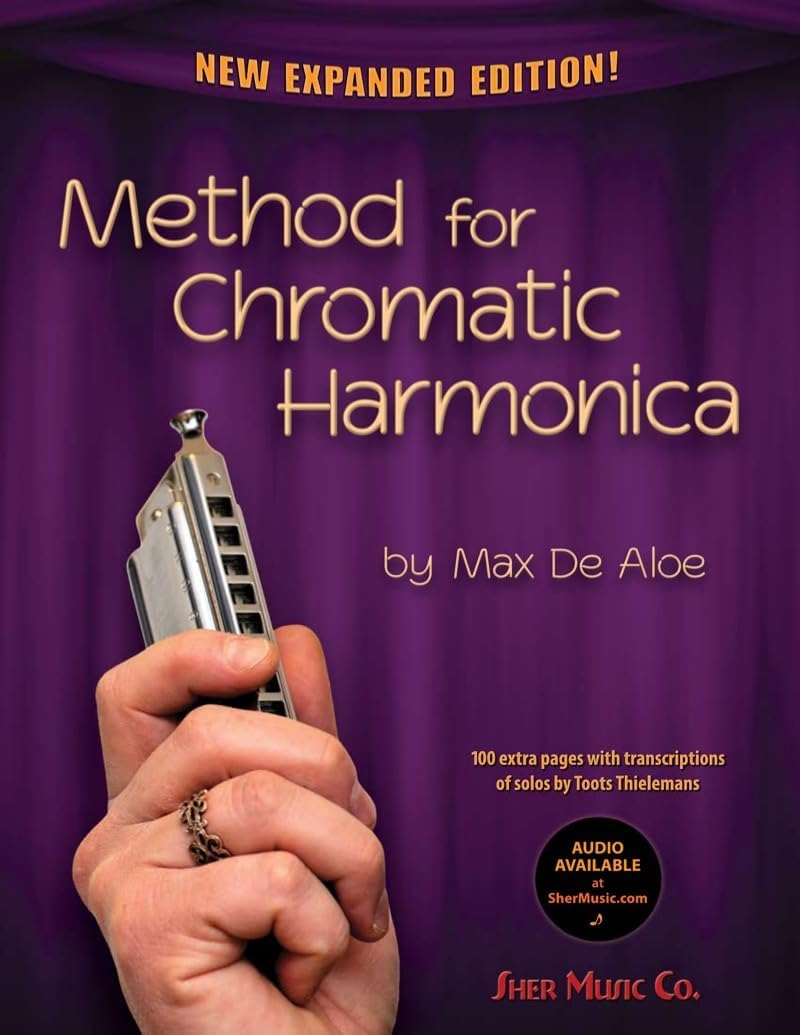
Method for Chromatic Harmonica
Product ID: 1319134
Buy anything from 5,000+ international stores. One checkout price. No surprise fees. Join 2M+ shoppers on Desertcart.
Desertcart purchases this item on your behalf and handles shipping, customs, and support to Uruguay.
New, Expanded Edition, 100 more pages, including transcriptions of solos by Toots Thielemans. This is a comprehensive method for the chromatic harmonica that treats it like a musical inst--- For beginning to advanced players, in any style of music ---play-along audio files at shermusic.com---Contains hundreds of exercises to develop technical proficiency in every key, as well as rhythmic awareness and melodic fluency. ---Exercises written in musical notation, not tablature--- Many tunes to practice, arpeggio studies, scale studies, sight-reading studies, sound production tips, and special harmonica techniques. Review: Excellent Resource! - This is an excellent resource! It seems to be a thorough and comprehensive introduction to chromatic harmonica for beginners and advanced players. Review: thorough instruction manual - really thorough. I'm learning a lot and not restricted to tabs or arrows.
| Best Sellers Rank | #238,149 in Books ( See Top 100 in Books ) #14 in Harmonica Songbooks #18 in Harmonicas #16,216 in Humor & Entertainment (Books) |
| Customer Reviews | 4.4 out of 5 stars 203 Reviews |
C**S
Excellent Resource!
This is an excellent resource! It seems to be a thorough and comprehensive introduction to chromatic harmonica for beginners and advanced players.
D**A
thorough instruction manual
really thorough. I'm learning a lot and not restricted to tabs or arrows.
T**Y
very supprised
The Harmonica is probably one of the hardest instruments to teach especially with genera of music. It's one of the only instruments that not only utilize the inhale and exhale but most if not, all harmonica players close their eyes and feel their way around the instrument. So, it's difficult to write music or even teach it. This book does it all. This is a reel book. He teaches you how to do drills and reels. I love the fact that he teaches you how to read music which is amazing considering you could pick up any piano book and learn how to play through the 12-hole chromatic harmonica. That's an invaluable skill. But he also leaves room for exploration as well. I love the fact that there is a one-year plan in this book. It gives you licks and a few drills, but it also gives you a song to learn utilizing all those different things and putting them together. This is perfect for the beginner or an intermediate player who is growing board with the instrument. I would recommend this to everyone.
G**R
Good, solid, serious method ... but best used with a teacher
This is one of the very few methods that treats the harmonica as a serious musical instrument. It guides the student into traditional notation, with a very well travelled route through wind instrument training: a little discussion about holding the instrument, breathing, embouchure, instrument selection, and a chapter (Two) that sets the way forward. The student plays exercises that introduce stepwise and interval playing in the easiest register. At this point I would have asked the author to emphasise counting, and using a metronome. Some studies have been recorded on a CD. No doubt this will help many students. Chapters Three to Seven, and Nine, are very good, as far as they go. Max De Aloe takes the student through all the keys, beginning with a simple scale study in each key, some pattern work to consolidate the knowledge of the scales, mixed intervals, and applications to tunes and studies in a range of styles. This is excellent material, and Max extends the student out to other texts: standards and jazz charts in the Real Books, and technical work in both flute and saxophone books, jazz pattern books, and theory and harmony. I strongly support this approach. Chapter Eight is a set of scales (nine, for each key), some of which are "unnecessary", in my view. Do students really benefit from learning natural minor scales? Two forms of blues scale? And the book omits Dorian and Mixolydian modes, diminished scales, whole tone scales -- all of which are more useful to jazz improvisers than some of the included scales. (But this is a method for musicians of all genres.) Chapter Ten is devoted to arpeggios, and the intelligent student would be well advised to integrate these into the earlier work, key by key, and not leave them until the end of the book is reached. From this beginning, the now advancing chromatic harmonica player should have no difficulty in finding much useful technical work (in books like Arban's Cornet Method) and in jazz study material and the wider wind instrument literature. With good support from a teacher, students will do very well with this book, and students of harmonica coming from other instruments will also build their skills well. Students new to music will need a lot of support, and extra material.
M**E
Not a beginners book
Not a beginners book.
A**R
This is a good book, but it will take real determination to ...
In reference to the existing comments, I found no problem with the printing quality in my copy as did the commenter giving it 1 star. "Gashreamer" gave it 3 stars and said that it was "very basic", which leads me to think that either he/she did not read past the first 8 pages or that he/she must already be an incredibly accomplished player. The method starts assuming that you know nothing about the chromatic harmonica (nor harmonicas in general). So it explains holding it, breathing, tone, etc. Then it begins to work on exercises in C, as in fist position on a diatonic harmonica. After that it introduces the use of the slide, and then begins to progress through the different musical keys. It labels these by months, so if you were to diligently follow this it would take 1 year to get through the method book. This is why I can't understand the comment about it being "basic." By the time you reach December the exercises are in the key of Gb-M (6 flats) and you've already gone through F#-M (6 sharps). This is anything but basic for any instrument. The author states that it is an advantage to have a teacher. He also treats the chromatic harmonica as a serious instrument rather than a toy, so there is an expectation that the reader will already know how to read the treble clef staff or will learn this on their own. This is a serious book. If you really applied yourself you could make serious progress. I doubt that you'll find people to play with that play in 5 or 6 sharps or flats, but going through the exercises and learning it will definitely make playing easier in any key. This is a good book, but it will take real determination to actually learn all that it has to offer.
M**A
An outstanding introduction to the Chromatic Harmonica... BUT...
This is an outstanding introduction to the Chromatic Harmonica... BUT... it's not an introduction to music itself. The author, Aloe, assumes you can read sheet music, dynamic markings, key signatures, etc. If you've played any other instrument then this isn't a problem. But if you only know how to read tabs this ain't gonna work for you. That being said, I strongly recommend this book. The method is great. The exercises are great. Aloe explaining "make sure you double back to these pages when you learn a new key" is great. This is a sound book.
J**H
A person needs to be able to read music to use this guide-book.
I should say, I didn't keep this item, I returned it. The only problem was, a good portion of the book was musical pieces written on music staff. I can't read music, I've always played instruments 'by ear'. But I did flip through the book and was impressed with the quality of the work. I could see that this would be very helpful to the right person.
L**T
Disciplina e regularidade
Ótimo metodo de gaita cromática. Como a maioria dos métodos, este é no formato com espiral, o que facilita o manuseio para o estudo. Veio muito bem emalado e chegou dentro do prazo. Alguns comentaristas criticam a ênfase do autor na sequência e repetição dos exercícios, mas acho fundamental seguir adiante nas lições só depois de executar muito bem as anteriores. É preciso criar uma base. Depois tudo fica mais fácil. Pular etapas no estudo de um instrumento musical, seja ele qual for, é apostar no insucesso.
F**N
Sehr hilfreich
Als langjähriger Bluesharpspieler entschloss ich mich die Chromatische in Angriff zu nehmen, weil man mit ihr einfach viel mehr Möglichkeiten hat. Das im Sinne von Noten. Tablaturen sind oft schwer zu finden ab einem bestimmten Niveau, aber mit der Chromatischen hat man unmengen an Material! Dieses Buch hilft sehr gut um dieses komplett!! neue Instrument zu lernen. Man lernt eben normale Spielübungen, um das Instrument kennenzulernen, dann kommen ab am Ende von jedem Kapitel meist ein paar Songs, die rhythmisch und jazzig sind...mit Playback auf der CD kann man somit sein Rhythmusgefühl trainieren. super Buch!
A**R
Excelente, merece la pena el precio
Realmente útil para tomarse en serio el estudio de la armónica cromática. Muy didáctico y con muchos ejercicios
C**N
Actual, fácil y entendible
Es un método sencillo pero muy confiable con todo lo que el principiante necesita para conocer e involucrarse con la armonica.
A**K
Excellent book for mature readers.
Good instructional books for playing the chromatic harmonica are not common. Here is a book that treats the harmonica as a real instrument. The author takes the student from a very basic (or non existent) skill level to being an expert player if the exercises are taken seriously and studied thoroughly. A knowledge of music theory is assumed but this can be easily obtained from other resources. This book is strongly recommended for mature readers. Very young children may be better off with a more light hearted and playful approach than is afforded by this book.
Trustpilot
5 days ago
2 months ago