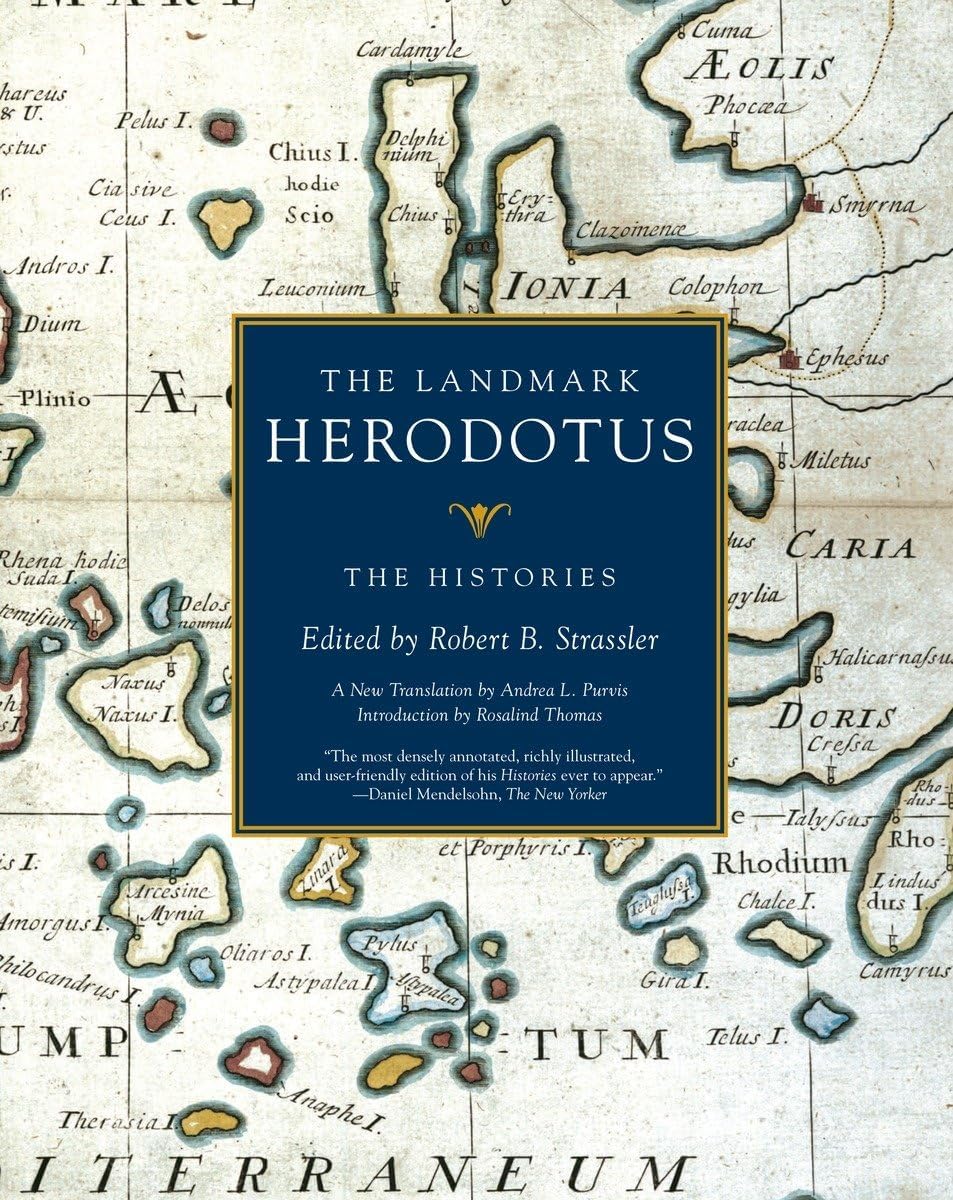
The Landmark Herodotus: The Histories (Landmark Series)
Product ID: 13274459
Buy anything from 5,000+ international stores. One checkout price. No surprise fees. Join 2M+ shoppers on Desertcart.
Desertcart purchases this item on your behalf and handles shipping, customs, and support to Uruguay.
“The most densely annotated, richly illustrated, and user friendly edition” of the greatest classical work of history ever written (Daniel Mendelsohn, The New Yorker) —from the editor of the widely praised The Landmark Thucydides. Cicero called Herodotus "the father of history," and his only work, The Histories , is considered the first true piece of historical writing in Western literature. With lucid prose, Herodotus's account of the rise of the Persian Empire and its dramatic war with the Greek city sates set a standard for narrative nonfiction that continues to this day. Illustrated, annotated, and filled with maps—with an introduction by Rosalind Thomas, twenty-one appendices written by scholars at the top of their fields, and a new translation by Andrea L. Purvis— The Landmark Herodotus is a stunning edition. Review: The best English edition of Herodotus you're likely to find - As a general rule, I don't review classics. Classics are classics for a reason—they have withstood the test of time—and there is very little of value that I can add to what countless generations of readers and scholars have already said about them. You ought to read classics *because they are classics*, not because they get good reviews on desertcart or GoodReads. And if you are interested in ancient history, and especially the history of Ancient Greece and the Persian Empire, you really ought to read 'The Histories' by Herodotus. So, let's assume that you've decided to read Herodotus. Now you've got to decide which edition of 'The Histories' to get, because there are several editions to choose from. That is where a book review can actually be of some help, and that is why I have written this review—not to offer my opinions about what Herodotus wrote, but to share my thoughts on one specific edition of his classic text: 'The Landmark Herodotus,' translated from the original Greek by Andrea L. Purvis and edited by Robert B. Strassler, with contributions from various other scholars. Assuming that you are looking for an English language edition of 'The Histories', you are unlikely to find a better edition than this one. While I can't comment on the accuracy of the translation, since I have never read Herodotus in the original Greek (alas, my Ancient Greek is not yet good enough to even attempt it), I can say that it is very readable. Andrea L. Purvis has translated Herodotus's text into clear, easy-to-understand, modern English that is a delight to read. I might even go so far as to say that Purvis's translation of 'The Histories' is a "page turner." I never once got bored with what I was reading—not even when Herodotus went off on one of his notoriously long digressions—and I was always eager to find out what would happen next in the story. But there are plenty of good English translations of Herodotus out there to choose from. What makes this edition of 'The Histories' so special has less to do with the translation itself than with the "bonus materials" that accompany the text. First of all, there are the maps—lots and lots and lots of maps! (If you love maps as much as I do, this edition is worth getting just for the maps alone.) Every three or four pages in the book you'll find a map showing the various locations that Herodotus mentions in the surrounding text. Every landmark (e.g. town, temple, battle site, river, mountain, sea, country) that Herodotus mentions in his text is identified on these maps, if its location is known (though the locations of some of the places he mentions have not yet been identified). These maps really help the reader follow the narrative and visualize where the various events in 'The Histories' took place. (I must presume that this edition is called the "Landmark" Herodotus because of these maps.) In addition to the maps, there are a number of photos and illustrations that help readers to better visualize the places and things that Herodotus talks about in his narrative. There are also tons of footnotes that provide map references and other information of interest to the reader. Plus, at the beginning of each "chapter" in the text (most of which are only one or two paragraphs long), there is a marginal note indicating when and where the events recounted in that chapter took place (if known) and giving a brief summary of what the chapter is about. In addition to these useful features, there is a long introduction by Rosalind Thomas discussing the significance of Herodotus's work, as well as 21 appendices at the end, written by various scholars, that shed additional light on the people, places, cultures, and events mentioned throughout 'The Histories.' This edition also includes a detailed outline of Herodotus's text, which gives the dates and locations for each section of the narrative. There is also a glossary of terms that are used in the book, a list of ancient authors referred to in the book, a short bibliography, a truly massive and detailed index (probably the most extensive index to Herodotus that you will find in print), and last but not least, even more maps!—in the very back of the book there is a series of detailed reference maps, with a comprehensive index, showing the location of every landmark mentioned in the text (excepting, of course, those whose location is unknown). I don't think you're likely to find another edition of Herodotus that is even remotely as chock full of features designed to aid the reader as this one is. I definitely recommend it. Now, as much as I love this edition of 'The Histories', it isn't perfect, and I can't in good conscience praise its many virtues without at least mentioning, in passing, its few vices. There are, quite frankly, a number of errors in the footnotes. Some footnotes are simply missing (i.e. there is a pointer to the footnote in the text but no corresponding footnote at the bottom of the page); others provide the wrong information (e.g. references to the wrong map). These errors are annoying, to be sure, and there are far more of them than there ought to have been in a well-edited book, but I don't want to exaggerate their importance. No book can be expected to be perfect, and these mistakes aren't severe enough to seriously detract from the overall value of this otherwise excellent book. 'The Landmark Herodotus' is still worthy of an unqualified five-star rating as far as I'm concerned, despite the errors. I highly recommend it. Before I go, I should note that 'The Landmark Herodotus' is only one volume in a series of classic historical texts edited by Robert B. Strassler, and I look forward to one day soon reading the other books in this series, which include 'The Landmark Thucydides,' 'The Landmark Xenophon's Hellenika,' 'The Landmark Arrian,' and 'The Landmark Julius Caesar,' plus the forthcoming 'The Landmark Xenophon's Anabasis' and 'The Landmark Polybius.' If these turn out to be even half as good as 'The Landmark Herodotus,' they will be an absolute treat to read. - - - CAVEAT: Be sure you are ordering the right edition! I have noticed that, when there are multiple editions of the same book available on desertcart, reviews for one specific edition will sometimes show up on the product pages for other editions of that same book. My review is specifically meant for 'The Landmark Herodotus,' edited by Robert B. Strassler. Please make sure that you are ordering that edition and not some other one. Review: The only way to read Herodotus - This review will rate "The Landmark Herodotus" in two ways. First, it will review this particular edition, and second, it will review the Histories of Herodotus itself. I give five stars to this edition of Herodotus. I cannot imagine reading any other edition of Herodotus; after looking through several other translations and editions, this one exceeds them all in many respects. The first and most relevant addition is the inclusion of maps every few pages. Herodotus mentions many different places in his work and unless you're a professor of Greek history, you won't know all of them. Every location that is known to modern scholars is plotted on the maps. Best of all, each map focuses on the places mentioned in the pages preceding it. That way the maps aren't cluttered, making it difficult to find a place that you've read about (unlike almost every other Greek history book available). Andrea Purvis's translation is excellent. It is clear, easy to understand, and uses 20th century English, unlike many of the other translations available which use old-fashioned and pretentious language. The appendices are very helpful and worth reading as you move through the book. They help to pull together many aspects of Herodotus's work. I also give five stars to the Histories of Herodotus as a work in its own right. What Herodotus has to say is interesting and hugely relevant to ancient history. Herodotus has many detractors who say that he was not as critical of his sources as he ought to have been. I disagree. Herodotus repeatedly gives several viewpoints for an issue and then explains why he thinks that one of them is the best. For example, he gives numerous theories for why the Nile floods in the summertime and then explains why he thinks one of them is true. Herodotus does claim that many of the oracles are credible and occasionally gives supernatural explanations to historical events (for example, the Greek victories at Plataea and Mycale). His reliance on the supernatural, however, is sensible or even progressive when compared with his contemporaries. Is he as empirically-minded as Thucydides? Perhaps not, but Herodotus's work does seem to suffer less from personal bias than Thucydides' "The Peloponnesian War". I fully recommend "The Landmark Herodotus" to anyone interested in Greek or Persian history or reading one of the classics of world literature.

| Best Sellers Rank | #18,180 in Books ( See Top 100 in Books ) #43 in Ancient Greek & Roman Philosophy #655 in Classic Literature & Fiction #2,065 in Historical Fiction (Books) |
| Customer Reviews | 4.8 out of 5 stars 739 Reviews |
G**L
The best English edition of Herodotus you're likely to find
As a general rule, I don't review classics. Classics are classics for a reason—they have withstood the test of time—and there is very little of value that I can add to what countless generations of readers and scholars have already said about them. You ought to read classics *because they are classics*, not because they get good reviews on Amazon or GoodReads. And if you are interested in ancient history, and especially the history of Ancient Greece and the Persian Empire, you really ought to read 'The Histories' by Herodotus. So, let's assume that you've decided to read Herodotus. Now you've got to decide which edition of 'The Histories' to get, because there are several editions to choose from. That is where a book review can actually be of some help, and that is why I have written this review—not to offer my opinions about what Herodotus wrote, but to share my thoughts on one specific edition of his classic text: 'The Landmark Herodotus,' translated from the original Greek by Andrea L. Purvis and edited by Robert B. Strassler, with contributions from various other scholars. Assuming that you are looking for an English language edition of 'The Histories', you are unlikely to find a better edition than this one. While I can't comment on the accuracy of the translation, since I have never read Herodotus in the original Greek (alas, my Ancient Greek is not yet good enough to even attempt it), I can say that it is very readable. Andrea L. Purvis has translated Herodotus's text into clear, easy-to-understand, modern English that is a delight to read. I might even go so far as to say that Purvis's translation of 'The Histories' is a "page turner." I never once got bored with what I was reading—not even when Herodotus went off on one of his notoriously long digressions—and I was always eager to find out what would happen next in the story. But there are plenty of good English translations of Herodotus out there to choose from. What makes this edition of 'The Histories' so special has less to do with the translation itself than with the "bonus materials" that accompany the text. First of all, there are the maps—lots and lots and lots of maps! (If you love maps as much as I do, this edition is worth getting just for the maps alone.) Every three or four pages in the book you'll find a map showing the various locations that Herodotus mentions in the surrounding text. Every landmark (e.g. town, temple, battle site, river, mountain, sea, country) that Herodotus mentions in his text is identified on these maps, if its location is known (though the locations of some of the places he mentions have not yet been identified). These maps really help the reader follow the narrative and visualize where the various events in 'The Histories' took place. (I must presume that this edition is called the "Landmark" Herodotus because of these maps.) In addition to the maps, there are a number of photos and illustrations that help readers to better visualize the places and things that Herodotus talks about in his narrative. There are also tons of footnotes that provide map references and other information of interest to the reader. Plus, at the beginning of each "chapter" in the text (most of which are only one or two paragraphs long), there is a marginal note indicating when and where the events recounted in that chapter took place (if known) and giving a brief summary of what the chapter is about. In addition to these useful features, there is a long introduction by Rosalind Thomas discussing the significance of Herodotus's work, as well as 21 appendices at the end, written by various scholars, that shed additional light on the people, places, cultures, and events mentioned throughout 'The Histories.' This edition also includes a detailed outline of Herodotus's text, which gives the dates and locations for each section of the narrative. There is also a glossary of terms that are used in the book, a list of ancient authors referred to in the book, a short bibliography, a truly massive and detailed index (probably the most extensive index to Herodotus that you will find in print), and last but not least, even more maps!—in the very back of the book there is a series of detailed reference maps, with a comprehensive index, showing the location of every landmark mentioned in the text (excepting, of course, those whose location is unknown). I don't think you're likely to find another edition of Herodotus that is even remotely as chock full of features designed to aid the reader as this one is. I definitely recommend it. Now, as much as I love this edition of 'The Histories', it isn't perfect, and I can't in good conscience praise its many virtues without at least mentioning, in passing, its few vices. There are, quite frankly, a number of errors in the footnotes. Some footnotes are simply missing (i.e. there is a pointer to the footnote in the text but no corresponding footnote at the bottom of the page); others provide the wrong information (e.g. references to the wrong map). These errors are annoying, to be sure, and there are far more of them than there ought to have been in a well-edited book, but I don't want to exaggerate their importance. No book can be expected to be perfect, and these mistakes aren't severe enough to seriously detract from the overall value of this otherwise excellent book. 'The Landmark Herodotus' is still worthy of an unqualified five-star rating as far as I'm concerned, despite the errors. I highly recommend it. Before I go, I should note that 'The Landmark Herodotus' is only one volume in a series of classic historical texts edited by Robert B. Strassler, and I look forward to one day soon reading the other books in this series, which include 'The Landmark Thucydides,' 'The Landmark Xenophon's Hellenika,' 'The Landmark Arrian,' and 'The Landmark Julius Caesar,' plus the forthcoming 'The Landmark Xenophon's Anabasis' and 'The Landmark Polybius.' If these turn out to be even half as good as 'The Landmark Herodotus,' they will be an absolute treat to read. - - - CAVEAT: Be sure you are ordering the right edition! I have noticed that, when there are multiple editions of the same book available on Amazon, reviews for one specific edition will sometimes show up on the product pages for other editions of that same book. My review is specifically meant for 'The Landmark Herodotus,' edited by Robert B. Strassler. Please make sure that you are ordering that edition and not some other one.
A**A
The only way to read Herodotus
This review will rate "The Landmark Herodotus" in two ways. First, it will review this particular edition, and second, it will review the Histories of Herodotus itself. I give five stars to this edition of Herodotus. I cannot imagine reading any other edition of Herodotus; after looking through several other translations and editions, this one exceeds them all in many respects. The first and most relevant addition is the inclusion of maps every few pages. Herodotus mentions many different places in his work and unless you're a professor of Greek history, you won't know all of them. Every location that is known to modern scholars is plotted on the maps. Best of all, each map focuses on the places mentioned in the pages preceding it. That way the maps aren't cluttered, making it difficult to find a place that you've read about (unlike almost every other Greek history book available). Andrea Purvis's translation is excellent. It is clear, easy to understand, and uses 20th century English, unlike many of the other translations available which use old-fashioned and pretentious language. The appendices are very helpful and worth reading as you move through the book. They help to pull together many aspects of Herodotus's work. I also give five stars to the Histories of Herodotus as a work in its own right. What Herodotus has to say is interesting and hugely relevant to ancient history. Herodotus has many detractors who say that he was not as critical of his sources as he ought to have been. I disagree. Herodotus repeatedly gives several viewpoints for an issue and then explains why he thinks that one of them is the best. For example, he gives numerous theories for why the Nile floods in the summertime and then explains why he thinks one of them is true. Herodotus does claim that many of the oracles are credible and occasionally gives supernatural explanations to historical events (for example, the Greek victories at Plataea and Mycale). His reliance on the supernatural, however, is sensible or even progressive when compared with his contemporaries. Is he as empirically-minded as Thucydides? Perhaps not, but Herodotus's work does seem to suffer less from personal bias than Thucydides' "The Peloponnesian War". I fully recommend "The Landmark Herodotus" to anyone interested in Greek or Persian history or reading one of the classics of world literature.
A**X
A wonderful edition of a classic work
This is an absolutely crucial book in the chronology of Western thought, for it is humanity's first attempt at tracing recent events (in his case, the Persian War) through rational means to human-understandable causes. With all of this said, it is crucial to understand that "History", as a modern word and concept, did not exist when Herodotus was writing. The entire paradigm of history only came out of the work of Herodotus and his successor Thucydides. Thus, Herodotus will not conform to many modern aspects of historical writing that twenty-first century readers would expect. Herodotus is blending ethnography, oral tradition, and writing conventions inspired by the Homeric Epics and Greek Tragedies all together to produce a type of narrative never before seen. It is important to keep this in mind, as many critics of Herodotus see him as lesser than Thucydides for failing to measure up to modern standards of historical narrative. Without Herodotus, there probably would have never been a Thucydides. It is unjust to measure Herodotus against a paradigm which took millennia to develop after he wrote his Histories. Now, onto the subject of his history and the the Landmark Edition of his work. This history culminates in the story of the Persian invasion of mainland Greece, and the Greek (partial) unification to oppose that invasion. Many of the legendary stories about Athens and the Spartans come from here: the battle of Marathon, where Athens achieved its first big victory; the battle of Thermopylae, where 300 Spartans and their often-forgotten allies and slaves fought to the death against the Persians; and other battles as well. All of this happens in the second half of his work. The first half of this work is a vast ethnography of multiple different cultures. Herodotus surveys cultural norms, origins, and encounters with the expanding Persian Empire. Here, he shows a surprising amount of care, respect, and sophistication when comparing foreign customs against his own. This section is crucial for background information and for defining the Persian war as a particular instance of a larger East-West conflict. Herodotus traces this conflict to a series of abductions of women, eventually leading to the famous Trojan War. Many people today would say that an East-West conflict is a Muslim-Christian conflict, but Herodotus shows that the hostility between the two go much further back. The Landmark Series has unequivocally set a new standard for producing ancient historical narratives. Any subsequent publication of Herodotus must match or surpass the work Robert Strassler has done on this series. Most editions of Herodotus will have a bundle of maps at either the beginning or end of the work. Any time the reader wants to find a particular location, he or she must flip through the entire book, find the relevant map, search the entire map for the location (often overlooking it), and doing this all while having a finger in the middle of the book so that he or she doesn't lose their place. The Landmark Edition has relevant maps printed on (more or less) every other page. The reader never has to flip through more than a handful of pages to find the relevant map. When they do get to the map, there is often a series of maps: one map of the general area, then a zoomed-in box which blows up the specific region. This specific map will have the relevant cities, geographical features, battle sites, etc. There are over twenty academic articles in the appendices which could, in of themselves, form a wonderful book on the classical world. There are articles on the structure of Athenian government, the Spartan society, the roles of women in classical society, ancient units of measurements, and much more. If anyone decides to read Herodotus's Histories in English, it would be foolish to use any other edition of his work than the Landmark Edition. This edition has rendered all others obsolete. I hope that this review has given the reader a sense of what this work does, why it is still important, and why the Landmark Edition is the absolute best out there right now.
J**E
Excellent! Reads like a Tom Clancy action novel--but real!
One of the best history books I ever read. (Another one is a Landmark issue also--Thucydides.) Not dry dates. Made people, their opponents and contemporaries, challenges, fates, dumb luck, the results, and those impacts come alive. What people thought, what they did, whether their motives were honorable or selfish. Reproduces famous and powerful addresses by orators as these democracies and tyrannies debate risks and benefits. Profoundly complete: So many maps made it easy to visualize who, did what, when, and where. (I drew arrows on them.) Copious footnotes substantiate what Herodotus wrote and clarify his points. Almost every paragraph has a short summary in the wide margins. And paragraphs are numbered, as used by serious readers to talk about their thoughts. (See 1.1-1.4.) Several appendices, written by noted scholars, expand the text by describing ancient Greek customs, government... Extensively indexed. But most important to me: the writing and translation are lively, fast, explains what's happening, records alternative opinions... I like Clancy, Grisham, Crichton--and now Herodotus.
M**E
So Good
Herodotus "invented" history by traveling and interviewing different peoples in order to put on record their histories and cultures. Before him, history is known through archaeological works such as inscriptions on monuments, government records, etc., and the Hebrew Scriptures. For the first time, Herodotus recorded history as we understand it today, which makes his work the earliest record of ancient traditions and culture. Being curious about the ways of life of different countries, his book sometimes feels like an ancient version of the Discovery Channel. His work is as full of Geography and Ethnography as it is historical content. He is open minded but judicious, so what you read is just this treasure chest of everything ancient. Much of the book focuses on the founding and expansion of the Persian Empire. Whenever the Persians encounter a new nation, he gives its history and a description of it's culture. He focuses a lot on Egypt and Scythia, but also writes about Babylon, Assyria, India, and all other peoples at the time. Since the Persians conquered or fought just about every civilized nation of their time, you get a tour of the known inhabited world of ~500 B.C and see how it came under Persian influence. The culmination is an epic narrative of the Greco-Persian Wars, which is when Persia makes its move on Greece, and which include the famous battles of Marathon, Thermopylae, and Salamis. These wars would determine whether Greece became a nation of slaves or a nation of intelligent men and women that defines Western civilization to this day. The Landmark edition is something else. You can't go ten pages without at least one excellent map (usually several). There are pictures of artifacts, ruins, and even aerial views of legendary battlefields. The appendices really put the work into context and IMO the 21 of them together make up a book within a book that teaches a lot about ancient history. The introduction and appendices also explain just how important this book is; Herodotus was the first to record history, so his information on Greece and the rest of the world is really the definitive source for a lot of what he talks about.
J**)
Indispensible for the First-Time Reader
Review of: "The Landmark Herodotus: The Histories," Edited by Robert B. Strassler. I am a new reader of Herodotus. As I was not sure of the best translation (or even what a good translation consisted of) I selected this volume. I was not disappointed as my experience has been very pleasant. I found this book to be very understandable for the common person. I found the extras such as the appendices, maps, margin notes with explanations, and pictures/illustrations to be very helpful. As other reader/reviewers have pointed this book absolutely reads like a travel guide. It is simply wonderful. Take, for example, how Herodotus describes the sexual practices of the Auseans who lived in an area now located in modern Libya: "They say that Athena is the daughter of Poseidon and Lake Tritonis, but that she found some fault with her father and gave herself over to Zeus, who then made her his own daughter. Well, at least that is what they say. They share intercourse with their women in common, promiscuously like beasts, and do not dwell together as couples. Whenever a woman's child has developed sufficiently, the men get together within three months, and whichever of them the child resembles most is acknowledged as the father" (Strassler, 2007, p. 356). The contents of the book consist of the Introduction, Editor's Preface, Translator's Preface, Dated Outline of Text, Key to Maps, Books one through nine, Appendices A though U, Glossary, Ancient Sources, Bibliography for the General Reader, Figure Credits, Index, and Reference Maps. In total it is a historical guide encompassing 951 pages. I thoroughly enjoyed it and will refer back to it many times. Well done. Five stars.
J**E
A truly outstanding volume, but take care with the format during shipping
I LOVE this series of historical treatments by Strassler. I have never seen historical "literature" handled with such incredible attention to "comprehensibility" ... making it easy to understand. The layout of every page, the inclusion of so many maps, the notations and comments all make this ancient text so much more approachable than any other presentation I've seen. The translation also makes the text very easy to digest and the combined effect of translation and presentation techniques makes this series truly one of a kind. This should be the standard by which most historical literature is presented, in my opinion. I purchased the paper-bound volume and I must offer some precautions there. This is a thick (over 950 pages) book printed on quality paper, and as a result, it's very weighty, in a literal sense. While it's an excellent volume printed and bound in a very high quality manner, the sheer mass of the book presents an issue ... if it's dropped, its own weight works against it, increasing the risk of damage. This needs to be considered when ordering the paper-bound version, as shippers who send it in a plastic bag sort of shipping parcel are not providing suitable protection to keep the cover and pages safe from drops and scrunches en-route. This book is a beautifully designed and executed volume and deserves a hefty cardboard book sleeve or properly sized box for shipment. My book was slightly damaged during shipment in a plastic bag style envelope and that's why I'm giving this particular version 4 stars, as I previously owned the Landmark Thucydides (hard bound) and it was a much sturdier tome. I don't regret this purchase one bit, but I'd be careful about ordering paper-bound if you can't guarantee the shipping method that will be used by the provider. If you're set on the paper-bound version, then make sure you get the chance to specify a corrugated shipping container. This book deserves nothing less. My shipper did offer a discount to recompense me for the damage to the book, and I do appreciate that. They stopped short of guaranteeing a more appropriate shipping parcel for my next order. That, to me, when dealing with such quality publications, is a mistake.
S**E
Best Histories ever! Formatted with notes on each page, so you don't get lost.
When you need a bunch of information -- when you need a deep dive into murky waters on a ponderous subject -- when you need Herodotus -- and I do -- this is it! Good price for a heavy book (900+ pages). Love the format, side margin notations, footnotes at the bottom (I need that too!) and the main text, let Herodotus talk to you. I have some old volumes of his histories, and this is so much better! Kudos to the seller, book in perfect condition and arrived fast.
I**S
Ein Muss für jeden Fan der Antike
Dieses Buch ist der Hammer, ich habe es für mich persönlich gekauft und konnte es auch für meine Uni verwenden, die originalgetreue Übersetzung und die Landkarten sind super hilfreich, außerdem finde ich das Seitenlayout generell sehr Leserfreundlich und angenehm übersichtlich
A**I
Gran libro
Buena traducción. Edición muy completa con ilustraciones y notas complementarias para entender el contexto. Llegó en buenas condiciones y francamente no puedo pedir más en cuanto a contenido, es un libro muy completo.
M**I
Its a great book
Great book!
K**Y
Read this superb edition!
Rereading the classic!
A**ー
30年以上欲しかったもの
1980年代ヘロドトスの歴史とトゥキディデスの戦史を岩波文庫とペリカンブックスの英訳版で読んでいましたが、普通の歴史地図では細かいところがわかるはずもなく、読了しても残念な気分を味わいました。これは本文と地図が詳しく記されているので姉妹版ともども、2作品を再読するのに強い味方となることでしょう。
Trustpilot
1 month ago
1 month ago