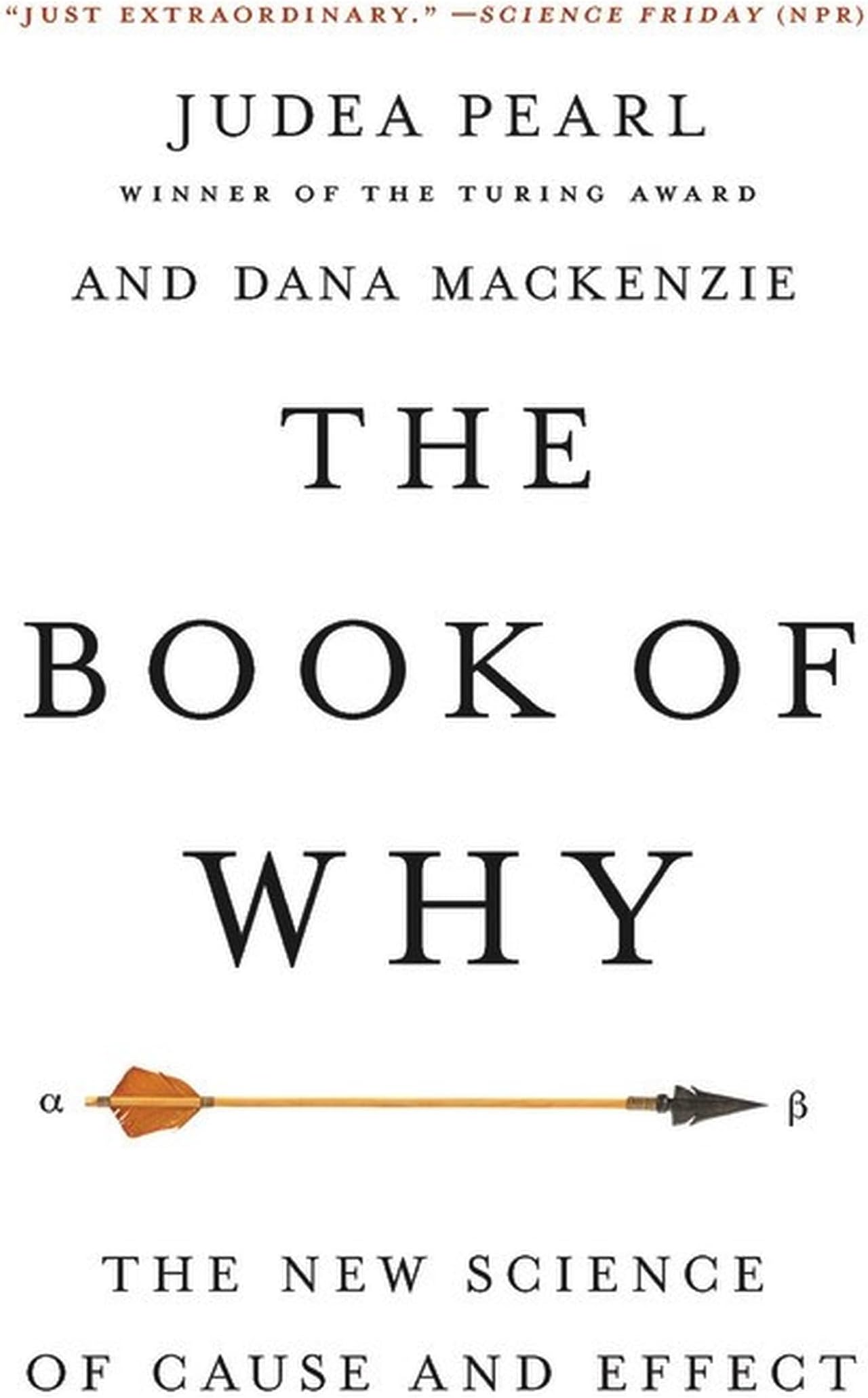
The Book of Why: The New Science of Cause and Effect
Product ID: 147338917
Buy anything from 5,000+ international stores. One checkout price. No surprise fees. Join 2M+ shoppers on Desertcart.
Desertcart purchases this item on your behalf and handles shipping, customs, and support to Uruguay.
The "extraordinary" (Science Friday), "illuminating" ( New York Times ) argument for how understanding causality has revolutionized science and will revolutionize artificial intelligence "Correlation is not causation." This mantra, chanted by scientists for more than a century, has led to a virtual prohibition on causal talk. Today, that taboo is dead. The causal revolution, instigated by Judea Pearl and his colleagues, has cut through a century of confusion and established causality -- the study of cause and effect -- on a firm scientific basis. His work explains how we can know easy things, like whether it was rain or a sprinkler that made a sidewalk wet; and how to answer hard questions, like whether a drug cured an illness. Pearl's work enables us to know not just whether one thing causes another: it lets us explore the world that is and the worlds that could have been. It shows us the essence of human thought and key to artificial intelligence. Anyone who wants to understand either needs The Book of Why . Review: A Summary of a Lifetime of Scientific Work with Implications for all of Humanity - The Book of Why is a popular introduction to Judea Pearl’s branch of causal inference. But it is also so much more. Pearl has written many other textbooks introducing his graphical approach. But in this book, Pearl provides an engaging narrative of the history of causal inference, the important distinctions he sees in his branch and its importance for the future of Artificial Intelligence. Briefly, Pearl views classical statistics as seriously flawed in not having developed a meaningful theory of causality. While able to demonstrate correlation, Pearl asserts that in classical statistics all relationships are two-way: that is 2x=3y+6 can also be written 3y=2x-6. We are left in doubt as to whether x causes y or y causes x. Fundamentally, Pearl sees this problem as still plaguing all artificial intelligence and statistics. In its place, Pearl argues that the exact causal relationship between all variables should be explicitly symbolized in graphical form and only then can mathematical operations tease out the precise causal effect. To be transparent, I am trained in the Rubin approach to causal inference and disagree with some of Pearl’s history and characterization of statistics. But that is not the point. The history is well-written, engaging and understandable by the lay reader. Similarly, his account of graphical causal inference theory is followable even for someone like myself who did not learn these techniques in graduate school. The last part of the book, where Pearl opines on the future of AI, is the most sensational. Pearl believes that if computers were programmed to understand his symbolization of causal inference theory they would be empowered to realize counterfactuals and thus engage in moral decision making. Furthermore, since Pearl himself was a pioneer in deep learning, his characterization of contemporary AI as hopelessly doomed in the quest to replicate human cognition because of a lack of understanding in causal inference will be sure to garner attention. But one would be misguided to think that speculations about AI or mischaracterizations of other kinds of causal inference make this book any less of a classic. For the first time, Pearl has written a popular, interesting and provocative book describing his branch of causal inference theory—past, present and future. This book is a must read then, not only for causal inference theorists, but more widely for those with any interest in contemporary developments in computer science, statistics or Artificial Intelligence. A book that, like Kahneman’s Thinking Fast and Slow, is a triumphant summary of a lifetime of work in scientific topics that have ramifications, not only for fellow scientists, but for all of humanity. Review: A fascinating introduction to causal reasoning - The book's subtitle, The New Science of Cause and Effect, aroused both my skepticism and my curiosity: skepticism because I wondered how such a science could possibly be new, curiosity because I wanted to find out. The authors explain: Causal reasoning is ingrained in us and essential to our thinking, yet the human and social sciences often shy away from it, partly because they lack the proper models for its application. To stay on the safe side, people often speak in terms of "correlation" rather than causation. But this just evades the problem of causality, which can actually be described and tackled. The book shows how. Reading it slowly, I reached the point where I could understand the explanations of the diagrams and formulas. I especially enjoyed Chapters 6 and 8 (on paradoxes and counterfactuals, respectively). Yet I was well aware, along the way, that to truly understand this subject--that is, to be able to create and apply causal models on my own--I would need to read the book several times, work through each of the examples, and then work independently on related problems. Even then, I could not guarantee that I would do this well, since causal reasoning requires careful analysis of the problem at hand: of all the variables involved in it and their causal relationship to each other. Take, for example, the discussion of the smoking/cancer debate in chapter 5. Those who doubted that smoking causes cancer--R. A. Fisher and Jacob Yerushalmy among them--posited a constitutional factor, a so-called "smoking gene," that would predispose a person not only to smoking, but to other unhealthy behaviors that can likewise lead to cancer. Pearl and Mackenzie demonstrate, through causal diagrams, that such an explanation of the smoking-cancer relation is implausible. That is, even if such a gene exists (and it does), it does not erase the direct causal relationship between smoking and cancer. This all makes sense and looks elegant on paper. But to arrive at it is a different matter. The book does not turn anyone into an expert; rather, it helps readers at all levels perceive the scientific problems more clearly. I have many books waiting for me, but this is one that I hope to reread. Its science is real, its problems intriguing, and its implications compelling. With models for causal reasoning, we can tackle issues like global warming with greater clarity and confidence. We don't have to choose between unwarranted conclusions and flailing uncertainty. Causal reasoning allows us not only to pose clearer questions, but to work our way toward answers. The Book of Why opens up a promising field.


| Best Sellers Rank | #19,519 in Books ( See Top 100 in Books ) #8 in Probability & Statistics (Books) #50 in History & Philosophy of Science (Books) #55 in Artificial Intelligence & Semantics |
| Customer Reviews | 4.4 out of 5 stars 2,428 Reviews |
A**S
A Summary of a Lifetime of Scientific Work with Implications for all of Humanity
The Book of Why is a popular introduction to Judea Pearl’s branch of causal inference. But it is also so much more. Pearl has written many other textbooks introducing his graphical approach. But in this book, Pearl provides an engaging narrative of the history of causal inference, the important distinctions he sees in his branch and its importance for the future of Artificial Intelligence. Briefly, Pearl views classical statistics as seriously flawed in not having developed a meaningful theory of causality. While able to demonstrate correlation, Pearl asserts that in classical statistics all relationships are two-way: that is 2x=3y+6 can also be written 3y=2x-6. We are left in doubt as to whether x causes y or y causes x. Fundamentally, Pearl sees this problem as still plaguing all artificial intelligence and statistics. In its place, Pearl argues that the exact causal relationship between all variables should be explicitly symbolized in graphical form and only then can mathematical operations tease out the precise causal effect. To be transparent, I am trained in the Rubin approach to causal inference and disagree with some of Pearl’s history and characterization of statistics. But that is not the point. The history is well-written, engaging and understandable by the lay reader. Similarly, his account of graphical causal inference theory is followable even for someone like myself who did not learn these techniques in graduate school. The last part of the book, where Pearl opines on the future of AI, is the most sensational. Pearl believes that if computers were programmed to understand his symbolization of causal inference theory they would be empowered to realize counterfactuals and thus engage in moral decision making. Furthermore, since Pearl himself was a pioneer in deep learning, his characterization of contemporary AI as hopelessly doomed in the quest to replicate human cognition because of a lack of understanding in causal inference will be sure to garner attention. But one would be misguided to think that speculations about AI or mischaracterizations of other kinds of causal inference make this book any less of a classic. For the first time, Pearl has written a popular, interesting and provocative book describing his branch of causal inference theory—past, present and future. This book is a must read then, not only for causal inference theorists, but more widely for those with any interest in contemporary developments in computer science, statistics or Artificial Intelligence. A book that, like Kahneman’s Thinking Fast and Slow, is a triumphant summary of a lifetime of work in scientific topics that have ramifications, not only for fellow scientists, but for all of humanity.
D**L
A fascinating introduction to causal reasoning
The book's subtitle, The New Science of Cause and Effect, aroused both my skepticism and my curiosity: skepticism because I wondered how such a science could possibly be new, curiosity because I wanted to find out. The authors explain: Causal reasoning is ingrained in us and essential to our thinking, yet the human and social sciences often shy away from it, partly because they lack the proper models for its application. To stay on the safe side, people often speak in terms of "correlation" rather than causation. But this just evades the problem of causality, which can actually be described and tackled. The book shows how. Reading it slowly, I reached the point where I could understand the explanations of the diagrams and formulas. I especially enjoyed Chapters 6 and 8 (on paradoxes and counterfactuals, respectively). Yet I was well aware, along the way, that to truly understand this subject--that is, to be able to create and apply causal models on my own--I would need to read the book several times, work through each of the examples, and then work independently on related problems. Even then, I could not guarantee that I would do this well, since causal reasoning requires careful analysis of the problem at hand: of all the variables involved in it and their causal relationship to each other. Take, for example, the discussion of the smoking/cancer debate in chapter 5. Those who doubted that smoking causes cancer--R. A. Fisher and Jacob Yerushalmy among them--posited a constitutional factor, a so-called "smoking gene," that would predispose a person not only to smoking, but to other unhealthy behaviors that can likewise lead to cancer. Pearl and Mackenzie demonstrate, through causal diagrams, that such an explanation of the smoking-cancer relation is implausible. That is, even if such a gene exists (and it does), it does not erase the direct causal relationship between smoking and cancer. This all makes sense and looks elegant on paper. But to arrive at it is a different matter. The book does not turn anyone into an expert; rather, it helps readers at all levels perceive the scientific problems more clearly. I have many books waiting for me, but this is one that I hope to reread. Its science is real, its problems intriguing, and its implications compelling. With models for causal reasoning, we can tackle issues like global warming with greater clarity and confidence. We don't have to choose between unwarranted conclusions and flailing uncertainty. Causal reasoning allows us not only to pose clearer questions, but to work our way toward answers. The Book of Why opens up a promising field.
G**R
Why? Your child knows. Your robot does not. (And data alone won't solve the problem.)
It is doubtful that Professor Pearl is at all surprised by the polarity in the reviews of this book. I imagine, in fact, he has a slight smile on his face. This is a man that clearly does not cower from a debate. To me this is not so much a book about science but a book about statistics, which are used almost universally. Many of his examples involve science – hard or social is irrelevant – because that is the world he knows. My world is business, and I can tell you from experience that everything he says about the disregard for causality and the limitations of linear statistics using data alone is spot on. The book covers many fronts but the overarching theme is causality. Why? When we investigate cause and effect how do we know that we have reached the right conclusion without challenging that conclusion, both intuitively and using the tools of mathematics? One of the great myths of science today is that we have conquered the causality problem. We haven’t. Most scientific discoveries are ultimately proven wrong, or at least incomplete. Major drug studies cannot be replicated. And peer review alone – the gold standard of proper science – is not, by itself, any guarantee of truth. In a recent study of scientific papers published on COVID-19, all of which were peer reviewed before being published in prestigious journals, the researchers found that a surprising number ultimately had to be retracted. In my world, the world of business, the results are both staggering and a bit horrifying. A large percentage of students graduating from university today with an interest in business have degrees in something to do with data: data mining, data analysis, Big Data. Data is the new marketing. If you want to launch a program or make an investment you must first make the “business case.” That means you must create a statistical case, almost always based on data. Unfortunately, these cases are often wrong and businesses continue to make bad investments. The preoccupation with data is based on the belief that “data are facts.” But that’s only partially true. Data are facts only in a specific context. And there can be an infinite number of contexts in the real world, a world that is constantly changing. With data in hand, people are no longer asking why. They are no longer even bothering to access their intuition to ask what they might be missing. Intuition, in fact, has become a dirty word, something akin to voodoo or folklore. When it comes to AI, Professor Pearl notes that we are not as far along as many people assume. We are decades away from AI that is even remotely humanlike. Because, as Pearl notes, machines cannot imagine what isn’t. They cannot ask why at even the simplest level. Yet humans, even young children, do it all the time. At least we used to. Which is why I don’t believe we will ever create AI that is humanlike. We don’t yet understand how or why humans think intuitively and what prompts us, or allows us, to imagine alternate realities. How can we teach machines to do it? We can only use algorithms, piled one on top of the other, to calculate a probable answer. And while machine learning can make these algorithmic machines incrementally more accurate, I do not wish to defer to an incrementally more accurate answer when it comes to the big issues of life and society. Or my health. It has been widely reported, for example, that the engineers of Google are no longer entirely sure how their search engine works. It’s too complex. Which is why modifications are not just calculated and applied. They are tested first, on a large test database, to see what results they get. Those results are then reviewed intuitively to see both if they make sense and are what the engineers expected. And that is how we should treat all statistics. Why? Why? Why? Professor Pearl has given us some tools to help in the process. But he has not given us a final solution, as even he admits. Nonetheless, he has moved us down the path. His methods still require assumptions and work largely in the world of probabilities. This book will be a tough read if you are uncomfortable with mathematics. And there are a lot of models and formulas that will be impossible to decipher if you don’t speak the language of mathematics. In every case where he offers a formula, however, he explains what it says, so that while he admits a personal fondness for formulas you can really just ignore them and still get a lot from this book. He is a little harsh, however, regarding other people in the scientific world, past and present, some of whom have obviously offended him in the past. I found that a little off-putting, which is the only reason I didn’t rate the book a 5. Nonetheless, this is an insightful book by a passionate man and I believe I invested my time wisely in reading it.
J**C
Very interesting read
Someone recommended this book to me based on my interest in causality, specifically Goldratt's thinking processes and his change question sequence (why change, what to change, what to change to, how to cause the change and how to measure and sustain the change). I had long thought AI was snake oil, with its use in areas where it shouldn't be used. Pearle describes the problem with AI in the title, The Book of Why. AI tries to predict upward from correlations. One must down determining why a problem exists and the assumptions around that cause, not predict blindly from a lack of understanding of the underlying system's interrelationships. I attended an academic conference, and as you might imagine, the hot topics were AI and data analytics. There was no research question, no propositions and conclusions, no working hypotheses, just very large data sets and the application of numerous statistical models to determine what might be correlated. DATA DREDGE! Much of Pearle's book was above my head, but I suggest that he study Goldratt's thinking processes and his categories of legitimate reservation (rules of logic) and teach readers to build a system model of the environment before applying AI. I believe AI is a powerful new methodology, BUT I fear we will have decades of misapplication and wasted brainpower studying the wrong problems where simple logic would be a better alternative when applied using the question of WHY to dive deeper and deeper into our understanding of causalities before blindly applying AI. Great read for me. I applaud any author who wants to ask WHY like a scientist does. Please check out TOC for Education, where kids learn simple logic tools to improve their lives.
D**E
Great Read!
When learning statistics, students are inundated with the fact that correlation does not imply causation. This may be true, but it begs the question, what does imply causation? This is exactly the question that Judea Pearl and Dana Mackenzie adeptly address in The Book of Why. The book covers why causation is crucial, how the very concept of causation became taboo, and the burgeoning causation revolution that is enriching the sciences. It's an exciting journey! To the authors' credit, they were able to create a captivating narrative with engaging prose about a topic that is commonly construed as dry. They skillfully balance thorough treatment with repetitive drudgery. It is a delightful read. Those in the field of data science and other related disciplines will find this book particularly interesting. It challenges the current prevailing conception that everything that can be known is found in data. The reality is that the only thing a "deep-learning program can do [is] fit a function to data." (p.17) In other words, crunching data simply reveals associations. Real intelligence requires the ability to predict the outcome of conceived events and retrospectively determine alternate outcomes given altered data. This type of insight requires a model of how the data was created. Big data is not the final destination rather it is a milestone. Beyond the technical content, The Book of Why provides a glimpse into how personal bias can influence scientific facts. It serves at yet another reminder that human factors cannot be ignored. Scientists are infallible just like everyone else. The causal revolution is a testament to the bravery of many brilliant individuals who challenged the status quo. A final accolade worthy of mention is the book's accessibility. This isn't reading just for statistics geeks. Any person, regardless of their background, will have no issue keeping pace. Geeks and laymen alike will find it informative and gain a suitable understanding of the subject matter upon completion.
R**K
not for me...
I don’t know where to start with this book. This is definitely not the book I expected. I don’t know how I came across this book, I believe it was referenced in another book I read and after reading the description, it seemed fascinating. To me, the presentation of the book was quite dull and way too mathematical. The book started fairly interesting by describing human brains as very powerful and very complicated engines. Thus, creating an artificial intelligence that requires a large capacity to learn and adopt causal concepts is extremely. The rest of the book was mostly lifeless with diagrams and mathematical equations. Every so often, the author would discuss some real life situations that were very thought-provoking but it was not enough to save this book for me. Now I don’t want to through this book in the garbage. I am well aware that my small brain may not have grasped the concepts discussed, and just because I did not like the subject, does not mean the subject is useless. It just was not for me.
R**O
Muy buen servicio
Excelente tiempo de entrega y condición del producto.
M**4
great for what it is.
Given a valid causal framework, this book shows how to use collected data to answer previously unanswerable questions. I’m convinced the process is good. It doesn’t dive into causal discovery or the process of validating a causal framework—that is left to the scientist/user. This is the missing link, and it’s a huge gap because without this link his process is worthless. It is up to you still to make his process work. The largely undetected/unacknowledged limitation on AI/ML is their inability to validate the generalizations they make during training and use during testing/fielding because they invoke simple enumeration to find associative relationships or correlations and not causal relationships. The author mentions there is no science without generalizing (without induction), but does not cover how to validate generalizations, which is desperately needed if AI is to act on valid generalizations. The scientific method properly understood is a method of induction to find causal relationships via method of difference and similarity. The author’s understanding of the scientific method falls short and adopts the common understanding found in most textbooks, which is wrong and hinders causal discovery. His said he wouldn’t define casualty, and provides these reasons in chapter 1: “Any attempt to ‘define’ causation in terms of seemingly simpler, first-rung concepts must fail. That is why I have not attempted to define causation anywhere in this book: definitions demand reduction, and reduction demands going to a lower rung.” But he defined it only a chapter before in the introduction and says it’s simple: “the definition of “causation” is simple, if a little metaphorical: a variable X is a cause of Y if Y “listens” to X and determines its value in response to what it hears.” This is a huge editorial oversight and is likely to confuse the reader. The definition he gives is good enough to understand what he’s talking about, and good enough to generally reveal the value of his method, but it’s inadequate for going the next step of causal discovery. The way Aristotle considered causality is the application of the law of identity applied to action—this is the proper conceptualization of causality in my view. Given on object with X properties, doing Y to the object will cause the object to do Z every time because of its X properties. This allows us to generalize because everything with X properties will necessarily have to act the same way, Z, when doing Y to it. Y causes object X to do Z, because it is X; logically translates to all X will do Z when Y acts on it—the generalization. The scientific method when properly understood and applied is a method to discover “Y causes object X to do Z, because it is X” thus allowing the validated generalization “all X will do Z when Y acts on it”. This in short is the missing link we all need if the generalizations we use and act on are to be valid.
C**G
Buen libro
Detallado en la exposición del tema.
M**A
Loved the book
Loved the book
J**A
Um pacote com matemática, probabilidade, estatística e inteligência artificial
Livro interessante e muito informativo para quem se interessa por matemática, inteligência artificial.
V**I
Easy to read
it is good to read no matter which area of study you are doing. I am doing research in CS and found this one quite useful. The book is written in a casual and easy understanding way.
I**O
Good science
Good science in accessible language.
Trustpilot
2 months ago
2 weeks ago