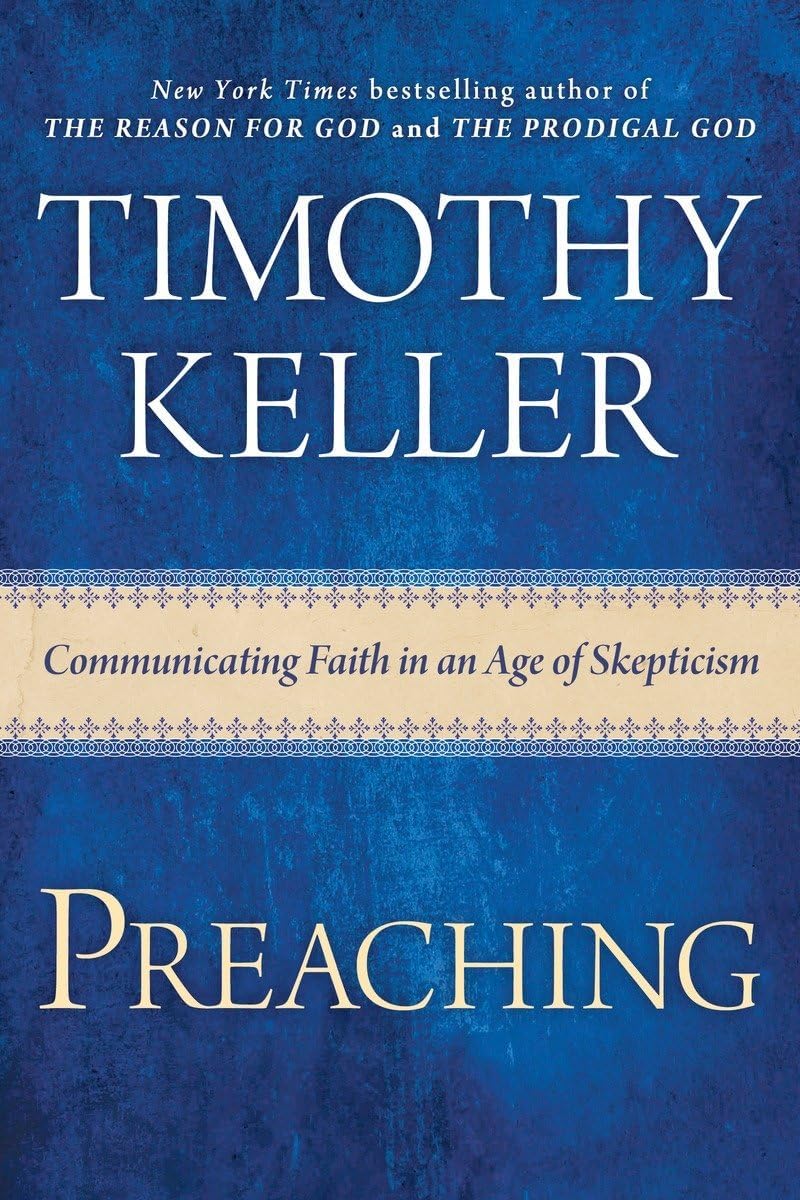
Preaching: Communicating Faith in an Age of Skepticism Hardcover – June 9, 2015
Product ID: 15233355
Buy anything from 5,000+ international stores. One checkout price. No surprise fees. Join 2M+ shoppers on Desertcart.
Desertcart purchases this item on your behalf and handles shipping, customs, and support to Uruguay.
Full description not available
G**D
A Helpful Book by a Respected Pastor Whose Writing Is Always Worth Reading
All Christians have a spiritual responsibility to “teach and admonish one another with all wisdom” (Col. 3:16). Some Christians have a further responsibility to teach the word of God more formally, whether in a Sunday School class or from the pulpit. While all Christians can read Tim Keller’s Preaching profitably, it is intended specifically for those with more formal responsibilities to communicate the faith. (Because most readers of this book will be pastors looking for sermon help, however, I’m going to refer throughout this review to preachers and preaching, instead of using broader terms like teaching or communication.)Keller divides his material into three parts.Part One, “Serving the Word,” argues that preachers should preach the Bible (Chapter 1), which means preaching the gospel (Chapter 2), which means preaching Jesus Christ (Chapter 3), about whom all Scripture is written (Luke 24:27). Keller recognizes that there are times when preachers should deliver topical sermons, but their bread-and-butter sermons should be expositional. Because Scripture tells the unified story of what God has done in Christ through the Spirit to accomplish our salvation, sermons should be gospel-centered. Two dangers need to be avoided: (1) “preaching a text, even about Jesus, without really preaching the gospel,” which is typical of moralistic preaching; and (2) “preaching ‘Christ’ without really preaching the text,” which is typical of proof-texting. To help avoid these dangers, Keller outlines six ways to preach Jesus from all of Scripture that are adequate to both the gospel and the context of a particular passage.Part Two, “Reaching the People,” opens with the recognition that preachers must contextualize their messages to their audiences (Chapter 4). Such contextualization has biblical precedent. For example, compare and contrast how Paul preached to Jews meeting in a synagogue (Acts 13:14–47) with how he preached to Gentiles meeting on Mars Hill (17:22–31). Contextualized preaching consists of a two-fold movement whereby sermons “adapt to the culture” as well as “confront the culture.” Because God created the world and humanity in his image, he has left traces of himself in all cultures. This makes adaptation possible. But humanity has sinned against God and distorted the goodness of his creation at all levels—individual and social, intellectual and emotional, spiritual and material. This makes confrontation necessary.Chapter 5, “Preaching and the (Late) Modern Mind,” is the best chapter in the book, in my opinion. It exposes the “baseline cultural narratives” that characterize the late-modern mind. (Keller prefers the term late-modern to postmodern because he thinks contemporary culture is “less a reversal of modernity than an intensification of its deepest patterns.”) These narratives include “the sovereign self,” “absolutely negative freedom,” “self-authorizing morality,” and “science as the secular hope.”Chapter 6, “Preaching Christ to the Heart,” is the second best chapter, in my opinion. It recognizes that people are affective beings, not merely intellectual ones. “Preaching cannot simply be accurate and sound,” Keller argues. “It must capture the listeners’ interest and imaginations; it must be compelling and penetrate to their hearts.”Part Three, “In Demonstration of the Spirit and of Power” consists of a single chapter about the character of preachers themselves. Keller writes, “your listeners will be convinced by your message only if they are convinced by you as a person.” Preaching, he goes on to say, thus deals with “text” (Bible-gospel-Christ), “context” (culture-heart), and “subtext” (what really motivates the preacher). Though Keller does not point this out himself, these three terms more or less correspond to the threefold division of classical rhetoric: logos (text), pathos (context), and ethos (subtext).Keller concludes the book with a helpful appendix about “Writing an Expository Message” that focuses on the goal of the biblical text, the theme of the sermon, an outline that develops this theme, and arguments, illustrations, and applications that flesh out this theme. The book concludes with 60+ pages of notes, roughly 20 percent of the entire book. These notes not only identify the source of quotations and books for further reading, they also extend Keller’s analysis. Because they are placed at the end of the book, however, they don’t distract from the development of his main themes. (If you are a fan of Jonathan Edwards, I encourage you to read note 28 on pages 271–275; it shows how Edwards contextualized his preaching to Indians at the Stockbridge Mission.)Though I found Preaching to be a helpful work, which was especially insightful on late modernity’s “baseline cultural narratives,” I nonetheless found myself asking a few questions.First, and this is impressionistic, I felt that some of Keller’s examples of how to preach Christ from all of Scripture were not adequate to the text’s context. For example, discussing the horrifying story of the Levite and his concubine (Lev. 19), Keller suggests the following as one of many possible ways to preach Christ from the passage: “When we see a man who sacrifices his wife to save his own skin—a bad husband—how can we not think of a man who sacrificed himself to save his spouse—the true husband?” I see Keller’s point, but is that really a way to find Christ in the text?Second, Keller defines the gospel in almost exclusively Pauline and Protestant Reformation terms: “we are saved through Christ alone, by faith alone, but not by a faith which remains alone. True salvation always results in good works and a changed life.” This is good and true, of course—see Ephesians 2:8–10, for example—but it fails to take into account other ways of summarizing the gospel, such as that of Jesus himself in Mark 1:15: “The time is fulfilled and the kingdom of God is at hand; repent and believe the gospel.” I can’t help but wonder whether the outline of a kingdom-gospel message fits neatly within Keller’s “metaoutline” for preaching:• Here’s what we face.• Here’s what we must do.• Why we can’t do it.• How Jesus did it.• How through faith in Jesus you should live now.Third, Keller’s conversation partners throughout the book are almost exclusively Calvinist. He does mention Protestant mainline preachers, but not evangelical Arminians, Methodists, or Wesleyan-Holiness preachers. (I’m an Arminian Pentecostal.) Given that these non-Calvinist evangelicals have produced quite a few well-known preachers, I can’t help but wonder whether they might have insights to share as well.In spite of these questions, Preaching is a valuable work by a respected pastor whose judgment on such matters is always worth listening to. I get the feeling I’ll be returning to this book again (and again).
D**E
Rocket Fuel for Expository Preachers
The two words that immediately come to mind when consideringTimothy Keller’s new book is: rocket fuel. Keller’s book is a supercharged approach to expository preaching.Preaching: Communicating Faith in an Age of Skepticism stands alone in book market that includes several approaches to preaching. Some books provide preachers with the nuts and bolts or the mechanics of preaching. Others focus on the rationale for expository preaching. Keller’s work includes both and so much more.Readers will be drawn to a few important items that stand out in this work:The Centrality of the GospelFirst, Keller is relentless about the necessity of gospel preaching. He stands with C.H. Spurgeon who famously admonished preachers to “preach a text and make a beeline to the cross of Christ.” Keller repeatedly challenges preachers to preach “Christ crucified,” to “preach Christ through every theme of the Bible.” Wherever the preacher finds himself in the biblical text, he must alert the listener to the person of Christ and the completed work of Christ. It is this feature that makes Keller’s work unique and should propel is work to the required reading list of every Bible College and Seminary course that pertains to preaching.The Importance of the HeartSecond, Keller focuses on the heart in biblical preaching:Preaching cannot simply be accurate and sound. It must capture the listeners’ interest and imagination; it must be compelling and penetrate to their hearts. It is possible to merely assert and confront and feel we have been very ‘valiant for truth,’ but if you are dry or tedious, people will not repent and believe the right doctrine you present. We must preach so that, as in the first sermon on Pentecost, hearers are ‘cut to the heart.’Dr. Keller walks readers through a critical discussion of the heart which is “the seat of the mind, will, and emotions, all together.” Critical to this discussion is the idea that expository preaching must move the heart to action. Keller notes, “It is all-important, then, that preaching move the heart to stop trusting and loving other things more than God … So the goal of the sermon cannot be merely to make the truth clear and understandable to the mind, but must also be to make it gripping and real to the heart.” Thus, Keller highlights the primacy of both the heart and the mind. To exclude the mind in the preaching endeavor will lead to contentless preaching. But to exclude the heart will necessarily lead to preaching which is void of application.The standout feature of this section is Keller’s treatment of Jonathan Edwards and his approach to the heart in preaching. Edwards refuses to pit the heart against the mind and argues for a view of preaching that integrates both. Keller does a terrific job of expounding Edwards’s work, Religious Affections and the impact such of view has on preaching.There is much to commend in Keller’s work on preaching. Readers are encouraged to dive in and benefit from this godly man who has mastered the preaching task. May the rocket fuel in Keller’s work launch many sermons into the stratosphere for the glory of God!Other titles that will serve preachers well include The Supremacy of God in Preaching by John Piper, He is Not Silent: Preaching in a Postmodern World by Al Mohler, The Kind of Preaching God Blesses by Steven Lawson, and Preaching and Preachers by Martyn Lloyd-Jones.I received this book free from the publisher. I was not required to write a positive review.4.5 stars
P**C
Good, but with some reservations
Subtitled ‘communicating faith in an age of scepticism’, the author sets out the importance of making Christ central to all preaching and placing Him at the core of all that we communicate.Keller explains how Christ can be preached from all Bible themes and characters (and should be) and also sets out how to preach into the prevailing culture.He emphasises the importance of ‘contextualisation’ – resonating with, yet challenging the culture around you.Keller commends: using accessible vocabulary; employing culturally respected authorities; demonstrating an understanding of people’s doubts and objections; affirming in order to challenge baseline cultural narratives; making gospel offers that push on the culture’s pressure points; and calling for gospel motivation.There's much to commend this textbook for evangelical preaching and many preachers will find much to engage with.I felt it would have been good to have said something about how God can also speak with people through other means (sacraments, nature, other people) than exclusively through preaching; and I felt that more could have said about the impact of social media on the preacher and the preacher's audience. I had to check the publication date to see that the book was not a re-publication of a much older volume.
A**R
If you want your sermons to be remembered and effective; read on!
As an amateur preacher I recognised that I needed to acquire outside assistance as I sought to improve my communication with congregations. I bought this book following a strong review in Christianity magazine. I have not read a great deal yet, hence restricting to four stars, but what I have read I have found invaluable. Interestingly I find I cannot read it like a book; picking it up and reading until the next meal (or duty!) Instead I will read for just a few minutes, put the book down, and try to apply what I have just been reading to the way I will deliver my next sermon - and it is exciting to see how both style and content are being shaped and definitely improved by this books teaching. I am particularly impressed by the depth of the treatment Timothy gives to his subject; preaching must come from the heart and be empowered by the Holy Spirit if it is to have both integrity and lasting impact. I have read about 10% of the book so far, but even to give a digest of that would over-load this review.
R**R
Preaching
Some really important insights here. Really made me think and encouraged me.helped my thin critically about some of the dreadful preaching I have experienced. I now know why it's dreadful.
C**8
Great for the learner preacher!
Shows the 'what and why' of Christian preaching in accessible language. Concentrates on making links between the Old and New Testaments, and the importance of being aware of the needs of the modern listener.
V**A
Essential for any serious evangelical preacher
I am about three quarters through this great book. Tim Keller sets out clear principles and uses practical illustration to bring his points to life. Anyone looking to work out a ministry of public preaching needs to digest what he says.It is deep book and not to be thought of as quick fix to effective ministry.
Trustpilot
2 months ago
1 month ago