We remain fully operational. Our teams are working around the clock to ensure your deliveries continue safely.

DOWNLOAD THE APP


Customer Services
Copyright © 2025 Desertcart Holdings Limited
DOWNLOAD THE APP
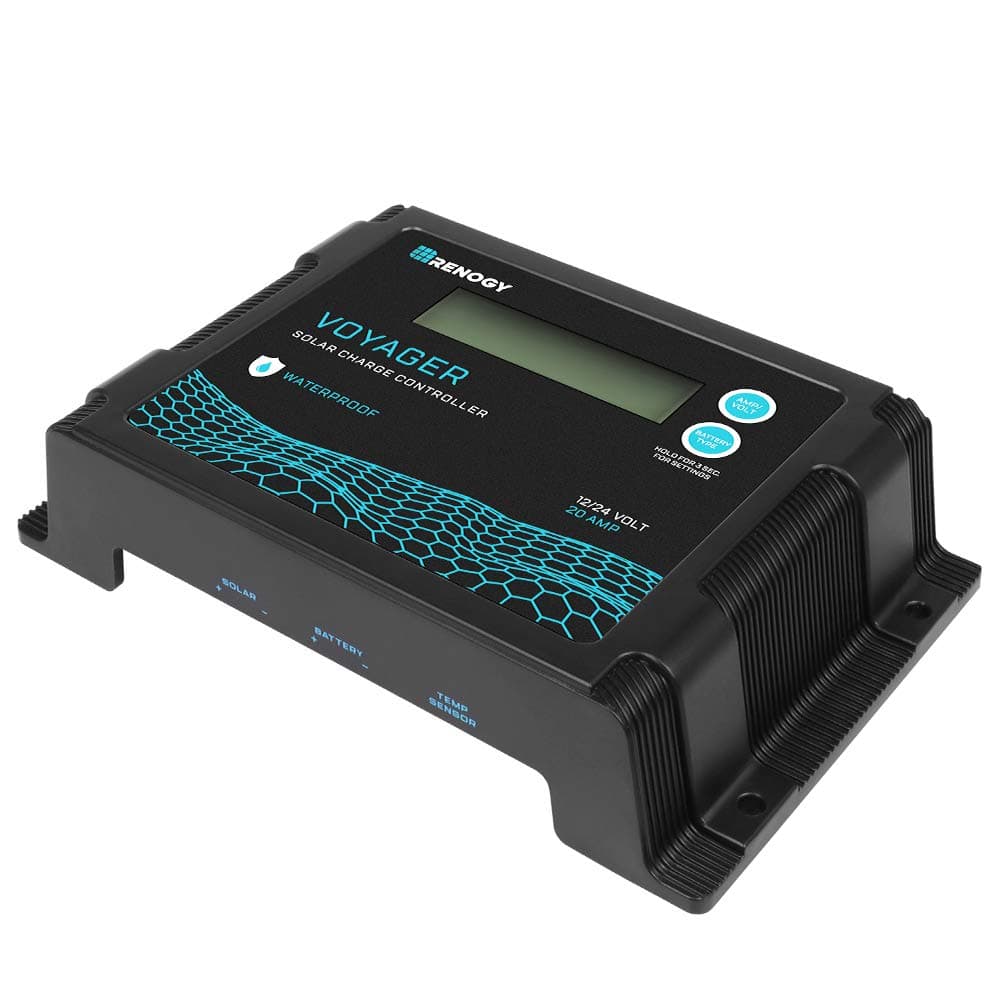

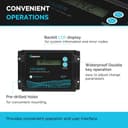


🔆 Power your adventures with confidence — the Voyager keeps you charged, rain or shine!
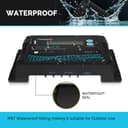
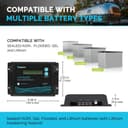
The Renogy Voyager 20A is a rugged, IP67 waterproof solar charge controller designed for 12V/24V systems. Featuring advanced 4-stage PWM charging technology, it supports multiple battery types including Lithium, AGM, Gel, and Flooded. Its backlit LCD provides real-time system data, while built-in protections ensure safe, efficient charging for RVs, boats, trailers, and off-grid setups.
















| ASIN | B07YXZMKD2 |
| Best Sellers Rank | #2,481 in Patio, Lawn & Garden ( See Top 100 in Patio, Lawn & Garden ) #1 in Renewable Energy Controllers |
| Brand Name | Renogy |
| Color | Black |
| Customer Reviews | 4.3 4.3 out of 5 stars (7,197) |
| Display Type | LCD |
| Global Trade Identification Number | 00810009713517 |
| Included Components | Voyager 20A Solar Charge Controller |
| Item Dimensions L x W x H | 6.08"L x 3.83"W x 1.4"H |
| Item Type Name | Solar Charge Controller |
| Item Weight | 8.8 Ounces |
| Manufacturer | Renogy |
| Material Type | Plastic |
| Operating Temperature | 149 Degrees Fahrenheit |
| UPC | 810009713517 |
| Voltage | 12 Volts |
| Warranty Description | 2-year material and workmanship warranty |
H**0
Works much better than the knock off
I like the battery types this controller can support. You can program the load to kick on when the panel stops producing power, though I'm using a photo sensor cell at the moment. Overall, I'm pleased so far. Oh, and not to mention the blue tooth addon.
T**Y
Exactly what I needed
I have an IRLP node with a 12V lithium battery for backup should the power go out and I needed a charge controller as the DC in I have is about 20V, which is naturally too high to simply directly connect. This controller is exactly what I needed. It will do SLA, flooded and lithium chemistries, you need to select type of battery manually, and you can dial in what charge voltage you want, in my case, according to the battery I have connected, it wants to see 14.4V. You can set up the LCD readout to display what you want for the most part and it has performed flawlessly since I have had it. The instructions are fairly clear on what you need to do to set it up and it actually is pretty easy. It has worked well during outages, switching from the input source to the battery is seamless. I am very happy with this controller and have already recommended this brand to my friends that were looking for one for their various reasons.
N**K
A good simple controller
Bought a 20A version for a small DIY solar for a shed. It is 100% waterproof, completely sealed off, a nice feature to have. The instruction manual is not the best but the device is very easy to install, just connect the wires (the battery first) and it will start working, no on/off switch. You need to select your battery type and the charging voltage. The display is quite primitive but it does the job. While working, it cycles through the input and output data. It starts to show error codes if the input current or battery charge are too low. Would be better if they had something more informative. It offers a temperature sensor as an option, but mine already came with it. It is helpful for optimal charging, but note that the sensor won't do anything if lithium is selected, it must have it's own BMS. In other words, you don't need this sensor if you have a lithium battery. If anything to complain about is that it is supposed to be installed on a wall, but there's no access to wires when it is attached to the wall, so if later you need to re-connect something you'll have to take the device off the wall for that. Overall, seems to be a good cost/benefit choice for a small system, let's see if it lasts. Mine is about 9 month old now and it had no issues, survived the NY winter.
L**.
worked great and good quality
worked great and good quality
P**.
Simple, reliable PWM controller. Gets the job done.
I built a small, off-grid solar system for my shed to power LED lights and a small ventilation fan that consisted of a 50W 12V-class panel (open circuit voltage around 20V), a 10 amp-hour LiFePo4 battery, and this charge controller. In that setup, it's worked great. It's a basic, workaday PWM charge controller that had worked great in my shed for several years until I decided to upgrade the system and added more panels and put in an MPPT controller. Pros: - Small size. - Reasonable price. - Terminals hold wires firmly and are easy to loosen and tighten. (Tip: crimp ferrules onto the ends of stranded wire rather and insert them into the terminals. Clamping stranded wire into the terminals is a bit harder, messier, and more prone to error.) - Backlit screen. - Easy to configure for flooded, AGM, and gel lead-acid batteries, as well as for LiFePo4 batteries. - Charging voltage is configurable for LiFePo4 batteries (in case you want to stop charging at, say, 14.4V rather than 14.6V). - USB ports are handy for charging phones or powering other devices. - It has options for turning the load on and off at and for various times. For example, the load can be turned on all the time, toggled with the push of a button, or when the sun sets (either until morning, or for various periods of time after sunset). - It supports -- but does not include -- a Renogy Bluetooth module that allows for remotely changing settings, seeing the current status, etc. from the Renogy app. - Manual is clearly written in English and explains all settings and options clearly. Cons: - This is a PWM controller which, while simpler, inherently limits its efficiency and requires a bit more planning relative to an MPPT controller. For example, connecting multiple 12V-class panels in series (or using one with a nominal open-circuit voltage greater than about 20V) provides no benefit. They need to be connected in parallel, and then one must make sure not to exceed the 10A current rating of the controller (it does not have any current limiting capability). - Turning on the load also enables the USB ports, which consume about 100mA of current when idle. With the load off, the current consumed by the controller itself is negligible. Still, it'd be nice to have the load on and disable the USB ports. - The on-device settings for having the load switched on or off at various times of day are unclear and require consulting the manual to know what the various codes mean. - The Bluetooth module is very basic and neither it nor the Wanderer 10 have any sort of data logging. You can see the current status and change settings, but no historical data is available. You apparently need some other Renogy device to accomplish that. - The Renogy app has many features, such as social features, promotions, etc. that distract from the core functionality of managing the controller. - Although the controller is reasonably priced, but the Bluetooth module is costly. Combined, their cost exceeds that of a reputable competitor's MPPT controller with built-in Bluetooth, data logging, a better app, and better integration with other devices and remote monitoring. In short, it's an inexpensive, simple PWM charge controller. If that's what you need, it'll do the job quietly and without complaint for years. However, if you want to use the Bluetooth module with this controller, you're limited to live monitoring and changing of settings only. No data logging or historical data is available. For less money than the controller + Bluetooth module, you can get a comparable-power-limit MPPT controller from a major competitor that includes better monitoring, data logging, and higher efficiency.
N**L
No complaints at all so far. Plugged a 160W Kings Folding panel into it, and in late afternoon, Winter sun on the east coast of Australia, angled towards the sun the best I could, I was pulling 7.85A out of this controller which is more than enough to keep my fridge running indefinitely off my lithium battery. Don't let people tell you that an MPPT is superior, because for small panels, there's very little difference in my experience. Excellent controller that I bought as a backup in case my CTEK blows an internal fuse (again) and is totally useless. Build quality is good, hard plastic with an aluminium base plate. The grub screws hold 8AWG cable very well and it won't pull out on their own easily. The LED indicators are very bright and easy to see in sunlight too.
C**E
Son cargadores solares de excelente calidad y modernos, vienen hasta con número de serie, funcionan muy bien con batería LiFePO4 y además vienen con la función de TIMER, los recomiendo ampliamente para cualquier tipo de proyecto fotovoltaico de iluminación.
A**R
Used to maintain trolling battery, worked great
P**D
I may have gotten a Friday afternoon item, you know , one of those things that were not quite finished off properly because the finishing hooter went off and the production line shut down and my unit was stuck in a box untested. Unfortunately it didn't support Lithium batteries, it said that it did in the advert, it said that it did on the Renogy webpages, but it didn't say that on the LCD display or on page 13 of the manual that came in the box with the unit. I contacted Renogy and after an hour of sending photos of my unit, serial number, receipt and explaining the situation it was suggested that I contact Amazon and ask them to sort it out. Anyway, they were as useful as a chocolate fireguard. Amazon, on the other hand, refunded me. So, now I am going to order a cheap mickey mouse controller, like the one in my shed's solar system, no branding, cheap as chips but it works. So much for going with a branded big name product. When I ran the Wanderer I couldn't even get more that 3,45v out of the load terminals, weird.... panel was producing 34v dc, battery 13.8v and load terminals 3.45v. Good luck with yours.
E**Z
Los equipos Renogy funcionan sin problemas, son fáciles de configurar y seleccionar el tipo de batería a utilizar, la identificación automática del voltaje es otro punto a su favor
Trustpilot
2 months ago
1 month ago