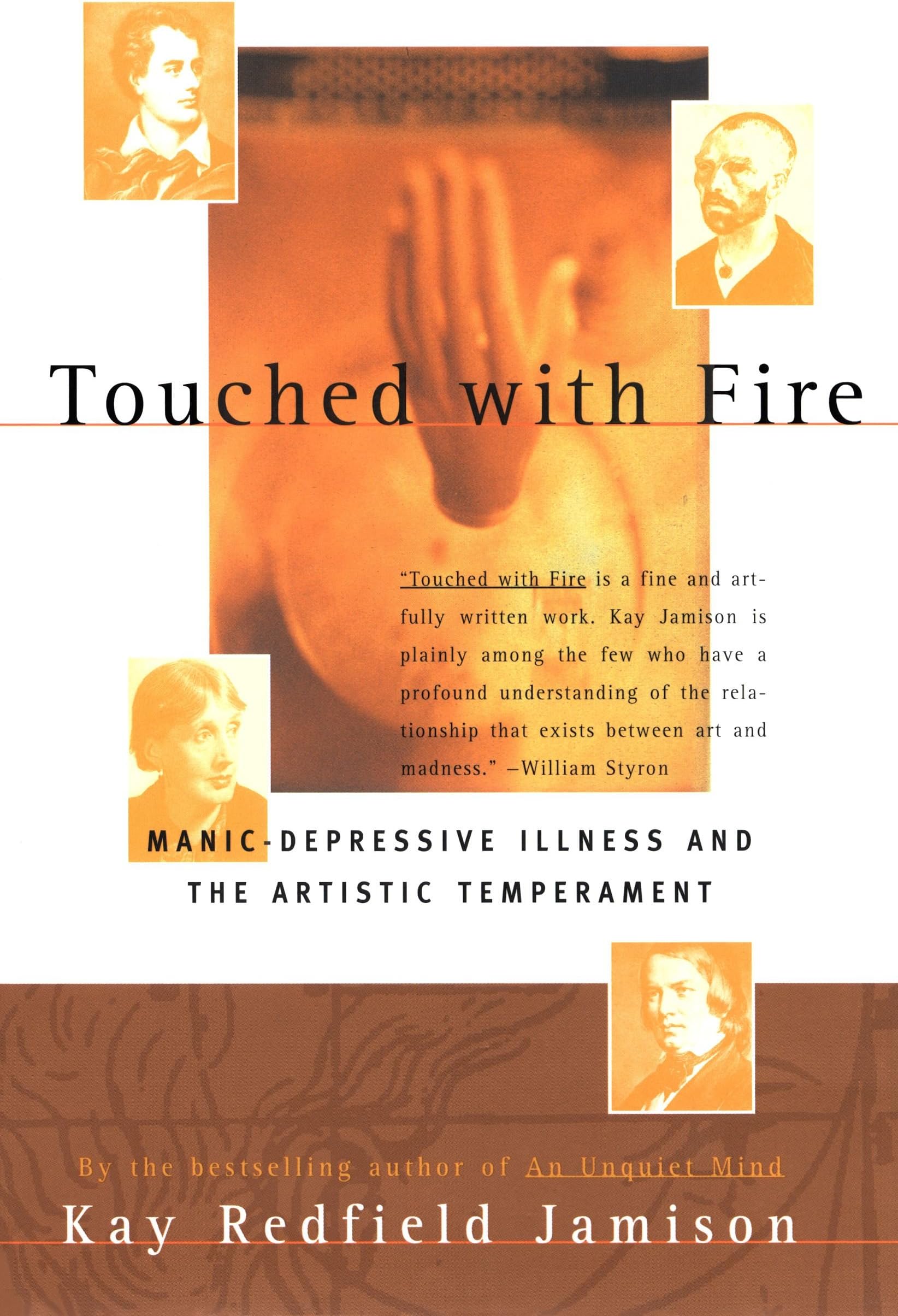
Touched with Fire: Manic-Depressive Illness and the Artistic Temperament
Product ID: 1702425
Buy anything from 5,000+ international stores. One checkout price. No surprise fees. Join 2M+ shoppers on Desertcart.
Desertcart purchases this item on your behalf and handles shipping, customs, and support to Uruguay.
Touched with Fire: Manic-Depressive Illness and the Artistic Temperament [Jamison, Kay Redfield] on desertcart.com. *FREE* shipping on qualifying offers. Touched with Fire: Manic-Depressive Illness and the Artistic Temperament Review: A Well Executed and Informative Book - Last night I finished reading Kay Redfield Jamison's book: Touched With Fire: Manic-Depressive Illness and the Artistic Temperament, and I would like to share with you some of the things that I've learned from her book. Jamison makes it clear that many people with extraordinary artistic abilities were (or are) manic-depressive, and that the manic-depression they suffered from no doubt contributed--positively--to their creative works. She also points out that, for the average person (meaning those who are not especially gifted with high intellectual and creative abilities), manic-depression can simply be a destructive and debilitating condition which interferes with their otherwise average and ordinary lives. Jamison studies, at length, the lives of many famous artists (mostly writers) whose works have undoubtedly been influenced, positively, by their having been (most of the artists' lives she studies are now dead) manic-depressive. What I found fascinating was just how similar these artists experience with manic-depression, as related to us by Jamison, in their words, mirrors my own experience. Jamison makes a good case by showing how these artists' manic-depression gave them an unusual ability to create works of art that were (or are) exceptionally transcendental in character because it gave them the ability to create, from both extremes of mania and depression, especially creative and holistic visions of the world as they perceive it to be. Without the two extremes of manic-depression, Jamison doubts that these artists' works would have been as inspired and inspirational to others as they are. These artists' manage to create--from of the depths of their despair and from the highs of their mania (or hypomania)--works of art that transcended the world as it is perceived by most people. As I mentioned, Jamison makes it clear that most people who suffer from manic-depression are not creative. For these people, manic-depression is a hindrance to their living what would otherwise be ordinary, normal lives. But for those whose manic-depression is coupled with keen insight, artistic temperament, and high intellectual abilities, the results are often the unusual artistic ability to communicate to society a unique vision of the world that far surpasses the ordinary vision of the world had by "normal" individuals. Jamison points out how artists with melancholy temperaments tend to brood over things, like the meaning of life, which most people will only give thought to occasionally. They seem obsessed with forming a larger (metaphysical) view of the world and, when coupled with the highs and lows of manic-depression, they are enabled to put together, as a whole, that which otherwise would be simply scattered thoughts, emotions, and life-experiences. In the depths of their depression, an artist with manic-depression can contemplate the deeper meanings of thought, emotions, and life-experiences, which allows them to form a holistic view of the world from their many and varied experiences of the world itself. The world is filled with examples of such polar opposites in nature: day and night, summer and winter, joy and sorrow, and these aspects of the natural world are mirrored the minds of manic-depressive artists. In the highs of mania or hypomania, the artist with manic-depression is able to work and to create with extraordinary energy and drive, which gives them a distinct advantage over the artist who do not suffer from manic-depression. Jamison points up the fact that artists who are not manic-depressive certainly do create extraordinary works of art, but the main point of her book is to say that there is a distinct and undeniable link between artistic creativity and manic-depression in some people. And she is also careful to point out the very real dangers of manic-depression, especially if left untreated. For one thing, she informs us that suicide is the leading cause of death for those suffering from manic-depression; surpassing even cancer and heart disease as the leading causes of death. Not only that, but those suffering from manic-depression--more so than those suffering from any other mental illnesses--are the most likely to take their own lives (especially when they are in a mixed-state condition). This fact, Jamison assures us, cannot and should not be overlooked. And she tells us that the person who is manic-depressive, but who is not of above average intellectual and artistic ability, should be taking psychotropic medications (such as lithium) in order to help them to control their moods. But, on the other hand, she reminds us that psych meds can also inhibit some artist's ability to create great works of art. She concludes her book with a frightening vision of the near future; of how medical science will continue to seek a "cure" for manic-depression through genetic manipulation and gene therapies and of the potential loss---both for the artistic individual suffering from manic-depression and for our society--of great works of creative genius, birthed from the artists' struggles with both deep depression and high energy mania, which would otherwise never exist. And that, for me, is a very frightening thought. As Jamison tells us, most artists who are manic-depressive seek psychiatric help, but many of them do not; and some even choose, willingly, to suffer the highs and lows because fear they will lose their unique perspective of the world around them and their relationship to it if they were to begin a regime of multiple psychotropic medications. For these artists, being manic-depressive is an important part of who they are and they do not wish to be medicated into mediocrity. I sympathize with these artists, because I, too, fear what would become of me if I were to medicate my condition. The fact that I am more sensitive emotionally and intellectually to the world around me, and to God, makes me who I am; and I have no desire to change who I am. Yes, it is very difficult, at times, to feel the emotional weight of the world's suffering on me, but I wouldn't trade it for anything. I think I bear only a tiny fraction of the anguish that God himself must feel and I feel privileged to be allowed to feel that weight. I think God wants me to learn from it, to express it to others, and to produce artistic works that will communicate those feelings. Jamison's book is very well executed and very informative. Perhaps, like me, you suffer from similar psychological and emotional anguish; perhaps, like me, you don't think you need to read her book because you don't think you are manic-depressive. Well, I finally realized that I was, which is why I finally read the book, and if you read her book you may realize that you are manic-depressive too. As Jamison tells us, manic-depressive illness is, sadly, often (and easily) misdiagnosed. She also points out that, contrary to popular belief, manic-depressive are quite normal and in good mental health most of the time. It's hardly full blown insanity, unless and until one finally goes over the edges of either of the two emotional extremes. One, very important thing that I noticed about the lives of the artists Jamison examines is how few (if any) of them had any relationship with Christ. Call me crazy, but if it weren't for the fact that the hope which Christ provides me is the anchor for my soul (Greek: psuke; meaning: psyche, or soul; see Hebrews 6:19), I probably would have become a raving lunatic a long, long time ago. Review: An Analysis of the Artistic Temperament - Who is this, who is this in the night of the heart? It is the thing that is not reached, the ghost seen by the soul... ~Sorley MacLean Touched with Fire reveals its secrets in startling revelations and comforting commentary. Throughout this brilliant work, Kay Redfield Jamison exhibits an insightful and calmly observant approach in the midst of manic-depressive complexity. She explores the reasons artists, writers, and composers are often fearful of the dampening of creativity through the use of chemicals like lithium. Although she often notes the tendency towards various addictions artists use to escape the erratic nature of mood disorders. The creative temperament seems to feed off emotional turmoil and often in the works of great poets we can feel the soul's turbulence. The reality of heightened imaginative powers, depression, insomnia, fatigue, rapid thoughts, inflated self-esteem, panic attacks, rage and emotional intensity of various varieties can all swim about in an ocean of ever changing periods of heightened creativity and suicidal tendencies. Within this ocean, brilliance is often born and fed by the storms raging in artist's minds. For the most part the author explains how many can life a normal life, yet as we read the descriptions and excerpts, we soon realize many danced too close to the cliff of despair and became a danger to themselves. Kay Redfield Jamison presents sweeping overviews of many authors and then delves into individual experience. She uncovers the lives of Robert Schumann, Ernest Hemingway, Vincent Van Gogh, Herman Melville, Virginia Woolf, Samuel Taylor Coleridge and Alfred, Lord Tennyson. According to the author and extensive analysis of current research, moody musicians, volatile poets and troubled artists may in fact be bipolar. This theory is explored in depth with over one-third of the book dedicated to cataloging the researcher's sources. There is much to learn here, like the difference between cyclothymia and manic-depressive illness. Some of the artists heal themselves through artistic expression, especially in May if they don't commit suicide in the same month. Others produce more writing in autumn. Poetry led me by the hand out of madness. ~Anne Sexton As the lives of numerous mercurial writers are explored, a common thread of creativity weaves itself into a blanket of madness which seems to seek to suffocate its victims with torturous emotions and dark nights of the soul. This then becomes a fascinating and intellectual read for anyone who has an interest in writing, poetry, psychiatry or the artistic temperament. If you write poetry or enjoy writing in general, this book could be most revealing and will explain why at times you might stay awake for 24 hours writing like mad and then have absolutely no desire to write for weeks at a time. While the author focuses on more extreme cases of bipolar disorder, she does give hope to the world by explaining that many who have bipolar disorder do mostly live normal lives. If you can call being on an eternal rollercoaster of intense emotions normal or even bearable throughout an entire life. While people who are bipolar may have periods when they feel absolutely fine, there is always the fear of the unknown, the dark night that is again fast approaching. After reading this book you will understand authors like Dorothy Parker and Virginia Woolf in a new light even though the author doesn't mention Parker. ~The Rebecca Review
| Best Sellers Rank | #54,479 in Books ( See Top 100 in Books ) #18 in Coping with Bipolar Disorder #24 in Social Services & Welfare (Books) #51 in Personality Disorders (Books) |
| Customer Reviews | 4.5 4.5 out of 5 stars (752) |
| Dimensions | 5.5 x 0.9 x 8.44 inches |
| Edition | Reissue |
| ISBN-10 | 068483183X |
| ISBN-13 | 978-0684831831 |
| Item Weight | 2.31 pounds |
| Language | English |
| Print length | 384 pages |
| Publication date | October 18, 1996 |
| Publisher | Free Press |
A**.
A Well Executed and Informative Book
Last night I finished reading Kay Redfield Jamison's book: Touched With Fire: Manic-Depressive Illness and the Artistic Temperament, and I would like to share with you some of the things that I've learned from her book. Jamison makes it clear that many people with extraordinary artistic abilities were (or are) manic-depressive, and that the manic-depression they suffered from no doubt contributed--positively--to their creative works. She also points out that, for the average person (meaning those who are not especially gifted with high intellectual and creative abilities), manic-depression can simply be a destructive and debilitating condition which interferes with their otherwise average and ordinary lives. Jamison studies, at length, the lives of many famous artists (mostly writers) whose works have undoubtedly been influenced, positively, by their having been (most of the artists' lives she studies are now dead) manic-depressive. What I found fascinating was just how similar these artists experience with manic-depression, as related to us by Jamison, in their words, mirrors my own experience. Jamison makes a good case by showing how these artists' manic-depression gave them an unusual ability to create works of art that were (or are) exceptionally transcendental in character because it gave them the ability to create, from both extremes of mania and depression, especially creative and holistic visions of the world as they perceive it to be. Without the two extremes of manic-depression, Jamison doubts that these artists' works would have been as inspired and inspirational to others as they are. These artists' manage to create--from of the depths of their despair and from the highs of their mania (or hypomania)--works of art that transcended the world as it is perceived by most people. As I mentioned, Jamison makes it clear that most people who suffer from manic-depression are not creative. For these people, manic-depression is a hindrance to their living what would otherwise be ordinary, normal lives. But for those whose manic-depression is coupled with keen insight, artistic temperament, and high intellectual abilities, the results are often the unusual artistic ability to communicate to society a unique vision of the world that far surpasses the ordinary vision of the world had by "normal" individuals. Jamison points out how artists with melancholy temperaments tend to brood over things, like the meaning of life, which most people will only give thought to occasionally. They seem obsessed with forming a larger (metaphysical) view of the world and, when coupled with the highs and lows of manic-depression, they are enabled to put together, as a whole, that which otherwise would be simply scattered thoughts, emotions, and life-experiences. In the depths of their depression, an artist with manic-depression can contemplate the deeper meanings of thought, emotions, and life-experiences, which allows them to form a holistic view of the world from their many and varied experiences of the world itself. The world is filled with examples of such polar opposites in nature: day and night, summer and winter, joy and sorrow, and these aspects of the natural world are mirrored the minds of manic-depressive artists. In the highs of mania or hypomania, the artist with manic-depression is able to work and to create with extraordinary energy and drive, which gives them a distinct advantage over the artist who do not suffer from manic-depression. Jamison points up the fact that artists who are not manic-depressive certainly do create extraordinary works of art, but the main point of her book is to say that there is a distinct and undeniable link between artistic creativity and manic-depression in some people. And she is also careful to point out the very real dangers of manic-depression, especially if left untreated. For one thing, she informs us that suicide is the leading cause of death for those suffering from manic-depression; surpassing even cancer and heart disease as the leading causes of death. Not only that, but those suffering from manic-depression--more so than those suffering from any other mental illnesses--are the most likely to take their own lives (especially when they are in a mixed-state condition). This fact, Jamison assures us, cannot and should not be overlooked. And she tells us that the person who is manic-depressive, but who is not of above average intellectual and artistic ability, should be taking psychotropic medications (such as lithium) in order to help them to control their moods. But, on the other hand, she reminds us that psych meds can also inhibit some artist's ability to create great works of art. She concludes her book with a frightening vision of the near future; of how medical science will continue to seek a "cure" for manic-depression through genetic manipulation and gene therapies and of the potential loss---both for the artistic individual suffering from manic-depression and for our society--of great works of creative genius, birthed from the artists' struggles with both deep depression and high energy mania, which would otherwise never exist. And that, for me, is a very frightening thought. As Jamison tells us, most artists who are manic-depressive seek psychiatric help, but many of them do not; and some even choose, willingly, to suffer the highs and lows because fear they will lose their unique perspective of the world around them and their relationship to it if they were to begin a regime of multiple psychotropic medications. For these artists, being manic-depressive is an important part of who they are and they do not wish to be medicated into mediocrity. I sympathize with these artists, because I, too, fear what would become of me if I were to medicate my condition. The fact that I am more sensitive emotionally and intellectually to the world around me, and to God, makes me who I am; and I have no desire to change who I am. Yes, it is very difficult, at times, to feel the emotional weight of the world's suffering on me, but I wouldn't trade it for anything. I think I bear only a tiny fraction of the anguish that God himself must feel and I feel privileged to be allowed to feel that weight. I think God wants me to learn from it, to express it to others, and to produce artistic works that will communicate those feelings. Jamison's book is very well executed and very informative. Perhaps, like me, you suffer from similar psychological and emotional anguish; perhaps, like me, you don't think you need to read her book because you don't think you are manic-depressive. Well, I finally realized that I was, which is why I finally read the book, and if you read her book you may realize that you are manic-depressive too. As Jamison tells us, manic-depressive illness is, sadly, often (and easily) misdiagnosed. She also points out that, contrary to popular belief, manic-depressive are quite normal and in good mental health most of the time. It's hardly full blown insanity, unless and until one finally goes over the edges of either of the two emotional extremes. One, very important thing that I noticed about the lives of the artists Jamison examines is how few (if any) of them had any relationship with Christ. Call me crazy, but if it weren't for the fact that the hope which Christ provides me is the anchor for my soul (Greek: psuke; meaning: psyche, or soul; see Hebrews 6:19), I probably would have become a raving lunatic a long, long time ago.
T**W
An Analysis of the Artistic Temperament
Who is this, who is this in the night of the heart? It is the thing that is not reached, the ghost seen by the soul... ~Sorley MacLean Touched with Fire reveals its secrets in startling revelations and comforting commentary. Throughout this brilliant work, Kay Redfield Jamison exhibits an insightful and calmly observant approach in the midst of manic-depressive complexity. She explores the reasons artists, writers, and composers are often fearful of the dampening of creativity through the use of chemicals like lithium. Although she often notes the tendency towards various addictions artists use to escape the erratic nature of mood disorders. The creative temperament seems to feed off emotional turmoil and often in the works of great poets we can feel the soul's turbulence. The reality of heightened imaginative powers, depression, insomnia, fatigue, rapid thoughts, inflated self-esteem, panic attacks, rage and emotional intensity of various varieties can all swim about in an ocean of ever changing periods of heightened creativity and suicidal tendencies. Within this ocean, brilliance is often born and fed by the storms raging in artist's minds. For the most part the author explains how many can life a normal life, yet as we read the descriptions and excerpts, we soon realize many danced too close to the cliff of despair and became a danger to themselves. Kay Redfield Jamison presents sweeping overviews of many authors and then delves into individual experience. She uncovers the lives of Robert Schumann, Ernest Hemingway, Vincent Van Gogh, Herman Melville, Virginia Woolf, Samuel Taylor Coleridge and Alfred, Lord Tennyson. According to the author and extensive analysis of current research, moody musicians, volatile poets and troubled artists may in fact be bipolar. This theory is explored in depth with over one-third of the book dedicated to cataloging the researcher's sources. There is much to learn here, like the difference between cyclothymia and manic-depressive illness. Some of the artists heal themselves through artistic expression, especially in May if they don't commit suicide in the same month. Others produce more writing in autumn. Poetry led me by the hand out of madness. ~Anne Sexton As the lives of numerous mercurial writers are explored, a common thread of creativity weaves itself into a blanket of madness which seems to seek to suffocate its victims with torturous emotions and dark nights of the soul. This then becomes a fascinating and intellectual read for anyone who has an interest in writing, poetry, psychiatry or the artistic temperament. If you write poetry or enjoy writing in general, this book could be most revealing and will explain why at times you might stay awake for 24 hours writing like mad and then have absolutely no desire to write for weeks at a time. While the author focuses on more extreme cases of bipolar disorder, she does give hope to the world by explaining that many who have bipolar disorder do mostly live normal lives. If you can call being on an eternal rollercoaster of intense emotions normal or even bearable throughout an entire life. While people who are bipolar may have periods when they feel absolutely fine, there is always the fear of the unknown, the dark night that is again fast approaching. After reading this book you will understand authors like Dorothy Parker and Virginia Woolf in a new light even though the author doesn't mention Parker. ~The Rebecca Review
B**N
Great book.
I have read this book several times. Made me feel better about my diagnosis of being bi-polar at age 52. Now I am 70. My new doctor says I'm not bi-polar. It was menopause causing my mood swings. Bought 3 copies in the past and gave one to each of my Daughters and my Mother.
K**M
very well researched and presented
I learned a lot. I wonder if there are more female writers and artists one could profile to round out the examples? The profiles are very well researched.
T**T
Definite Must Read
Dr. Jamison's scholarship on manic depression and artists/musicians/writers is impeccable. I often wondered about how mental illness impacted those who were gifted artistically and the author didn't disappoint. She quoted from the journals and letters of the sufferers and gave her own medical opinions. This book is a must read.
R**E
ça va
P**E
This book was all I expected. The best parts were the Lives of the Artists although it is strange that their biographers have not picked up on their disabilities in the same way, for example Lord Tennyson gets a very good and positive rating on his temperament from almost all biographers. The objective of the book was accomplished in that there are similarities between creative and manic depressive temperaments. I am not sure anyone with the condition will benefit from it as it is a very depressing read whereas the families, relations and friends of sufferers will definitely benefit enormously and it is for them that I recommend the book.
P**A
Interesante!
A**R
If you have been diagnosed with Bipolar Disorder (also known as manic-depressive illness), or if someone you know has been, get a copy of this book and pay especially close attention to pages 125 to 135. If this does not explain this condition to the reader, highly likely, nothing else will. This is a very highly authoritative work on Bipolar Disorder.
F**O
Great book
Trustpilot
2 weeks ago
2 weeks ago