⚡ Power up your precision with Tekpower’s analog edge!
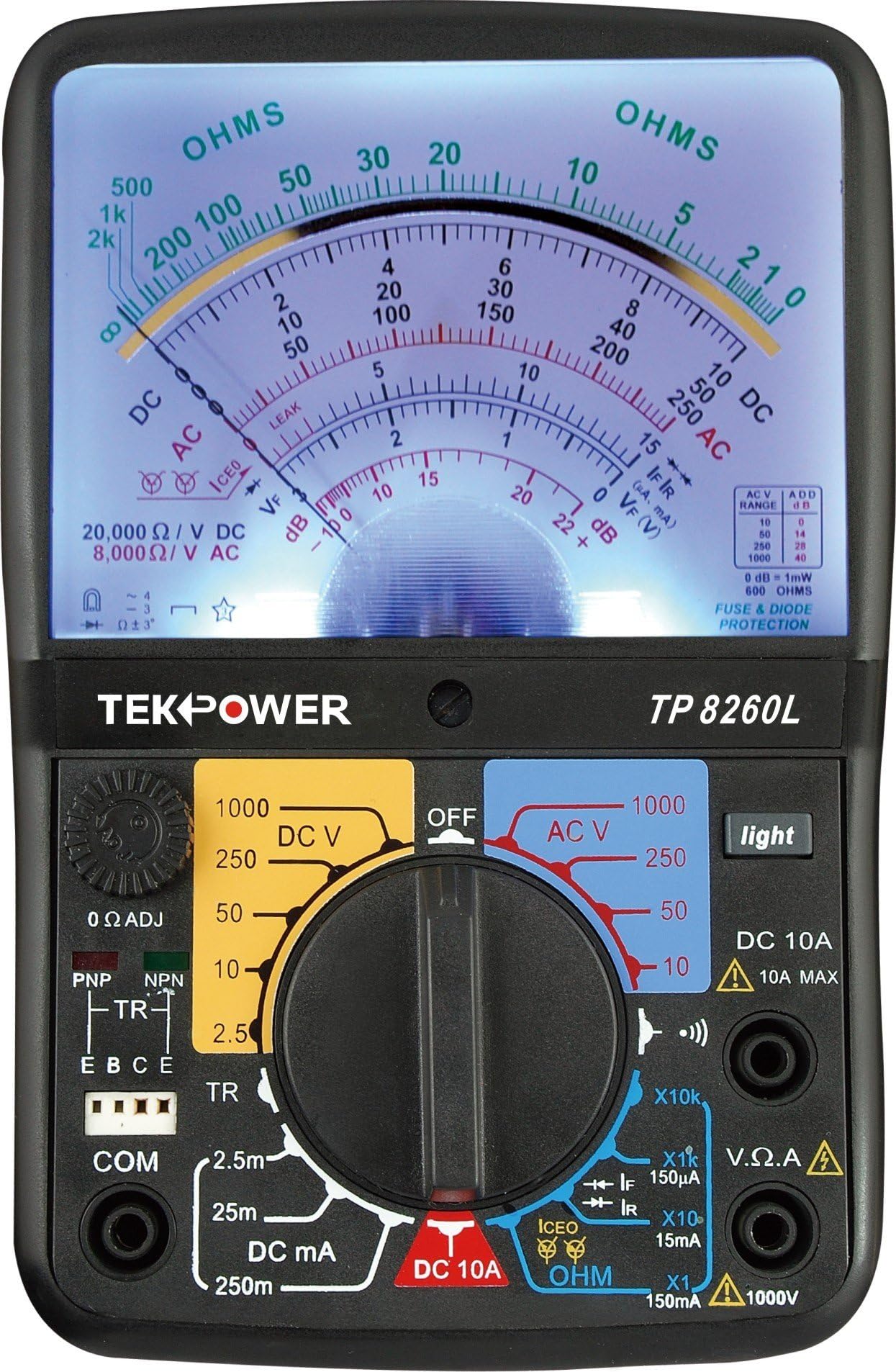
The Tekpower TP8260L is a robust analog multimeter designed for professionals and enthusiasts alike, offering a wide 20-range measurement capability including up to 1000V DC voltage, 10A DC current, resistance, continuity, decibel levels, and diode testing. Featuring a handy backlight for dark environments and a dedicated transistor test dock for PNP and NPN types, it meets EN61010/IEC1010 CAT II 600V safety standards. Its durable protective case and 1-year warranty make it a reliable, cost-effective choice for accurate analog measurements in diverse settings.
| ASIN | B00MJKS0EM |
| Best Sellers Rank | #426,864 in Tools & Home Improvement ( See Top 100 in Tools & Home Improvement ) #700 in Multi Testers |
| Brand | Tekpower |
| Brand Name | Tekpower |
| Color | Black |
| Customer Reviews | 4.1 out of 5 stars 376 Reviews |
| Item Dimensions | 6.25 x 4 x 1.25 inches |
| Item Weight | 14 Ounces |
| Item dimensions L x W x H | 6.25 x 4 x 1.25 inches |
| Manufacturer | Tekpower |
| Measurement Type | Multimeter |
| Minimum Operating Voltage | 2.5 Volts |
| Model | TP8260L |
| Power Source | Battery Powered |
| Specification Met | En61010/Iec1010 |
| Style | Standard |
| Style Name | Standard |
| UPC | 857852005048 |
| Unit Count | 1.0 Count |
B**.
A reasonably accurate and functional multimeter for its price range
I bought this device because I needed an analog multimeter for a personal project. I didn't want to spend more than the cost of this for a more reliable one, so this one seemed to meet my needs. After ordering the multimeter, when I saw the frequently returned item warning, I considered canceling the order. I don't regret I didn't do it. This is a low-cost analog multimeter. As such, we shouldn't expect it to be as reliable as top-of-the-line ones, like a Simpson, the ones from Hioki, Sanwa (not to be confused with the cheap copies, like Sunwa), or even most digital multimeters. Still, it met my expectations. For all the simple tests I ran, it showed an accuracy that was within the specified margin of error (3% full scale for DC voltage, 4% full scale for AC voltage and DC current and 3% full arc for resistance). The build quality is generally good. One aspect that particularly call my attention was the lubrication of the rotary switch contacts. This is something that I usually only find on more expensive devices. On the other hand, the test probes are of low quality. It also came with all the batteries included (2xAA + 1x9v), although they were cheap zinc-carbon batteries from a chinese brand. Unlike the description, it seems to me that the 10A jack is not protected by a fuse and only the VΩA jack is connected to a F0.5A/250V fuse. Inside, there are 3 calibration trimmers: The upper one for voltage, the middle for low current and the lower one for the 10A current. It allows separate adjustments for voltage and current, unlike some other multimeters, which only have one trimmer available for adjusting both at the same time. Although the multimter's accuracy was within its specification, I made some minor adjustments in the trimmers, using a DMMCheck Plus as reference device for the voltage and low current, which resulted in measurements for DCV and DCA that were practically "spot on". The resistance accuracy could be better. For example, when measuring 100Ω on the x10 scale, the needle remained at 9.5 (95Ω) instead on 10, even with proper adjustments after short circuiting the test leads and even with high end test leads from Probe Master. Of course, in this case, perhaps, I'm being a perfectionist, because this result is still inside the 3% full arc (which should be approximately between 114.5Ω and 87.5Ω). It has a background light button, that once pressed, stays on for about 25 seconds. There is not other way to turn off the light (other than removing the batteries). Also, when turning on the light, I measured a drop in the x10K resistance scale voltage from 12.20V to 11.57V. When I was measuring a 100KΩ resistor, with the light off, once I turned it on, this drop in voltage resulted in the movement of the needle from the 9.5 value in the Ω scale line (95KΩ) to 10.5 (100.5KΩ). To prevent this, it is necessary to short the leads and perform a new adjustment whenever the light is on or off, and do not turn the light on during measurements. This procedure is only necessary on the x10K scale, as I didn't notice any voltage drop in the other resistance scales, when the light was turned on. When I performed the continuity test, by shorting the provided test leads, the buzzer responded slowly with a raspy sound. But with good quality test leads, the buzzer responded perfectly, with a clear sound. I was able to measure the forward-biased voltage drop of some diodes with a reasonable accuracy, using the X10 resistance scale (measured 0.6V for a voltage drop of 0.57V). The provided voltage of the same scale is enough to turn on a led when testing it. Regarding the transistor test slot, it has the sole purpose of measuring the polarity of the transistors. Other measurements, such as leakage current must be carried out externally with the test leads. To anyone interested, in more details that I couldn’t find in the manual or elsewhere, I measured the following voltages and current for the resistance tests, using my trusty Brymen digital multimiter: x1: -3.12V, 134.7mA; x10: -3.12V, 15.2mA; x1K: -3.12V, 154.9µA; x10K: -12.20V, 62.6µA; buzzer: -2.71V. Note: As in other analog multimeters, the voltage in the resistance test is reversed (COM is positive). This must be taken into account when testing diodes and/or leds. For DCA, I also measured the following burden voltages: 2.5mA: 235.9mV/mA; 25mA: 24.2mV/mA; 250mA: 2.7mV/mA; I was unable to reliably measure the burden voltage for the 10A, but the values I obtained were between 20mV/A to 30mV/A. Compared with my other analog multimeters, this one have twice the burden voltage. Also, the lack of micro-amp scale is a disadvantage. Overall, despite these minor drawbacks, I'm satisfied with this multimeter. For anyone considering buying one of these, I recommend the acquisition of additional proper testing leads, because the ones included are kind of crappy (as with most middle/low-end multimeters). I gave it 5 stars, not because it stands out among other multimeters, but because, in the class of low-cost analog multimeters, it met all my expectations, I didn't see any major flaws, and it deserves a prominent position among low-cost analog multimeters.
P**R
Rarely accurate, quality meter for reasonable price
Purchased an Amprobe AM-270 digital meter first, but then purchased this one because I still enjoy the traditional analog multi-meter, also known as a VOM, and my old Radio Shack meter died a few years ago. Also analog meters are easier to read, when measuring voltages that are continually changing. After reading Amazon reviews of lots of other meters, decided on this one. No unnecessary junk features on this one- tests AC and DC volts and DC amps, resistance, and even has an interesting transistor test feature. Includes a great white LED light that for the scale, and has a great continuity beeper, not a faint buzzer or slow responding electronic sounder, that seems to be a problem with many other meters per Amazon reviewers. The transistor test feature seems a bit quirky, and I doubt I would even bother with it. Buy a real transistor tester, if you need one. But for traditional volts, milliamps, and resistance measurements, this is an impressive meter for the price. Not a Fluke or Simpson, but not $250 either. I ran a comprehensive set of tests in my environmental lab using high accuracy equipment and calibration standards. Surprisingly, the Tekpower manual lists 3 and 4 percent of full scale as the DC and AC accuracy spec, which is rather mediocre accuracy, but my meter actually turned out to have 3% of reading DC accuracy and 4% of reading AC accuracy which is excellent. The 1000 volt DC range was a bit off. For example, 100 volts on this range reads 120v or 20% error, but further up the scale, 140 volts input reads 150 volts, only a 7% error. If you measured the 140 volts on the lower 250 volt scale, the meter reads 142 volts, or 1.4% error. That is why you should make a measurement on the upper end of the scale on analog meters.The resistance readings turned out to be unusually accurate for any analog multimeter. Essentially no visible error on readings between the 0 and the 200 mark. Exception was on the X1 range, with resistances up to 100 ohms, the error was between 14% and 5%. Probably not a major issue for low value resistances. 50 ohms on the x10 range was 4% low, then better accuracy above. Quality of construction is fine, and the manual is well written in good English, and helpful in making measurements for non-technically minded users. Great analog meter, reasonably priced for sensible design and quality. Amazon has lots of meters for half the price, and less, but even Chinese manufacturers can not work miracles- you will get what you pay for.
K**T
A very nice analogue VOM
If you want the last word in accuracy and every feature you can think of, then you would be better off with the best digital meter you can afford from a reputable brand. But if you want an analogue meter that will cope with most routine measurements, is accurate enough for most purposes, and is nice to handle and read, this one is as good as any and better than most I have encountered in over seventy years of using these things. The scale light may seem like a gimmick, but it makes the instrument much easier and more pleasant to use if taking readings up to the accuracy of which it is capable, even under good ambient lighting. All in all, very highly recommended.
J**H
How to fix. Also Paint the pointer a contrasting color. I still love this meter.
Working on my back in a dark basement, I turned the knob to measure 220V AC. Except the gray knob does not have the pointer painted so that it contrasts with the background. I ended up trying to measure the resistance of 220 Volts. No problem right, that is what the fuse in the case is for. I even stocked up on the 500ma mini fuses just in case. The whole meter is dead now even after replacing the fuse. :-( I can accept responsibility for this but I might have properly set the meter if the pointer was painted. It is a Human Factors thing, it is why they do not put the ejection seat leaver next to the parking brake lever on aircraft. I still love this little meter and will buy another one. The one star is just to warn others. I leave my original review intact: I love this meter. Excellent for sorting out stepper motor leads and coils with the 1 ohm scale. Just cannot do that with my auto ranging Fluke digital with readings jumping all over the place. I still prefer digital for setting voltages. I would say that digital is for those who want just an answer. Analog is for those who want understanding. Both have their place but I think the world needs more understanding. The light worked once or twice and never came on again. Do not buy this for the illuminated scale. Minus one star to call attention to buyers who may purchase this specifically for the light function. I personally can live without the light. The time out period was way to short for the few times it did work. Update: I used the Ohm Meter functions for tracing out ground circuits and the readings appeared a bit wonky. I worked the zero calibration knob back and forth numerous times to break in the contact surface of the potentiometer. Then I turned the main function knob back and forth around the dial numerous times to have the contacts clean themselves. After that the reading were reliable and consistent. I also had to mechanically zero the meter movement which is no big deal. I still love this meter for its size and functions especially at this price. I would buy again despite the light not working.
R**R
Very Nice Meter but Mine Arrived with Some Problems
I like the meter. It's just what I was looking for and I would give it five stars if it didn't arrive with problems. I'm sure I could have sent it back and probably got a good one in return but that would take longer and I'd still drop a star for the hassle. After unboxing I was doing a functional check and found I had to adjust the ohm meter quite a bit to get it to zero when touching leads together. I also found the voltage reading low compared to my digital meter. Then I found the backlight didn't work at all. I started to rebox it but figured it might be less work just to fix it. I found a bad switch was the problem with the back light and I had one in my supplies I was able to substitute. While I was changing the switch the ground wire that goes to the meter pointer came loose. I couldn't even see any solder on the end of the wire so couldn't have had much of a connection. I resoldered it and reassembled. Now the backlight works and the voltage reading is spot on. I had to readjust the ohm meter pointer too so apparently low voltage and the need for high gain on ohm dial was caused by a poor ground from the meter. Anyway everything works great now. It's a nice looking meter and great for anyone wanting an analog meter.
G**.
my new favorite multitestor
The display is easy to read and the light feature is better than most. I have half the vision I did 10 years ago and I have no issues reading this. I plan on buying a second one so I can have one upstairs and one in the basement as with advanced arthritis and neuropathy, stairs are becoming unfriendly to me. Great value in my opinion.
S**N
Very nice analog meter
I have been into electronics since I was a little kid. I grew up with analog meters. Digital meters are great but there are somethings easier to measure on analog, things like the sweep and taper of a potentiometer or the discharge rate of a capacitor. Digital meters don't have the immediate and easily visible response that analog meters have. Digital numbers jumping around make no sense but seeing a needle move along a scale is easily observed. This meter is a very good one especially for the price.
K**R
A must for troubleshooting short circuits and open circuits in ...
A must for troubleshooting short circuits and open circuits in cables. Very clear, accurate, simple to use for any skill level of electrician. This performs as well as the expensive meters, and at a fraction of the price. The needle movement is much quicker than the digital meters for those intermittent faults that sometimes take hours to find, just watch for the needle sweep on the resistance setting that the fault is picked up on.
Trustpilot
2 months ago
2 months ago