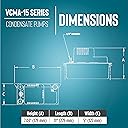
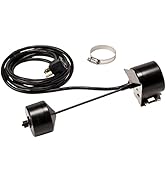
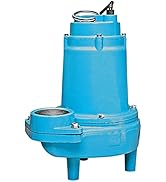
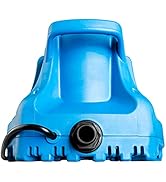
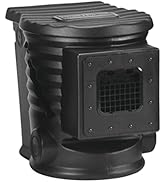
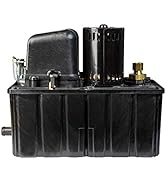
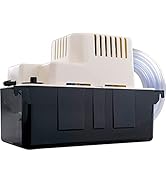
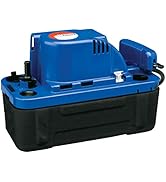
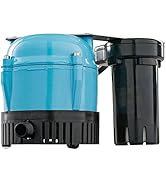
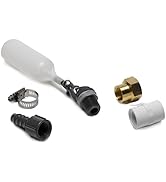
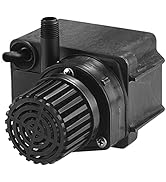
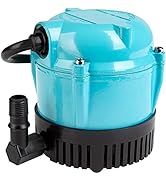
Revised 5-30-20 This review is specifically for the Little Giant model VCMA-15ULST, also known as the 554415, condensate pump; there are several similar looking pumps by the same manufacturer, so please read my description below of the important differences. This pump, and the other similar ones by Little Giant (Oklahoma City, Oklahoma), is primarily intended to receive condensate water from an air conditioning unit, or related equipment that generates condensed water; it is NOT for use with flammable or explosive fluids. The pump is actually like a small sump pump, and consists of a small 1/2 gallon tank, the pump itself, and a float switch to operate the pump. The condensate water enters the pump tank, usually by gravity, and accumulates until the float switch detects a high water level, at which point the pump turns on and stays on until the float switch detects a low level, and the pump then shuts off. The pump discharge is via a built-in check valve having a 3/8” hose barb, to which suitable 3/8” ID hose must be attached. Through hose of this size, the pump is able to discharge the water a considerable distance both vertically and horizontally. Certainly, it is able to push water up a height of one normal residential house level, for example from a basement up to above ground level, so that it can be routed outdoors, or into a drain, sink or whatever. It can also pump across a floor to a floor drain or sump pit, or can pump up from the pump location to a ceiling above, then across to a wall, and back down to a sink, drain or sump pit. Now, here is my attempt to describe and differentiate between the various similar models, since various listings on Amazon and elsewhere can make selecting the appropriate model somewhat confusing. Little Giant produces two very similar sub-series in the VCMA series, the VCMA-15 and the VCMA-20. The only difference between these appears to be that the -15 has a 1/50 HP pump motor while the -20 has a 1/30 HP pump motor; it seems that the -15 and -20 refers to the height in feet that the pump can elevate water. The models in the -20 sub-series obviously have a better ability to pump more water a greater distance and/or height; this sub-series can also be obtained with a 220V motor option, while it appears that the -15 sub-series is 115VAC only. I recommend checking the online manuals of spec sheets before purchasing, although I have personally found Little Giant’s documentation on their website to be rather sparse on desired details. This review is for a specific pump in the -15 sub-series, so you should know that it has the lower capacity pump. Within the VCMA-15 sub-series, there are additional digits in the model number that have important meaning to the purchaser. The model number always starts out VCMA-15UL, but then there may be one or two additional digits. The addition of an “S” means that the pump includes a secondary float switch that detects high-high level; this can be used to shut off the air conditioner or other condensing equipment that is generating the condensate water, or it may be used to operate some kind of audible and/or visual alarm. The addition of a “T” means that the pump comes with a 20 foot long clear vinyl discharge hose that fits the 3/8” hose barb on the pump’s check valve. This particular Amazon listing is for the VCMA-15ULST model which is also referred to as 554415, so you can tell that it has the secondary high-high level switch AND includes the 20 foot long discharge hose. The pump’s manual, which is for all models in the VCMA series, is annoyingly vague about certain things, and one of those is the maximum pumping distance and height. The manual I have says the -15 sub-series has a “15 foot shut off”, whatever that means; my guess is that it cannot pump higher than 15 feet, but I don’t know of that is correct. Elsewhere in the same manual, it says, “Route outlet (discharge) tubing or piping from pump straight up as high as necessary. Do not extend higher than 75% of the total dynamic head capacity of the pump.” Nowhere in the manual does it say what the number is. Nowhere on the actual pump does it say how high it can be relied on to operate properly. Suffice it to say that pumping from a basement floor level up to the ceiling, or even up to a sink or drain on the next floor up seems to be within this pump’s capacity. The manual DOES recommend against using a discharge hose or pipe larger than 3/8” ID; apparently use of a wider discharge can result in excessive reverse flow as the pump is shutting off, and maybe the check valve cannot deal with that. It is strongly recommended that the discharge hose/pipe be installed such that it does bend back down near the end, so it should be routed to go up at least a few inches higher than its eventual discharge into a drain. It is important that the condensate drain line going INTO this pump’s tank be configured such that its bottom cannot press flat against the bottom of the pump tank; any pipe or hose coming INTO the pump tank should ideally be configured to stop at a level slightly inside the top of the pump tank, so the condensate water can drip into the tank. If the pipe or hose coming in cannot be configured to drip, it should at least be cut at an angle at its bottom end. Note that this pump works well with portable dehumidifiers, so that they do not need to have their own tanks emptied. Most such dehumidifiers are set up with a garden hose fitting on the side or the back, and the condensate water drips from there into the dehumidifier’s own tank. But if you install a hose with a garden hose type fitting onto the dehumidifier’s own fitting, then the condensate water will run out the hose instead of into the dehumidifier’s own tank. That hose can then be routed to drain into this pump’s little tank. HOWEVER, the vertical distance between the dehumidifier’s drain hose fitting and the top of this pump’s tank might be only a few inches, and I have found that if the hose from the dehumidifier slopes even slightly uphill before it bends to go into the tank, the condensate water will not drain properly. I have also found that if the hose extends too far down into the pump’s tank, the condensate water will stop flowing once the tank’s water level rises much above the bottom of the hose. What I did was this: I bought a short washing machine hose, and cut off a piece about 14” long, and screwed the end fitting onto the dehumidifier. Then I used a brass hose barb fitting (sized to match the ID of the washing machine hose) and a brass 45 degree elbow to redirect the flow downwards. I then fit a length of brass pipe to the other side of the elbow, and stuck the pipe down into the pump’s tank. I trimmed the pipe length such that the hose sloped slightly downhill from the dehumidifier to the elbow. Then I drilled a few ¼” holes through the pipe at different heights (in retrospect, I think drilling a single hole on the pipe, located just below the lid of the tank, would suffice). This way, the pipe’s length defines the slope of the hose from the dehumidifier and supports its weight, but the flow of condensate water can never be blocked in any way, and water or air can always escape easily through the hole(s) and drip into the pump’s tank. NOTE: In the three photos I have attached to this review, the first one shows a preliminary test with just the washing machine hose going into the sump tank directly, while the other two photos show the revised hose configuration with the brass elbow and pipe into the pump tank; you can see how the revised version has the hose angling downwards much better. IMPORTANT: While the pump may or may not come with 3/8” ID discharge hose (it WILL if you buy this exact model being reviewed), let’s assume that you are using that kind of hose. The pump does NOT come with a hose clamp, yet the instructions are clear that the pump’s check valve hose barb cannot hold the hose tightly enough to prevent leaks due to back pressure of water in the hose, especially if you route the hose up many feet in height. The hose can pop off the barb and potentially quite a bit of water can flow backwards into the floor. Worse, if for some reason the discharge end of the hose happens to be IN WATER, all that can siphon back down the disconnected bottom end of the hose. So, plan on buying and installing a suitable hose clamp where the discharge hose fits over the check valve hose barb. The pump’s tank holds about 1/2 gallon of water (it actually holds more, but that extra is reserved for the optional high-high level float that the pump comes with if the pump model number has the “S” at the end, as this specifically reviewed pump does). The tank has three inlet holes on its top cover, and you can use any one, or two or all three of them at the same time, as long as the combined condensate flow rate does not exceed the pumping capacity. The pump comes with two plugs which cover any unused inlet holes; this is good to keep out vermin. Once the inlet and discharge pipes/hoses are set up, the only thing you need to do is plug in the pump’s power cord. I recommend pouring water from a gallon jug into one of the unused inlet holes until the pump turns on, to verify that the primary float switch is working and that the pump can indeed pump the water all the way to wherever you have the discharge located. In my installation, the pump was only raising the water about four feet, and it took only perhaps 15 or 20 seconds to pump out the tank. Normally, this pump simply rests on the floor next to the air conditioner coil or other source of condensate water. The pump can also be mounted to a wall using the two brackets on the corners of the pump tank, or it can be screwed to the side of an HVAC unit. The brackets are sized to fit #8 screws or bolts. Now, about that “S” in the pump’s model number, which means that there is a high-high level float switch which is entirely separate from the primary level switch/float. The manual recommends NOT using this extra level switch to control motors or any other large electrical loads. As configured by the factory, this switch is ready to be connected in series with the thermostat wiring that normally turns the air conditioner on, so a high-high level will stop the production of additional condensate water; in other words, this switch is factory configured as “normally closed”, opening on high-high level. If you wish to have the switch operate some kind of alarm, then you need to remove the pump motor cover and reconfigure the switch. There is a single screw on top of the pump housing, and you remove that and also remove any tank inlet hole plugs adjacent to the discharge check valve hose barb. Then the pump housing slides towards the hose barb, and then lifts off. You can easily see where the two “pigtail” wires for the switch come into the case and connect to the switch. One wire is connected to the bottom switch terminal and the other is connected to the middle switch terminal; grab that middle wire’s push-on connector with a needle-nose pliers and pull it off of the switch, and then push in onto the top switch terminal. Put the cover back on the pump, being careful to route the switch ‘pigtail’ wires out the slot in the case. The switch is now configured as “normally open”, closing only on high-high level. In my installation, I purchased a loud 6V buzzer and used a battery holder for four AA cells, to result in a 6V battery. I wired the battery, the buzzer and the high-high level switch’s pigtail wires into a simple series circuit, so if the tank level reaches high-high level, the buzzer will sound. I mounted the battery and the buzzer on a 3.5” x 11” piece of 1/4” plywood, screwed to the side of the tank using two 8-32 bolts and nuts. If using this pump with a portable dehumidifier, you could rig up a circuit to have the high-high level switch operate a relay, whose contacts could then be used to interrupt AC power to the dehumidifier. I find that tipping the pump unit to one side will activate the high-high level switch, so that is an easy way to test it. Otherwise this pump has a limited 12 month warranty, and it seems to be of good quality design, materials and construction.