
Desertcart purchases this item on your behalf and handles shipping, customs, and support to Uruguay.
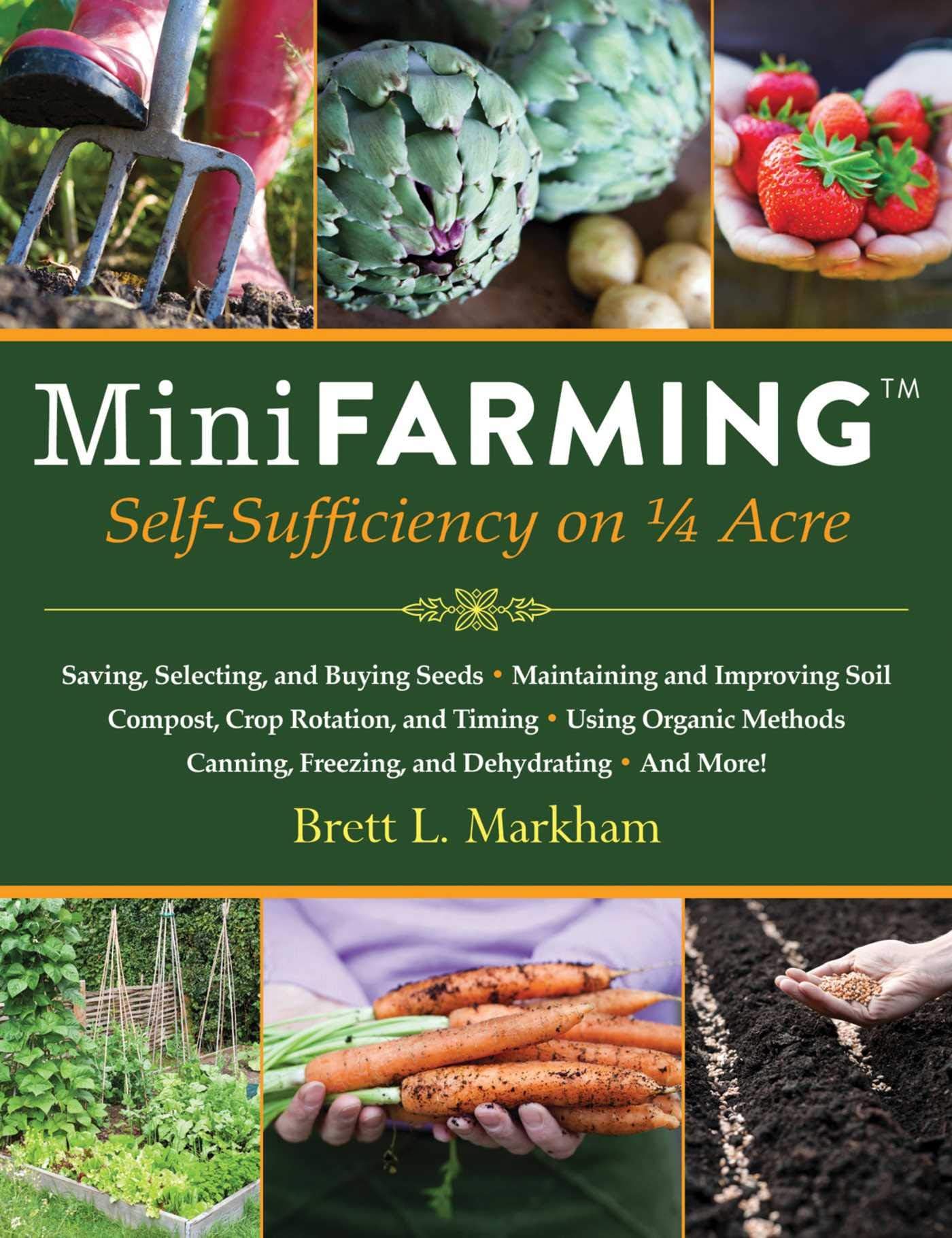
More than 150,000 copies sold—National Bestseller! Go back to basics—compost, raising chickens, water and irrigation, dealing with pests, and much more—with this unique, full color bestseller (over 400,000 sold). Mini Farming describes a holistic approach to small-area farming that will show you how to produce 85 percent of an average family’s food on just a quarter acre—and earn $10,000 in cash annually while spending less than half the time that an ordinary job would require. Even if you have never been a farmer or a gardener, this book covers everything you need to know to get started: Buying and saving seeds Starting seedlings Establishing raised beds Soil fertility practices Composting Dealing with pest and disease problems Crop rotation Selling your produce arm planning, and much more. Because self-sufficiency is the objective, subjects such as raising backyard chickens and home canning are also covered along with numerous methods for keeping costs down and production high. Materials, tools, and techniques are detailed with photographs, tables, diagrams, and illustrations. Review: Excellent, well-organized guide on moving from casual gardener to self-sufficient gardener - While I've maintained small gardens and potted plants for years, for 5+ years I've casually kept a 1,000 square foot garden. I've mostly winged it... sometimes impressively, other times with dismally. But, never consistent year over year results. I picked up this book to take my gardening to the next level and broaden my horizons. In short, I'm very satisfied with the insights and guidance I've gleaned from this book. I'd go so far as to say that while you don't need a background in gardening to benefit from this book, this book is a perfect fit for people in my situation. Here are the pros and cons from my perspective. Pros: - The content of each chapter is very well organized, with concepts building onto one another very neatly. - The broader subject matter of the chapters takes one through the process of planning, preparing, selecting, timing, managing, etc. most everything one would need to successfully grow a garden. - This book strikes a good balance between giving you the key information you need for any one aspect of self-sufficient gardening, but not inundating you with too much detail. (In other words, this book threads the needle on delivering a lot of helpful information, while still feeling like an easy read.) - I've seen other reviews for this book that complain that the author 'rips off' others' ideas and re-packages them for profit. I read quite a bit and have over the years seen serious examples of what these other reviewers are claiming. But, in the case of this book, while the author informs on alternative (and even competing models) for gardening, the author always informs the user on what, in his experience, has or has NOT worked from various models; how he has modified some of those ideas to work in his growing climate; and where he completely parts ways from others' techniques and espouses his own approach (including very clear instruction on how to use his modified or totally unique processes). - Finally, where possible, the author provides the equivalent of 'modified workouts' for those 'less fit' (MY WORDS, NOT HIS) in their gardening abilities. In other words, the author provides sufficient detail on what might be the most efficient and beneficial approach to say irrigation or composting, but then across the various subjects covered in the book, he provides a less expensive/quicker/initially easier alternative for those lacking the time, resources, space, skills, etc. to fully implement the best possible approach for one aspect or another of gardening. For example, as I'll be looking to expand my garden this next spring, I fully intend to utilize some of the quicker soil prep techniques offered up in this book for use in a pinch while I build up my long-term composting and soil amendment routines. Cons: - While some of the chapters really cover all the bases for the targeted subject matter (i.e. plant spacing, soil prep, etc.). Others give you just enough to run with but leave you wanting more. A good example of this would be Chapter 7 ("Time and Yield"). While the author gives a good and broad overview of timing techniques (i.e. succession planting, timed planting, interplanting etc.), for such an important subject matter, I was disappointed by just how short this chapter was. I live in Michigan, with a shorter growing season. I see this topic as critical for people in shorter growing zones like mine, and apart from a quick overview of each of the techniques used to maximize productivity, and a handful of real-world examples of plant groups that work well for things like succession planting (taking into consideration their hardiness in colder climates), this chapter really leaves readers wanting. - While this book is beautifully illustrated, there's no doubting that the abundance of pretty pictures of garden produce, chickens, tools, etc. serve as fill to make the book feel a bit more substantial in size than it need be. I don't want to over play this point, as A LOT of the illustrations (pictures/graphics/tables) are pertinent to the content of the book (and in any event, some amount of artwork is always nice to have), BUT... I think you could produce this book, still with plenty of beautiful illustrations, and reduce it from its current 227 pages (including the index and notes pages) down to 175 pages. Review: One of the best on gardening, mini-farming, food self-sufficiency - I just read this book and I am very impressed. It compares favorably both to classics of intensive gardening and to classics on self sufficiency. Less complicated than How to Grow More Vegetables and Fruits: (And Fruits, Nuts, Berries, Grains, and Other Crops) (How to Grow More Vegetables: (And Fruits, Nuts, Berries, Grains,) , less expensive and resource-hogging (in terms of peat moss, vermiculite, and grids) than All New Square Foot Gardening (which is still well worth buying for the beginning gardener; the charts on planting for a continuous three-season harvest alone are probably worth the price of the book). More focused and with more current (though perhaps still debatable) numbers than One Acre and Security: How to Live Off the Earth Without Ruining It , and written for an even smaller (and tractor-free) scale than Successful Small-Scale Farming: An Organic Approach (Down-To-Earth Book) . This book contains the simplest and most understandble description of double-digging that I have ever read, and the simplest way of placing seeds at the correct spacing in intensive gardening. It has good discussions of thermophilic composting and of the importance of aging compost; various types of irrigation systems; food requirements per person and practical ways of meeting them (including the economic infeasibility of growing wheat in the home garden); making aerated compost tea with a simple and inexpensive homemade system; the best media for seed starting; an introduction to saving and storing seeds, and references to excellent books that provide more information (such as Seed to Seed: Seed Saving and Growing Techniques for Vegetable Gardeners and Breed Your Own Vegetable Varieties: The Gardener's & Farmer's Guide to Plant Breeding & Seed Saving ); inexpensive ways to extend the growing season; fruit trees, bushes, and vines; raising poultry for eggs and/or meat; organic and certified naturally grown; and maximizing the money you make selling produce. The chapter on preserving the harvest by canning, freezing, and dehydrating (no mention of Root Cellaring: Natural Cold Storage of Fruits & Vegetables ) is not in-depth and will not take the place of other books on the subject, but serves as a good introduction. The only disappointment to me was that there was no mention of sheet composting (see Lasagna Gardening: A New Layering System for Bountiful Gardens: No Digging, No Tilling,No Weeding, No Kidding! ); I might suggest building your raised beds in that way rather than by double digging. If you are trying to move off the grid, grow 100% of your own food, and make your own clothes, this may not be the book for you. If you'd like to raise a lot of your own food in a garden that will fit in the typical suburban yard (the actual number of square feet he suggests cultivating for a family of three is just under 1/20th of an acre), this book is a great place to start.


| Best Sellers Rank | #10,305 in Books ( See Top 100 in Books ) #2 in Sustainable Agriculture (Books) #2 in Fruit Gardening #3 in Organic & Sustainable Gardening & Horticulture |
| Customer Reviews | 4.6 out of 5 stars 6,940 Reviews |
M**L
Excellent, well-organized guide on moving from casual gardener to self-sufficient gardener
While I've maintained small gardens and potted plants for years, for 5+ years I've casually kept a 1,000 square foot garden. I've mostly winged it... sometimes impressively, other times with dismally. But, never consistent year over year results. I picked up this book to take my gardening to the next level and broaden my horizons. In short, I'm very satisfied with the insights and guidance I've gleaned from this book. I'd go so far as to say that while you don't need a background in gardening to benefit from this book, this book is a perfect fit for people in my situation. Here are the pros and cons from my perspective. Pros: - The content of each chapter is very well organized, with concepts building onto one another very neatly. - The broader subject matter of the chapters takes one through the process of planning, preparing, selecting, timing, managing, etc. most everything one would need to successfully grow a garden. - This book strikes a good balance between giving you the key information you need for any one aspect of self-sufficient gardening, but not inundating you with too much detail. (In other words, this book threads the needle on delivering a lot of helpful information, while still feeling like an easy read.) - I've seen other reviews for this book that complain that the author 'rips off' others' ideas and re-packages them for profit. I read quite a bit and have over the years seen serious examples of what these other reviewers are claiming. But, in the case of this book, while the author informs on alternative (and even competing models) for gardening, the author always informs the user on what, in his experience, has or has NOT worked from various models; how he has modified some of those ideas to work in his growing climate; and where he completely parts ways from others' techniques and espouses his own approach (including very clear instruction on how to use his modified or totally unique processes). - Finally, where possible, the author provides the equivalent of 'modified workouts' for those 'less fit' (MY WORDS, NOT HIS) in their gardening abilities. In other words, the author provides sufficient detail on what might be the most efficient and beneficial approach to say irrigation or composting, but then across the various subjects covered in the book, he provides a less expensive/quicker/initially easier alternative for those lacking the time, resources, space, skills, etc. to fully implement the best possible approach for one aspect or another of gardening. For example, as I'll be looking to expand my garden this next spring, I fully intend to utilize some of the quicker soil prep techniques offered up in this book for use in a pinch while I build up my long-term composting and soil amendment routines. Cons: - While some of the chapters really cover all the bases for the targeted subject matter (i.e. plant spacing, soil prep, etc.). Others give you just enough to run with but leave you wanting more. A good example of this would be Chapter 7 ("Time and Yield"). While the author gives a good and broad overview of timing techniques (i.e. succession planting, timed planting, interplanting etc.), for such an important subject matter, I was disappointed by just how short this chapter was. I live in Michigan, with a shorter growing season. I see this topic as critical for people in shorter growing zones like mine, and apart from a quick overview of each of the techniques used to maximize productivity, and a handful of real-world examples of plant groups that work well for things like succession planting (taking into consideration their hardiness in colder climates), this chapter really leaves readers wanting. - While this book is beautifully illustrated, there's no doubting that the abundance of pretty pictures of garden produce, chickens, tools, etc. serve as fill to make the book feel a bit more substantial in size than it need be. I don't want to over play this point, as A LOT of the illustrations (pictures/graphics/tables) are pertinent to the content of the book (and in any event, some amount of artwork is always nice to have), BUT... I think you could produce this book, still with plenty of beautiful illustrations, and reduce it from its current 227 pages (including the index and notes pages) down to 175 pages.
M**B
One of the best on gardening, mini-farming, food self-sufficiency
I just read this book and I am very impressed. It compares favorably both to classics of intensive gardening and to classics on self sufficiency. Less complicated than How to Grow More Vegetables and Fruits: (And Fruits, Nuts, Berries, Grains, and Other Crops) (How to Grow More Vegetables: (And Fruits, Nuts, Berries, Grains,) , less expensive and resource-hogging (in terms of peat moss, vermiculite, and grids) than All New Square Foot Gardening (which is still well worth buying for the beginning gardener; the charts on planting for a continuous three-season harvest alone are probably worth the price of the book). More focused and with more current (though perhaps still debatable) numbers than One Acre and Security: How to Live Off the Earth Without Ruining It , and written for an even smaller (and tractor-free) scale than Successful Small-Scale Farming: An Organic Approach (Down-To-Earth Book) . This book contains the simplest and most understandble description of double-digging that I have ever read, and the simplest way of placing seeds at the correct spacing in intensive gardening. It has good discussions of thermophilic composting and of the importance of aging compost; various types of irrigation systems; food requirements per person and practical ways of meeting them (including the economic infeasibility of growing wheat in the home garden); making aerated compost tea with a simple and inexpensive homemade system; the best media for seed starting; an introduction to saving and storing seeds, and references to excellent books that provide more information (such as Seed to Seed: Seed Saving and Growing Techniques for Vegetable Gardeners and Breed Your Own Vegetable Varieties: The Gardener's & Farmer's Guide to Plant Breeding & Seed Saving ); inexpensive ways to extend the growing season; fruit trees, bushes, and vines; raising poultry for eggs and/or meat; organic and certified naturally grown; and maximizing the money you make selling produce. The chapter on preserving the harvest by canning, freezing, and dehydrating (no mention of Root Cellaring: Natural Cold Storage of Fruits & Vegetables ) is not in-depth and will not take the place of other books on the subject, but serves as a good introduction. The only disappointment to me was that there was no mention of sheet composting (see Lasagna Gardening: A New Layering System for Bountiful Gardens: No Digging, No Tilling,No Weeding, No Kidding! ); I might suggest building your raised beds in that way rather than by double digging. If you are trying to move off the grid, grow 100% of your own food, and make your own clothes, this may not be the book for you. If you'd like to raise a lot of your own food in a garden that will fit in the typical suburban yard (the actual number of square feet he suggests cultivating for a family of three is just under 1/20th of an acre), this book is a great place to start.
S**E
Very Informative!
Great book, I just don't care for the part on killing Chickens. I could never kill anything and certainly couldn't slaughter anything. I'm no vegetarian, but it's just a personal thing where that is concerned. I would however be one before I'd kill an animal myself or even watch it. Outside of that chapter the rest of the book is fabulous & has great ideas. It did also inform me as to what the chicken industry is doing in our country and it did influence how I will purchase eggs now and in the future. I would however like to comment that the section on raising chickens for eggs was much appreciated & could be useful to anyone. It includes what to feed them, how to house them, when to get the eggs from the nests, what to do to prevent vitamin difficencies etc.. The gardening part of the book is well thought out and is an easy read. Much information is included, including how to collect your own seed so you do not need to always purchase seeds every year which is awesome :o The book also tells you how to fertilize etc. I combined this book with techniques from Container Gardening and 4 Season Harvest & have had much success in a patio garden that is 14X8 and have never grown anything in my life. I've been eating fresh produce for the entire summer now, and have a fall garden currently growning so it has been great and will continue to be wonderful through the winter. I do not plan to always live in a condo so that is one reason why I went ahead and incorporated techniques from this book into my current gardening plan. It's an easy read and can be used in manhy ways other than out in the country :o)
W**Y
A Great Book To Read
I have always wanted to build a small-scale raised bed garden in the area next to my house to grow a lot of my own vegetables. There is a wealth of knowledge available on the web, but a lot of it is fragmented or only posted in order to sell some product.... This book was great! It was very detailed and it answered a lot of the questions I had. This book is good for someone who wants to know what all may be involved in starting your own mini-farm, how much work is needed, equipment recommendations, what you can expect in the beginning as well as how to sustain your mini-farm for years to come. This book is what I would expect if I went to a expert mini-farmer and asked them to write a book that would give me an idea of what being a mini-farmer was like and what it involved. I thoroughly enjoyed reading this book. It has large text and thick pages and is well written. Every once in a while the author gets a little deep into facts or figures, but sometimes it helped me understand a particular aspect in greater detail. I have always wanted to keep chickens and have my own fresh eggs. After reading this book and seeing what was involved, I decided I might not want to get into all that... This book doesn't tell you everything you need to know to raise chickens, but it was enough to get a good idea about how much work it could possibly be. Not saying I'll never try, just know I'm not going to try and tackle starting a mini-farm and raising chickens all in the same year. Oh, and if you ever wanted to know how to slaughter your own chickens, the author goes into great detail... I don't know what else you would need to know... He even gives you plans for building your own chicken plucker. After reading this book I don't think I can go out and start a perfect mini-farm, but I do have a better grasp of when and where to start, and what all will be involved. This book is great if you are the type of person who is a planner and wants to lay everything out before you try and tackle a large task. If you are thinking about planting your own garden for your family or even to sell to make some money on the side, I highly recommend this book. I liked this book some much I ordered: Maximizing Your Mini Farm: Self-Sufficiency on 1/4 Acre Maximizing Your Mini Farm: Self-Sufficiency on 1/4 Acre
C**N
Outstanding book for any gardener
I will have to admit when it comes to these type of books I generally see myself as a book browser. Rarely do I find a book that holds my attention to the end but I just finished this book this morning from end to end! I started marking things of interest and good info for others that look at it after me and it is packed with great information, detailed illustrations, resource suggestions etc. now in my late 50s I can say I have been gardening for a pretty long time but an old dog can always learn new tricks or ways of thinking about things and what is nice about this book is it is not overwhelming. Applying the methods to mini farming even if you have more than 1/4 acre just means you will be able to better grow rotate and manage your food production. It also has great details on pests and diseases. All in all I don’t usually write many reviews but I stopped immediately this morning and wrote this one because the book is just well put together. Oh I almost forgot they have some good information on raising chickens as well which I have started doing recently. Most of all have fun with it gardening and farming is supposed to be rewarding in more ways than just food output. I find plucking weeds and such a therapeutic exercise and good distraction in such a chaotic world we find ourselves in these days.
K**R
Love Love LOVE this book!!
Update 9.5 years later (August 2012): I STILL Love this book and so do many other people! I continue to give this book as a gift to any friend who expresses a desire to be more self-sufficient and it has helped multiple families do just that. Update 9 years later (2019): I STILL love this book and continue to gift it to others. I saw some of the prominent reviews which hated the book were from 2017 so I don't know why they are at the top of the list. They also contain inaccurate info. For instance, the one that says every chapter is the author saying where he stole the idea from and where to go read the original content. There are photos of multiple pages of the book in the product description so you can read for yourself and see that is not true. And I would also like to point out, it's gardening! Are there that many original ideas for something humans have done for millennia? So every author that reviewer mentions is also giving readers knowledge obtained from someone else. Every person I have gifted this book to loves it and learns from it. I've been gardening 10 years now and still learn (or re-learn) now things when I browse through this book. LOVE IT!!! Original post from November 2012: I bought this book with slight misgivings simply because all the reviews were so positive and I'm a skeptic. I was thrilled to get the book and learn my fears were baseless. I cannot believe the amount of helpful information in it! It's laid out beautifully, the tips are practical and useful, the photos are gorgeous, and he tells you stuff you didn't even think to think about but totally need to know! I know I'm gushing, but as a newer gardener with a lot to learn who wants to be a GREAT gardener, this book is phenomenal. I'm buying it for my friend for xmas and have recommended it to everyone I know who wants to grow a garden but was always too overwhelmed to do so.
S**E
my opinion
As described. Good info & good price. Guess Im not a beginner after all. Knew most and figured out the rest. If you were never around it, never had a yard, never grew anything and lived in the city -- great book!!
J**E
Good book
Great book
P**L
Very practical introduction
This book is a thoroughly good read to introduce you to the idea of efficient food production on a small plot, and effectively bypasses the more traditional folklore-based practices of traditional home veg growers. Various named theories of intensive growing are explained and appraised. There is good science here, explained clearly, and with sufficient information and references to explore further. Although the writer's experience is in New England, the book makes it very simple to convert everything to a place with different climate. I read the book through in a couple of days. It was something of a page turner! I am now using it as a reference for development of my own far-from-perfect plot.
E**N
Thanks
Good
N**J
Good but not best.
Good but not best.'' All new square foot gardening'' is much better.
A**E
Tolle Anregungen
Das Buch ist für Anfänger geschrieben. Sehr viele interessante Denkansätze und eine solide Einführung In den modernen Mini-Garten. Mit einer Tabelle über Fruchtfolgen und sich Gegenseitig fördernde Pflanzen wäre das Buch perfekt.
T**M
Good clear direction
Well written and has some good equations in it to grow enough, good crop plans
Trustpilot
1 month ago
3 weeks ago