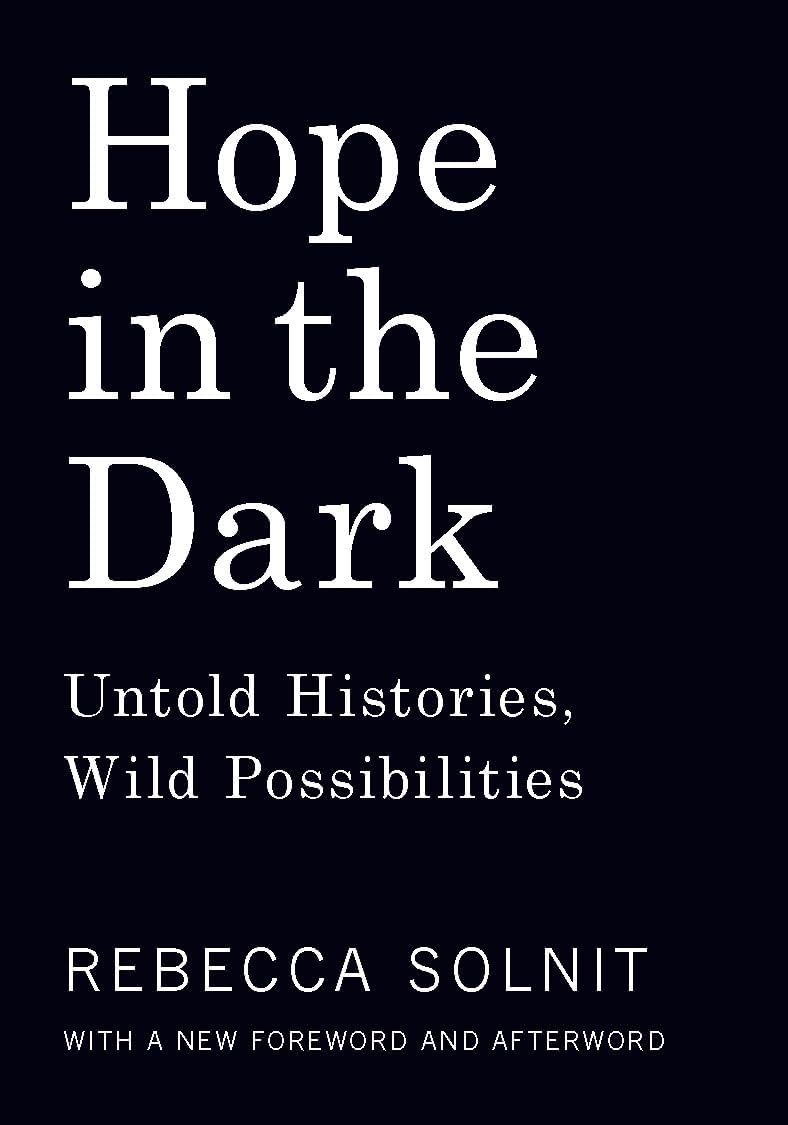
Hope in the Dark: Untold Histories, Wild Possibilities
Product ID: 24649883
Buy anything from 5,000+ international stores. One checkout price. No surprise fees. Join 2M+ shoppers on Desertcart.
Desertcart purchases this item on your behalf and handles shipping, customs, and support to Uruguay.
“No writer has better understood the mix of fear and possibility, peril and exuberance that's marked this new millennium.” ―Bill McKibben “An elegant reminder that activist victories are easily forgotten, and that they often come in extremely unexpected, roundabout ways.” ―The New Yorker A book as powerful and influential as Rebecca Solnit's Men Explain Things to Me , her Hope in the Dark was written to counter the despair of radicals at a moment when they were focused on their losses and had turned their back to the victories behind them and the unimaginable changes soon to come. In it, she makes a radical case for hope as a commitment to act in a world whose future remains uncertain and unknowable. Drawing on her decades of activism and a wide reading of environmental, cultural, and political history, Solnit argued that radicals have a long, neglected history of transformative victories, that the positive consequences of our acts are not always immediately seen, directly knowable, or even measurable, and that pessimism and despair rest on an unwarranted confidence about what is going to happen next. Now, with a moving new introduction explaining how the book came about and a new afterword that helps teach us how to hope and act in our unnerving world, she brings a new illumination to the darkness of 2016 in an unforgettable new edition of this classic book. Writer, historian, and activist Rebecca Solnit is the author of eighteen or so books on feminism, western and indigenous history, popular power, social change and insurrection, wandering and walking, hope and disaster, including the books Men Explain Things to Me and Hope in the Dark , both also with Haymarket; a trilogy of atlases of American cities; The Faraway Nearby ; A Paradise Built in Hell: The Extraordinary Communities that Arise in Disaster ; A Field Guide to Getting Lost ; Wanderlust: A History of Walking ; and River of Shadows, Eadweard Muybridge and the Technological Wild West (for which she received a Guggenheim, the National Book Critics Circle Award in criticism, and the Lannan Literary Award). A product of the California public education system from kindergarten to graduate school, she is a columnist at Harper's and a regular contributor to the Guardian. Review: A necessary, healing interjection. Should be read by all political organizers - It's easy for political activists to overlook their own victories. Activists are driven by a bold, transformative vision of change. That vision is indispensable and is the fuel of progress, but it can also encourage activists to adopt a narrative whereby organizers defeat evil and their positive vision of the future comes into existence. But the world is far too ambiguous and chaotic for that narrative; viewing change in those terms leads activists to see their work as resulting only in defeat, which causes burnout and cynicism while discouraging new people from joining a movement. Change is never easy to see and progress never moves on a clear linear path. Solnit outlines a different vision of change, one which is unpredictable, chaotic, improvisational. Total defeats lead to revolutions generations later; technologies produced by militaries become the engine of peace; supposedly lost causes are resumed; a speech to a nearly empty audience sparks a movement. These aren't just idle theories, Solnit provides real-world examples. Solnit interrogates the ambiguities and forgotten histories of movements and finds thousands of victories; some that only changed one person's life, some that overthrew dictators -- but all victories. It's our obligation to find and celebrate these forgotten victories in order to remind ourselves of our collective power to change the world and inoculate ourselves against the despair and cynicism that would lead us to willingly forfeit the collective power that all of human history clearly shows we possess. Solnit's history of activist victories is driven by a theory of hope as a discipline, not a foreign object one does or does not possess. Hope requires action and practice; action requires a belief that the world can be changed; believing that the world can be changed requires a knowledge and respect of history. The chaotic (ridiculous?) nature of the world makes it impossible to ever know the full impact of our actions; believing that actions driven by love can improve the world requires a leap of faith; all of human history indicates that that faith is the only engine of change and that it actively imposes new realities on the world, even if we can't fully predict or understand what those realities will be. That gaping unknown between action and impact is the 'dark' Solnit refers to; darkness like a womb, not depression. Changing the world requires giving up the idea that we'll understand what that change looks like. Absurd? Well... What did the dark look like to an abolitionist resisting slavery in 1814; a woman demanding equal political rights in 1790; an environmentalist opposing new pipelines in 2017? In these catastrophic times with the rise of the far-right, the corporate takeover of our government and media, the existential threat of climate change, and growing wealth inequality, despair and cynicism are easy. Every day corporate power aims to demobilize and alienate us further. Hope has never been a more vital and powerful discipline. Hope is a radical choice; a choice necessary to overcome the crises facing our planet. Solnit reminds us that choosing to practice hope isn't delusional or naive, it's a rational (though difficult) choice that has always been integral to progress. Hope is a choice that burdens us with responsibilities, responsibilities that enrich our lives. Hope requires action. Let's act. Review: A reminder to keep on truckin' - This book is a little dated; originally written in the early 2000s, even the 3d edition (which I read) was written before Donald Trump, which degraded so many political norms and expectations. HOWEVER: the central message remains clear, and that is that history is like an iceberg: what we see is not even half of what's there. It's a reminder to the average citizen like me that really boring things like tracking neighborhood zoning decisions or writing letters to the editor or picking up the trash--every little thing counts. When I feel discouraged, I remind myself of the first sentence: "Your opponents would love you to believe that it's hopeless, that you have no power, that there's no reason to act, that you can't win." Highly recommended.

| Best Sellers Rank | #20,484 in Books ( See Top 100 in Books ) #39 in Feminist Theory (Books) #47 in History & Theory of Politics #128 in Sociology Reference |
| Customer Reviews | 4.4 out of 5 stars 1,055 Reviews |
G**E
A necessary, healing interjection. Should be read by all political organizers
It's easy for political activists to overlook their own victories. Activists are driven by a bold, transformative vision of change. That vision is indispensable and is the fuel of progress, but it can also encourage activists to adopt a narrative whereby organizers defeat evil and their positive vision of the future comes into existence. But the world is far too ambiguous and chaotic for that narrative; viewing change in those terms leads activists to see their work as resulting only in defeat, which causes burnout and cynicism while discouraging new people from joining a movement. Change is never easy to see and progress never moves on a clear linear path. Solnit outlines a different vision of change, one which is unpredictable, chaotic, improvisational. Total defeats lead to revolutions generations later; technologies produced by militaries become the engine of peace; supposedly lost causes are resumed; a speech to a nearly empty audience sparks a movement. These aren't just idle theories, Solnit provides real-world examples. Solnit interrogates the ambiguities and forgotten histories of movements and finds thousands of victories; some that only changed one person's life, some that overthrew dictators -- but all victories. It's our obligation to find and celebrate these forgotten victories in order to remind ourselves of our collective power to change the world and inoculate ourselves against the despair and cynicism that would lead us to willingly forfeit the collective power that all of human history clearly shows we possess. Solnit's history of activist victories is driven by a theory of hope as a discipline, not a foreign object one does or does not possess. Hope requires action and practice; action requires a belief that the world can be changed; believing that the world can be changed requires a knowledge and respect of history. The chaotic (ridiculous?) nature of the world makes it impossible to ever know the full impact of our actions; believing that actions driven by love can improve the world requires a leap of faith; all of human history indicates that that faith is the only engine of change and that it actively imposes new realities on the world, even if we can't fully predict or understand what those realities will be. That gaping unknown between action and impact is the 'dark' Solnit refers to; darkness like a womb, not depression. Changing the world requires giving up the idea that we'll understand what that change looks like. Absurd? Well... What did the dark look like to an abolitionist resisting slavery in 1814; a woman demanding equal political rights in 1790; an environmentalist opposing new pipelines in 2017? In these catastrophic times with the rise of the far-right, the corporate takeover of our government and media, the existential threat of climate change, and growing wealth inequality, despair and cynicism are easy. Every day corporate power aims to demobilize and alienate us further. Hope has never been a more vital and powerful discipline. Hope is a radical choice; a choice necessary to overcome the crises facing our planet. Solnit reminds us that choosing to practice hope isn't delusional or naive, it's a rational (though difficult) choice that has always been integral to progress. Hope is a choice that burdens us with responsibilities, responsibilities that enrich our lives. Hope requires action. Let's act.
T**T
A reminder to keep on truckin'
This book is a little dated; originally written in the early 2000s, even the 3d edition (which I read) was written before Donald Trump, which degraded so many political norms and expectations. HOWEVER: the central message remains clear, and that is that history is like an iceberg: what we see is not even half of what's there. It's a reminder to the average citizen like me that really boring things like tracking neighborhood zoning decisions or writing letters to the editor or picking up the trash--every little thing counts. When I feel discouraged, I remind myself of the first sentence: "Your opponents would love you to believe that it's hopeless, that you have no power, that there's no reason to act, that you can't win." Highly recommended.
J**O
Great writer
My girlfriend liked this book so much that she took it after she broke up with me.
S**Y
Inspiring, motivating, healing; an existential prayer of action
This book is an inspiring and motivating intellectual journey into the progress of human action. It is filled with fascinating history and dense with wisdom, deeply thoughtful, and so hopeful that I find myself reaching for it when I go to bed at night and wake up in the morning. When I become I filled with dread about modern dysfunctions, or the enduring cost of sexism and racism, I pick up this book for comfort and solace, but also compelling motivation. I'm sorry that the The New Yorker and other literary magazines ignored Rebecca Solnit and many other talented women, of all races, for many years. The space they are opening up is too often occupied by the privileged children of people like Christopher Hitchens, who might have less to say than people who have forged their own paths. When these outlets truly open up, we will have access to the wisdom and insights of Solnit and many others sooner, and more often. I'm only sorry that I did not discover the brilliance of Solnit years ago, when this book was published. But like many literary classics, it is every bit as relevant today, and even more important.
J**E
Rebecca Solnit explains the reasons she remains hopeful for the future
An interesting, conversational book, which in a series of short essays, the author explains her reasons to keep on hoping in activism to slowly make a better, but never perfect world. She presents a series of examples where people have come together to improve the lives of others, from bringing down the Berlin wall, to helping people dig out of natural and unnatural disasters. Some of the essays come off a bit dated (most of the book dates from the early 2000s), for instance, she mentions the then newly elected president of Brazil as a bright spot, but just look at the situation in Brazil today. This edition of the book ends with a newer piece (from 2016), focusing on her hopeful feelings of progress being made in addressing climate change, and the importance of being hopeful and not giving in to despair about people addressing this most important existential threat. In the handful of years since, at least to me, it feels like we’ve only gone backwards. I think the book does a great job of explaining why Solnit has remained hopeful and why hope is important, but it didn’t do an especially good job of actually making me feel any more hopeful, unfortunately.
J**N
Needed More Now Than Before
Written in 2004, in the wake of the USA’s unjustified war on Iraq (and updated with additional chapters along with a new Foreword and Afterword), Solnit’s disquisition on the power—and the need for—hope is perhaps more relevant today, on the eve of our Fascist president-elect’s second term. Do not be fooled by the book’s brief length—the prose is profound. Solnit eloquently explains why she believes hope is not only possible but necessary when it might seem that there is no chance for empathy or justice. She boldly takes on virtue signaling (“the point becomes the demonstration of one’s one virtue rather than the realization of results,” p. 23) as well as the limits of binary thought (“there are far more than two political positions, and the old terminology only blinds us,” p. 84) and explains the importance of acknowledging progress while also understanding the need to continue working for more (“’We are winning,’ said the graffiti in Seattle, not ‘We have won,’” p. 78). Along the way, she offers some poetically inspirational ideas. For example, “Stories move in from the shadows to the limelight (p. 34), “I believe in hope as an act of defiance” (p. 110), and “I write to give aid and comfort to people who feel overwhelmed by the defeatist perspective, to encourage people to stand up and participate, to look forward to what we can do and back at what we have done” (p. 142). If you’ve been wondering how we’ll make it through to 2028, you need to read this book.
H**S
Honest self examination requires us to stay hopeful
Loved this book for the honest examination of activism, and our human need to confront the truth. We must change, yet we (humans) struggle with understanding how to do so, while facing daily devastation & challenges. Yet, there is reason for hope & we must not let our despair hold us hostage. Even though this book is now several years old, there are frightening few differences today in the progress we’ve accomplished & too many additional setback’s foreshadowed.
P**S
A great read.
I love this book. It was written in the early 2000s but it is just as relevant today. It certainly does give me hope for the future.
K**R
Don't go home yet!
This book has been a relevation. A balanced and non centric view on how society can change for better. It's about learning that it's always early to go home!
D**A
Essential Reading for our times
This is a wonderful book which, although originally published some 20 years ago, feels as important and compelling now as at did then, if not more so for we live in strangely disturbing times. Everyone should read this.
A**E
Super!
Sehr gutes Buch,tiefgründig und klug.
B**O
Solnit writes so well; with such clarity and with ...
Solnit writes so well; with such clarity and with such passion that she is hard to put down. I've read other essays of hers but this one in particular has been the most engaging and thoughtful and, ultimately, inspirational.
A**R
We all need hope.
Very encouraging.
Trustpilot
2 weeks ago
2 months ago