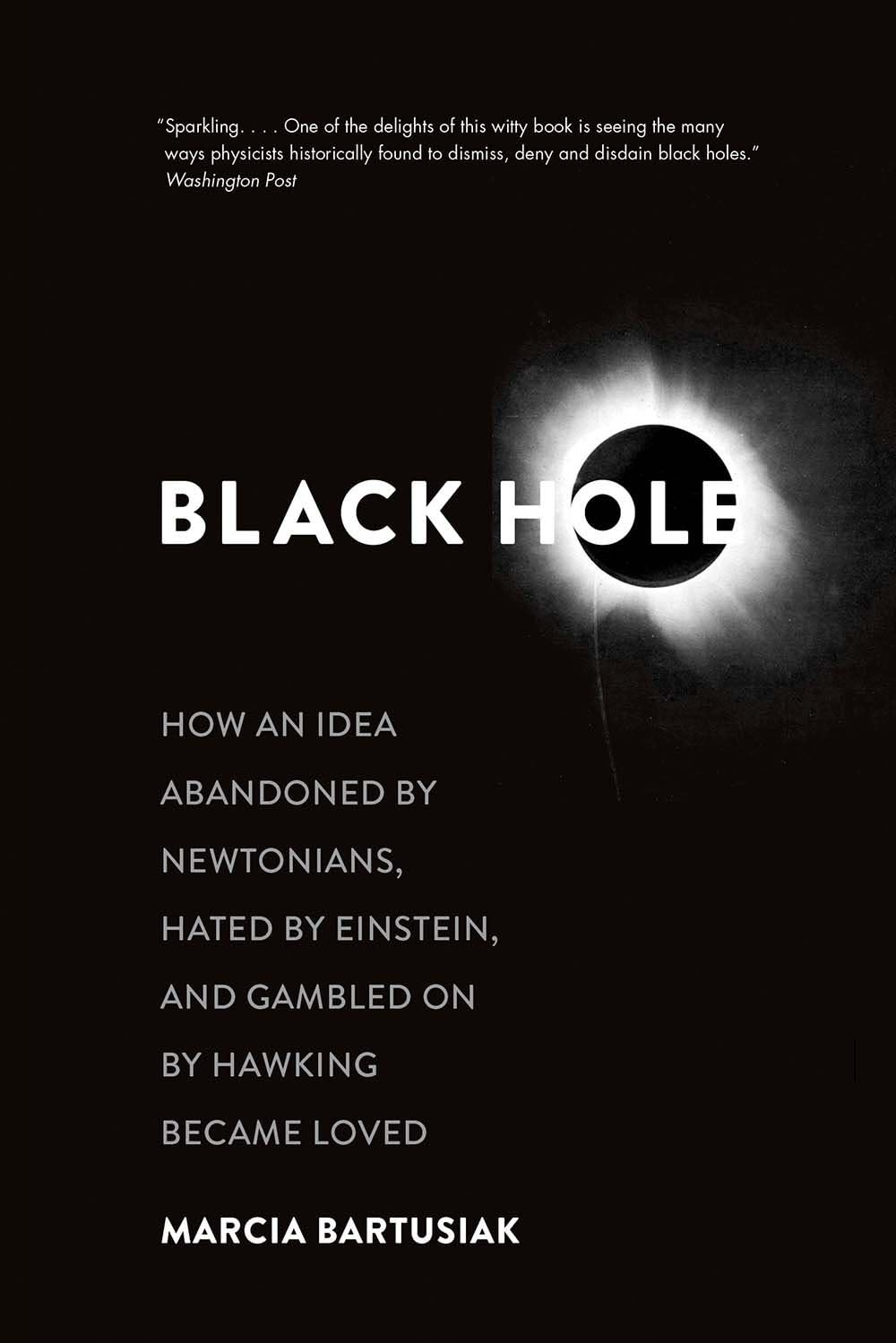
Black Hole: How an Idea Abandoned by Newtonians, Hated by Einstein, and Gambled On by Hawking Became Loved
Product ID: 27938640
Buy anything from 5,000+ international stores. One checkout price. No surprise fees. Join 2M+ shoppers on Desertcart.
Desertcart purchases this item on your behalf and handles shipping, customs, and support to Uruguay.
The contentious history of the idea of the black hole—the most fascinating and bizarre celestial object in the heavens For more than half a century, physicists and astronomers engaged in heated dispute over the possibility of black holes in the universe. The weirdly alien notion of a space-time abyss from which nothing escapes—not even light—seemed to confound all logic. This engrossing book tells the story of the fierce black hole debates and the contributions of Einstein and Hawking and other leading thinkers who completely altered our view of the universe. Renowned science writer Marcia Bartusiak shows how the black hole helped revive Einstein’s greatest achievement, the general theory of relativity, after decades during which it had been pushed into the shadows. Not until astronomers discovered such surprising new phenomena as neutron stars and black holes did the once-sedate universe transform into an Einsteinian cosmos, filled with sources of titanic energy that can be understood only in the light of relativity. This book celebrates the hundredth anniversary of general relativity, uncovers how the black hole really got its name, and recounts the scientists’ frustrating, exhilarating, and at times humorous battles over the acceptance of one of history’s most dazzling ideas. Review: Great History! - This history of the development of the notions and physics of collapsed stars, including black holes, is accurate, very readable (no equations) and thorough. The author’s attention to the players and her excellent writing make it a very enjoyable read for anyone interested in stars. Review: A good overview of the history and science of black holes - Black holes are unusual objects. They are now recognized as some of the most important cosmic laboratories for studying all kinds of physics phenomena, from general relativity to quantum mechanics. And yet as science writer Marcia Bartusiak describes in this book, their road to success has been paved with a lack of interest from their own pioneers and many haphazard detours. Bartusiak traces the conception of the idea of black holes to a Cambridge don named Joh Mitchell who asked whether an object could be so dense that even light would not escape its gravitational pull. This idea lay buried in the scientific literature until the early 20th century when astronomers began asking questions about the constitution of stars. It was a young Indian astrophysicist Subrahmanyan Chandrasekhar who first thought about gravitational collapse on his way to graduate school in England. Bartusiak describes well Chandrasekhar's battles with the old English establishment of astronomers in getting his ideas accepted. He was so frustrated in his endeavors that he switched to studying other topics before he finally got the Nobel Prize for his work decades later. The next actors on the stage were the volatile Fritz Zwicky and the brilliant Lev Landau and Robert Oppenheimer. Landaa and Zwicky laid out the first contours of what's called a neutron star while Oppenheimer was really the first scientist who asked what happens when a star completely collapses to a point, what was later called a singularity. Interestingly both Oppenheimer and Einstein - whose general theory relativity shines in all its glory in black holes - either refused to accept their reality or showed a complete lack of interest in them in their later years. After his pioneering work Oppenheimer never even entertained the subject. The story of black holes is a good instance of scientific revolutionaries turning conservative. As Bartusiak narrates, it fell to a young breed of brilliant scientists led by John Wheeler in the US, Dennis Sciama in the UK and Yakov Zeldovich in the USSR to work out the details of black hole astrophysics. They in turn inspired a whole generation of students like Kip Thorne, Roger Penrose and Stephen Hawking who contributed to the discipline. Bartusiak's book also has a readable account of the experimental discoveries in x-ray and radio astronomy which turned black holes from speculation to reality. As the book makes it clear, the importance of observational astronomy and developments in electronics in the discovery of these wondrous objects cannot be underestimated. The book ends with a brief description of Hawking's work on black holes that led to the proposal of so-called Hawking radiation, energetic radiation engendered by the principles of quantum mechanics that can allow particles to escape from a black hole's surface. I was disappointed that Bartusiak does not pay more attention to this exciting frontier, especially regarding the meld of ideas from information theory and computer science with thermodynamics and quantum mechanics that has been published in the last few years. Overall Bartusiak's volume is a good introduction to the history and physics of black holes. My only concern is that it covers very little information that has not been already documented by other books. Kip Thorne's "Black Holes and Time Warps: Einstein's Outrageous Legacy" remains the standard reference in the field and covers all these discoveries and more much more comprehensively and engagingly, while Pedro Ferreira's "The Perfect Theory" which came out this year treads the same ground of experimental discoveries. This is not a bad book at all but it came out slightly late: if you really want to read one book on black holes I think it should be Thorne's.
| Best Sellers Rank | #2,223,051 in Books ( See Top 100 in Books ) #222 in Astrophysics & Space Science (Books) #1,507 in Astronomy (Books) #3,260 in History & Philosophy of Science (Books) |
| Customer Reviews | 4.5 out of 5 stars 316 Reviews |
A**E
Great History!
This history of the development of the notions and physics of collapsed stars, including black holes, is accurate, very readable (no equations) and thorough. The author’s attention to the players and her excellent writing make it a very enjoyable read for anyone interested in stars.
A**R
A good overview of the history and science of black holes
Black holes are unusual objects. They are now recognized as some of the most important cosmic laboratories for studying all kinds of physics phenomena, from general relativity to quantum mechanics. And yet as science writer Marcia Bartusiak describes in this book, their road to success has been paved with a lack of interest from their own pioneers and many haphazard detours. Bartusiak traces the conception of the idea of black holes to a Cambridge don named Joh Mitchell who asked whether an object could be so dense that even light would not escape its gravitational pull. This idea lay buried in the scientific literature until the early 20th century when astronomers began asking questions about the constitution of stars. It was a young Indian astrophysicist Subrahmanyan Chandrasekhar who first thought about gravitational collapse on his way to graduate school in England. Bartusiak describes well Chandrasekhar's battles with the old English establishment of astronomers in getting his ideas accepted. He was so frustrated in his endeavors that he switched to studying other topics before he finally got the Nobel Prize for his work decades later. The next actors on the stage were the volatile Fritz Zwicky and the brilliant Lev Landau and Robert Oppenheimer. Landaa and Zwicky laid out the first contours of what's called a neutron star while Oppenheimer was really the first scientist who asked what happens when a star completely collapses to a point, what was later called a singularity. Interestingly both Oppenheimer and Einstein - whose general theory relativity shines in all its glory in black holes - either refused to accept their reality or showed a complete lack of interest in them in their later years. After his pioneering work Oppenheimer never even entertained the subject. The story of black holes is a good instance of scientific revolutionaries turning conservative. As Bartusiak narrates, it fell to a young breed of brilliant scientists led by John Wheeler in the US, Dennis Sciama in the UK and Yakov Zeldovich in the USSR to work out the details of black hole astrophysics. They in turn inspired a whole generation of students like Kip Thorne, Roger Penrose and Stephen Hawking who contributed to the discipline. Bartusiak's book also has a readable account of the experimental discoveries in x-ray and radio astronomy which turned black holes from speculation to reality. As the book makes it clear, the importance of observational astronomy and developments in electronics in the discovery of these wondrous objects cannot be underestimated. The book ends with a brief description of Hawking's work on black holes that led to the proposal of so-called Hawking radiation, energetic radiation engendered by the principles of quantum mechanics that can allow particles to escape from a black hole's surface. I was disappointed that Bartusiak does not pay more attention to this exciting frontier, especially regarding the meld of ideas from information theory and computer science with thermodynamics and quantum mechanics that has been published in the last few years. Overall Bartusiak's volume is a good introduction to the history and physics of black holes. My only concern is that it covers very little information that has not been already documented by other books. Kip Thorne's "Black Holes and Time Warps: Einstein's Outrageous Legacy" remains the standard reference in the field and covers all these discoveries and more much more comprehensively and engagingly, while Pedro Ferreira's "The Perfect Theory" which came out this year treads the same ground of experimental discoveries. This is not a bad book at all but it came out slightly late: if you really want to read one book on black holes I think it should be Thorne's.
A**E
What Thinking Hard About Gravity Will Do
It is exciting to look up into the sky and remember that so many of those points of light are actually stars as big as our Sun and that many of them also have planetary systems. They are so far away and yet through the science of astronomy we can learn so much about them. Observation is one of the primary tools of science but it isn’t its only tool. Extrapolation based upon what is already known can lead to some pretty crazy ideas. One those crazy ideas is the title of Marcia Bartusiak’s latest book – BLACK HOLE It was the natural philosopher John Mitchell who first theorized the existence of what became known in the twentieth century as black holes. Building upon the insights on gravity that made Isaac Newton famous, Mitchell asked how light would behave in more and more massive stars. In observing stars in a binary system, Mitchell posited that not only could you detect the obvious tug of the stars on one another but you could also figure out if that tug affects the light being emanated from those stars. “Measure the velocity of a beam of starlight entering a telescope, and voila, you acquire a means of weighing the star.” (13) Then Mitchell went extreme. What is the size a star would need to be to not emit any light? How big would such an object need to be for any light rays it radiates to return to its surface? Bartusiak notes that “this is where the ‘black hole’ possibility arises.” (13) And Mitchell’s insight marks the first steps ever taken into the bizarre world of the black hole. Black holes may be terrible places to go near but I can assure you that BLACK HOLE by Bartusiak is nothing like those light-sucking collapsed stars. But it is a difficult book to put down and you may find yourself reading chapter after chapter after chapter. And since the main text of the book only comprises around one hundred and ninety pages, you may complete the book before you know it! If it weren’t for the fact that I outlined every chapter after I read them I would have completed BLACK HOLE in about two days. BLACK HOLE reads like a narrative, essentially beginning with Mitchell and his scientific predecessors and progressing to the present day with the work of men like Kip Thorne and Stephen Hawking. Perhaps the most interesting sections can be found in chapter four that is titled, “There Should Be a Law of Nature to Prevent a Star from Behaving in This Absurd Way.” In it Bartusiak explains the resistance to black holes from famous scientists like Arthur Eddington. The British scientist had taken to “bullying [Subrahmanyan Chandrasekhar] to protect a fanciful mathematical scheme he had been working on for eighty years” (57) the scheme of which was essentially to keep quantum mechanics and relativity away from one another. This was typical of Eddington, an unfortunate black mark on his illustrious career. You might recall it was Eddington who went on that expedition to demonstrate Einstein’s theory of general relativity correct by photographing the sun during an eclipse. It is unfortunate that such a brilliant man would be so resistant to the scientific progress men like Chandra were making. If you are looking for a technical work on black holes, this book is not it. Nor should we expect it to be. Instead, this book gives us history and in so doing it reveals how science works – warts and all. Bartusiak has given us a glimpse into the scientific method and its users. Along the way we learn that brilliant men can be petty, hunches turn into fairly accurate models, and that we are all better off because of the hard and deliberate work of thoughtful scientists seeking to understand the world.
D**X
A beautifully written and engaging book
A beautifully written and engaging book. It takes you down the path of not only what happened, but also who did it and why it happened. We too often think of the scientists as just the still, black and white pictures in text books and forget that they were people with personalities. Some very stern, others pranksters, but all brilliant and struggling to find the answers that we, sometimes, take for granted as being self evident and no need to take a closer look. Plato and Aristotle were "right" until Galileo and Newton showed that they weren't completely right. Newton was "right" until Einstein showed Newton wasn't completely right. Who will come along and show that Einstein wasn't completely right, or Hawking, or any of the other scientists of today?
G**N
A joy to read
The author not only has a masterful command of the subject-matter, she writes in a wonderfully captivating and entertaining way, stringing a story of momentous scientific advance with beads of individual scientists, their aspirations, their foibles. At times very funny, it is a joy to read. I am not scientifically or mathematically adept (to put it mildly), and really had the illusion, while reading the story, that I understood something of the subject matter. I shall never look at the sky as i did before.
W**D
Very Good Read, but neglects all of the fascinating recent controversies.
Like most of Marcia Bartusaiak's books on Astronomy etc. this work is vwey well written and a pleasure to read. I give it only four stars, however, since it doesn't treat the most interesting part of the story, namely the recent period after the discovery that black holes really and truly exist. Here the work of Stephen Hawikng and the subsequent presentation of various different models of what black holes might actually do, for example the current controversy over whdther they have "fire walls" around them, is central. Maybe she is saving that material for a sequel?? I hope so!!
R**.
great overview of the history leading to the acceptance of the existence of black holes.
Anyone interested in the cosmos and in the evolution of the universe. A very easy read for those without a science background.
M**R
Good book.
This is a really good book about the people in physics. Some very smart people (like Albert Einstein) refused to believe that black holes might be real. They ridiculed to work of physicists who wanted to develop the theory of black holes. Sometimes it takes a long time for the truth to emerge. Here it was about 50 years. If you find this interesting, read the book. My local library system has three copies.
く**こ
読みやすいブラックホールの本
ブラックホールの歴史をわかりやすく書いたポピュラーサイエンス本です。
A**R
Easy read and enjoyable
Good read, easy to digest. A little light on the science in places, but a good history story and a well written narrative
M**E
Breve historia de los agujeros negros
Muy fácil de leer
M**B
Great read. Displays the history of physics in determining ...
Great read. Displays the history of physics in determining the existences of black holes and how each discovery leads to the next. Very clear and easy to follow. Space definitely a lot more interesting than previously thought.
A**R
Interesting history of black holes
Interesting and readable. Does not require a degree to understand this book. Wonderful to read how the concept of black holes changed in a century and baffled the best minds of physics.
Trustpilot
2 weeks ago
1 month ago