We remain fully operational. Our teams are working around the clock to ensure your deliveries continue safely.

DOWNLOAD THE APP


Customer Services
Copyright © 2025 Desertcart Holdings Limited
DOWNLOAD THE APP
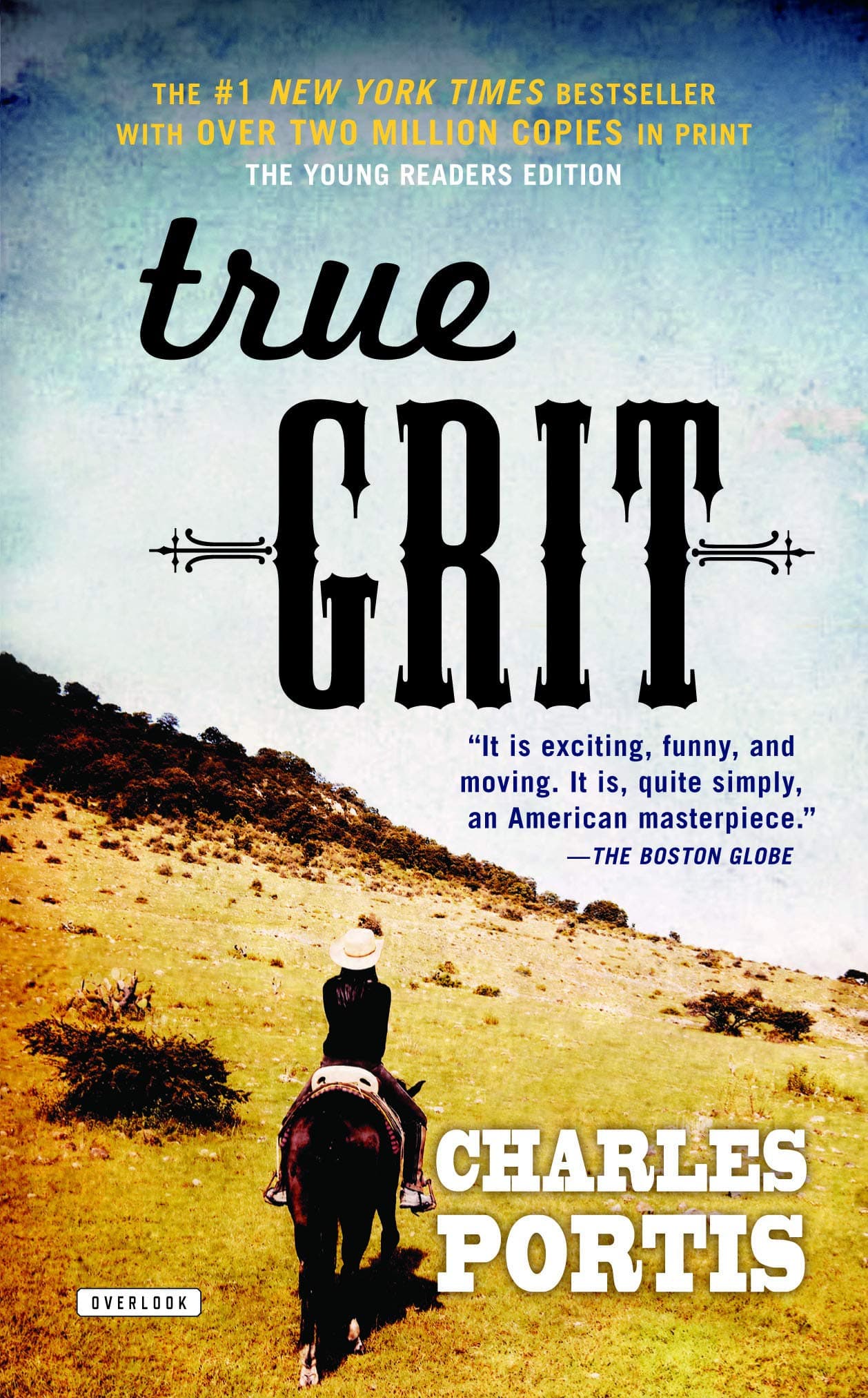
desertcart.com: True Grit: Young Readers Edition: 9781468313154: Portis, Charles, Marcus, LeonardS: Books Review: The classic western novel narrated by protagonist Mattie Ross - True Grit by Charles Portis is the classic western novel narrated by protagonist Mattie Ross, first published in 1968, that was made into two classic movies (one starring John Wayne from 1969 and a second starring Jeff Bridges from 2010). The book description from the publisher describes it best: “True Grit tells the story of Mattie Ross, who is just fourteen when the coward Tom Chaney shoots her father down in Fort Smith, Arkansas, and robs him of his life, his horse, and $150 cash. Filled with an unwavering urge to avenge her father's blood, Mattie finds and, after some tenacious finagling, enlists one-eyed Rooster Cogburn, the meanest available U.S. Marshal, as her partner in pursuit, and they head off into Indian Territory after the killer. True Grit is essential reading, an undeniable American classic as eccentric, cool, funny, and unflinching as Mattie Ross herself.” I read this novel immediately after reading another novel I loved by Portis: The Dog of the South. The two novels couldn’t be more different. The Dog of the South is irreverent, quirky, and takes place around the time of its publication (1979); True Grit is deadpan, an adventure of revenge with camaraderie between a ragtag crew, and takes place in 1878. Told by Mattie Ross as an old woman, recounting the time when she was 14 and sought retribution for the murder of her father by a scoundrel, Tom Chaney, her deadpan delivery probably springing more from her older perspective than the younger. But, it’s fun to envision this 14-year old speaking to codger Rooster Cogburn and a flashy Texas Ranger named LaBoeuf (pronounced La Beef) in her dry, matter-of-fact way. The story immediately begins with Mattie’s recounting of her father’s unfortunate murder by the hands of a drunken Tom Chaney, and she leaves home to procure a marshal to bring Chaney to justice in Arkansas. She desperately wants revenge and to see Chaney hung for his crime. After asking around to folks all too confused about a child commandeering a marshal, she picks Cogburn, as he’s described as the meanest of all the marshals, and the man she believes to have “true grit.” They reluctantly team up with LaBoeuf, who is also hunting Chaney. The real pleasure of this story is watching the relationship between these three, very different characters who, at first, don’t want to work together as a team, but reluctantly do so. Over time, they all discover that each of them is fully capable of bringing Chaney to justice when they work together. Rooster and Mattie especially build a close camaraderie as they get to know each other in the wild country. Portis’ writing style is terse and lean. There is some humor when the characters speak to each other in their deadpan euphemisms, although this book isn’t laugh-out-loud funny like The Dog of the South. But where both books are similar is with Portis’ excellent dialogue, which is funny, vibrant, and rings true-to-life. Portis is a master at dialogue and I can see why True Grit was adapted into two films. If there is a downside to this novel, it’s the loose structure of chapters, some of which stretch to 70 pages in length, too long in my opinion, but this is a small quibble. Side note: the novel is way more violent and gory than either movie depicts, but this is appropriate for this type of revenge story. I thoroughly enjoyed this book and I highly recommend it. I would give this book 4 and 1/2 stars. Review: Out of the lengthy list of books deemed “American Classics” this one is by far my favorite. Charles Portis’ use of language is c - True Grit is the story of thirteen-year old Mattie Ross who, allied with the stone-faced Rooster Coburn, embarks on an adventure to bring her father’s killer to justice in western times. The novel’s central theme is that everything comes at a price. Tom Chaney ultimately suffers for killing Mattie’s father, and our protagonist has to undergo severe sacrifice to get justice. This is a story about paying your dues - nothing is free in this world, not vengeance or justice or malice. Everything comes at a price. Out of the lengthy list of books deemed “American Classics” this one is by far my favorite. Charles Portis’ use of language is captivating and really transport you to the old west. Portis demonstrates a masterful understanding of his characters and the world they inhabit, making for an engrossing read. An odd thing about this novel is that is feature zero subplots. The story is first and foremost about Mattie and Rooster’s quest to apprehend Tom Chaney. Bereft of any unnecessary narrative fat, the story moves nimbly forward at all times, proving a quick and straightforward read over it’s 200 pages. The novel is admittedly a hard one to pick up. The western language can be intimidating to some, but Portis doesn’t use fancy words just for the sake of sounding smart. The old language is easy to follow, and personally, the world around this story was one of my favorite parts of the book. If you are willing to emerge yourself in the old west, or enjoy straightforward, quick reads, this is for you. The stories brief narrative is surprisingly compelling. Within its short page count, Portis packs in several morally ambiguous scenes where Mattie really questions if what she’s doing is right - and it’s those ideas that bleed into the thematic through line of the novel itself. Like I said before, this is a story about paying your dues, and Mattie certainly grapples with that idea until the bitter climax. It’s these moments that ground the novel in reality, and make Mattie a c character that I could relate to. It greatly increased my enjoyment of the novel. Beautiful prose, well-drawn characters and fresh, interesting ideas make for a quick, compelling read.











| Best Sellers Rank | #2,091,477 in Books ( See Top 100 in Books ) #263 in Teen & Young Adult Westerns #1,856 in Teen & Young Adult Classic Literature #2,713 in Teen & Young Adult Fiction on Girls' & Women's Issues (Books) |
| Customer Reviews | 4.6 out of 5 stars 8,610 Reviews |
S**N
The classic western novel narrated by protagonist Mattie Ross
True Grit by Charles Portis is the classic western novel narrated by protagonist Mattie Ross, first published in 1968, that was made into two classic movies (one starring John Wayne from 1969 and a second starring Jeff Bridges from 2010). The book description from the publisher describes it best: “True Grit tells the story of Mattie Ross, who is just fourteen when the coward Tom Chaney shoots her father down in Fort Smith, Arkansas, and robs him of his life, his horse, and $150 cash. Filled with an unwavering urge to avenge her father's blood, Mattie finds and, after some tenacious finagling, enlists one-eyed Rooster Cogburn, the meanest available U.S. Marshal, as her partner in pursuit, and they head off into Indian Territory after the killer. True Grit is essential reading, an undeniable American classic as eccentric, cool, funny, and unflinching as Mattie Ross herself.” I read this novel immediately after reading another novel I loved by Portis: The Dog of the South. The two novels couldn’t be more different. The Dog of the South is irreverent, quirky, and takes place around the time of its publication (1979); True Grit is deadpan, an adventure of revenge with camaraderie between a ragtag crew, and takes place in 1878. Told by Mattie Ross as an old woman, recounting the time when she was 14 and sought retribution for the murder of her father by a scoundrel, Tom Chaney, her deadpan delivery probably springing more from her older perspective than the younger. But, it’s fun to envision this 14-year old speaking to codger Rooster Cogburn and a flashy Texas Ranger named LaBoeuf (pronounced La Beef) in her dry, matter-of-fact way. The story immediately begins with Mattie’s recounting of her father’s unfortunate murder by the hands of a drunken Tom Chaney, and she leaves home to procure a marshal to bring Chaney to justice in Arkansas. She desperately wants revenge and to see Chaney hung for his crime. After asking around to folks all too confused about a child commandeering a marshal, she picks Cogburn, as he’s described as the meanest of all the marshals, and the man she believes to have “true grit.” They reluctantly team up with LaBoeuf, who is also hunting Chaney. The real pleasure of this story is watching the relationship between these three, very different characters who, at first, don’t want to work together as a team, but reluctantly do so. Over time, they all discover that each of them is fully capable of bringing Chaney to justice when they work together. Rooster and Mattie especially build a close camaraderie as they get to know each other in the wild country. Portis’ writing style is terse and lean. There is some humor when the characters speak to each other in their deadpan euphemisms, although this book isn’t laugh-out-loud funny like The Dog of the South. But where both books are similar is with Portis’ excellent dialogue, which is funny, vibrant, and rings true-to-life. Portis is a master at dialogue and I can see why True Grit was adapted into two films. If there is a downside to this novel, it’s the loose structure of chapters, some of which stretch to 70 pages in length, too long in my opinion, but this is a small quibble. Side note: the novel is way more violent and gory than either movie depicts, but this is appropriate for this type of revenge story. I thoroughly enjoyed this book and I highly recommend it. I would give this book 4 and 1/2 stars.
J**R
Out of the lengthy list of books deemed “American Classics” this one is by far my favorite. Charles Portis’ use of language is c
True Grit is the story of thirteen-year old Mattie Ross who, allied with the stone-faced Rooster Coburn, embarks on an adventure to bring her father’s killer to justice in western times. The novel’s central theme is that everything comes at a price. Tom Chaney ultimately suffers for killing Mattie’s father, and our protagonist has to undergo severe sacrifice to get justice. This is a story about paying your dues - nothing is free in this world, not vengeance or justice or malice. Everything comes at a price. Out of the lengthy list of books deemed “American Classics” this one is by far my favorite. Charles Portis’ use of language is captivating and really transport you to the old west. Portis demonstrates a masterful understanding of his characters and the world they inhabit, making for an engrossing read. An odd thing about this novel is that is feature zero subplots. The story is first and foremost about Mattie and Rooster’s quest to apprehend Tom Chaney. Bereft of any unnecessary narrative fat, the story moves nimbly forward at all times, proving a quick and straightforward read over it’s 200 pages. The novel is admittedly a hard one to pick up. The western language can be intimidating to some, but Portis doesn’t use fancy words just for the sake of sounding smart. The old language is easy to follow, and personally, the world around this story was one of my favorite parts of the book. If you are willing to emerge yourself in the old west, or enjoy straightforward, quick reads, this is for you. The stories brief narrative is surprisingly compelling. Within its short page count, Portis packs in several morally ambiguous scenes where Mattie really questions if what she’s doing is right - and it’s those ideas that bleed into the thematic through line of the novel itself. Like I said before, this is a story about paying your dues, and Mattie certainly grapples with that idea until the bitter climax. It’s these moments that ground the novel in reality, and make Mattie a c character that I could relate to. It greatly increased my enjoyment of the novel. Beautiful prose, well-drawn characters and fresh, interesting ideas make for a quick, compelling read.
J**R
Compelling, classic novel
My Rating - Put it on your list Level - East, short Summary After the murder of her father, Mattie Ross tracks the culprit to Fort Smith, Arkansas where she enlist the help of the Marshall Rooster Cogburn. He eventually takes the case, after meeting a Texas Ranger who is also chasing the man for various other crimes. After telling her no, the men begrudgingly accept that she will come with them. They head into nearby Indian Territory, where the eventually find the man and others in hiding after a train robbery. My Thoughts Portis waste no pages of this short book with writing that isn't action. The book starts with the murder and then Mattie heading to Fort Smith and doesn't stop until the final few pages as he concludes the book. Interestingly, the book is written form the perspective of Mattie, who is looking back and telling the story. I think this adds to the quick and action-packed pace. The three main characters are all unique and compelling, even if they a little cliched. Two movies have been made from this, I've seen neither, but know that the Ranger is played by Matt Damon in the most recent one. From the movies where he has tried to be unlikable, I think that fits well. Cogburn is most in line with the grizzled not necessarily lawful anti-hero, while Mattie is more head strong and stubborn. Each character is somewhat iconic in fiction. In case you were wondering, 'true grit', is the term she uses when explaining what she was looking for in a Marshal to track the murderer. It is a compelling story, though the ending felt rushed. There are some of the usual tropes, but there were also a few surprises and twist. Overall, it is a fun, easy book to read, definitely one for the beach/vacation. It is also an American classic, so a novel to put on your list. More reviews at MondayMorningTheologian.com
Y**T
One of the best western novels of all time
Great western story, told with humor without the outwardly appearance of intending to do so. Rooster is a character with lots of blemishes but does indeed have true grit.
A**R
A great classic: Very underrated
I read this book as a child and enjoyed it very much. However, I did not appreciate all that went into the writing of it. Although Charles Portis wrote this book in 1968, it is written in the style of the 1860’s. The phrasing and words used are from the period and I did not catch any breaks from that, such as using some modern terminology or situations. There had to have been a good deal of research done to make this book seem so authentic. The characters were very solid. The commentary that Mattie gave on current affairs was humorous, but demonstrated her stalwart character. I liked the way Rooster Cogburn was such a complex character with multiple layers of personality. As for the title, it is hard to say who the True Grit applies to. Cogburn, yes, but to Mattie as well and even a little to LeBeuf, who changes the most in the book, I think. If you read this book when you were younger, you should definitely read it again, as you’ll catch a lot more nuances in it the second time around. I have seldom read a more harrowing passage from a book than the portion about Mattie falling into the viper pit and their ride to save her. If you have a preteen or young teen, this is a great book to give, even from a historical point of view , to help them see how different things were in the 1800’s. In the South. For women. It’s no wonder that a movie was made from the book only 1 year later. Although Rooster was really a younger man than John Wayne.
K**E
True Grit Audio Book is a Winner
I purchased this audio CD so I could listen to the book while commuting back and forth to work. It is the first audio book I have ever listened to, so I do not have any other audio book experiences I can compare it to. Even so, I wish to write a short review expressing my feelings on this unique (for me) experience. The audio book comes in a package of 6 CD's. The total time to present the book is about 6 hours and 30 minutes. The recording is clear and free of defects. At the close of the book, there is a bonus reading of Donna Tartt's essay on the enduring significance of Charles Portis' "True Grit". The story of True Grit was written by Charles Portis in 1968. It humorously and dramatically retells the story of Mattie Ross and her quest to bring to justice the killer of her father, Frank Ross. To apprehend the killer, Tom Chaney, 12 year old Mattie enlists the services of Deputy Marshall Reuben Cogburn, who has a reputation for "shooting first and asking questions later", as well as being a "greasy vagabond drunkard". For Mattie, Cogburn has the "grit" necessary to bring Chaney in, and this trumps all his less desireable characteristics. I must say that I am pleasently surprised with the reading of True Grit by Donna Tartt. Since the book is narrated by the main character, Mattie Ross, Ms. Tartt's acquired southern accent fits the expected voice of Mattie Ross. Tartt's reading of the book is technically flawless. Her intonation and interpretation of the book is accurate and easy to understand. She alters her voice slightly for the different characters in the book, which makes dialogue easier to understand. I have read this book outloud to my daughter, and I have to applaud Ms. Tartt for her flawless recording. Again, since I do not have any other audio books to compare to, it is difficult for me to offer any constructive criticism, therefore, I give the audio book a 5-star rating. konedog
E**Z
Classic Read!
This story is beautifully put together, as any classic has been - that's what makes it so timeless! I appreciate it now that I'm an adult. As a teenager, it was a required read for English class and I never read it. I was practically an academic-delinquent back then anyway so I don't even remember how I got through class without reading...or maybe I did and forgot everything exactly after the weekly reading quizzes ended. Even so, I heard recently that this book was a great story about a girl that (kind of) kicks butt - so I had to refresh my memory since it didn't ring that way for me back then, and I'm glad I did. Now, writing this review after college and at a still youthful 22-years old, I would hope that this book continues to give every interested reader the same charm that it brought me. It's old-school and bad-ass. It's cold-cut and true-western straight from the start. If you're reading this, it's likely because you're looking for some insight that isn't about the "hype". I will just say this - whether you're a shoulder-shrugging teenager or experienced literary enthusiast, this book might come off dry until you see what's between the lines. That's probably the hard part. Most people want things to be "Michael Bay" drama or "Twilight" fantasy with distractions like wild chase-scenes or pubescent hormonal conflicts. The writing here is straight-up though, but in a comically "no BS" kind of way. You won't find chapters or wild plot twists, and the characters aren't anything "fantasy" or inherently special. They're all kind of ordinary, and not at all! Reading this book feels like someone is telling you this story straight from the mouth. I think that there is something eerily exciting about that. And it's beautiful.
C**G
A Classic Good Enough to Teach
I first read Charles Portis' "True Grit" about 40 years ago. At that time, I was a young teen girl myself, and Mattie Ross became my hero in many ways. I love the (1969) film as well. I even open-air taped it from the television and would listen to it when I went to sleep at night. My best friend and I memorized it and would recite it on long walks in the woods. I read the book possibly ten times back then. I had ordered it through one of those clubs at school. Many years later, I bought the film on DVD. When I heard about the Coen Brother's 2010 release, my childhood bestfriend and I vowed to see it on opening night. But I also remembered the book with great fondness so I bought it again and began to read it. It is even better than I remembered. The adventures of the opinionated, tight-fisted and fiesty Mattie Ross are enthralling and hilarious all at once. Her personality comes through so clearly in the narration, including her digressions, that you can practically see, hear and smell her. And of course the infamous Rooster Cogburn, the one-eyed Marshal who's as tough as any villian in the Old West, secretly tender to "little sister," and full of his own sordid history. Then there is the arrogant LeBoeuf (who does not have a first name), who is appealing and tough in his own, cocky way. These are only the major characters, while minor characters come across as clear and important as these. Lawyer J. Noble Daggett, Lucky Ned Pepper, Tom Chaney, Quincy and Moon, Col. Stonehill, Mrs. Floyd, Gramma Turner, among others, all play vital roles in Mattie's adventure. Even Columbus Potter, Rooster's trusted friend and fellow Marshall, who has died by the book's first line, comes through clearly and with pertinent value to Rooster's being and the unfoling of events for Mattie. And I cannot forget to mention the heroics of Little Blackie and Bo, trusted beasts who prove their own form of "grit." Part of what is remarkable about this book is that Portis not only managed to create vivid and lively fictional characters, but has done so in the context of real U. S. History. Rooster rode with Quantrill. Mattie meets Frank James and Cole Porter. She witnesses (with Rooster on the stand) the workings of "The Hanging" Judge Parker's court and the executions of the Yankee George Maledon. All these and more real people in the history of our nation as it struggled to recover from the Civil War. And Portis intertwines them with these beloved characters with ease and accuracy. I teach adult education: students who are working toward attaining their GEDs. Reading is not in the forte of many of them. So I always search for a great book to present to them. Last year, we did "To Kill a Mockingbird." We read aloud, answered questions and discussed the book. This year, I'm teaching "True Grit." I have written chapter questions, made vocabulary lists and collected information on the historical characters in the book. I am excited to start this project, not only because of the impressive literary work it is, but because it offers an invaluable lesson on the value of courage, persistence, sacrifice and acheivement. As for the Coen Brothers Film, I did like it. I felt the art direction was very true to the book. But in script it digressed much more than the 1969 version. IN reality, neither of them can truly stand up to this remarkable book.
Trustpilot
1 month ago
4 days ago