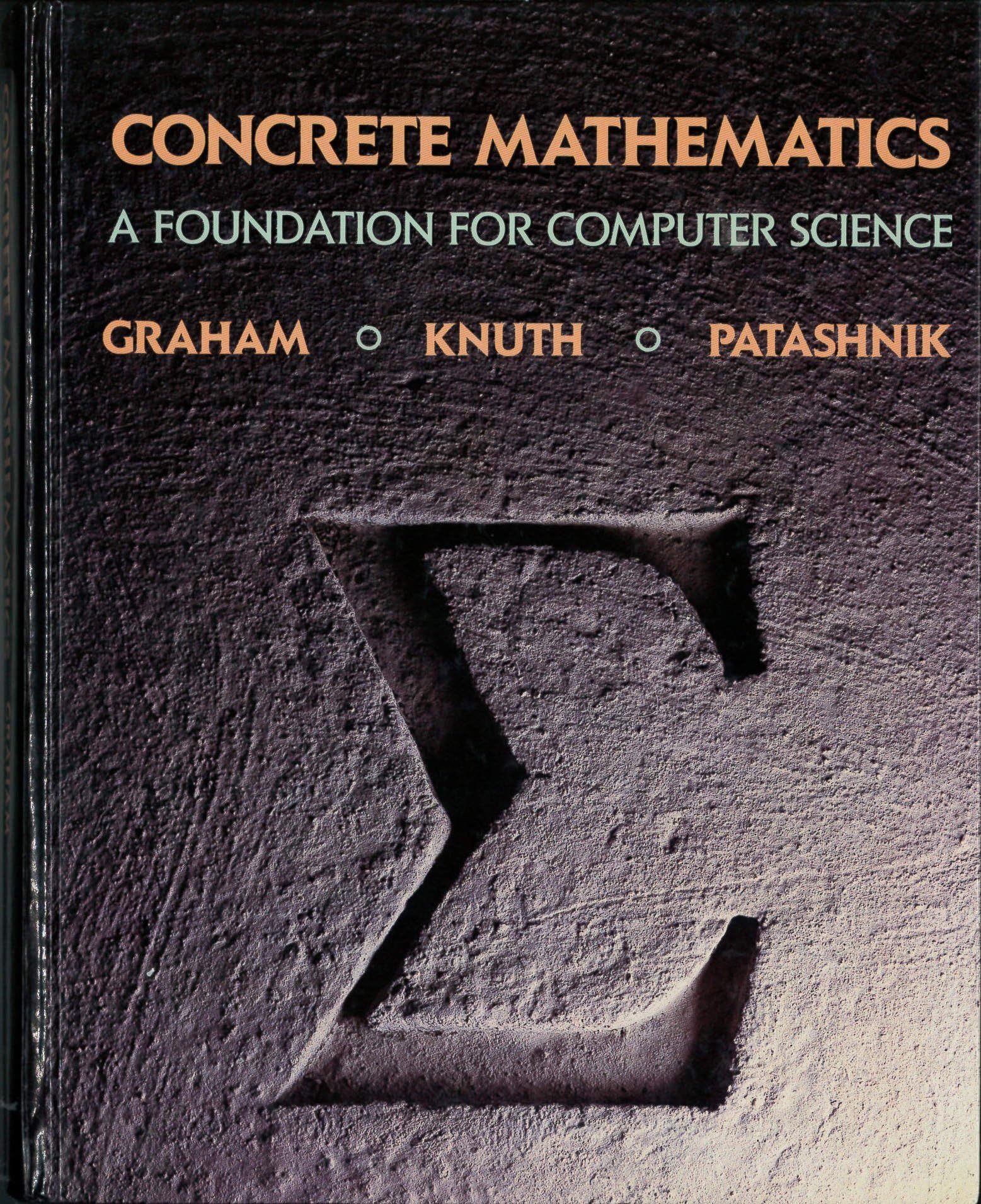


Concrete Mathematics: A Foundation for Computer Science (2nd Edition): 8601400000915: Computer Science Books @ desertcart.com Review: Phenomenal introduction to discrete math & asymptotics - This book is classic Knuth: brilliant, comprehensive, inviting, and playful. Highly, highly recommended. This book is ideal for self-study. Material covered includes the basics of discrete math, plus some extras needed for analysis of algorithms. There is an explicit and polemical slant towards a concrete (Knuth calls it 'Eulerian') approach, but this basically just means the emphasis is on explicit calculation and motivating examples, rather than 'elegant' formality and abstraction. In terms of topics, the book starts with a chapter introducing recurrences, then guides the reader through developing familiarity and calculational skill with sums and sigma notation; floors and ceilings; modular arithmetic and a bit of number theory; binomial coefficients and special functions, finally culminating with generating functions, which provide a general framework for solving recurrences encountered in earlier chapters. There are also a couple of chapters on discrete probability and asymptotics, which round out the stated goal of the book: covering preparatory mathematical material needed for the analysis of algorithms in Knuth's Art of Computer Programming. As with TAOCP, the problem sets are as enjoyable and carefully constructed as the exposition, and the solutions are included in the back of the book (about 500 pages of exposition, and about 100 pages of solutions). These problems could easily keep an interested person busy for a lifetime. They are each graded using Knuth's customary scale, and range from the trivially easy to open research problems. Review: Maybe best book of its kind, but no walk in the park. - I love this book. It's extremely dense, which is great for me because I will keep learning from it for months or years to come. If you're relatively new to the subject, like me, a lot of this book won't be easy to comprehend the first time around, however with determination and online resources for help, you can get through it. Even without online resources, if you keep going when you don't understand something, and try to work out the examples on paper, you will get far. After studying this book for a while, go back to the sections that you missed the first time and they should make more sense. Try as many of the exercises as you can, some are very difficult, but others can be accomplished the first time around. This book is not for the faint of heart. If you aren't using it for a class, it will take a lot of dedication to make it through. That said, it's one of the best resources for learning discrete and continuous mathematics that relate to computer science. A great precursor to many of the great algorithm books.
| Best Sellers Rank | #115,678 in Books ( See Top 100 in Books ) #5 in Computer Algorithms #17 in Programming Algorithms #83 in Mathematics (Books) |
| Customer Reviews | 4.6 4.6 out of 5 stars (268) |
| Dimensions | 9.38 x 7.82 x 1.44 inches |
| Edition | 2nd |
| ISBN-10 | 0201558025 |
| ISBN-13 | 978-0201558029 |
| Item Weight | 2.8 pounds |
| Language | English |
| Print length | 672 pages |
| Publication date | February 28, 1994 |
| Publisher | Addison-Wesley Professional |
J**.
Phenomenal introduction to discrete math & asymptotics
This book is classic Knuth: brilliant, comprehensive, inviting, and playful. Highly, highly recommended. This book is ideal for self-study. Material covered includes the basics of discrete math, plus some extras needed for analysis of algorithms. There is an explicit and polemical slant towards a concrete (Knuth calls it 'Eulerian') approach, but this basically just means the emphasis is on explicit calculation and motivating examples, rather than 'elegant' formality and abstraction. In terms of topics, the book starts with a chapter introducing recurrences, then guides the reader through developing familiarity and calculational skill with sums and sigma notation; floors and ceilings; modular arithmetic and a bit of number theory; binomial coefficients and special functions, finally culminating with generating functions, which provide a general framework for solving recurrences encountered in earlier chapters. There are also a couple of chapters on discrete probability and asymptotics, which round out the stated goal of the book: covering preparatory mathematical material needed for the analysis of algorithms in Knuth's Art of Computer Programming. As with TAOCP, the problem sets are as enjoyable and carefully constructed as the exposition, and the solutions are included in the back of the book (about 500 pages of exposition, and about 100 pages of solutions). These problems could easily keep an interested person busy for a lifetime. They are each graded using Knuth's customary scale, and range from the trivially easy to open research problems.
R**S
Maybe best book of its kind, but no walk in the park.
I love this book. It's extremely dense, which is great for me because I will keep learning from it for months or years to come. If you're relatively new to the subject, like me, a lot of this book won't be easy to comprehend the first time around, however with determination and online resources for help, you can get through it. Even without online resources, if you keep going when you don't understand something, and try to work out the examples on paper, you will get far. After studying this book for a while, go back to the sections that you missed the first time and they should make more sense. Try as many of the exercises as you can, some are very difficult, but others can be accomplished the first time around. This book is not for the faint of heart. If you aren't using it for a class, it will take a lot of dedication to make it through. That said, it's one of the best resources for learning discrete and continuous mathematics that relate to computer science. A great precursor to many of the great algorithm books.
E**R
Print version is great. Do NOT buy the kindle version
There are so many font and ligature issues in the kindle version of this book, it is virtually unuseable. But the print version is great. Other reviewers take issue with the lack of examples for some of the more advanced topics, and one reviewer attributes other's favorable reviews to Knuth "fan-boy-ism". I feel Knuth is (deservedly) a legend because of the topics he chooses and the detail in which he covers them--not because he always has the best way of presenting the information to students. Even though his books include exercises, I don't consider any of Knuth's books to be good textbooks and I am glad I never had to take a course where any of his books were used as the main text. I have been writing scientific applications software for over forty years, and Knuth's books have proven to be extremely valuable reference books for me. Compare the topics covered in Knuth's books to other algorithm books like Sedgwick or Cormen, et al. and you will find lots of useful information that is unique to Knuth.
O**E
Maths poetry
Amazon did a great logistics job. I really like what this book brings to the table. A rigorous and yet pleasant presentation of maths for computer scientists.
U**N
A Path to Redemption for a CS State Schooler
I originally bought this book as a source of remedial study following the end of my US state school CS undergrad experience (I completed a BS Computer Science in 2013, > 3.5 GPA), and as preparation for V1 & V4 of TAOCP. I use the word remedial here in the sense that I felt that I was missing a critical foundation in the mathematical analysis and derivation of algorithms, even after the course-work of that degree. I've done 3 chapters of it in full, and I will mention a number of things that other reviews haven't talked about. Due to the horrendous time commitment of this book, I strongly suspect this is because those reviewers haven't actually worked through it, and have instead chosen to skim and allow Knuth fanboyism, along with the desire for mutual association, to cloud their opinions. I'm revoking a star simply to balance those reviews out, and so that graduates in similar situations have an actual informed critical opinion of this book to find among the reviews. Take-Aways (As of Ch 3): There are many aspects of summations, integer functions, and proofing that: I never saw covered in my CS degree, are unforgettable, and can be immediately applied to most algorithm research. Those alone make this book worth every penny. Further, the problems posed by this book are more than just repeated mechanics, as I have seen in books like those mentioned below. Each problem is carefully chosen, thorough, and exposes multiple aspects of each topic. They really do weed out many faults that I wasn't really exposed to- as a small example: the importance of ensuring validity of n-1 and n-2 hypothesis & base cases during an induction proof. The Bad: Students educated through a contemporary CS track at most American uni's, I believe, (e.g. Rosen Discrete Math, Cormen Algorithms) will find this book both terrifyingly terse and frustratingly paced. In many cases, examples are given without derivation. In many cases, important points are made without obvious connection to previous topics. This is not without a solution however, and getting through this book is often an acquired technique of paper noting things as-you-go, as well as a learned hyper-literacy. The terseness is also a double-edged sword, as sometimes I found it useful as an extra opportunity to practice the taught methods to see if I could come to the same result. Further, the reader should be prepared to go back and review propositional logic & university calculus theorems (atleast FTC, definite vs indefinite integrals). For example, the description of sum by parts in the section on finite calculus assumes _much_ from the reader, and being able to use university calc. as a point of reference to get through that is helpful. A lot of exercises are tersely explained in both problem and solution. Further, many solutions are totally left-field (having little to do with material in the book). This isn't necessarily bad, as even taking the wrong path to a solution is very educational. However, at some point the reader has to make a judgment as to how long to commit to a certain problem. Many terse problems & left-field solutions instill the wrong judgment: quitting too early. Conclusion: Attention to detail & extra work is necessary to overcome the terseness of this particular beast, but it's worth it. I recommend this book for developers confronted with algorithm optimization problems, as a well as for a different take on parts of discrete math, and definitely for students coming out of a US state school CS program, the last which this book complements very well. Having worked through some of V1 TAOCP, I would also say that the book is effective in expanding upon its math underpinnings (V1 at-least), and incidentally, does give one confidence to tackle Knuth's other works.
P**R
Provo a mandare la recensione dopo la lettura completa solo dei primi tre capitoli ed avere sfogliato gli altri. Non è un testo di computer science come erroneamente si potrebbe dedurre dalla lista degli autori, ma tratta degli strumenti di matematica discreta (dimostrazione per induzione, sommatorie, funzioni discerete, teoria dei numeri elementare, analisi combinatoria, ecc.) utili all'analisi degli algoritmi. L'origine va ricercata in un corso tenuto da Knuth e parte del materiale è confluito nel primo volume di The Art of Computer Programming. In Concrete Mathematics gli argomenti sono affrontati in modo più approfondito, con molti esempi e soprattutto con esercizi risolti. I trucchi, gli esempi e gli esercizi presentati sono forse il pregio maggiore di questo libro di non facile reperibilità (non facile almeno per la versione cartacea). Pur non richiedendo particolari prerequisiti la lettura ed la comprensione di alcuni passaggi non è sempre semplice. Seguendo pazientemente gli autori si possono migliorare le proprie abilità di calcolo e di manipolazione delle relazioni discrete.
A**N
Contiene todo lo básico, aunque en mi opinión debería de estar un poco mejor explicado, en su defecto recomiendo mejor el de introducción a algoritmos.
C**H
I only started but I love the book, it has a great "applicable maths" feel to it. It really is a book for falling in love with the beauty of mathematics. But, my only minor complaint is some of the explanations are a little "sparse". The authors draw conclusions that my mind does not see, but this can be seen as an opportunity to self research from other sources, or to give up. 10/10 Happy Reading!
K**R
The definitive book on Computer Science - Wither or not you're seeking a job in industry or pursuing grad studies, this book will prepare you for any of the math thrown at you in full fledged Computer Science program (Summations, Proving Correctness, Asymptotic Running times, Series, etc). The book is not written like your typical academic text book you see these days. It contains full solutions, in plain and concise English, and a lot of humorous footnotes by TA's and Students. If you're a freshman or junior in a Computer Science program and just have done Calculus 1 and Discrete Math, you'll want to work through this if you want to masterfully analysis algorithms later on in your program. Anyways, it's from the Legend himself - Knuth!
ジ**ー
この本は日本語でも出版されていますが、原著よりも高く1万円以上するので割高です。英語がとても無理と言う人以外は原著を買ったほうがいいと思います。なぜならこの本はとてもユーモアのある英語の文体で書かれており、その良さは原著で一番味わえます。 この本は大学数学の本にありがちな抽象論をすっ飛ばして、いい意味で高校数学のような技のある証明方法で整数論の重要な定理を証明しています。応用例が多く、特に高校数学などで実践的に使いたくなる手法が多いです。 この本は高校生、大学生の両方にお勧めできますが、特に高校生に読んでほしいと思います。なぜなら整数と数列の発展的な学習で抽象論のない高校生向けの本はこれ以外に良い本を見たことがないからです。月刊大学への数学などで発展的な内容の記事がありますが、この本はより深い内容まで突っ込んでしかもわかりやすく説明しているため大学への数学を読みこなせる高校生にとって最適な本です。
Trustpilot
1 month ago
2 weeks ago