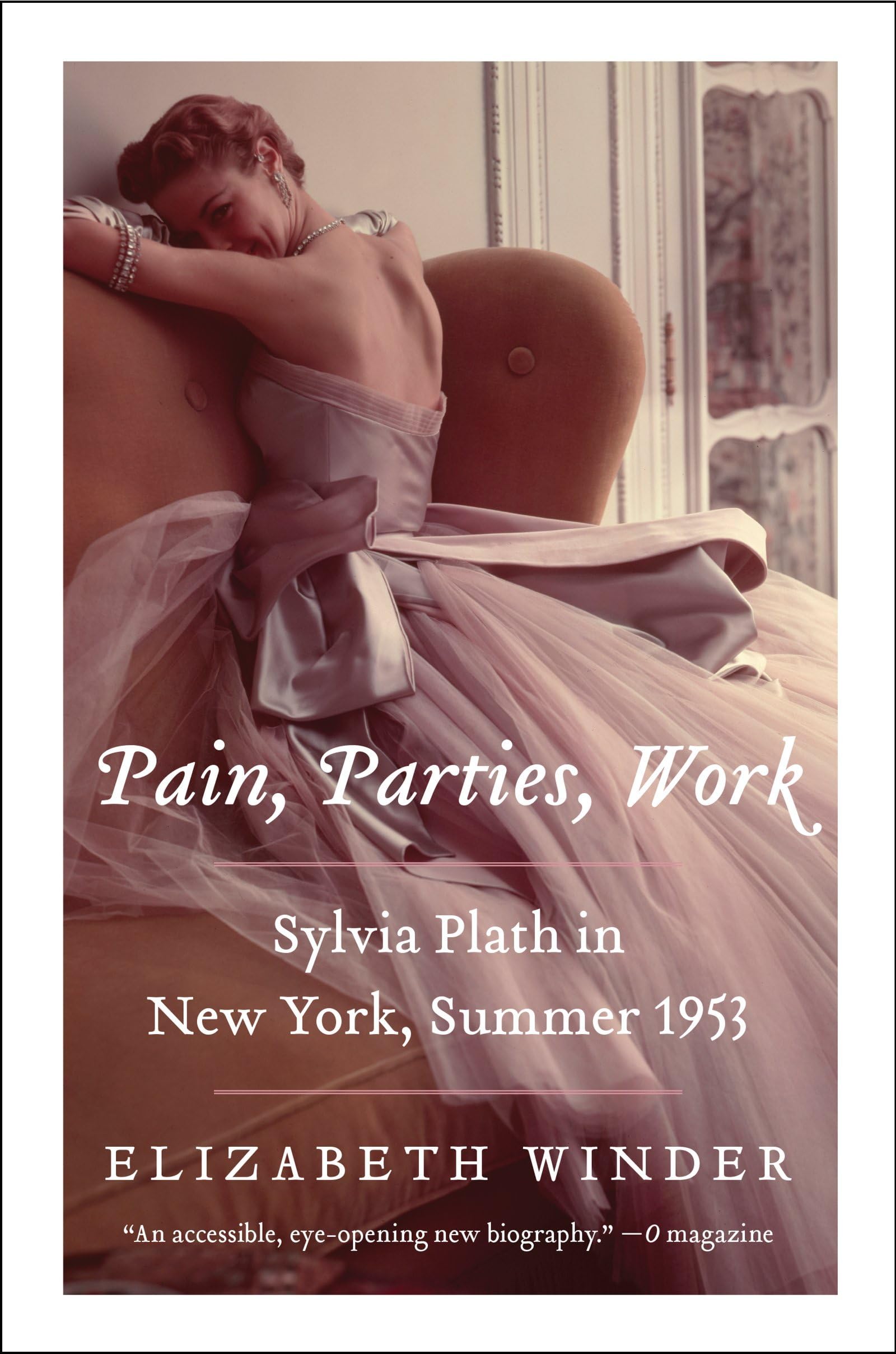
Pain, Parties, Work: Sylvia Plath in New York, Summer 1953 – An Intimate Literary Biography of a Life-Changing Month (P.S.)
Product ID: 3254208
Buy anything from 5,000+ international stores. One checkout price. No surprise fees. Join 2M+ shoppers on Desertcart.
Desertcart purchases this item on your behalf and handles shipping, customs, and support to Uruguay.
Pain, Parties, Work: Sylvia Plath in New York, Summer 1953 – An Intimate Literary Biography of a Life-Changing Month (P.S.) [Winder, Elizabeth] on desertcart.com. *FREE* shipping on qualifying offers. Pain, Parties, Work: Sylvia Plath in New York, Summer 1953 – An Intimate Literary Biography of a Life-Changing Month (P.S.) Review: Looking through The Bell Jar - In Pain, Parties, Work: Sylvia Plath in New York, Summer 1953 (HarperCollins, 16 April 2013), Elizabeth Winder has approached a pivotal period of Sylvia Plath's life in a novel way. Similar to the ingenuity in scope of Andrew Wilson's recent biography Mad Girl's Love Song: Sylvia Plath and Life Before Ted, Winder writes primarily on a snapshot period of Plath's life and weaves together a short, quirky narrative based on archival research, information obtained from books, and new interviews with Plath's fellow guest editors. I was curious how one would write a 265-page biography based on one month/one summer of Plath's life. October 1962, I could see: there is a fair amount of information about this period and certainly enough creative work to really bring that aspect in as well. But, June 1953 there is less material available: very few letters, sparse journal-writing, no creative writing (other than possibly copy Plath wrote for the Mademoiselle issue). The bulk of the book is structured week-by-week (First Week, Second Week, etc.), which is a brilliant way to approach the events; and within each chapter there are sections which break down quite nicely into manageable, readable bits of writing. There are additional chapters too, that widen the context from just Sylvia Plath in June 1953 such as "Sylvia Before," "The Issue," and "Aftermath" to name a few. "Sylvia Before" is one of the more successful chapters of the book: in particular the sub-content in this chapter such as "Field Trip" (and the sub-sub content "Vitals") and - the best of them all - "A Dictionary of Adolescence." This is Pain, Parties, Work is at its best. The chapter "The Issue" is a short, intense look at the the August 1953 Mademoiselle: and bravo to Winder for such an examination. Salient details were also to be found in "Aftermath." Scattered throughout each chapters are boxes of quotes, memories, and other information. These sidebars contain contextual, supporting information, quotes and other information, but occasionally disrupt the flow of the text. As such, I was never quite sure whether to read the boxed off material in the flow of the narrative or as separate side-bars. There are many reasons to buy this book, not the least of them being for the perspectives of, Sylvia Plath, Mademoiselle, and 1950s style, fashion, and culture that her survivors give, as well as the snippets of new information. A natural way to approach this book is from the lens of Plath's portrayal of these events in her novel The Bell Jar. Reading Pain, Parties, Work will require a significant wiping clean of preconceived ideas about what you think you know about some of the people and events from those 26 days in June that Plath manipulated for her book. Certainly some of what Pain, Parties, Work reveals about Sylvia Plath's "queer, sultry" month is mind-blowing. The most important scene to me was the event at the Forest Hills Tennis Club (now the West Side Tennis Club) in Queens. An absolute revelation. Like Plath's novel, Winder freely intertwines significant experiences from other years of Plath's life into the text. In The Bell Jar, we are drawn to Esther Greenwood's story of isolation and disappointment and depression and the inequality and double standards of 1950s America. Likewise and more importantly, we are also drawn to Sylvia Plath's experiences and emotions from the time. Esther Greenwood tells us in the opening chapter of The Bell Jar that she was "supposed to be having the time of her life" (The Bell Jar, 1963, 2). What Winder has done in Pain, Parties, Work is to show that as Plath's fellow guest editors "shared their memories of June 1953, I realized that the difficulties Sylvia endured were not unique, but part of a larger crisis--being an ambitious, curious girl in the 1950s" (Author's Note xi). It goes to show that living the dream has consequences and that feeling of emptiness and of "moving dully along in the middle of the surrounding hullabaloo" was not restricted to just Sylvia Plath (The Bell Jar, 3). About the end of the internships, Guest Editor Laurie Glazer says it best: "We dispersed in different directions to have our letdown alone" (Winder 221). And this is part of the power of both Plath's story and of The Bell Jar: that there is a universality to it to which people connect with on what seems to be a molecular level. Winder did her research, particularly with the fashions that were out that June, as well as things lost to me such as lipstick color, bra-designs, perfumes and other - dare I say - feminine things that had a profound meaning and influence on the 1953 version Sylvia Plath. I appreciate having the information now. The images in the book, though grainy, are relevant, but based on some of the memories recalled, the opportunity to present fetish items like the bathrobe Plath traded to Janet Wagner (aka Betsy/Pollyanna Cowgirl) was passed up. And, do any of the Guest Editors that year still have either the plastic starfish sunglasses case or the book of Ernest Hemingway short stories given to those who suffered from ptomaine poisoning? To sum: Pain, Parties, Work: Sylvia Plath in New York, Summer 1953 is an easily digested book with fascinating new facts and memories of Sylvia Plath. There is no excuse not to read Elizabeth's Winder's Pain, Parties, Work: Sylvia Plath in New York, Summer 1953. In addition to being available in print (which is the best medium) Pain, Parties, Work: Sylvia Plath in New York, Summer 1953 is also available on Kindle. Review: Entirely Enjoyable - The beauty of Pain, Parties, Work is its context: Winder is less about dishing previously unknown details on Sylvia Plath (although there is a bit of that too; note the country club scene), and more about showing us the environment and culture of the time. This book is a fast read with intriguing insets that echo the spirit and structure of women's magazines such as the Mademoiselle magazine Plath and the gang produced that sweltering summer of 1953. With strong, lovely writing, Pain, Parties, Work turns away from the dark drama of Plath (thank God) and shines a light on the fashion, trends, and attitudes that shaped her.


| ASIN | 0062085557 |
| Best Sellers Rank | #1,454,164 in Books ( See Top 100 in Books ) #1,390 in Author Biographies #1,540 in American Fiction Anthologies #3,229 in Women's Biographies |
| Customer Reviews | 4.1 4.1 out of 5 stars (228) |
| Dimensions | 0.8 x 5.2 x 7.9 inches |
| Edition | Reprint |
| ISBN-10 | 9780062085559 |
| ISBN-13 | 978-0062085559 |
| Item Weight | 7.4 ounces |
| Language | English |
| Print length | 288 pages |
| Publication date | April 1, 2014 |
| Publisher | Harper Perennial |
P**G
Looking through The Bell Jar
In Pain, Parties, Work: Sylvia Plath in New York, Summer 1953 (HarperCollins, 16 April 2013), Elizabeth Winder has approached a pivotal period of Sylvia Plath's life in a novel way. Similar to the ingenuity in scope of Andrew Wilson's recent biography Mad Girl's Love Song: Sylvia Plath and Life Before Ted, Winder writes primarily on a snapshot period of Plath's life and weaves together a short, quirky narrative based on archival research, information obtained from books, and new interviews with Plath's fellow guest editors. I was curious how one would write a 265-page biography based on one month/one summer of Plath's life. October 1962, I could see: there is a fair amount of information about this period and certainly enough creative work to really bring that aspect in as well. But, June 1953 there is less material available: very few letters, sparse journal-writing, no creative writing (other than possibly copy Plath wrote for the Mademoiselle issue). The bulk of the book is structured week-by-week (First Week, Second Week, etc.), which is a brilliant way to approach the events; and within each chapter there are sections which break down quite nicely into manageable, readable bits of writing. There are additional chapters too, that widen the context from just Sylvia Plath in June 1953 such as "Sylvia Before," "The Issue," and "Aftermath" to name a few. "Sylvia Before" is one of the more successful chapters of the book: in particular the sub-content in this chapter such as "Field Trip" (and the sub-sub content "Vitals") and - the best of them all - "A Dictionary of Adolescence." This is Pain, Parties, Work is at its best. The chapter "The Issue" is a short, intense look at the the August 1953 Mademoiselle: and bravo to Winder for such an examination. Salient details were also to be found in "Aftermath." Scattered throughout each chapters are boxes of quotes, memories, and other information. These sidebars contain contextual, supporting information, quotes and other information, but occasionally disrupt the flow of the text. As such, I was never quite sure whether to read the boxed off material in the flow of the narrative or as separate side-bars. There are many reasons to buy this book, not the least of them being for the perspectives of, Sylvia Plath, Mademoiselle, and 1950s style, fashion, and culture that her survivors give, as well as the snippets of new information. A natural way to approach this book is from the lens of Plath's portrayal of these events in her novel The Bell Jar. Reading Pain, Parties, Work will require a significant wiping clean of preconceived ideas about what you think you know about some of the people and events from those 26 days in June that Plath manipulated for her book. Certainly some of what Pain, Parties, Work reveals about Sylvia Plath's "queer, sultry" month is mind-blowing. The most important scene to me was the event at the Forest Hills Tennis Club (now the West Side Tennis Club) in Queens. An absolute revelation. Like Plath's novel, Winder freely intertwines significant experiences from other years of Plath's life into the text. In The Bell Jar, we are drawn to Esther Greenwood's story of isolation and disappointment and depression and the inequality and double standards of 1950s America. Likewise and more importantly, we are also drawn to Sylvia Plath's experiences and emotions from the time. Esther Greenwood tells us in the opening chapter of The Bell Jar that she was "supposed to be having the time of her life" (The Bell Jar, 1963, 2). What Winder has done in Pain, Parties, Work is to show that as Plath's fellow guest editors "shared their memories of June 1953, I realized that the difficulties Sylvia endured were not unique, but part of a larger crisis--being an ambitious, curious girl in the 1950s" (Author's Note xi). It goes to show that living the dream has consequences and that feeling of emptiness and of "moving dully along in the middle of the surrounding hullabaloo" was not restricted to just Sylvia Plath (The Bell Jar, 3). About the end of the internships, Guest Editor Laurie Glazer says it best: "We dispersed in different directions to have our letdown alone" (Winder 221). And this is part of the power of both Plath's story and of The Bell Jar: that there is a universality to it to which people connect with on what seems to be a molecular level. Winder did her research, particularly with the fashions that were out that June, as well as things lost to me such as lipstick color, bra-designs, perfumes and other - dare I say - feminine things that had a profound meaning and influence on the 1953 version Sylvia Plath. I appreciate having the information now. The images in the book, though grainy, are relevant, but based on some of the memories recalled, the opportunity to present fetish items like the bathrobe Plath traded to Janet Wagner (aka Betsy/Pollyanna Cowgirl) was passed up. And, do any of the Guest Editors that year still have either the plastic starfish sunglasses case or the book of Ernest Hemingway short stories given to those who suffered from ptomaine poisoning? To sum: Pain, Parties, Work: Sylvia Plath in New York, Summer 1953 is an easily digested book with fascinating new facts and memories of Sylvia Plath. There is no excuse not to read Elizabeth's Winder's Pain, Parties, Work: Sylvia Plath in New York, Summer 1953. In addition to being available in print (which is the best medium) Pain, Parties, Work: Sylvia Plath in New York, Summer 1953 is also available on Kindle.
F**E
Entirely Enjoyable
The beauty of Pain, Parties, Work is its context: Winder is less about dishing previously unknown details on Sylvia Plath (although there is a bit of that too; note the country club scene), and more about showing us the environment and culture of the time. This book is a fast read with intriguing insets that echo the spirit and structure of women's magazines such as the Mademoiselle magazine Plath and the gang produced that sweltering summer of 1953. With strong, lovely writing, Pain, Parties, Work turns away from the dark drama of Plath (thank God) and shines a light on the fashion, trends, and attitudes that shaped her.
L**S
Interesting story, but I wish the author had waited five more years to write it
This book was a very clever idea and adds much to the story and myths of Sylvia Plath. It was a fascinating read. Alas, it also has the stamp of a bright, insightful but still too young writer and would have greatly benefited if the writer had let it "cook" a few more years. It is also often over-written and feels a bit like a writing school project. Still I liked it in spite of this and recommend it to readers interested in Sylvia Plath, women's history, and the 1950s. As a tiny nit-pick, I will point out that Sylvia was very unlikely to have had a "shampoo and blow dry" in 1953 but rather would have had a "shampoo and set." Blow-drying didn't really start until the 1980s as anyone who tried to straighten her hair with orange juice cans in the 1960s and 1970s will recall. Also, whatever Sylvia thought at the time, it is now very clear from the archives of the old Soviet Union that the Rosenbergs were guilty as charged. It seems as if the author is unaware of this.
K**R
"People are like boxes. You would like to open them up and see what's inside, but you can't."
In this eminently readable book, Syliva Plath is quoted as saying this to her startled friend Laurie after a day at the zoo. Her friend thought she might have been referring to the people watching they had done, but I think Sylvia meant herself. This book centers around the dream job of junior editor at Mademoiselle given to Sylvia and nineteen other girls. Curiously, a covert hand writing expert had warned her staff that she was likely to suffer a breakdown, something she found out by accident. Her editor saw her to be all facade. "You might be there another day and find an entirely different personality." Interspersed within the discourse are a multitude of quotes and observations made by the people who interacted with this brilliant young woman. Her own journal is quoted where possible. And her works at Mademoiselle are cited. This technique should make for boxy and irritating flow to the prose, but in fact achieves just the opposite. And I believe this interspersing of stories emphasizes the inner contradictions suffered by Sylvia. If nothing else, she experienced the conflict of needing solitude to write while working in a deeply social setting. The "normalcy" of the bright and shining writer has long confounded readers. She adored fashion, ate to satiation, and enjoyed luxury. When not pulled back into herself, she could be entertaining and wryly funny. To me this work actually seems to complete a piece of the puzzle of the illness of the golden girl. Now, years later, psychiatry is well acquainted with the tragedy of the young person glinting with potential returning home from college and or work in complete breakdown. At the age of twenty, Sylvia was ripe for the breathrough of genetic predisposition or for the expression of neurochemicals or for the appearance of whatever theorized function of this breakdown that can occur in early adulthood. While the stress of Mademoiselle probably hastened the process, it seems unlikely to have caused it. This interpretation of Plath's illness added a dimension to this novel for me. But one certanily can find contradictory meanings to mine and still feel trememdously fulfilled by the skill of this work. The author has taken a risk in format and I think it paid off well. The prose is deeply compelling and one can almost feel that you can put down your book and find yourself in the newly stylish New York of the middle of the century. I highly recommend that you read this book.
E**C
I've read a lot of Sylvia Plath biographies and her time in New York is often given less attention so writers can skip to the part with Ted Hughes. Lots of interesting social context about the period and interviews with other guest editors, it seems a lot of original research was done rather than just raking through old stuff. An interesting and enjoyable read.
D**K
As a fan of Sylvia Plath’s poetry, this book really drew me in. Everything else I ever read about her was focussed on her struggles and ultimate suicide. This book told the back story of her youth and young adulthood in a way that kept the reader entertained and informed. Through personal interviews we see Sylvia’s youth, humanity and incredible work ethic. Her time in mental institutions were harrowing, as she was there when so much experimentation was happening. I felt I knew her better after reading this gem.
E**A
As described
C**I
Life opens up like an exotic flower in that torrid summer in New York. A promising author on the cusp of success. But it could all go wrong
S**N
exactly as described
Trustpilot
1 month ago
1 month ago