Buy anything from 5,000+ international stores. One checkout price. No surprise fees. Join 2M+ shoppers on Desertcart.
Desertcart purchases this item on your behalf and handles shipping, customs, and support to Uruguay.
๐ Power your projects with precision and peace of mind!
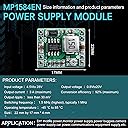
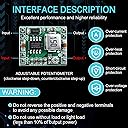
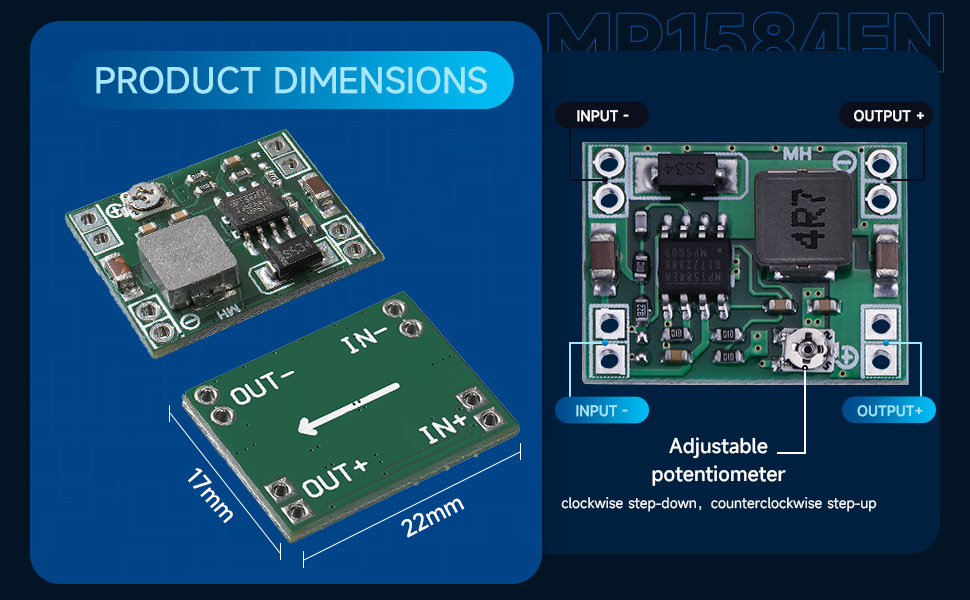
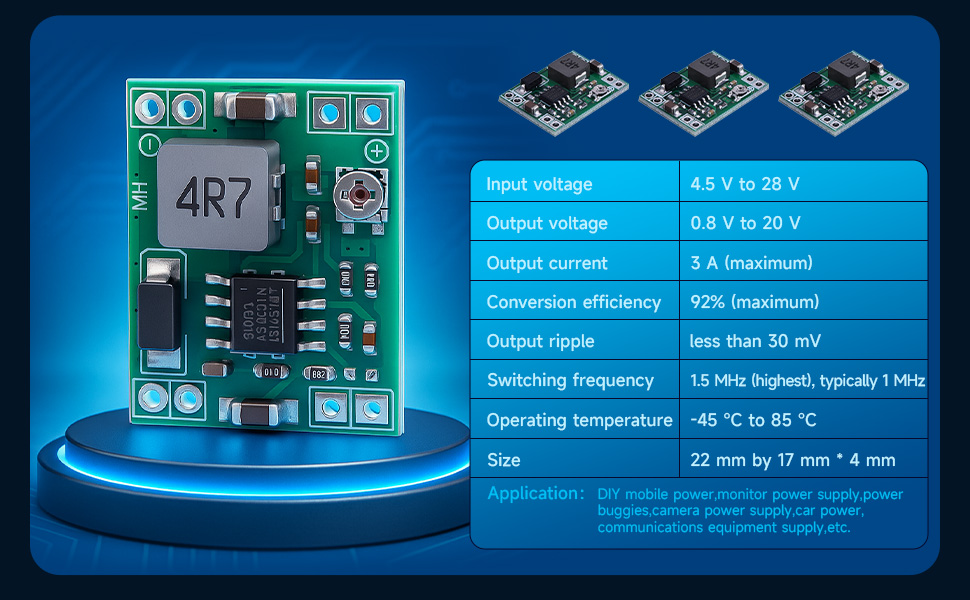
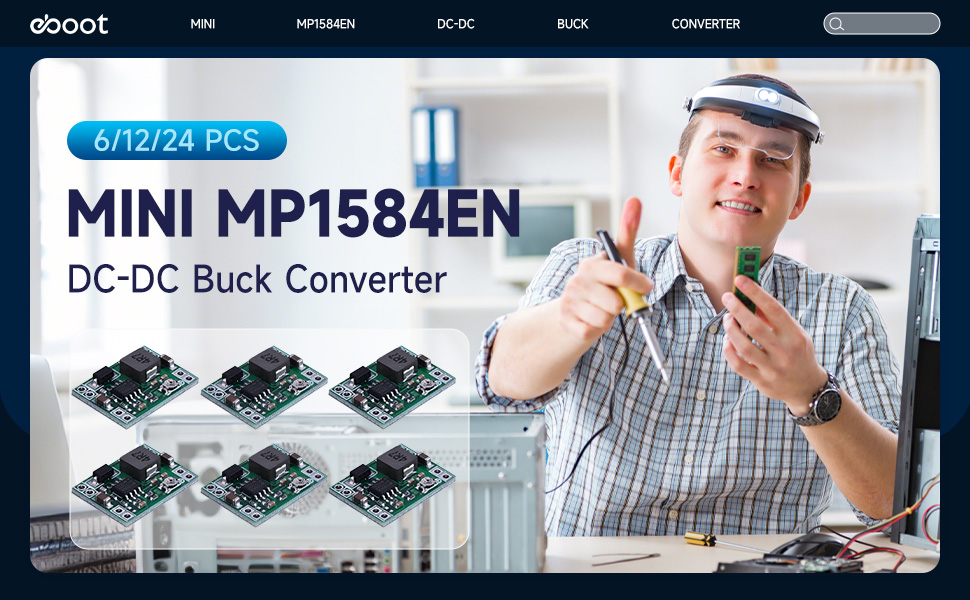
The EBOOT Mini MP1584EN is a high-efficiency DC-DC buck converter module that steps down voltages from 4.5V to 28V to a finely adjustable output between 0.8V and 20V. Delivering up to 3A with 92% efficiency, its compact 22x17x4 mm design fits tight spaces while maintaining cool operation. Engineered with a fail-safe mechanism, it prevents damaging voltage spikes on failure, making it a trusted choice for powering sensitive electronics. This 6-pack offers excellent value for professionals and hobbyists needing reliable, precise voltage regulation.


| ASIN | B01MQGMOKI |
| Best Sellers Rank | #42,707 in Tools & Home Improvement ( See Top 100 in Tools & Home Improvement ) #169 in Power Converters |
| Brand | EBOOT |
| Color | green black |
| Customer Reviews | 4.4 out of 5 stars 1,336 Reviews |
| Input Voltage | 3 Volts |
| Item Dimensions | 0.16 x 0.87 x 0.16 inches |
| Item Weight | 18.14 g |
| Item dimensions L x W x H | 0.16 x 0.87 x 0.16 inches |
| Manufacturer | eBoot |
| Mfr Part Number | Mini MP1584EN |
| Model Number | Mini MP1584EN |
| Number of Outlets | 6 |
| Output Voltage | 20 Volts |
| Plug Type | DC Jack |
| Power Source | Battery Powered |
| UPC | 713072676690 |
| Unit Count | 6.0 Count |
S**E
Dont even skimp on voltage regulators or you will pay for it.. these are great!!!
Excellent adjustable buck style voltage regulators.. don't get hot, provide a soild voltage feed with raises and falls that stay within 1 to 2 hundredths a volt.. give a fairly clean output voltage (still need a LC filter if you want very clean wave forms) provides 0.6 to 23 volts from my testing.. able to pull a constant 3.5 amps off it at 16.8v without it getting hot 2.5amps at 20volts gets warm but ok... 3amps at 20v will cook the coil in about 20 minutes.. at 12v I was able to pull a solid 4.2a off it for 2 hours and the temp never got above 97F, 4.5a at 12v smoked it in 7 minutes... If you cook the coil on it it does NOT allow full voltage to pass through (I have had some buck regs fail and allow full voltage to pass through for a few seconds.. I killed two of these intentionally to make sure that when it failed no voltage pass through and on neither one did that happen and that makes me VERY HAPPY. A failure acts like a breaker, it fails it fails and circuit is instantly broken.. I tested this with a O-scope and it had 0ms of full voltage seep when it failed..) These are incredibly cheap and excellent quality.. over preform and stay dang steady.. These are without a doubt the best cost to preformance ratio bucks you can buy... Bucks are not a place to skimp and buy as cheap as possible BECAUSE a failure on a buck that is supplying constant regulated voltage to high dollar electronics and fail and allow unregulated voltage to seep by for even a 1ms can damage sensitive to voltage electronics and ruin your day and make you wish you wouldn't have saved that 30 cents per piece.
L**S
Great way to reduce fan speed
I used this to reduce the speed of a 24V fan, making it nearly silent. I snipped the fan wires and soldered them onto this board, then taped it down. Turned on the fan and adjusted the screw until it was the right balance of airflow and noise. Overall, works really well and price is great.
S**X
Good Compact Buck Converters, But Test Them First
I bought the 3-pack of these MP1584EN buck converter modules, and 2 out of the 3 worked. The one that didnโt work had visible damage: the MP1584EN regulator IC was cracked, and after testing it, I confirmed that the chip was shorting out. Iโm not sure if that happened during shipping or before it was packaged, but the other two modules worked fine. For the working ones, they have been good little buck converters. They are very small, which is nice for compact electronics projects where space is limited. The voltage adjustment works well and is very precise, but the potentiometer is sensitive, so it takes small turns to dial in the exact voltage you want. Once adjusted, it held the voltage fine for my use. I also did a quick current test on one module by briefly shorting the output through a multimeter in amps mode, and it showed around 500 mA. That may just be the moduleโs short-circuit protection kicking in, so I donโt think that means it can only output 500 mA. It may be able to supply more with a proper load that actually draws current instead of a direct short. For my low-power project, though, it was more than enough, and the working modules never really got warm. Overall, I like them. They are small, easy to use, and work well for low-power electronics projects. Iโd just recommend testing each one before installing it permanently, especially if you are using them for something important.
N**U
Worked great in the beginning
It worked great when I tested one of them. So I permanently glued it to my setup. And now the potentiometer is not changing the voltage on 3 of them. I am pretty sure I didnโt turn it too far but who knows maybe I applied too much force. So just be gentle I guess. Giving it 1 star because the product was great when it worked. But didnโt even last a few seconds of adjustments. EDIT: I changed my mind. They are working really good now. Yeah the potentiometer can be finicky but it works. By trial and error you can get the right voltage. Just be careful to go really slow and gentle while changing voltage. Donโt push down too hard and turn slowly.
W**H
Pretty good but one thing....
I have been using these converters for a while now and so far, they have been great. The potentiometer has it's pros and cons depending on your application but I do like the idea of being able to fine tune the output. CON: However, the main issue with this design is the form factor. The mounting holes will NOT line up with standard 2.54mm breadboard or pcb. You will need to bend some male header pins to mount and it works but it's kind of ugly. They are great for prototyping but I have no idea of long term durability. Just remember to set the potentiometer with a bench supply, multimeter and plastic flathead (I use the probe adjustment screwdriver for my scope) - once connected, if you need to make fine tuning adjustments, turn the potentiometer SLOWLY! If you do not need adjustable output, you might want to find a fixed output alternative.
J**.
Adjustable voltage
Iโm an Escape Room owner and have used these many times to reduce 12vdc voltage to 9v, 6v, 4.5v to power different escape room technical props/puzzles. Iโve also used to replace battery operated Halloween props like blow mold pumpkins using a 12v power supply and knocking down the voltage to replace the need for batteries. Cat5 wire or speaker wire works well, in a pinch, to accomplish this. As others have mentioned, adjusting voltage is a bit tedious and requires a small (tiny) screwdriver and it is somewhat hard to dial in, but it works with a little patience. Make sure your input power and polarity is correct or you will fire the circuit board. I tend to use a large heat shrink tube to enclose/protect the circuit board after hooking things up.
P**N
Too cheap - outside of basic prototyping don't use this
This is an example of "if it sounds too good to be true, it is". I have several other buck converters - they work great. For a project I needed smaller units to provide at least 5V/1A - I would like to to be able to handle 2Amps. This looked like a good option - small and "agile". As others have written - it's HARD to adjust. I had to use special screw drivers to make adjustments (ceramic) - I destroyed the first unit I tried to use. Even a tine adjustment makes a "huge" difference and getting to the exact right voltage is hard. WORSE - the moment I put a load on the output, the voltage dropped a few decimal points. So I had to start all over again. I was never able to get "exactly" 5.1v as I wanted - it jumped between 5.12 and 5.0x. Worse, touching the potentiometer also resulted in changes. So expect to spend quite a while doing this. I'm beginning to think just adding a zener for voltage regulation post this unit is much better and more precise. It's for this reason alone I'm keeping them. This unit goes bonkers when the input amp hits around 1amp. I had a 1.1amp using a simple load resister on the unit, with a 12V input. Initially I managed to get that working, and it ran for a few minutes very steady according to my scope. I then wanted to up the amperage use and that's when things went bad. Once I put a load higher than the 1.1Amp the unit keeps turning on/off. Worse, even at 12V it wanted 1.5A on the input to just drive this - while it kept switching on/off. My current limit initially made me think my 5 minute test had destroyed it. It just keeps turning on/off when there's a substantial load. So for my project this will not work. If you need less than 1Amp on the output this looks like a great solution vs. a regulator that gets very hot around 0.5A (at least if you use the good old 7805). It's a great alternative that works once you've dialed the unit in. Do consider a zener for more precise regulation - set the output a bit high so it will be right under load. I compared the units temperature during the 5 minute test run with a 7805 - the 7805 maxed out at around 150C - when I turned it off. This unit never got higher than 45C - much better from an efficiency perspective. So it's too cheap to really be useful. But for a quick prototype where you don't have a cheap transformer with steady voltage, this will definitely do.
K**.
Great product
Great product, work as described.
C**S
Cheap, easy, and efficient
I got these to power a raspberry pi on my 3d printer. it was really simple to set it to 5.3v out on 24v in and it gets warm but not to a concerning level. voltage seems steady. Seems to be working great! cant wait to use the other 5 somewhere
A**E
Excellent product
As described. Works perfectly.
A**R
Not the smallest but it's okay
It had the right pin pitch for a breadboard and the pot could be adjusted to get the right output voltage.
A**R
Flexible, easy to use, and excellent value
This device is small and adjustable to any voltage within the range specified, not just the discrete voltages listed. ie you don't select a voltage from a finite set of choices, you adjust it to anything you want in the range. Once set, it doesn't matter what the input voltage is, so long as it's within the specified range. At 3A rated output, it's perfect for mobile application payloads (eg. on drones), instrumentation platforms, and so on to name a few. At the low cost these devices sell for, I'm going to buy another batch just to have them around for those last minute projects that need a great stable power supply.
C**Y
Does what it says.
I used this buck converter to convert a set of solar LED string lights to run off the 12v battery in my tent camper. I simply connected it to a spare 12v battery on my bench to set the output to 3.5v before shrink-wraping and installing it by splicing into the existing exterior light circuit on the trailer. I was concerned that a higher input voltage while charging the trailer battery may effect the output voltage but it does not. Steady 3.5v regardless of input voltage. I will report back on dependability and heat generation after I've run them for an extended time in a few weeks.
Trustpilot
1 day ago
5 days ago