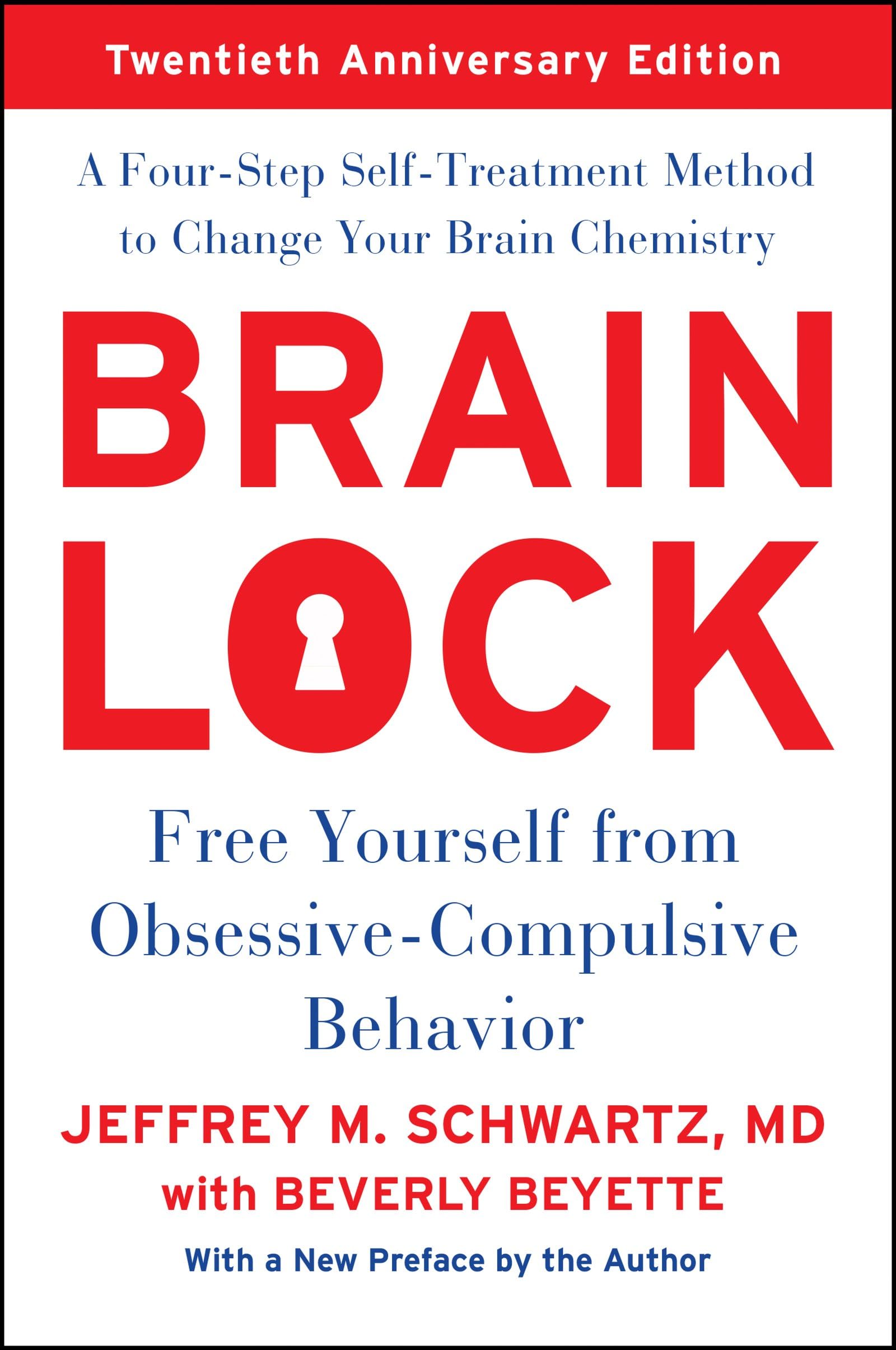
Brain Lock, Twentieth Anniversary Edition: Free Yourself from Obsessive-Compulsive Behavior
Product ID: 37190567
Buy anything from 5,000+ international stores. One checkout price. No surprise fees. Join 2M+ shoppers on Desertcart.
Desertcart purchases this item on your behalf and handles shipping, customs, and support to Uruguay.
Brain Lock, Twentieth Anniversary Edition: Free Yourself from Obsessive-Compulsive Behavior [Schwartz, Jeffrey M.] on desertcart.com. *FREE* shipping on qualifying offers. Brain Lock, Twentieth Anniversary Edition: Free Yourself from Obsessive-Compulsive Behavior Review: A strategy guide for retraining your brain - Brain Lock is a book for those that would like an overhead view of their disorder. It helped me feel a detachment from the disease, not so much by encouraging me to dissociate myself from it, but rather by describing it as part of my brain whose opinions I should feel free to ignore. With OCD, you know it isn't normal to think how you do, but you feel like there will be consequences if you ignore your compulsions or distract yourself from your obsessions. And so, we either perform our nonsensical tasks, or we spend countless hours and valuable brain cycles going through the many reasons NOT to perform said tasks. One of the major revelations of Brain Lock is that BOTH of these responses play into the hands of the disorder. Either way, you are wasting your time and becoming unbelievably stressed out and not getting any closer to being rid of the problem. Only by looking at the thoughts as foreign and allowing yourself to move on to other business can you break yourself out of the cyclical thinking ("brain lock") that plagues us. I hope that you will find, as I have, that as the years progress, the brain lock subsides, and the real you emerges. It is not a cure, and there can be relapses. Despite this, it reminds me of exercising for years and getting injured. You are put out of your routine for a while, but once you are able to get back in the gym, you are not back where you were years ago. Your strength returns, and your progress resumes. 2010 Edit: Still doing well, but I wanted to join in with those recommending cognitive behavioral therapy (and ERP, and the rest of its friends). While this book was quite effective for me, it might be because I had/have a "pure obsession" type of OCD, where the compulsions are all performed mentally. These can include scrupulosity, health concerns, and counting. Exposure therapy is the gold standard for OCD (and phobias, and any disorder where there is an irrational anxiety/fear/disgust response that the brain fails to extinguish). This book has clearly worked for those with overt compulsions (checking, hoarding, cleaning), but I no longer consider it the first choice for such problems. This book does, indeed, recommend its own type of avoidance strategies. That said, the four steps encouraged me to refuse to engage in my mental rituals, accepting the concomitant distress as irrational and dismissible. In other words, this can be very effective exposure and acceptance therapy for pure obsession types of OCD. Review: This book should have been a pamphlet - Although overly simplistic and poorly written, this book has been incredibly helpful for me as a person who has suffered with OCD since childhood. I had never identified my OCD as such until college, although vaguely I always knew something was going awry in my mind (I guess I just thought everyone had these same struggles). A counselor recommended this book, so I skimmed through it and began trying the '4 steps' (summary later in the review). At first it was counterintuitive and seemed like I was leaving important thoughts behind. In time I began to realize those 'important thoughts' were my obsessions, and that constantly refocusing mitigated their power to depress or paralyze me. I joined a meditation group and have realized that the steps in this book are similar to what I learned there. Both are a conscious process of 1) Observing thoughts as they come to mind 2) Allowing those thoughts to be in the mind without judgement 3) Allowing oneself to refocus on the present. Mr. Schwartz showed that this process causes actual changes in brain chemistry over time, decreasing the frequency and intensity of intruding thoughts. This book has had the greatest effect on me of any book I have ever read. It may not work for all kinds of OCD, but it sure worked for me. Here's a summary of the steps: Step 1: RELABEL Recognize that the intrusive obsessive thought is a COMPULSIVE one. Recognize it by saying "There's that compulsive thought again." The goal is to control your responses to the thoughts, not to control the thoughts themselves. Step 2: REATTRIBUTE Realize that the intensity and intrusiveness of the thought is caused by its compulsive nature. You did not cause the thought to occur. It just is there. There is nothing you can do to make it go away immediately. Trying to make them go away will only pile stress on stress. Step 3: REFOCUS Just because the obsessive thought or compulsion intrudes, it does not mean you have to act on it. Work around the compulsive thought by focusing your attention on something else, at least for a few minutes: DO ANOTHER BEHAVIOR. You must train yourself in a new method of responding to the thoughts, redirecting your attention to something other than the compulsive thought. The goal is to stop responding to the compulsive thoughts while acknowledging that, for the short term, these uncomfortable feelings will continue to bother you. You learn that even though the compulsive thought is there, it doesn't have to control what you do. By REFOCUSING, you reclaim your decision-making power. The thoughts in your brain are no longer running the show. Refocusing isn't easy. It will take significant effort and even tolerance of some pain. But only by learning to resist the compulsions can you, in time, decrease the pain. The idea is to delay your response to an obsessive thought or to your urge to perform a compulsive behavior by letting some time elapse-preferably at least fifteen minutes-before you even consider acting on the urge or thought. In the beginning or when the urges are very intense, you may need to set a shorter waiting time, say five minutes, as your goal. Note: Sometimes the urge will be too strong, and you will perform the compulsion. This is not an invitation to beat yourself up. Step 4: REVALUE Do not take the compulsive thought at face value. It is not significant in itself. You do not have to act on the compulsive thought. After adequate training in the first three steps, you are able in time to place a much lower value on the compulsive thoughts and urges. Although in the short run, you can't change your feelings you can change your behavior. By changing your behavior, you find that your feelings also change in time.
| Best Sellers Rank | #11,007 in Books ( See Top 100 in Books ) #3 in Compulsive Behavior (Books) #4 in Obsessive Compulsive Disorder #215 in Personal Transformation Self-Help |
| Customer Reviews | 4.6 out of 5 stars 2,400 Reviews |
I**H
A strategy guide for retraining your brain
Brain Lock is a book for those that would like an overhead view of their disorder. It helped me feel a detachment from the disease, not so much by encouraging me to dissociate myself from it, but rather by describing it as part of my brain whose opinions I should feel free to ignore. With OCD, you know it isn't normal to think how you do, but you feel like there will be consequences if you ignore your compulsions or distract yourself from your obsessions. And so, we either perform our nonsensical tasks, or we spend countless hours and valuable brain cycles going through the many reasons NOT to perform said tasks. One of the major revelations of Brain Lock is that BOTH of these responses play into the hands of the disorder. Either way, you are wasting your time and becoming unbelievably stressed out and not getting any closer to being rid of the problem. Only by looking at the thoughts as foreign and allowing yourself to move on to other business can you break yourself out of the cyclical thinking ("brain lock") that plagues us. I hope that you will find, as I have, that as the years progress, the brain lock subsides, and the real you emerges. It is not a cure, and there can be relapses. Despite this, it reminds me of exercising for years and getting injured. You are put out of your routine for a while, but once you are able to get back in the gym, you are not back where you were years ago. Your strength returns, and your progress resumes. 2010 Edit: Still doing well, but I wanted to join in with those recommending cognitive behavioral therapy (and ERP, and the rest of its friends). While this book was quite effective for me, it might be because I had/have a "pure obsession" type of OCD, where the compulsions are all performed mentally. These can include scrupulosity, health concerns, and counting. Exposure therapy is the gold standard for OCD (and phobias, and any disorder where there is an irrational anxiety/fear/disgust response that the brain fails to extinguish). This book has clearly worked for those with overt compulsions (checking, hoarding, cleaning), but I no longer consider it the first choice for such problems. This book does, indeed, recommend its own type of avoidance strategies. That said, the four steps encouraged me to refuse to engage in my mental rituals, accepting the concomitant distress as irrational and dismissible. In other words, this can be very effective exposure and acceptance therapy for pure obsession types of OCD.
J**N
This book should have been a pamphlet
Although overly simplistic and poorly written, this book has been incredibly helpful for me as a person who has suffered with OCD since childhood. I had never identified my OCD as such until college, although vaguely I always knew something was going awry in my mind (I guess I just thought everyone had these same struggles). A counselor recommended this book, so I skimmed through it and began trying the '4 steps' (summary later in the review). At first it was counterintuitive and seemed like I was leaving important thoughts behind. In time I began to realize those 'important thoughts' were my obsessions, and that constantly refocusing mitigated their power to depress or paralyze me. I joined a meditation group and have realized that the steps in this book are similar to what I learned there. Both are a conscious process of 1) Observing thoughts as they come to mind 2) Allowing those thoughts to be in the mind without judgement 3) Allowing oneself to refocus on the present. Mr. Schwartz showed that this process causes actual changes in brain chemistry over time, decreasing the frequency and intensity of intruding thoughts. This book has had the greatest effect on me of any book I have ever read. It may not work for all kinds of OCD, but it sure worked for me. Here's a summary of the steps: Step 1: RELABEL Recognize that the intrusive obsessive thought is a COMPULSIVE one. Recognize it by saying "There's that compulsive thought again." The goal is to control your responses to the thoughts, not to control the thoughts themselves. Step 2: REATTRIBUTE Realize that the intensity and intrusiveness of the thought is caused by its compulsive nature. You did not cause the thought to occur. It just is there. There is nothing you can do to make it go away immediately. Trying to make them go away will only pile stress on stress. Step 3: REFOCUS Just because the obsessive thought or compulsion intrudes, it does not mean you have to act on it. Work around the compulsive thought by focusing your attention on something else, at least for a few minutes: DO ANOTHER BEHAVIOR. You must train yourself in a new method of responding to the thoughts, redirecting your attention to something other than the compulsive thought. The goal is to stop responding to the compulsive thoughts while acknowledging that, for the short term, these uncomfortable feelings will continue to bother you. You learn that even though the compulsive thought is there, it doesn't have to control what you do. By REFOCUSING, you reclaim your decision-making power. The thoughts in your brain are no longer running the show. Refocusing isn't easy. It will take significant effort and even tolerance of some pain. But only by learning to resist the compulsions can you, in time, decrease the pain. The idea is to delay your response to an obsessive thought or to your urge to perform a compulsive behavior by letting some time elapse-preferably at least fifteen minutes-before you even consider acting on the urge or thought. In the beginning or when the urges are very intense, you may need to set a shorter waiting time, say five minutes, as your goal. Note: Sometimes the urge will be too strong, and you will perform the compulsion. This is not an invitation to beat yourself up. Step 4: REVALUE Do not take the compulsive thought at face value. It is not significant in itself. You do not have to act on the compulsive thought. After adequate training in the first three steps, you are able in time to place a much lower value on the compulsive thoughts and urges. Although in the short run, you can't change your feelings you can change your behavior. By changing your behavior, you find that your feelings also change in time.
D**M
Good book but don't but all your eggs in this basket
This book has been very insightful. I haven't applied the four steps yet, but you don't have to finish the book to begin. Each step works alone, but only the four together will provide the actual self-treatment. I like how they focus so much on the science - it really validates the book and motivates the reader to understand that OCD is purely a chemical issue, it is not their fault, and there is hope for a better quality of life. I'm about half-way through the book. I bought it because I suffer from retroactive jealousy. I feel the worst is behind me because: I'm mindful that this problem is internal and is not anyone's fault, I sought out professional help in the form of weekly psychotherapy sessions (an experience that will be serendipitous for all that seek it), by studying these kinds of behaviors and really wanting my relationship to work out. It takes work, but you will grow personally because of it. Be patient. My favorite line from the book so far: "It's not what you feel that matters, but what you do." I would say don't expect this book to solve all your lives problem, but I would definitely recommend this book because it opens your eyes to so many things about OCD and life in general. Good read!
M**.
This book changed my life.
I was diagnosed with OCD when I was a teenager (I'm now 27). Throughout the years I've had various obsessions and compulsions ranging from excessive hand washing, touching, counting, fear of contamination/disease, and obsessive intrusive thoughts about harming others. A few years ago I went through a terrible obsession about hurting others. I almost lost my job due to this obsession because I couldn't focus on anything other than the obsession. Not only that, I was physically deteriorating. I felt so terrible for the thoughts that were going through my head that I didn't want to eat, work, or socialize. I just wanted to sleep, because that was the only time I had peace in my mind. I was seeing 2 therapists at the time and had been on anti-depressants for years; nothing was helping. I decided to go online and see if there were any books that may help. I looked up books specializing in OCD and found "Brain Lock". I saw lots of positive feedback from other readers. I can't even imagine how different things would be in my life now if I hadn't found and read the book. This book helped me overcome my obsession of harming others. I still have OCD - that will probably never go away, but this book helps me remember that when I'm wrapped up in an obsession that it is just that - an obsession. I'm struggling again with a new obsession so I bought the book again (lost the other copy I had while moving) and I'm planning on re-reading it. This book is one of the best tools I've found to fight obsessive thoughts. I recommend it for anyone that is tormented by obsessions.
B**M
Classic book, use appendix for technique steps
I've bought multiples of this book in hardback, paperback, and Kindle in multiple editions. (The paperback is made rather cheaply.) I've given copies of this to friends and family as I think it's useful to anyone with OCD. Although it stresses extreme cases of what I would call "physical" OCD, the techniques also work for obsessive thought patterns, not just those with a physical manifestation. So an OCD about a topic or a worry are also addressed by the same techniques. If you don't want to bother reading the book but want the help it offers, you can just skip to the appendix with the steps for dealing with OCD (relabeling,etc.). I've seen this be helpful for multiple people, and it's a relief for many to know that it is not them choosing to have these thoughts, but simply the brain misfiring. It's not a character flaw, but a biological short circuit that can be rewired through practice.
S**R
Simple, effective, amazing...
After years of psychotherapy and countless medication changes I found it a losing battle that seemed to have no end. My psychiatrist had moved out of town and I was assigned a new psychiatrist. At our first meeting she suggested I sounded like I had OCD. Being that everyone claims to have OCD I was initially thinking "oh great another meaningless diagnosis". She then referred me to a specialist that treats OCD. The specialist recommended this book to me along with the OCD Workbook. As soon as I opened this book up I saw that 99% of my problem was in-fact OCD. I have what is called "Pure-O". It means that all of the compulsions and obsessions go on in my head. I dont need to constantly touch things or do rituals other than ones I do in my head like saying repeated mantras. This simple fact freed me from many of my outlandish obsessions almost immediately! The more subtle ones, however do persist. Realizing that OCD is a physiological and not just a psychological disorder is also empowering. This book gives 4 simple to understand and perform new rituals that in time actually rewire the brain to some extent. I may never be totally free from OCD, but I will be able to better manage its ravaging nature, and to me makes this one of the best books I have ever read.
M**Y
Very informational on OCD
The counselor I just started seeing suggested this book. This book has provided me with information that has allowed me to reflect on how my OCD has affected me my entire life. It is not easy to face the information and realize how much OCD has controlled my life. I now understand my OCD better, and hope this book will continue to guide me along with the help of my counselor to take more action to assist me with coping.
S**I
Skin deep
The reviewer Judith Shapiro wrote a good review but I'd like to touch on a few things I found unhelpful in this book. I'm a well educated professional in an unrelated field, and I wanted to learn more about why OCD follows me around and waxes and wanes, I'm in a period of the most extreme OCD of my life in the last few months. I have the contamination type of OCD (severe fear of rabies and hantavirus contamination in particular). The strategies in this book are overly simplistic and could easily have been covered in 50 pages without all the "ra ra, you can do it!"type stuff and case studies of very extreme examples. The idea that "it's not me, it's my OCD" simply doesn't resonate with me well. I don't believe that my mind and myself are distinctly separate and that this is ALL my mind playing tricks on me. To do so would absolve me of responsibility. This book tries to lead you to believe that none of this is reasonable or your fault, and I don't feel that's entirely honest. OCD, whether I want to admit it or not IS a part of who I am. from a biological perspective, I believe there are likely to be some positive survival fitness aspects to it. The idea of OCD versus OCPD isn't as clear cut as it seems. I have intense shame and embarrassment of my symptoms and thoughts, but I do admit this is part of my personality. I find much of the positivity and bias towards the four steps is not helpful for me to understand my illness. The four steps are clear and easily understandable, but the book tends to reek of a sales pitch and can be judgmental about medication or other methods. Don't get me wrong, there is power in the four steps and constantly reminding yourself that it is OCD. That has been helpful, but it certainly isn't a magic bullet for everyone. The CBT methods that aren't well covered in this book scare the bejesus out of me because that's not how I feel I'm wired. I do not desensitise easily... I understand if this book is taking the attitude it is to try to be positive and uplifting, but I'd much prefer to understand all sides of OCD rather than just the PR friendly version that tries to make you feel less responsible than you may actually be. I want to know what exactly is misfiring in my brain. This book seems positive to a fault in that regard. I know a large aspect of my OCD relates to being unable to see tasks as complete, and an inability to rationally deal with exceedingly small probabilities and risks or the inherent double standards my brain uses for, say, rabies, versus driving over the speed limit. These strategies don't help me with those underlying issues. Overall this book is moderately helpful to beat the idea into you that your behaviors are a symptom of OCD, which can certainly be helpful, but it is only skin deep and provides a clearly biased view of OCD and OCD treatment.
Trustpilot
1 month ago
2 months ago