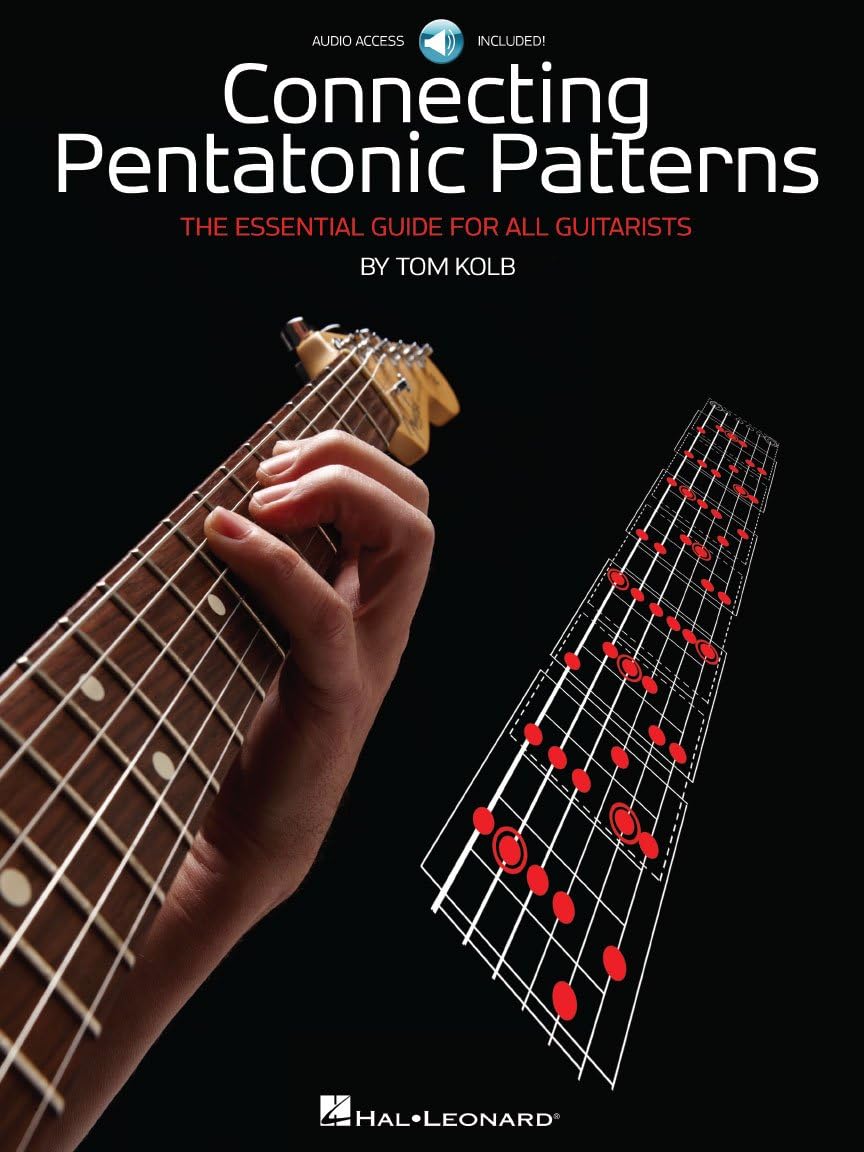
Connecting Pentatonic Patterns – The Essential Guide for All Guitarists | Guitar Sheet Music Songbook with Online Audio | Hal Leonard Guitar Tablature and Music Theory Instruction | By Tom Kolb
Product ID: 3783184
Buy anything from 5,000+ international stores. One checkout price. No surprise fees. Join 2M+ shoppers on Desertcart.
Desertcart purchases this item on your behalf and handles shipping, customs, and support to Uruguay.
Connecting Pentatonic Patterns – The Essential Guide for All Guitarists. Connecting Pentatonic Patterns is an essential guitar sheet music songbook designed to help players break free from the limitations of the pentatonic box. Written by Tom Kolb and published by Hal Leonard, this comprehensive instructional guide is suitable for guitarists of all levels, from beginner to advanced. The book focuses on expanding fretboard knowledge and offers practical exercises that enable players to solo seamlessly across the neck. With 144 pages of detailed lessons, guitar tablature, and clear explanations, it’s an indispensable resource for anyone looking to enhance their improvisation skills. This user-friendly softcover edition includes online audio access with demonstrations of every example and jam tracks for practice, allowing players to learn at their own pace. The audio can be streamed or downloaded, providing flexibility for practicing anywhere. Whether used for self-study or as a music teacher resource, this book is perfect for guitar students, professional musicians, and hobbyists. Its comprehensive approach ensures that players not only learn patterns but also understand how to connect them musically. With clear instruction, practical applications, and interactive learning tools, Connecting Pentatonic Patterns is an excellent gift for pianists interested in guitar theory, as well as a valuable addition to any guitarist’s collection. Start unlocking the fretboard and elevate your soloing skills with this essential guide. Review: I love the book. Only through chapter one, but I love it. - I first picked up a guitar 22 years ago and have been in bands ever since. I never had a guitar lesson in all that time but I did learn how to read music in band back in high school and I figured out guitar tab a while ago. I bought this book to help break me out of a rut. Over the years, I've amassed a few dozen riffs that I slice up and rearrange here and there but I was tired of using and reusing them. After I recently joined a band with a highly prolific songwriter I could no longer ignore the rut. His songs used up all my tricks! It was time to get some new inspiration. It was time to learn how to properly use the fretboard instead of relying on gimmicks. The first chapter is dedicated to the first pentatonic pattern, then each of the next four chapters bolts another pentatonic pattern on to what you previously learned. By the end of chapter five, you’re soloing over the entire fretboard. Chapter 6 changes from minor to major and then Chapter 7 shows you how to switch between the two in the same solo. I’m only through chapter one. It’s taken me a month to get through the first 28 pages. So, I am progressing at an average of a page a day. Some pages flew by taking only minutes. Then there were some exercises that did something new for me that I’ve heard others do, but never tried myself. The trick is to really follow each exercise closely paying attention to the suggested fingers, down picks and up picks. I discovered that if I took the rifs from each exercise and made a little song for myself, I learned them faster. I’ve actually already applied some of the lessons I’ve learned to original music in my band. After finishing a page, I found myself looking forward to the next day so I could learn some more. I actually looked forward to the next page like reading a spy novel or something. Each day I went back and reviewed each previous exercise before learning the new page. By the time I got to the solo at the end of chapter one, I was ready. Surprise! Many of the riffs I learned in the Chapter also appeared in the solo. Like I said earlier, while learning the riffs, I used them in my own songs to help memorize them. Seeing them in the solo at the end of chapter one showed me new ways to use those same riffs. So the chapter has helped me in two ways. I also can’t say enough about the tracks online at Hal Leonard’s website. The online web player lets you loop any section of a lesson. You can even slow it down or speed it up. The solo tracks let you pan all the way to the left so you can hear just the backing tracks and solo over them yourself. Or, you can keep the balance in the center and play along with the solo. I imagine this book is going to take me half a year to get through. Once finished I have no doubt I’ll keep going over the exercises to keep them fresh in my mind. Even though I only just now finished chapter one I can honestly say that I highly recommend this book. If you're a moderately skilled guitarist, this book will definitely help you get to the next level. Review: Core Knowledge for Blues, Rock and Jazz Guitarists - This book provides a logical approach to expanding the basic minor pentatonic scale. You will learn the five shapes of the minor pentatonic and how to connect them in digestible steps, greatly increasing your fret board knowledge in the process. Each chapter explains a pattern and how it is connected to the previously learned patterns. Then provides numerous licks to help you understand how to incorporate it into your playing. The chapters end with 2 full solos, one for beginner/intermediate players and another for more advance players, to put the knowledge into a larger musical context. The solos also have measure by measure breakdowns explaining how the concepts are applied. Most of the examples are in a blues/rock vein but the material is very translatable to other styles. The patterns are tackled in the form of minor pentatonics but later chapters discuss major pentatonics and how the same patterns can be used in that context. The patterns and solos are presented in standard notation and tablature and are meticulously annotated with fingerings, pick direction, palm mutes etc. Very few guitar books are notated this well and NONE give you tips on how to reproduce the tone you are hearing in the examples. Each lick gives you a notation like (bridge humbucker; medium/light overdrive) and the full solos at the end of the chapter offer additional tone tips such as gain, EQ and effect settings.This is invaluable information for beginning/intermediate players who are struggling with how to reproduce the sound that they hear on other people recordings. This is a great resource to get you proficient at playing major and minor pentatonics. If you want to take it further I suggest Pentatonic Khancepts: Book & CD


| Best Sellers Rank | #153,211 in Books ( See Top 100 in Books ) #110 in Music Theory (Books) #136 in Guitars (Books) #632 in Music Instruction & Study (Books) |
| Customer Reviews | 4.6 out of 5 stars 643 Reviews |
M**T
I love the book. Only through chapter one, but I love it.
I first picked up a guitar 22 years ago and have been in bands ever since. I never had a guitar lesson in all that time but I did learn how to read music in band back in high school and I figured out guitar tab a while ago. I bought this book to help break me out of a rut. Over the years, I've amassed a few dozen riffs that I slice up and rearrange here and there but I was tired of using and reusing them. After I recently joined a band with a highly prolific songwriter I could no longer ignore the rut. His songs used up all my tricks! It was time to get some new inspiration. It was time to learn how to properly use the fretboard instead of relying on gimmicks. The first chapter is dedicated to the first pentatonic pattern, then each of the next four chapters bolts another pentatonic pattern on to what you previously learned. By the end of chapter five, you’re soloing over the entire fretboard. Chapter 6 changes from minor to major and then Chapter 7 shows you how to switch between the two in the same solo. I’m only through chapter one. It’s taken me a month to get through the first 28 pages. So, I am progressing at an average of a page a day. Some pages flew by taking only minutes. Then there were some exercises that did something new for me that I’ve heard others do, but never tried myself. The trick is to really follow each exercise closely paying attention to the suggested fingers, down picks and up picks. I discovered that if I took the rifs from each exercise and made a little song for myself, I learned them faster. I’ve actually already applied some of the lessons I’ve learned to original music in my band. After finishing a page, I found myself looking forward to the next day so I could learn some more. I actually looked forward to the next page like reading a spy novel or something. Each day I went back and reviewed each previous exercise before learning the new page. By the time I got to the solo at the end of chapter one, I was ready. Surprise! Many of the riffs I learned in the Chapter also appeared in the solo. Like I said earlier, while learning the riffs, I used them in my own songs to help memorize them. Seeing them in the solo at the end of chapter one showed me new ways to use those same riffs. So the chapter has helped me in two ways. I also can’t say enough about the tracks online at Hal Leonard’s website. The online web player lets you loop any section of a lesson. You can even slow it down or speed it up. The solo tracks let you pan all the way to the left so you can hear just the backing tracks and solo over them yourself. Or, you can keep the balance in the center and play along with the solo. I imagine this book is going to take me half a year to get through. Once finished I have no doubt I’ll keep going over the exercises to keep them fresh in my mind. Even though I only just now finished chapter one I can honestly say that I highly recommend this book. If you're a moderately skilled guitarist, this book will definitely help you get to the next level.
J**E
Core Knowledge for Blues, Rock and Jazz Guitarists
This book provides a logical approach to expanding the basic minor pentatonic scale. You will learn the five shapes of the minor pentatonic and how to connect them in digestible steps, greatly increasing your fret board knowledge in the process. Each chapter explains a pattern and how it is connected to the previously learned patterns. Then provides numerous licks to help you understand how to incorporate it into your playing. The chapters end with 2 full solos, one for beginner/intermediate players and another for more advance players, to put the knowledge into a larger musical context. The solos also have measure by measure breakdowns explaining how the concepts are applied. Most of the examples are in a blues/rock vein but the material is very translatable to other styles. The patterns are tackled in the form of minor pentatonics but later chapters discuss major pentatonics and how the same patterns can be used in that context. The patterns and solos are presented in standard notation and tablature and are meticulously annotated with fingerings, pick direction, palm mutes etc. Very few guitar books are notated this well and NONE give you tips on how to reproduce the tone you are hearing in the examples. Each lick gives you a notation like (bridge humbucker; medium/light overdrive) and the full solos at the end of the chapter offer additional tone tips such as gain, EQ and effect settings.This is invaluable information for beginning/intermediate players who are struggling with how to reproduce the sound that they hear on other people recordings. This is a great resource to get you proficient at playing major and minor pentatonics. If you want to take it further I suggest Pentatonic Khancepts: Book & CD
C**F
You learn all the pentatonic scales patterns
Really a good book
T**E
Great learning tool.
I wish I had this book much earlier in my guitar career. It really helped me map the fretboard to better understand it. The book includes several excercises as you progress through the different sections of the fretboard. I suggest this book to everyone. On a side note I rarely write reviews, this one deserved it.
K**R
This book is everything I was hoping it would be
I really can't tell you how much this book is helping my abilities already. I got it a few days ago and played through page 20 and have enjoyed every page. With every new exercise I use the online audio, and then practice slow and up tempo with a metronome until I can play each exercise at the listed tempo. It's been challenging, but an absolute delight. I encourage everyone to buy this book it is absolutely worth every penny.
S**.
Challenging but in a really good way
I bought this book to better improve my overall guitar soloing aptitude (along with two other books - one of which is complete garbage) and I find myself stuck to this book. It is completely thorough in that it starts off slow but then ramps up as each chapter progresses. At the end of each chapter there is a "solo" where you can take everything you have learned and compile that into something more meaningful. It kinda reminded me of my classical piano solos when I was younger in that it took everything I learned over the course and put it all together... and that works for ME. It may not work for you but I got this teaching method and style. More importantly, I was able to walk away with some great techniques and lessons from this book by being able to not only diver deeper into the Pentatonic scaling and patterns but to be able to connect them across several musical keys. There is a reason Hal Leonard is the industry leader in teaching and techniques. I am kicking myself for not going to this book first instead of the "garbage" book I referenced earlier. I am very happy I made this purchase.
R**T
Excellent, fun book, practicing from it every day now
I've noodled around on the guitar for years, but never went very far, due to a lack of having the right instructional material, motivation, and practice. About 4 months back, I got much more serious about it and am now practicing about an hour a day. I've bought a number of books based on good reviews and they all have some pro's and con's, but this book is consistently good, IMO. Start from the beginning and work through it in order. The licks are great and there are some cool solos further into the book, which I'm looking forward to learning. I would say that it is appropriate to start learning from after first learning some pentatonic scales, basic legato (h/p, bends), and getting some callous built up on your fingertips, maybe 1-2 months into your journey. If you're at least halfway serious, it's a fun book that breaks the monotony of a lot of other instructional materials.
H**D
This is What You Get....
This book will teach you how to develop a seamless familiarity with both major and minor pentatonic scales, from one end of the fingerboard to the other. Tom Kolb’s method is to show how neighboring scale patterns “link up” by teaching you licks that make use of both patterns. In other words, each lick begins in one pattern and moves into its neighboring pattern to end. The licks in Chapter One are the only exceptions to this, as Kolb must present a number of licks in fingering pattern #1 before he can show you how to move OUT of pattern one. In other words, you must be somewhat grounded in pattern one, before you can move out of it! Beginning with Chapter Two, every single lick involves TWO pentatonic fingering patterns, and each lick is included *only* for teaching how to connect the two patterns in question. The licks in Chapter Two all connect fingering pattern #1 and fingering pattern #2. By the time you’ve learned all the moves in Ch. 2, you’ll be able to clearly visualize the many ways of connecting pattern 1 and pattern 2. Playing that area of the fingerboard will be as easy as playing a single pattern–but you’ll be moving back and forth–connecting these two patterns. Subsequent chapters work similarly. Chapter Three presents a ton of licks that connect pattern 2 and pattern 3. The licks in Chapter Four will develop your muscle memory for connecting minor pentatonic patterns 3 and 4. And so on, through five minor and major pentatonic fingering patterns. This is a hefty book, and working through it will take some effort. However, if this stuff were easy, everybody would be doing it – so put in the time–learn a lick a day, and before you know it, you’ll practically own the fingerboard. The licks presented here are very good, imho. Juicy blues and rock licks that any player should be proud to play. I think it bears pointing out that the principles taught here for connecting pentatonic fingering patterns could easily be adapted to connecting major scale patterns, modes, harmonic and melodic minor licks and fingering patterns, etc. The only slightly bothersome things (maybe it won’t bother you) is that the suggested pick directions are often unorthodox. If you’re used to playing basically downstrokes on downbeats, upstrokes on upbeats, prepare for system shock. Kolb routinely suggests you begin phrases with upstrokes (on downbeats), and suggests you play downs on upbeats – and there are lots of broken triplet figures, with tricky pick directions; this is not beginner material, but absolutely playable if you take it slow and listen to the CD. Just a minor qualm. 144 pages, opens flat for study.
J**Z
Buen libro
Cumple a la perfeccion el estudio de las pentatonicas. Con algunos solos para aprender a usarlas. Lo dicho, buen libro.
D**Z
Con acceso a contenido online
Tiene un gran número de ejercicios y se puede acceder al audio mediante la plataforma de Hal-Leonard así como descargar los tracks. Me gustó.
M**.
Praktischer Theorie-Einstieg in die Welt der Gitarre
Ein kleine Story zu meiner Vorgeschichte - vielleicht findet sich jemand wieder. Ich spiele seit über 10 Jahren Gitarre bzw. habe gespielt, mit längeren Abständen. Leider aber immer nur nach Gehör und wirklich nur das allernötigste an Theorie, das man dafür benötigte. Nicht weil ich zu faul bin, sondern weil ich als Autodidakt nie den richtigen Einstieg gefunden habe. Entweder zu weit fortgeschritten oder zu Basic. Letztes Jahr habe ich nun wieder begonnen zu spielen und dachte mir "ganz oder gar nicht" und habe mich nach Büchern umgesehen. Der Markt ist gewachsen und mittlerweile gibt es richtig gute Bücher, meistens auch von Autodidakt spielenden Gitarristen, die es verstanden haben, Lernende da abzuholen, wo es wirklich schwer verständlich wird. Dieses Buch ist eines davon. Man bekommt ein Buch mit einem Konzept. Für Beginnende ideal, aber nicht leicht und vor allem nicht langweilig, sondern klassisch bluesig / rockig. Etwas, das eigentlich jeder Gitarrist mal gelernt haben sollte, um mitreden zu können. Außerdem macht es Spaß zu spielen. Dazu gibt es aufgenommenes Material für jedes Lick und jedes Solo, damit man sich auch anhören kann, wie etwas klingen sollte. Dieses Konzept hat zum ersten mal nach über 10 Jahren richtig eingeschlagen. Ich bin dabei geblieben und hatte von Anfang an Spaß - das allererste Mal! Das Material reicht für sicher locker ein Jahr oder auch länger, wenn man beherrschen will, was einem im Buch gezeigt wird. Ich habe Chapter 1 fertig, habe fast täglich gespielt und das hat gut 3 Monate gedauert. Das kann man auch schneller machen, wird aber dann nicht wirklich gut klingen. Gut Ding braucht eben Weile! Ganz großes Lob an den Autor, der es damit geschafft hat, schwierige Inhalte in die Praxis zu übertragen und damit auch sinnvoll und unterhaltsam zu lernen. Das Ding ersetzt im Prinzip die Musikschule, wenn man dem Konzept folgt. Zumindest locker das erste Jahr! Uneingeschränkte Kaufempfehlung für wirklich sinnvolle Lektüre.
P**E
A fairly easy task to take on if you keep at it.
I still say I am someone who plays around with a guitar, as I am self taught. The blues scale is a must and worth the time input to be able to play it in five different places on the neck. Stick with it, this book is great in order to get where you want to get. Lots of licks from the scale.
M**M
Just excellent
I probably have bought 30 or 40 guitar instruction books over the years, and this is definitely one of the best! The licks build on each concept, are short and just fun to play with solid audio examples. I've only scratched the surface with this book and it's already helped solidify some concepts and given me more more tools to use in any key. Looking forward to digging into this one more!
Trustpilot
1 day ago
1 month ago