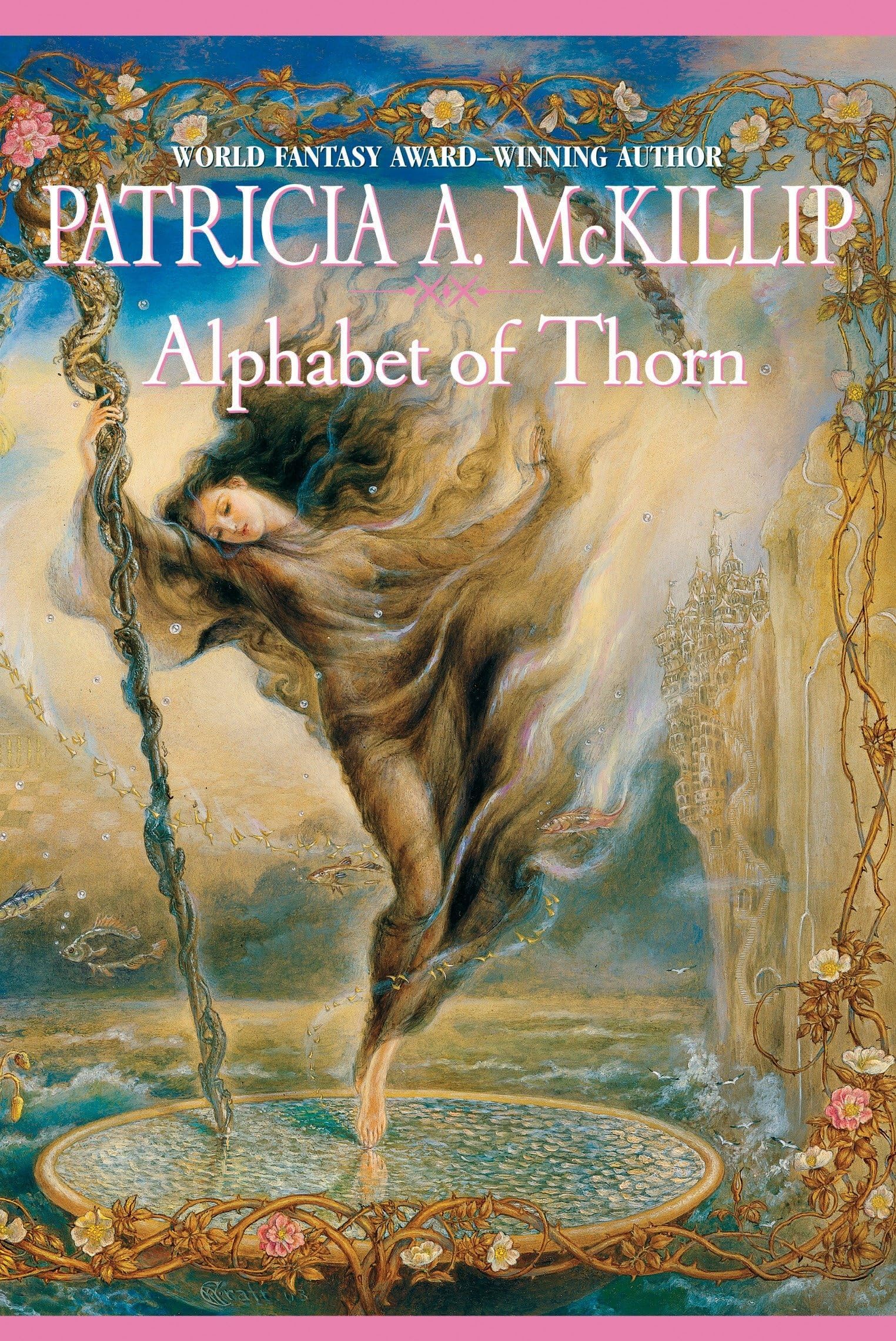
Alphabet of Thorn
Product ID: 38701871
| Best Sellers Rank | #695,931 in Books ( See Top 100 in Books ) #1,340 in Historical Fantasy (Books) #3,569 in Romantic Fantasy (Books) #5,841 in Epic Fantasy (Books) |
| Customer Reviews | 4.6 out of 5 stars 381 Reviews |
C**I
Alphabet of Thorn
Nepenthe is an orphan in the kingdom of Raine. She was raised by librarians to become a very skilled translator and spends her days decoding very old texts in long-forgotten languages and translating them into her own language. One day, she meets Bourne, a student at the Mage School, and he gives her a book written in an alphabet of thorns. Nepenthe is immediately drawn to the ancient book and becomes obsessed with translating it, learning all about the emperor Axis and his mysterious sorceress Kane. But the book doesn't follow any of the rules - it refers to places and conquests and people that existed long after the author and its main characters could possibly have lived. And there are problems in Raine, too- the new, young queen Tessera is facing dissent from within her own kingdom, but a more terrifying, completely unknown threat is coming, too. And the only warning is to "Beware the thorns." I realize the book sounds really not that exciting in my poor attempt at a plot summary above, but IGNORE the plot summary. Really, this book is all about the book within the book (I love books about books!) and how that story and its characters impact everyone else and all the action. Axis' and Kane's lives are revealed, little by little, throughout the story until readers begin to understand just how intimately their lives influence those of Nepenthe, Tessera and all their friends. In a way, it reminded me of The Blind Assassin, but that's really only because both books have stories that not only are fascinating to read, but also reveal so much about the other people that populate the narrative. Another aspect of this book that was the source of much of my love was the faint hint of feminism. Not so much to blast you over the head with a "Girls rule! Boys drool!" approach, but enough to make you take notice. For example, the great sorceress Kane has gone down in 3,000 years of history as a man, not a woman, and it's only as Nepenthe begins translating that she realizes that Kane is a very powerful sorceress, not a sorcerer. And she's not the only historical figure that people assume is a man based on the accomplishments that have trickled down through history; it is a theme that comes up multiple times. Similarly, there is the idea of women having the right to choose their destiny- to face their fears and their problems and decide the proper course of action. The women in this novel are not bystanders or inactive participants; they move their lives along certain paths and deal with the consequences of those decisions. I loved that. I also loved that McKillip makes the people in this book a very diverse bunch. She doesn't make race an important distinction in her novel; rather, people come in all different shapes and sizes and colors and with varying degrees of magical ability, and no one seems to care much at all. It's quite liberating to see such a diverse and open-minded world. But what kept me reading straight through for hours on end was the book. And the book within the book. Can you even imagine an alphabet of thorns? Also mentioned are the languages of fish and birds and the winds and so many more. I would love to see how these languages come through onto paper. I had a lot of fun trying to visualize them, but they seem completely foreign in construction to anything available to my mind. And the world that McKillip creates- a huge castle on the edge of the world, so high up on a cliff that you can't even hear the water crashing below, a magical wood that reveals different things to different people, a school that can float in the air, and a rich diversity of characters with a long and storied history. It was wonderful to soak all of that in, especially since the book is written in such lovely language. In many ways, this novel reads like a fairy tale. It's so evocative of magic and romance and destiny, all written in such a manner that you can feel the multiple layers of the world you're visiting, but can't quite see them. It was just what I wanted, and I'm so thrilled to have discovered McKillip. I can't wait to read more!
P**P
High Fantasy - Don't give up on it!
This novel is the exact opposite of the one I read just before it. Where as the last one started out with a bang then fell of the tracks, this one gets better and better as it goes along. Other than the dual timelines, always a favorite of mine, this book feels like typical high fantasy UNTIL the plot takes a twist that I would never have seen coming. A highly imaginative, fascinating plot, with a building sense of impending doom that is inescapable. Great job there. As usual for Patricia McKillip, the writing lends itself to a feel of dreaming, with the characters not quite solid, but well suited to the tale. My only complaint is that the ending seemed a little too abrupt, a bit of a let down after that incredible build up. And the writing doesn't have the lush lyricism of The Bards of Bone Plain, my favorite from this author. The book is clean in terms of language and intimacy, there are intimate scenes, but they are behind closed doors.
R**R
"She Has No Idea What Brute Force and Subtleties Can Hold a Realm Together..."
Once again Patricia McKillip crafts a wonderful story, and although I must admit that I haven't read all of her novels, I think it's safe to say that "Alphabet of Thorn" is one of her best works. Out of her many books I *have* read, this one is definitely my favourite. Her beautiful language, her startling imagery, her intricate plot, her mind-twisting ideas...all come together in this stunning story. In a beautiful cliff-top palace by the sea (so high that one cannot hear the ocean from the top) a coronation is taking place for the young and inexperienced Queen Tessera. Delegates and dignitaries from the Twelve Crowns (the term given to the divided countries that rule under the Queen's supervision) have come to bestow their blessing - and their judgments - on the new Queen. Tessera is in a precarious situation, as any number of her new subjects could take this opportunity to overthrow the monarchy and establish themselves as high-ruler of Raine. But beneath all the pomp and colour, dug deep into the cliff, is the royal library, where scholars and librarians go about their business out of sight of the bustle above. Nepenthe is a young foundling, raised by the librarians and now working as a transcriptor in the underground library when she travels to the nearby floating school of wizardry to fetch a book that needs translating. But as soon as she has the mysterious book in her hands, one that is written in a twisted language of thorns, she finds herself transfixed. Slowly she begins to translate the strange text, uncovering the history of the Emperor Axis and his sorcereress/lover Kane (I only wish McKillip had given them better names). Axis was obsessed with conquering, and Kane was obsessed with him: together the two swept across their world, and in translating the text, Nepenthe is swept up in their tale. She is hardly aware of the political machinations going on above-ground, though she is slightly more attentive toward Bourne, the young wizard in training (unfortunately part of a treasonous family) who delivers her the book. But what compels Nepenthe to translate the book, how will it finish, and what does it have to do with the trouble brewing in Raine? I'll say this as simply as possible: this is a terrific book, with an intricate plot and a great twist mid-way through. Newcomers to McKillip's style can sometimes be a bit off-put by the language, and when I first discovered McKillip it took me a while to get used to the fact that the story was often hidden behind the dense use of language. But the more of McKillip you read, the more you get used to it, and I found "Alphabet of Thorn" compulsive reading. Every chapter I finished, I couldn't wait to get to the next one. There are a couple of unnecessary quirks - I couldn't understand Bourne's presence at the wizard-school (simply because McKillip doesn't explore the rules of magic-users in this world; leading me to wonder why every country didn't send their kids into the school to learn how to use useful magic that can be used in their favour) and the romance between Bourne and Nepenthe wasn't entirely convincing. But those are minor quibbles, and do nothing to affect the flow of the story. There are so many good ideas packed into this book that a less-gifted author would have probably split them up into several different books. I loved the parallel between the darkness of the subterranean library and the bustle of the palace, as well as the intricate political maneuvering that Tessera must negotiate (including the prickly relationship between herself and her deceased father's old advisor Vevay, who doesn't think Tessera has the mettle to rule). Then there's the way McKillip plays with the mutability of history and legend, plus it never ceases to amaze me at how McKillip can take a simple image, for example, a folded cloth - and form an entire theme around it. If you want to know how, you're just going to have to read the book! If I say anymore, I'll just end up giving away the entire plot - so get your hands on it.
J**S
Words and thorns...
I had two books by Patricia A. McKillip I hadn't read yet, Alphabet of Thorn and The Bards of Bone Plain, and I wanted to take one to the beach last week with me. I didn't know which one to choose but I ended up choosing Alphabet of Thorn because it was the smallest of the two (paperback) so it was easier to carry. Mind you, I wasn't sure I wanted to read this one first... boy, was I in for a treat. This book... this book crept into my heart and tangled itself around it, not like thorns, but like the embrace of a long lost lover. Patricia McKillip is a sorcerer of the written word. She creates worlds and people that feel alive and real even when everything is soaked up in magic. She weaves stories and poetry and magic together with the expertise of a goddess. There is always something about her books that reaches beyond the ordinary life and shakes your soul awake. I only know that magic and beauty spill out of her pen, leaving me breathless and enthralled. Is it any wonder she is by far one of my favorite authors? Even though Alphabet of Thorn isn't perfect (the word rue and its derivations - ruefully, rueful, etc.- were thoroughly abused and the ending felt extremely rushed), it has become my favorite McKillip novel, along with The Changeling Sea. It trapped me from the very first pages just like the young transcriptor Nepenthe was ensnared by the book of thorns in the novel. I fell in love with the characters, the world, the story. Everything. I wasn't expecting that. McKillip caught me off guard, like she always does. My only complaint is that I didn't want the book to end. It left me wanting more, a lot due to the fact that, like I said, the way things were wrapped up felt rushed, but also because I didn't want to leave that world and its characters just yet. This was one of those times when you actually miss the characters. All in all, Alphabet of Thorn is one of the best books ever written and will remain forever in my heart.
A**H
Beautifully written with a surprising twist at the end
I bought and read this book in 2005 as a paperback. I liked it, with its obscure, unlikely characters, but I was unsatisfied with the resolution. It didn't end as I expected. Still, I gave it five stars, because McKillip's prose is as far above other fantasy authors as Tolkein's. But I didn't re-read it. Until this week, 17+ years later. Wow! I missed about half of what was going in the book. The three main characters are all women: the new queen of Raine, who's sixteen and rather homely and distracted, nothing like her dynamic father who died suddenly. The orphan Nepenthe, who was found by a head librarian and taught to be a translator. And a mysterious sorceress, Kane, from thousands of years ago who conquered the world with her lover Axis. Men appear in the story, but they're mostly action figures and love interests. Quite a fun change from male-dominated fantasy stories. The story resolves itself beautifully at the end, but you don't see it coming.
C**R
A good read
All of McKillip's books are wonderful; I've been a fan for a long time. This is no exception but since it seems to be written for the younger reader, it seems too short for the story line at hand with a quick resolution at the end. The story is intriguing and not easy to predict for an ending; the idea of language hiding magic is one of McKillips recurring themes and this is another great approach. My only complaint is that the story is too short; it is beautifully written but the resolution seems premature and too pat. That said, this is still a wonderful addition to her pantheon of books filled with magic and beautiful prose.
M**K
One of my favorites
I have this in hardback and also on my Kindle. It's probably one of my favorite books. The way McKillip writes is magical. Her worldbuilding is solid. She really knows how to bring the reader into her worlds. Nepenthe is a orphan, raised in the Royal Library as a transcriptionist. She is ensnared by a book with a thorn alphabet and finds she cannot stop reading/transcribing it. There is another timeline/story with a twist. I've read it more than once and will likely read it again. If you like sweeping, lyrical fantasy with magic, then you will like this book.
I**Z
A book to savour and dream
In McKillip's world, battles are fought not just with might, but also with wit. Nothing is what it seemed. It's story is simple, but I was so caught up in the writing that when the ending crept up, I was, once again, delightfully surprised and a little sad. Surely there is more? I cried. Even if the ending was abrupt, it's enough fodder for my daydream. Highly recommended for fantasy readers. If you like Diana Wynne Jones's Hexwood, you'd love this too!
J**S
My favourite book...and with good reason
This book is my absolute favourite book and with good reason. The story is beautifully written and the characters are so alive, so real, that you are drawn into their lives easily. The storyline is original which seems difficult to do nowadays: A book of thorns that only one girl can translate which tells the story of an ancient emporer and his battle consort with a side order of politics in the present and two wars which may intersect. Yes, with that kind of plot this has to be by Patricia A McKillip. Though maybe I love this book so much because I want to be Nepenthe. I wish I lived in a library that's so big that rooms get forgotten about for decades...
N**K
Must read
I loved loved this book... it kept me up the whole night until I finished it in the wee hours. As the book progresses, one gets an idea about the whole mystery but still, it makes for a thrilling ending when it is finally revealed.
E**I
Very interesting story
The story is absolutely fascinating, even if it has some faults. There are too many things going on at the same time and too many storylines colliding, but the book is awfully full of ideas and amazing characters.
A**N
Interesante libro
Historia interesante y original. Es el primer libro de Patricia que leo y me ha gustado mucho su estilo de escritura. Lo recomiendo!
S**N
洋書はいいな
Kindleがあって ハヤカワもKindle化してほしい マキリッフのKindle化希望!!~
Trustpilot
1 week ago
2 months ago