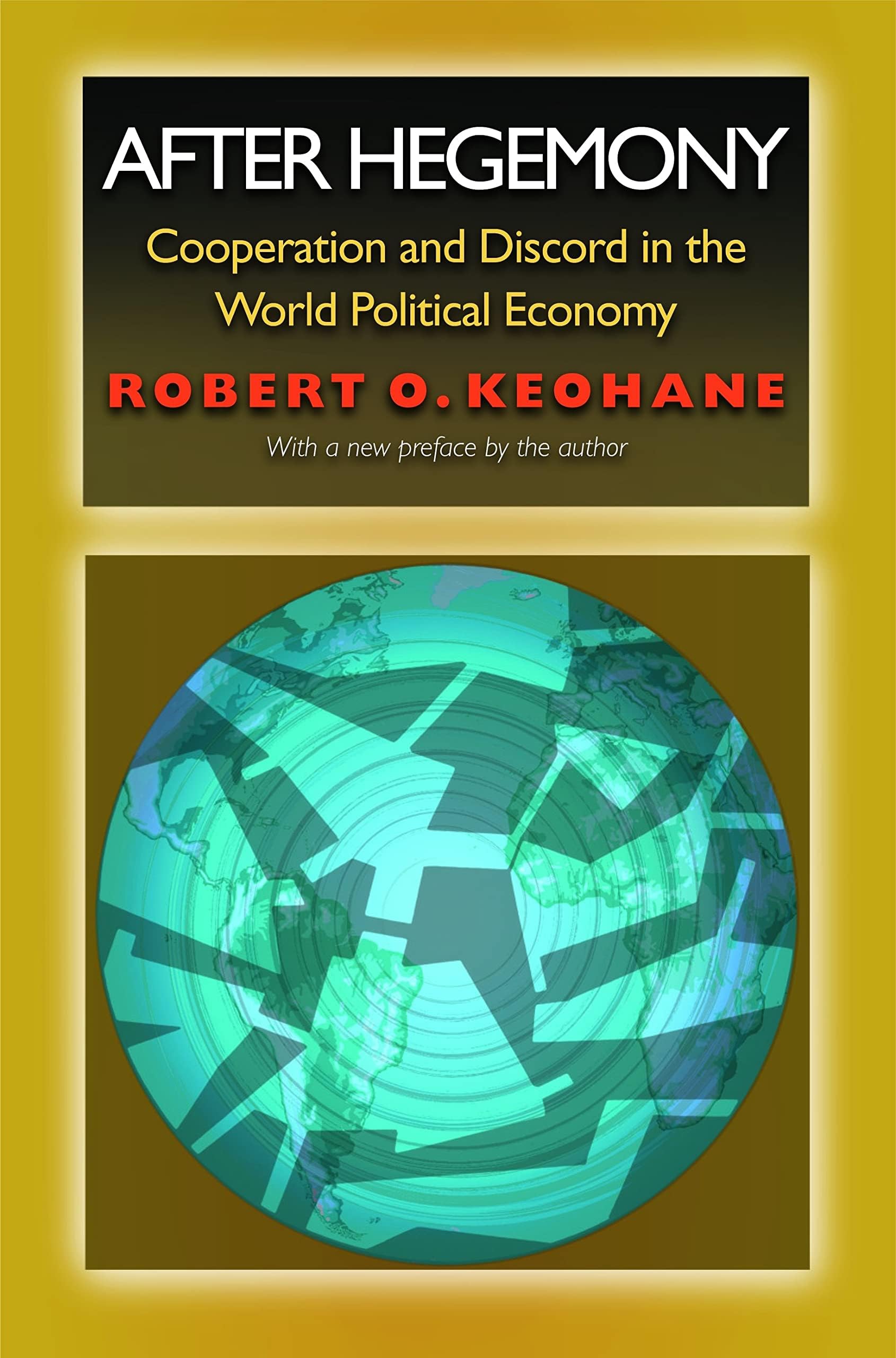
After Hegemony: Cooperation and Discord in the World Political Economy
Product ID: 4202600
Buy anything from 5,000+ international stores. One checkout price. No surprise fees. Join 2M+ shoppers on Desertcart.
Desertcart purchases this item on your behalf and handles shipping, customs, and support to Uruguay.
This book is a comprehensive study of cooperation among the advanced capitalist countries. Can cooperation persist without the dominance of a single power, such as the United States after World War II? To answer this pressing question, Robert Keohane analyzes the institutions, or "international regimes," through which cooperation has taken place in the world political economy and describes the evolution of these regimes as American hegemony has eroded. Refuting the idea that the decline of hegemony makes cooperation impossible, he views international regimes not as weak substitutes for world government but as devices for facilitating decentralized cooperation among egoistic actors. In the preface the author addresses the issue of cooperation after the end of the Soviet empire and with the renewed dominance of the United States, in security matters, as well as recent scholarship on cooperation. Review: Required reading for anyone in international relations - Keohane 1984—how many times have you seen that citation while perusing books, articles, or reviews? Keohane is up there with Waltz, Jervis, and Mearsheimer. Everyone in international relations develops their position in response to these scholars. Even for the most ardent realists, Keohane's influence cannot be understated, and perhaps realists will get the most out of reading this work. Regardless, anyone who wants to have more than a passing interest in IR needs to read this book, enough said. Review: A roadmap for the post hegemonic world - This book makes a persuasive case for continuing to invest in American liberal order institutions such as the IMF and the WTO, even though the world has become multilateral. Strategic cooperation continues to be reward reaped by those willing to abide by the political and monetary regimes that benefit advanced industrial nations. The alternative is anarchy and Leonard argues for a mix of realism and rational egoism. I heard Kissinger's voice in this neo-Realpolitik understanding of where opportunity lies in this populist raging, protectionist leaning broken world. Coercive cooperation might still be the answer.
| Best Sellers Rank | #780,738 in Books ( See Top 100 in Books ) #576 in Political Economy #5,030 in International & World Politics (Books) #6,308 in Economics (Books) |
| Customer Reviews | 4.4 out of 5 stars 59 Reviews |
M**.
Required reading for anyone in international relations
Keohane 1984—how many times have you seen that citation while perusing books, articles, or reviews? Keohane is up there with Waltz, Jervis, and Mearsheimer. Everyone in international relations develops their position in response to these scholars. Even for the most ardent realists, Keohane's influence cannot be understated, and perhaps realists will get the most out of reading this work. Regardless, anyone who wants to have more than a passing interest in IR needs to read this book, enough said.
S**S
A roadmap for the post hegemonic world
This book makes a persuasive case for continuing to invest in American liberal order institutions such as the IMF and the WTO, even though the world has become multilateral. Strategic cooperation continues to be reward reaped by those willing to abide by the political and monetary regimes that benefit advanced industrial nations. The alternative is anarchy and Leonard argues for a mix of realism and rational egoism. I heard Kissinger's voice in this neo-Realpolitik understanding of where opportunity lies in this populist raging, protectionist leaning broken world. Coercive cooperation might still be the answer.
J**T
Classic, Accessible, Enduring
In "After Hegemony" (1984/2005), Robert Keohane provides an enduring study of political economy, which he frames as the interactions between pursuits of power and pursuits of wealth. His book is a product of its time, written on the verge of perestroika in the Soviet Union and at a point in which scholars were questioning American's role in global leadership and its related position that dominated international institutions such as the World Bank, International Monetary Fund, and the global energy market after the Second World War. Could American hegemony prevail in the free world? How would that dynamic change after the end of the Cold War? Keohane tackled the first question by analyzing historical patterns leading to the international situation, while employing a light touch of empirical exposition to keep the book digestible not just for scholars and students, but also for the interested public. The second question was unthinkable at the time of publication, a fact he acknowledged in the preface of the 2005 edition to the text. Other influential political scientists made similar notes in later editions of their seminal works, including Samuel Huntington's "The Soldier and the State" (1957/1981), Kenneth Walt'z "Man, the State, and War" (1959/2001) and Edward Luttwak's "Coup d'État" (1968/2016). In the preface to his 2005 edition, Keohane notes the influence of the changing times upon the shape of the arguments his book seeks to present. However, he notes that the basic foundations of these arguments remain relevant. This is especially true as the United States managed to carve out a new form of hegemony for itself somewhere between the uncertain unipolar period after the Cold War's end and the beginning of the Global War on Terror that would set new structures of power dynamics in motion. Keohane's basic outline of the interaction between individual financial interests and state-level power consolidation endures. He leaves it to the next generation to answer how the American power dynamic will change.
D**B
As contemporary as it was in 1984
Excellent book, still useful to understand world politics after all this time. The new preface by the author presents brilliantly the major shortcomings of the theory as well as the unresolved questions and directions for research.
"**"
"Non-hegemonic cooperation is difficult but not impossible"
In After Hegemony neoliberal institutionalist Robert O. Keohane deals with the 'central political dilemma': How to organize international cooperation without hegemony? Or in other words, is cooperation possible in the post-hegemonic world? Keohane audaciously contends that cooperation is possible without hegemony since international regimes make this cooperation possible. In this sense, he criticizes hegemonic stability theory (HST) since HST necessitates a hegemon for regime maintenance specifically and for international cooperation in general. This book, however, might not be considered as a fundamental criticism of the realist theory since it accepts basic realist premises of international cooperation. For instance, he takes states as the major actors in international politics in which they have interest maximizing goals. On the other hand, Keohane also basically argues that 'although hegemony can facilitate cooperation, it is neither a necessary nor a sufficient condition for it...hegemony is less important for the continuation of cooperation, once after began, than for its creation'.In this respect, he differentiates hegemon's role in creation of international regimes from their maintenance. While he keeps hegemonic power important in creating regimes he does not see hegemon so significant for the their maintenance. What are the functions and/or benefits of international regimes? Institutions/regimes provide information, decrease transaction costs, monitor compliance, create issue linkages and prevent cehating. Then, they serve states' self-interests and generate international cooperation. Fear of retaliation and search for reputation are the key reasons why states eschew to break the rules of international regimes. The concept of 'bounded rationality' is also important in Keohane's functionalist theory of regimes. In this framework, states are willing to uphold international regimes for their self-interests. According to him 'bounded rationality' relaxes the strict assumptions of rationality and they make states emphatically interdependent to each other. Then it leads to shifts in state preferences and they will be more likely to cooperate by means of international regimes. In this respect, Keohane tends generally to see interdependence as a beneficial element for international cooperation. Moreover, After Hegemony have case studies in three issue areas; trade, money, and oil. Keohane examines international regimes in these areas for post-hegemonic period when the US power began to decline by the early 1970s. He finds hegemonic stability theory relevant for oil while he does not for the issue areas of trade and money. in this sense, he also point out the limits and possibilities of both HST and his regime theory.Overarall, he makes the point: non-hegemonic cooperation is difficult but not impossible.
G**A
Does hegemony serve the 21st century international political order?
Robert Keohane's 'After Hegemony' provides important tools to understand post cold war international relations and international order. While the end of the cold war provided the most appropritate international political ambience to evaluate the role of hegemony, as Dr. Keohane does, his coinage of the term 'bounded rationalism' comes handy in explaining the fact that capitalist and developed powers may be prepared to gravitate towards cooperation by sacrificing some of their 'hegemonic' or 'dominating' instincts. One example is trade. Gone are those days when the imperialist-capitalist powers went to war for possession of overseas markets. The post cold war era, at the behest of the liberal United States, believes in trade cooperation and in mutual discussions. Dr. Keohane's is a very useful book in changing the realistic concept of the overriding role of force and power in settling international issues. It is true that Dr. Keohane, rightly, never discount the role of power altogether but he shows enough ingenuity in dishing out a more rational and positive approach towards understanding the undercurrents of hegemonic psychology. All these simply go to show how increasing democratization on a global scale in so many spheres render the role of hegemony redundant. Although, this will take some time if that road is pursued and Dr. Keohane's fine book shows how. Gautam Maitra Author of 'Tracing the Eagle's Orbit: Illuminating Insights into Major US Foreign Policies since Independence.
F**I
some optimism for international politics
I have never shared realism's pessimism towards international politics in general and international cooperation in particular. For me, cooperation among states was logical and practical. It was logical, because in the long run cooperative states were better off than non-cooperative ones; it was practical, because most international problems -such as nonproliferation of nuclear weapons, setting up an international monetary system, and alleviating international poverty- required collective solutions. What makes Robert Keohane's After Hegemony important in my eyes is its logical and empirical support to the possibility and existence of cooperation among states. The aftermath of WWII witnessed a mushrooming of international organizations/institutions to facilitate international cooperation in political as well as economic issues. The dominant realist theory of international relations did not have a well-defined theory of international organizations. But a sub-theory of realism -hegemonic stability theory- argued that the unchallenged hegemony of the United States was the driving force behind this international institutionalization and the relative peace it espoused (Gilpin 1981). All these institutions were established under the hegemony of the US and therefore their influence on world politics was dependent on the hegemonic status of the US. Thus, when in 1970's and 1980's the hegemony of the US declined with the recuperation of the Japanese and the West European economies, hegemonic stability theory expected a reversal in the impact of international institutions on world politics. Keohane's central aim in After Hegemony is to challenge these pessimist realist evaluations of the decline in US hegemony. Keohane rejects realism's pessimist evaluations on two grounds. First, he argues that international cooperation is possible among nations and does not require a hegemon in the first place. Second, he argues that even though the national interests of states have a role in the establishment of international institutions, these institutions take a life of their own once they start rolling. Keohane first challenges the neorealist link between states' egoism and the rarity of cooperation among them. He states, "Realist assumptions about world politics are consistent with the formation of institutionalized arrangements, containing rules and principles, which promote cooperation," (67). He maintains that egoistic governments "can rationally seek to form international regimes on the basis of shared interest," which actually reflects "rational egoism," (107). From his perspective, only a "myopic self-interest" understanding prevents states from cooperating when it is actually in their interest if the issue is evaluated with other issues (99). Keohane then develops a theory of international institutions in which he argues that international institutions, or more broadly international regimes, influence the way and the extent to which states cooperate with each other. He states that by providing principles, norms, rules, and decision-making procedures, regimes "prescribe certain actions and proscribe others," (59). However, international regimes are valuable to governments not because they enforce binding rules on others, "but because they render it possible for governments to enter into mutually beneficial agreements with one another," (13). Regimes do that through multiple channels. First, they create an environment whereby states obtain information about other states' intentions and preferences. Second, international regimes can be regarded as "quasi agreements", which, although lacking a legally binding force, "help to organize relationships in mutually beneficial way," (89). Once a regime is established, states' concern about `retaliation' and `reputation' makes them "forward looking" and generally urges them to cooperate. And third, Keohane argues that international regimes decrease "transaction costs" for parties involved, thereby increasing incentives to cooperate (90). Keohane was heavily influence by Ernst Haas who challenged the statist view in international politics and argued that the actors in international relations are all entities capable of putting forth demands effectively; "who or what these entities may be cannot be answered a priori," (1964, 84). Thus, Keohane is opposed to the realists' argument on the insignificance of international institutions and argues that regimes can affect the interests and policies of states by influencing their "expectations and values," (63). Although he accepts that international regimes are not "beyond the nation-state," he maintains that they are not pure "dependent variables" as argued by neorealists, but rather "intervening variables" with semi-independent effects on states' behavior (63-4). Therefore, international regimes are easier to maintain than to create (50). I do not have significant problems with the institutionalist theory Keohane develops in After Hegemony. Yet I must confess that institutional theory is more a theory of international cooperation than a theory of international relations. By borrowing from both realism and liberalism, Keohane succeeded in developing a concrete and persuasive theory of cooperation among states. Also, like some others (Moravscik 1997, Mearsheimer 1995, Gilpin 2001) I do not think that Keohane's institutional theory can be regarded as a "neoliberal" argument. Keohane shares realism's assumptions of anarchy, rationality, and egoism but maintains a more optimistic view on the cooperation among states. Hence, as he himself states elsewhere, his position is not "against" structural realism, but "beyond" structural realism (1984, 191). Personally, I would rather consider him an "optimistic realist" than a "neoliberal institutionalist". Yet this does not undermine the strength of his arguments. Finally, if empirical evidence is a support to the accuracy of theories, the history of the European Union since the end of the Cold War gives extensive support to Keohane's argument on international institutions. Some realist (Mearsheimer 1990) expected a reversal in the integration of European countries after the end of the Cold War. By contrast, Keohane argued that because common interests are likely to persists and the institutions of the European Community are well-entrenched, we should expect further integration in Europe (1993, 291). The current deepening as well as expansion of European integration after the Cold War confirms Keohane's prediction and gives further support to Keohane's institutional arguments.
W**E
Not what you might think from the title
Hegemony is a popular buzz word in international politics these days. Talking heads throw it around every Sunday morning. So one might expect a book entitled After Hegemony to be discussion on American foreign policy "after hegemony." In this case - Wrong! This is a nearly 20 year old book with a title that is currently a trendy topic. And it deals with political economy and "regime" formation, such as international monetary regime, international trade regime, and international oil regime, how these regimes were founded during the time period the author considers the time of US economic (and military) hegemony (the 1950's and 60's) and how they evolved during the years after US hegemony had passed according to the author. For students and academics who are interested in the political and economic theory of how organizations are created and evolve, how "rational actors" (governments) behave on the macro scale, how preponderance of power allows a nation to create regimes (that is rules sets) that favor its policies, how these regimes become self-perpetuating, this is the book. It is an academic analysis of the subjects. If you are looking for something relating to the oft discussed current "American Hegemony" and its likely impact on US and world relations, this is not the book. Look on.
D**O
un classico
un classico
A**R
Cooperation and good reputations may also foster and facilitate the creation of ...
After Hegemony Cooperation and Discord in the World Political Economy Robert O. Keohane Princeton, New Jersey Princeton University Press 1984 290 pages Winner of the 1989 Grawemeyer Awards for Ideas Improving World Order, Keohane’s After Hegemony explores the idea that cooperation can exist in the world after the decline of hegemony. His main line of inquiry concerns why we continue to observe increasing cooperation despite the decrease in hegemonic power. He suggests that this is possible due to the continued existence of international regimes. Split into four main parts, this book profits a theory which is an alternative to that of Realist Hegemonic Theory and in order to contextualise his points, Keohane uses the example of the United States (US) as a hegemon in the period directly after World War II. His theories are explored from a systematic level (Keohane:26:1984), and from a realist perspective as regards the working of the states. In general Keohane believes that states cooperate for two reasons. Firstly they desire the same outcome and secondly they are essentially being forced to by a hegemon. With the apparent decline of the latter, Keohane aims to discover whether the former is sufficient enough reason on its own. As stated above Keohane’s main point throughout is that “non hegemonic cooperation is possible, and that it can be facilitated by international regimes”. (Keohane:49:1984) By ‘cooperation’ he means cooperation between states which is defined as “mutual adjustment” (Keohane:12:1984). He defines international regimes, or institutions, as they are sometimes referred to, as a set of “implicit or explicit principles, norms, rules and decision-making procedures.” (Keohane:57:1984) In believing that non hegemonic cooperation is possible, Keohane directly refutes Hegemonic Stability Theory (HST) which states that, “the clearer and larger the concentration of power in the leading state, the more peaceful the international order associated with it will be.” (Wohlforth:385:1999) Keohane argues that this theory is not only outdated, but that it also “makes imperfect predictions.”(Keohane: 34:1984) He is again critical when he suggests that HST is not valid or fit for purpose. The fact that “the theory of hegemonic stability is supported by only one or at most two cases casts doubt on its general validity.” (Keohane:37:1984) He believes that the theory neither carries enough weight nor has sufficient kudos to be used to qualify the way the international system works. In chapter three however, Keohane states that “there is some validity in a modest version of the first proposition of the theory of hegemonic stability - that hegemony can facilitate a certain type of cooperation - but there is little reason to believe that hegemony is either a necessary or a sufficient condition for the emergence of cooperative relationships.” (Keohane:311984) In this instance he is perhaps crediting the hegemon for creating and fostering cooperation but does not deem it fundamental or indeed necessary to maintain it. Just as a hegemon has the ability to regulate in order to maintain cooperation, so too have international regimes. Similar incentives previously used by a hegemon such as coercion/rewards and punishments may be utilised by states via international regimes. Keohane also stressed the importance of a state’s reputation, as the manner in which a state acted in the past may have implications on future dealings. Cooperation and good reputations may also foster and facilitate the creation of new regimes in the future, thus perpetuating cooperation. In facilitating cooperation, regimes also reduce uncertainty and transaction costs and solve the problem of asymmetric information. In short, “we derive a need for international regimes.” (Keohane:88:1984) It should also be noted however that it is Keohane’s belief that a hegemonic power may be required initially in order to set up these international regimes. It may then be the case that without an initial hegemon this cooperation would not be possible, however in Keohane’s view, the continuation of state cooperation is nonetheless affected. To summarise Keohane believes that not only can cooperation between states exist after hegemony, but that they cooperate far more than they compete. This cooperation is facilitated by international regimes which are maintained because they benefit the state’s self-interest. Having summarised Keohane’s views, I will now conclude this review with my own thoughts. Whilst the period of hegemony discussed in the book relates to the fifteen to twenty years or so following World War II, the US of today, in my opinion, is still very much considered a hegemonic power. Whilst it can be argued that China and, to a lesser extent, considering the difficulties of interstate cooperation, the European Union pose a threat to the US’s hegemonic status, both are still a long way from being legitimate or convincing challengers. Despite its rapid growth over the past four decades, having the world’s second largest economy and a military spend second only to that of the US, China still lags far behind in comparative terms. Furthermore, even if China became a credible challenger for hegemonic status, the US would more than likely subsist as a regional hegemon. Similarly, I would argue that other countries still very much depend upon the US in order to get things done. For this reason it may take some time to determine whether or not Keohane is right. Whilst Keohane admits that much has happened since he wrote this book, it is my view that not enough has occurred to wholly accept his assumptions as accurate. It is interesting to note that this book makes little mention of domestic politics and the importance of same. However considering its nature, it is understandable and perhaps even an intentional omission. Nevertheless, given that domestic politics, in my opinion, play a major role in the working of a state and it’s outlook as regards the international system, I believe it to have been an unfortunate omission and something that could perhaps be developed in any future writings which could also expand on his analysis so as to include not only advanced capitalist, egoist countries, but also developing countries. In chapter 10 Keohane suggests that HST is appropriate in terms of issues concerning oil and that regime theory is appropriate to matters such as economics and trade. This serves to accidentally highlight the limitations of both HST and regime theory . In finding a use for HST Keohane himself exposes some inconsistencies in his book regarding his criticisms of HST when he says “We have seen the most striking contention of this theory - that hegemony is both a necessary and a sufficient condition for cooperation - is not strongly supported by the experience of this century. Taking a longer period of about 150 years , the record remains ambiguous.” (Keohane:35:1984) Could it be the case that, as previously mentioned, it is because the US is still very powerful, perhaps the most powerful state in the international system, that regimes still in fact exist? Perhaps a hegemon is not important solely in relation to the creation of regimes but also for their continuation - that is yet to be seen. Perhaps with the US’s decrease in hegemonic status we might see a decrease in regimes themselves or of their functionality. Or perhaps the regimes will just transform in alignment with the next superpower aiming for hegemonic status. In conclusion, Keohane contextualises the states in the realm of realism but then discusses them behaving in a more liberal fashion facilitated by cooperation. I find this an interesting way of looking at the realist world of today, rather than the foreboding, pessimistic visions of the world, so often portrayed by other theorists and agree with Keohane in so far as “we need to go beyond Realism, not discard it.” (Keohane:16:1984)
A**E
Good book
Good book
ぬ**や
アメリカ卓越の維持
アメリカが超大国として現れた戦後からしばらくたち、 ニクソンショックに示されるようにアメリカが経済においてはもはや 欧州、日本に甘い顔できなくなり、競争者として見なし始める70年代、 なぜアメリカが衰退せず、トップドッグとして振る舞い続けたのかを、 アメリカが戦後敷いて来たレジームに求める。 今日、BROCsなど新興国が猛追して来ている現状、このレジームが維持できるのか、 はたまた無極化に向かうのか試されている。
E**E
He was quite pleased.
Gift for a friend. He was quite pleased.
Trustpilot
1 month ago
2 weeks ago