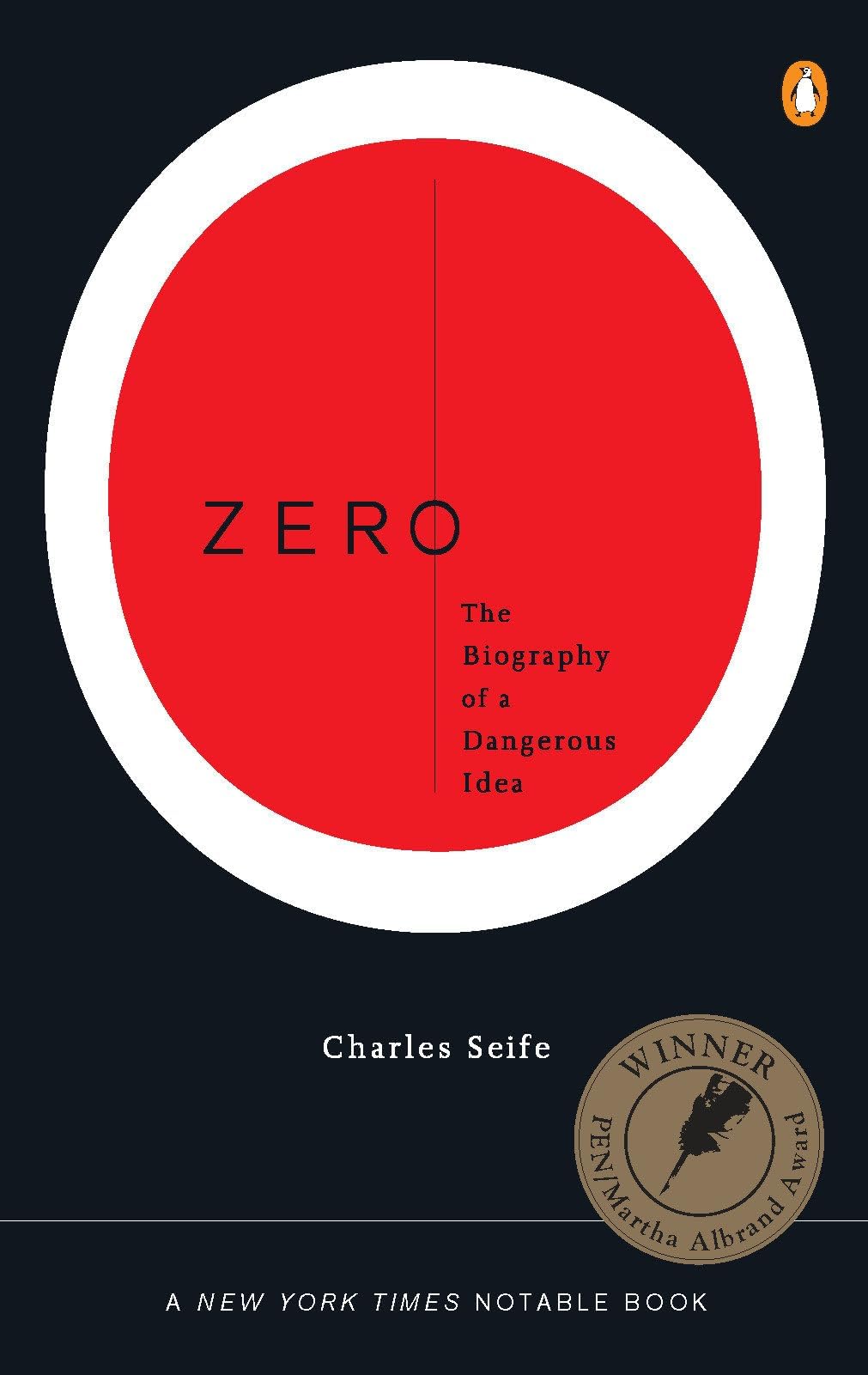
Zero: The Biography of a Dangerous Idea
Product ID: 4593611
🌍Cultural impact
📚Engaging narrative
🧠Intellectual exploration
Buy anything from 5,000+ international stores. One checkout price. No surprise fees. Join 2M+ shoppers on Desertcart.
Desertcart purchases this item on your behalf and handles shipping, customs, and support to Uruguay.
📖 Zero: Where Nothing Becomes Everything!
Zero: The Biography of a Dangerous Idea explores the profound implications of the number zero, tracing its historical journey from ancient civilizations to its pivotal role in modern mathematics and philosophy. This engaging narrative reveals how zero has challenged perceptions and transformed cultures, making it a must-read for anyone interested in the intersection of numbers and ideas.
| Best Sellers Rank | #59,285 in Books ( See Top 100 in Books ) #19 in Popular & Elementary Arithmetic (Books) #23 in Mathematics History #168 in History & Philosophy of Science (Books) |
| Customer Reviews | 4.5 out of 5 stars 1,330 Reviews |
A**S
A great history of math from Pythagorean geometry to String Theory
Charles Seife with three degrees in math and journalism from Ivy League schools is a very talented science writer. This is the first book of five he wrote on math and sciences. This entertaining book covers much of the history of math. Among many other things, it is an insightful revisionist look at the Greek legacy. The Greeks left a formidable legacy in geometry but held back math for over a millennium. This is because they treated numbers almost exclusively as geometric shapes. They fanatically rejected basic mathematical concepts that did not fit a geometric framework such as: negative numbers, irrational numbers, the concepts of Zero and infinity. This rendered them innumerate outside geometry. They fanatically rejected those concepts to protect Pythagorean geometry. Several Greek mathematicians daring to explore those concepts paid with their lives. Pythagoras, leader of a mathematically oriented cult, sentenced one such heretic mathematician to death. Given the Greeks mentioned gaps, they had no way of developing algebra and calculus which are the foundation of our information-algorithmic world. Obviously, calculus includes both algebra and geometry. So, geometry is not outdated; but, it is just a subset of mathematics. Aristotelian physics was so influential in the West that it set it back relative to other civilizations for over a millennium. Archimedes just a century after Aristotle came close to freeing the West from the Greeks shackling math legacy. He was on the verge of discovering calculus principles when he was killed by a Roman soldier. Had it not been for this inadvertent killing, calculus could have been discovered 1800 years before Newton. Where would we be now 1800 years into our own future? Indians will take the leap into modern mathematics by integrating Greek geometry and Babylonian mathematics (they invented zero). Indian texts from 476 AD indicate that Indians had our modern numerals down. They passed on their knowledge to the Arabs who did make huge contribution to mathematics such as Al-Khowarizmi who developed algebra in the 800s. In turn, the Arabs transferred their number system to us. So, we call it Arabic numerals instead of Indian numerals. One of the Arabs great contributions was to reject the Aristotelian world entirely and therefore allow their math discoveries to flourish. However, the Christian Church will prevent early adoption of Arabic math for centuries. Eventually, the West catches up with the Renaissance and Scientific Revolution. It will take Fibonacci, an Italian mathematician, to reintroduce Arabic numerals including the concept of Zero to the West in the 1200s. In the 1400s Brunelleschi, an Italian architect and painter, will introduce the concept of Zero in painting (convergent lines to a single point creating perspective for the first time). Copernicus uncovers that the Earth revolves around the Sun in the 1500s (utmost rejection of the Aristotelian world). The 1600s will account for an explosion in Western mathematics. Descartes will create analytical geometry tying geometry and algebra (any shape can be described by an equation). Soon after, Pascal introduces probability theory. And, soon after Newton and Leibniz introduce independently calculus. Seife credits Newton with coming up with the concept first, but Leibniz with coming up with the better concept. Today's calculus actually uses Leibniz structure (not Newton). Seife tackles complex mathematics starting with chapter 6. Seife explores the power of zero and its counterpart: infinity. Seife explains the development of projective geometry, imaginary numbers (i.e. square root of -1), complex numbers (who have a real and an imaginary component), Rieman sphere, singularities (numbers where equations break down), infinities that can be additive and subtractive, and Set Theory. Seife moves on to Quantum Mechanics and the Theory of Relativity. He explores the tension between the two that relate to the different impact that Zero has on both theories. Seife while explaining those theories also covers the Heisenberg Principle, Black Holes and Escape Velocity, Wormhole, the Pauli Exclusion, and the Chadrasekhar Limit. Seife moves on to String Theory as an effort to reconcile Quantum mechanics and the Theory of Relativity. Oddly enough, String theory works by getting rid of Zero that cause both theories to be inconsistent with each other. String Theory represents the hope of developing a Theory of Everything that would once and for all reconcile the Theory of Relativity and Quantum Mechanics. However, String Theory has major problems besides getting rid of Zero. It requires a 10-dimensional space or 6 more than the Theory of Relativity (Time is the 4th dimension). Those 6 dimensions have no meaning. And, Strings will never be observable. Therefore, many scientists don't consider it science.
G**D
Nothing... Something to get excited about
I'll admit, writing a book about nothing and making it exciting is probably a challenging thing to do. This is going to be a rather odd thing to bring up at the start of the review, but I have to ask did people read a different book than I did? Seriously, I read through just about every negative review and the points made against the book are barely in the book I read. If anything, they focus in on a minor detail, interpret it wrong, and then give the book a one star. I digress, let me get to the review and then I may go over some points to refute. This book focuses on the history of Zero for the most part. In there it touches upon historical moments in mathematics and later in physics as it gets to the modern scientific era. I personally found the research on the early history quite on point and very fun to read (there's a lengthy bibliography at the end if you feel the need to see his words backed up). The sensational writing didn't bother me at all, because I realize the relationship between the title and the style. Seife is trying to make nothing exciting! If you didn't get that point or got annoyed with that style then you missed out on a really fun read. The author tried to include fairly random historical anecdotes about the people discussed to lighten the mood in the book. I thought these were fun additions and interesting to read as well. Overall the book is written in decently easy to understand language. I have a fairly decent mathematical background and I didn't feel I really needed to know everything to read the first half of the book. However, when Seife starts delving into concepts like Calculus and Set Theory I think knowing how to do calculus was definitely a help in understanding this section. If you're more of a lay reader and more interested in the history than the math then this book really might be a bad choice. The first part is absolutely fascinating, but it does get confusing towards the end, especially when he starts delving into Quantum Theory and Particle Physics. One aspect on the section of early history that I found particularly fascinating was the relation of zero to philosophy. The ancients were heavily influenced by beliefs and philosophy so it's not much of a stretch to think this influence stretched beyond just those subjects and into math and science. So when Pythagoras and Aristotle reject notions of the void philosophically it's reasonable to assume they would find such notions nonsense mathematically. For a long time, and still today, Math is merely a representation of the world we see and observe. They didn't observe voids or vacuum's during Aristotle's time so naturally they wouldn't exactly latch onto it as a real possibility. One thing that really fascinated me was the possible hindrance philosophy and belief (or religion) had in holding back mankind's ability to progress mathematically. The main reason that zero didn't make it into the western world probably had more to do with the stranglehold the Romans put on the people than with their unwilling to believe in the void or infinity, which is also why it was trade that finally used zero. However, there were intellectuals alive and breathing during the Dark Ages and a lot of their hindrance to accept concepts like zero was philosophical. The Church had adopted Aristotle's model of the universe and it was blatantly wrong. (This book does not say Aristotle is at fault for holding back people philosophically, it merely says his view/model, that the Earth is the center of the universe, is wrong. Which it is.) However, the rising power of the Catholic Church adopted his explanation and said it was a fact and back then their word was law. Once mathematics and science came across discrepancies in that proof then Church asserted its power and only tried to tighten its grip on those communities until people revolted against it. I'm not saying zero is the reason we got out of the Dark Ages, but it didn't hurt us any! It probably helped us a lot more in the long run. My point in bringing this up is that things like belief and philosophy can hinder progress in fields like the sciences. (These are not beliefs, as in making assumptions about testable criteria by the way.) It seems to make more sense, that if you must derive some divine notion, you would interpret the data, not try to fit the data into a preconceived belief. Thus belief would interpret the math and math would not interpret the belief. The ancients had this backwards for a long time, which I think that's a major factor and this book touches upon that. As I mentioned above the book can change gears into something very complicated. I think this is kind of the downfall of this book for some people because the confusing explanations at the end leave them on a low note. As the book progressed and got beyond my mathematical understanding I found the explanations a lot more confusing. When it finally got out of the confusing areas I think it picked up again during the sections on the expansion of the universe. I enjoyed the parts of Zero Point energy, but I'm not entirely sure it's written in a fashion that is easily understood. Seife makes comments in a very historical manner and I think that really confuses people at times. Such as one reviewer complained that the books information is outdated on Vacuums and concepts like limitless energy. However, this book does touch on that subject during its discussion of Zero Point energy, maybe it was merely presented in a way that confused readers? I'm not entirely sure; I didn't personally feel confused until he started talking about Set Theory, which I clearly need to brush up on. In the end I simply loved this book. I tore through it in a mere three days and I'm a pretty slow reader. I personally didn't mind the sensationalizing of zero to fairly emphatic levels. This is a book about nothing after all and you might as well make it sound really exciting! Maybe there should've been more exclamation points so we can see how impressive the author's thoughts really are! Anyway I had fun with this book, but I wouldn't recommend it to people that haven't made it beyond calculus or else the second half might get a little confusing. Previously understanding Einstein's work would be a bonus to getting through this book as well. Other than that the first half is absolutely fascinating and I feel I walked away with more knowledge than I went in even if the book repeated a lot of things I already knew. Overall Rating: 4.5 out of 5
W**W
amazing
I have recently decided that I love numbers, how they work, how they solve equations, and how they solve the mysteries of the universe. This book peaked my interest of numbers in a variety of spheres. I hope to continue to learn how numbers assist me in explaining everything that I don’t know.
E**T
Fascinating and illuminating!
I loved this book. I did get kind of bogged down halfway through by math concepts my mostly forgotten long-ago college calculus couldn't cope with, but I kind of just wallowed through those and had no more real difficulty later on. Or at least no more difficulty than most regular people have when reading about quantum physics, multiple dimensions, and trying to grasp that zero and infinity are more or less the same thing. The concepts are difficult but the writing is lucid, and I recommend the book strongly. Seife also makes a very sly in-joke in this book: he's talking about some theory and says parenthetically, "I have a wonderful proof of this, but alas, this book is too small to contain it." Which is a reference to what Pierre de Fermat wrote in the margin of one of his notebooks (except he said "margin" instead of "book") about what came to be called Fermat's Last Theorem, setting mathematicians to pulling out their hair for something like 350 years afterwards. The eventual solution to *that* famous Gordian knot was described in "Fermat's Enigma," by Simon Singh--another great book about math for the layperson.
E**T
Zero is a first number
This is a great book for learning about this history of math, and also one for showing how math can help you understand reality...if you let it. The book talks about initial resistance to the use of zero - however the resistance mostly came from the Greek community steeped in Euclidean geometry. India and the Mayans of Central America figured it out pretty quickly (and I think accountants too). After all everyone understands what having "no more eggs" is like. Although the book starts with the concept of zero, it expands into its opposite - infinity where math begins to get really strange. This book shows how the evolution of math is one of the greatest innovations of the human species, but it often has to fight our older preconceptions of reality. Are you up to the challenge?
B**S
Readable even by a lay audience, but struggles a bit with mathematical rigor
The concept of zero is one we all take for granted. That there is an integer between positive and negative one seems no less intuitive to us than that there are such integers as one and negative one themselves. But it was not always so. Like everything else in mathematics, the concept of zero had to be discovered. Charles Seife’s book Zero: The Biography of a Dangerous Idea traces the development of zero from its development in the East through its reluctant acceptance in the West, ending with its surprising implications in modern physics. In many ways, Zero is a remarkable text because it captures the essence of mathematical discovery in terms accessible to a lay audience. However, where it succeeds admirably in terms of its accessibility, it stumbles a bit in scientific and mathematical rigor. One of the book’s central claims, made explicit in its subtitle, is that zero is a dangerous idea and that its development was resisted throughout much of Western history because of its philosophical implications. To many of us in the 21st Century, it seems odd that major institutions like churches and governments would fear a number. Indeed, it seems odd to modern sensibilities even that a number should be so connected to philosophical ideas. Yet Seife argues throughout the first half or so of the book that zero has profound philosophical and theological implications because admission of zero as a number is equivalent to admission of “nothing” as a concept. Further, admission of zero/nothing into philosophy, if the argument is followed to its natural conclusion, also requires admission of the infinite. For a society built upon twin foundations of Christian theology and Aristotelian philosophy, one can understand how this would be a dangerous idea indeed, and the book meticulously yet engagingly traces these arguments. This equivalence between “zero” and “nothing” is maintained throughout the book’s text, which is perhaps understandable but also unfortunate. In modern mathematics, zero and nothing are not equivalent concepts. If anything, “nothing” is more akin to the mathematical construct of the empty set, whereas zero is actually something—it is a number. It has a specific value and it has specific properties. One could fairly argue that this is a minor semantic point and that the author’s association between zero and nothing is just a bit of hyperbole meant to keep the reader engaged. While it certainly makes for lively reading, it also carries severe risks of generating misunderstanding in the minds of lay readers, especially since the book focuses only on the development of zero (briefly touching on closely related topics) to the near-exclusion of all other intellectual development over the same time. A worthwhile example is Seife’s discussion (pp. 84-87) of the development of forced perspective in paintings. True, as the author maintains, there is a certain manifestation of zero at the vanishing point at the center of perspective drawings. Also true, as the author also claims, there’s a kind of infinity associated with that zero in that all of the infinite space not explicitly depicted in the drawing’s foreground is collapsed into that infinitesimal point. However, asserting as the author does that the “nothing” into which the background objects in a perspective drawing disappear is equivalent to the number zero seems a bit hyperbolic and requires some additional support. Even more troubling is the author’s treatment of the calculus. Though the independent development of these ideas by Newton and Leibniz (and their resulting rivalry) makes for entertaining reading that likely could go a long way toward interesting non-mathematician readers in as famously difficult a subject as calculus, the modern definition of a derivative—the very definition that keeps mathematics logically sound—is confined only to an approximately one-page description in the appendix. Readers who ignore the appendix (or fail to understand it) could walk away from the book with some incorrect ideas about derivatives and how they relate to the physical world. Within the main text of the book, the author comes dangerously close to incorrectly asserting, for example, that the value of the fraction 1/0 is equal to infinity. The truth is that this fraction is undefined, but calculus allows us to work with such unwieldy fractions by observing that the limit of the function 1/x goes to infinity as x approaches zero. The same issue plagues the author’s discussion of L’Hopital’s rule (pp. 123-125) which deals with the limiting behavior of such indeterminate forms as 0/0. Throughout its treatment of mathematical ideas, the book sacrifices accuracy for readability in a way that could lead the lay reader to incorrect conclusions. Everything in the book builds up to its concluding discussions involving how zero manifests in physics. As a treatment of how mathematics, philosophy, and empirical science interrelate as scientists and other thinkers try to make sense of the world, the book is a triumph. It moves effortlessly between treatment of zero as a number—a pure mathematical abstraction—and how that number manifests in the physical universe. Readers, even ones not particularly keen on mathematics, can’t help but feel the excitement pouring off the page as the author traces development after development, leading to one surprising conclusion after another. However, even here the reader needs to be careful not to get the wrong ideas. Zero is not a physical thing. It is a number. And mathematical abstractions, though immeasurably useful in the study of physics, don’t always produce results that make sense in physical reality. A worthy example would be “Gabriel’s Horn,” a mathematical construct not considered in the book but relevant to its subject. This geometric figure is the result of rotating the graph of the function y = 1/x around the x-axis, yielding a kind of trumpet shape. What’s interesting about this figure, as can be studied through calculus, is that it has a finite volume but an infinite surface area. Obviously such a figure can’t exist in physical reality. It exists as a mathematical construct, but if someone tried to actually build one, the physical limitations of the building material (such as the size of atoms) would eventually take over to prevent the paradox. And yet, exactly these kinds of conclusions from mathematical abstractions have been used in physics, as described by the author, to give us such bizarre ideas as black holes, time dilation, and more. The difference between pure mathematical abstraction and physics, however, is that physics requires empirical support. We know there are black holes, surprising as they may be, because we’ve observed them. Seife glosses over the important distinctions between mathematical physics and pure mathematics in a way that serves well to keep the book readable and engaging but serves poorly to give the reader a truly accurate understanding. For example, the book simply describes a black hole as a point of zero volume, but the reality is because no information can escape a black hole’s event horizon (which is substantially larger than the supposedly zero-volume singularity at its center), any assertion of what’s really inside should be made with substantial care. Ultimately, Zero: The Biography of a Dangerous Idea is well worth our attention and provides a great example of how to render even such stereotypically dry subjects as mathematics and mathematical physics engaging to lay audiences. It should serve well to get people interested in its subject, but doesn’t quite succeed in actually educating them about the finer details.
C**N
Very nice read, often gift to people
I'm a big fan of this book... it's a nice read, and you can really apply the concepts to life. I often give as presents to people close to me.
T**T
A Taxing, Yet Really Fun Read
Overall a really great journey through the concept and history of Zero. It gets bogged down with a wee bit of advanced math at times, but if you can hang in there and plow through those periodic detours, it really paints a fascinating historical progression of the concept of Zero. I also enjoyed that as it tells the tale of Zero, it does so against a backdrop of how many times through history that a few brave souls dare to look "outside the box", go against the generally accepted " truths" of the time, and revolutionize the understanding of our place in the physical world we live in.
D**S
Maximum Enjoyment: Zero Effort
The humour amid the facts, the light touch on mathematical areas, and the easy flow of information make this book a delight to read. Zero: The Biography of a Dangerous Idea is an enjoyable memory trip. Without realizing it you are being reminded of the history you knew about zero from Pythagoras and Aristotle to Babylonia up to today ; the importance of zero's inclusion in our number system, the leadership and presence off the 60-base number system even in to-day's world with 60 seconds in a minute, 60 minutes in an hour,, and 360 degrees in a circle; and the sway of philosophy and government in repressing or supporting mathematical achievements. I look forward to Charles Seife's treatment of other mathematical hills and valleys of knowledge ... the calendar, the calculator, the computer, robotics, ....
K**R
Good
I was looking for a history book, and it got to thecnical for my liking. Not really an easy read.
A**I
Very Nice reading!
As the title suggests ( and it's written by a mathematician so, although filled with humour, it's very sticking to the point ) this is the biography of how Zero went from non-being important to becoming ( at least according to the author ) an all-important matter. Gotta warn you though: the guy takes this Zero thing very seriously, as far as making fun of ( almost ) the whole of humanity, including his former mathematician colleagues.
Z**H
Amazing
The way the book ties the concept of Zero across so many disciplines; cultures, discoveries- etc. Fascinating book _ One of a kind
R**N
Its a great book!
This book was really good. I just read a newspaper article and read about the Casimir effect, which was conveyed to me through the book. I never thought in my life that a book in the math history category could convey as much as this book did for me. Of course, reading about the disciples of Pythagoras can seem very dry to some, but you should stick with it anyway, as it really is food for thought.
Trustpilot
1 week ago
4 days ago