
⚡ Master the art & science of electronics — your ultimate toolkit for innovation!
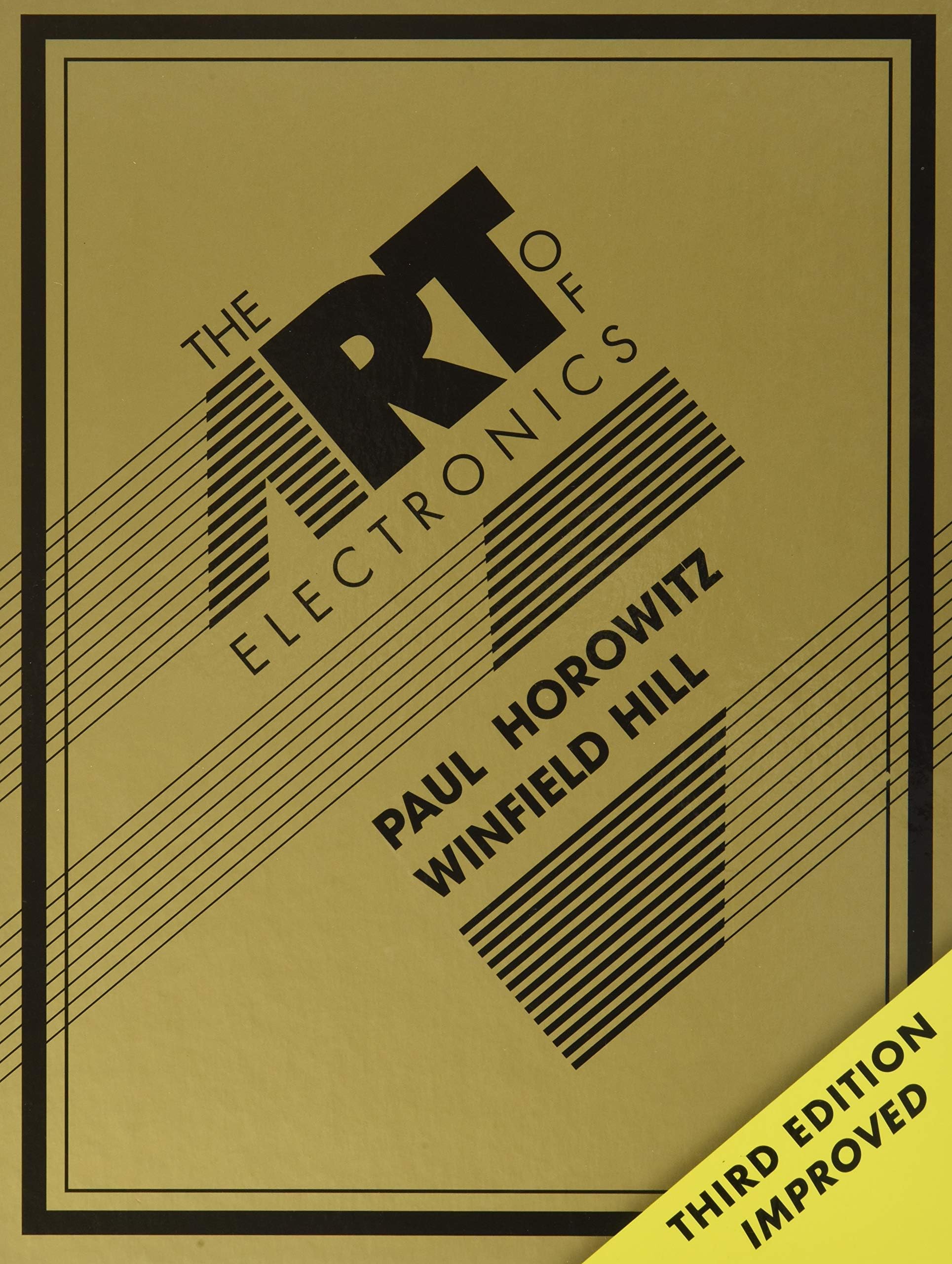
The Art of Electronics, 3rd Edition by Horowitz and Hill is a 1192-page authoritative textbook and reference, blending foundational theory with practical insights across analog and digital electronics. Highly rated and widely used in academic and professional circles, it covers everything from transistors and operational amplifiers to microcontrollers and signal processing, making it an essential resource for students and engineers aiming to excel in electronics design and application.

| Best Sellers Rank | 127,905 in Books ( See Top 100 in Books ) 45 in Electronics & Telecommunications Engineering 89 in Engineering Physics 181 in Electronics & Communications Engineering |
| Customer Reviews | 4.8 out of 5 stars 2,110 Reviews |
A**C
The most completely, beautifully explained and explored electronic book i have ever read.
* Physical The book has 1192 pages. Its printed on slightly thin but good quality paper but has good text readability. * Target Audience H.N.D, Under graduate, post graduate, Masters? In my humble opinion, this book covers all the above. * What's the best bits? This book has inherited some of the 2nd Art of Electronics stuff. The rest is all shiny new. This book covers and gives a tremendous breadth AND depth of information. From Foundation, Bipolar Transistors, Field - Effect Transistors, Operational Amplifiers, Precision Circuits, Filters, Oscillators and Timers, Low Noise Techniques, Voltage Regulation and Power Conversion, Digital Logic, Programmable Logic Devices, Logic Interfacing, Digital meets Analogue, Computers Controllers and Data Links, Microcontrollers, Appendix A, B, C , D, E, F,G, H Transmission lines and Impedance Matching, (I) Television, (J) Spice, (K) Where do i buy Electronic goodies?, (L) Workbench Instruments and Tools (M) Catalogues Mags and Data Books (N) Further Reading and References (O) the Oscilloscope (P) Acronyms and Abbreviations. The way it organised is a work of art in its self. The information is beautifully organised. And with limited mathematical content is too help not frustrating. Its the easiest first then increasingly technically explained and explored as you progress through it. This is a MUST for your degree studies. It gives you so much as you explore its topics. Is it an encyclopedia or a textbook? Both! You can read this dropping into some topics. There is so much I can't show you this or that, it's all beautiful!. The topics you find hard are explained clearly. Is it professional quality? Yes! At the latter parts, the design work is so clear. For example, the stuff on ADC / DAC is eye popping usefully and clearly explained. The best I have ever read! As is the filters stuff. * Summary This book is H.N.D, Hons Degree, (and perhaps) Masters level support for in-depth electronics studies. It's clear, and up to date. What are you waiting for? If your studying electronics, then you need to buy it! I recall when i started studying electronics, the previous Art of Electronics, Book 2 it was overwhelming. Go for an easier one to start with, such as Practical Electronics for Inventors, book 4, and Learning the Art of Electronics then drift into this superb volume. If you can have an 'open book' exam, allowing you to bring a book in with you, then you need to have in-depth knowledge of this book prior to this, but its a great help if you know your way around it already.
J**S
It's all in here. Get it!
"All" may be a bit of a stretch, but it's close. I have the first edition of this book from my undergraduate days in the 1980s. Then I left university and did nothing with the knowledge I was supposed to have gained. But recently, having had my eye caught by some "clever" YouTube electronics makers, I felt a hankering, yearning and a stirring of desire to recapture the spirit of things past. As if gripped by an unseen force I found myself accumulating various components and sticking them to circuit boards with molten solder. I was surprised by how much basic info I had retained. I was not surprised by how much I had forgotten. How to make up for that lost knowledge? How to get up to speed with anything new that might have appeared - after all it's been the best part of 40 years. Of course I turned to Google, but found myself sometimes disagreeing with the advice given there. This is where this book comes in. It is comprehensive. The style is just the right blend of conversational and technical. And yes, I found vindication within its pages. Also shame, as though I was righter than Stack Exchange, I was not quite as right as Horowitz and Hill! If you want to go beyond copying blindly to understanding, if you want to make something that not only works but works well, if you want to embrace the art and, dare I say it, craft of electronics, then this is the book for you.
J**D
Long awaited 3rd edition
This is the long awaited successor to the highly regarded 2nd edition which was released in 1989. If you are an engineer, technician or hobbyist, this is a must have on your book shelf. The quality of the writing, the presentation, the layout is above reproach. The content covers the vast field of electronics from basic principles to complex concepts While large parts of the 2nd edition are still highly relevant, the new edition brings the reader up to date with the vast developments in electronics in the last 26 years. While it is possible to read it from cover to cover (got a spare week!) but more likely just dip into the particular aspect that interests you or have become a bit rusty on the details. It doesn't rely on a high level grasp of mathematics and formulae are used sparingly Diagrams and graphs are used extensively to convey an intuitive grasp of subject matter. The writing style is friendly and at times even humorous but never strays away from clear and concise explanations of complex phenomena. It isn't cheap at approx. $100 USD but having read the print off my 2nd edition I had no hesitation in shopping around to buy the 3rd edition. The only slight criticism I would make is that it doesn't come with a dust jacket.
P**N
Excellent, comprehensive coverage. Consider the Kindle Version if you have a large tablet.
This book is way bigger and heavier than I expected - but that's because it is so comprehensive. It has been on my wish list ever since the 3rd edition was launched. I wish I had bought it 2 years ago as I might have read most of it by now! The style of the book is that of an experienced engineer telling you all they know and emphasising what is important - rather than an academic / technical lecturer. This makes the book far more accessible than one might expect from a Harvard professor - think of Paul Horowitz as the Richard Feynman of electronics. The only reservation is that the sheer size and weight means this is a document you read on a desk, workbench or table and not on your lap. I purchased the print version as I was concerned that tech books don't display well on Kindle devices. I have downloaded the Kindle sample onto my IPad and the format is retained completely. I am seriously considering buying the Kindle version AS WELL as it's better suited to casual reading (though I think some of the more complex tables might be hard to read). I studied Electronics at University and worked for several years in design before moving to computer systems. This is an excellent, accessible and practical text. Worth every penny of it's price - don't make my mistake, buy it now!
J**O
this is the best book on electronics that I have found
Having the second edition for many years, this is the best book on electronics that I have found, this book should be read by every electric engineer, and by every electronics hobbits that wants’ to have a practical and in deep knowledge of electronics. This book isn’t for the faint at heart, because all the subjects are treated width excruciating details, and with pin point precision. All components are real and in several aspects are characterized beyond their datasheet specs. The book style of engaging with you is unique and very friendly, I can’t recommend it enough. In the future there will be a second volume with even more advanced material that I’m ancient to read from cover to cover, like I’m reading this first volume. If you are new to electronics you should also start reading at the same time the book Learning the art of electronics, it will teach you in a very intuitive way all the first steps with practical labs to jump start you in electronics. On a personal note, the authors are wonderful people. Reading this book, it’s like having a calm and consistent voice in the background sharing deep secrets of electronics design with us.
T**M
Misprint
Page 1041-1056 are printed twice?
M**N
Amazing Book that deserves ebook typesetting
I'm not going to talk to much about the contents, there are plenty of reviews that cover that. Anyone who is serious about electronics should have this and a number of other books as reference. For quality and content it gets 4 stars. However, in this day and age, it isn't really acceptable that ebooks can't be read on a kindle. I accept this is due to the typesetting, which is complicated in this book. However, I think it is high time books of this ilk modernise and provide flowable formats. There is nothing specifically in this tome that couldn't be re-set. I only knock one star off because there are plenty of alternative readers (Tablets, Web, etc) that do support print set books like this, so I still get the value from the purchase. But not being able to use my kindle at all is disappointing.
O**E
Heavy!
This book had been on my 'Wishlist' since it was first published, as the price back then was more than my wallet could stomach. Well, the waiting has finally paid off, with Amazon offering it for nearly a third of the launch price! This tome comes in at a whopping 2.5kg or thereabouts. As others have noted, the paper used is quite thin, but it would have to be, given the page-count - 1260-ish. Don't know if the price-drop is connected, but my copy had a small defect - 4 pages, almost dead-center, were still joined at the corners, a result of the paper becoming creased before being cut. The effected area was only about 10mm x 10mm at 2 corners, and using a scalpel, i was able to carefully cut away the tiny amount of surplus paper - the 'surgery' is barely noticeable. Far more able individuals have commented on the material contained within. I will say that, having loved the style of the v2 pdf version, v3 seems to follow on in the same vein. I really like the fact that 'modern' components are referenced throughout the example circuits/theory descriptions, making the whole learning experience seem much more grounded in reality. All in all, an astounding book, but for what I paid, it's an incredible bargain..
Trustpilot
1 month ago
1 week ago