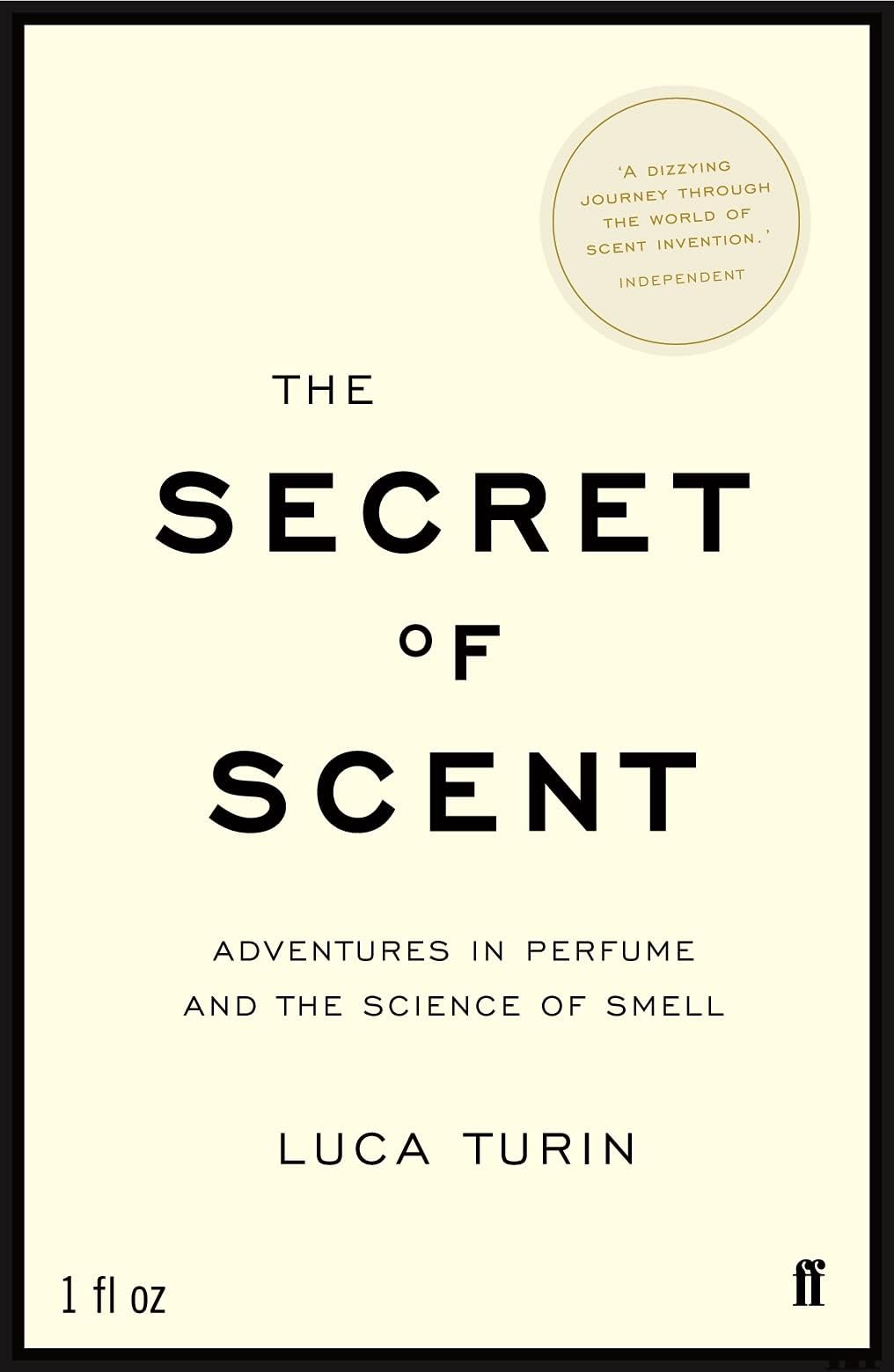
The Secret of Scent: Adventures in Perfume and the Science of Smell
Product ID: 48269656
Buy anything from 5,000+ international stores. One checkout price. No surprise fees. Join 2M+ shoppers on Desertcart.
Desertcart purchases this item on your behalf and handles shipping, customs, and support to Uruguay.
Buy The Secret of Scent: Adventures in Perfume and the Science of Smell Main by Turin, Luca (ISBN: 9780571215386) from desertcart's Book Store. Everyday low prices and free delivery on eligible orders. Review: How do you smell? - Luca Turin's book concerns our sense of smell, or at least, his argument that human's distinguish between different molecules which emit smells due to their vibration. Four of our sensory systems, which is to say, vision, hearing, touch and taste are reasonably well understood and documented. However, our fifth sense, that of smell, is somewhat of an unknown, the subject of continued debate. Just how does the human olfactory system differentiate between one fragrance or smell and another? This is the question Luca Turin's book seeks to address as part of the science of smell, in relation to his long-term work within the perfume industry. His argument is that we differentiate smells due to what is called 'vibration theory of olfaction'. Turin is not the first to theorise on the subject of smell differentiation. Others in this field have - and in some cases still do - hold the view that our sense of smell is no different from what occurs with systems elsewhere in the human body, which rely on receptors and the shape of molecules...but there's a problem with this approach. For example, there are molecules that are quite different in their structure and yet smell exactly the same. The smell of almonds is a good example. One type tastes great in the form of marzipan on cakes, the other type will kill you! But you need to read the book to put this in its correct perspective. The shape theory is also known as the 'lock and key' model. The vibration theory has it that the bonds between atoms which make up all molecules actually stretch, vibrate or bend and twist at certain frequencies between their covalent bonds (or molecular bonds); a chemical bond that involves sharing of the electron pairs between atoms. Much of Turin's argument was strengthened in 1991 when biologists Dr Linda Buck and Dr Richard Axel discovered what are called transmembrane proteins which are believed to be the odour receptors and the genes that encode them, a significant step in our understanding of how the olfactory system works and which earned them a Nobel prize in 2004. While Turin's book is beautifully written and provides a solid argument and clear explanation, it is not for the chemistry novice. Some understanding of organic chemistry is essential, in particular benzene ring molecules. However, additional information is readily available from the Internet and a little research is certainly well worth the effort to fully appreciate this superbly interesting text book, which can, for academic purposes, be considered an excellent primary source. Review: It's like book porn for perfume geeks - I bought this book on a whim - and because of the amazing reviews it had - and I wasn't disappointed. This is more than a book, it is a journey through fragrance and France and chemistry and business politics all wrapped up with nostalgia and exquisitely crafted prose. Yes it is heavy on the chemistry but that's perfumery! The intricacies of scent molecules and atoms are woven like a spell or story rather than a science textbook - you'll be fascinated even if you hated school science. The book is small and easy to handle, making it ideal bedtime reading (oh come on, I can't be the only one who reads science in bed? can I?). The author's powers of description are so apt that I could swear that wafts of Patchouli and Ambrette seed were gently diffusing from the pages and sending me into raptures. I will be sad when I have finished, much like when engrossed in a touching film and the end brings about that grey melancholy of 'normal life' again.
| Best Sellers Rank | 241,713 in Books ( See Top 100 in Books ) 142 in Evolutionary Psychology 546 in Scientist Biographies 659 in Beauty & Fashion (Books) |
| Customer reviews | 4.4 4.4 out of 5 stars (233) |
| Dimensions | 12.7 x 1.5 x 19.7 cm |
| Edition | Main |
| ISBN-10 | 0571215386 |
| ISBN-13 | 978-0571215386 |
| Item weight | 180 g |
| Language | English |
| Print length | 224 pages |
| Publication date | 17 May 2007 |
| Publisher | Faber & Faber |
B**A
How do you smell?
Luca Turin's book concerns our sense of smell, or at least, his argument that human's distinguish between different molecules which emit smells due to their vibration. Four of our sensory systems, which is to say, vision, hearing, touch and taste are reasonably well understood and documented. However, our fifth sense, that of smell, is somewhat of an unknown, the subject of continued debate. Just how does the human olfactory system differentiate between one fragrance or smell and another? This is the question Luca Turin's book seeks to address as part of the science of smell, in relation to his long-term work within the perfume industry. His argument is that we differentiate smells due to what is called 'vibration theory of olfaction'. Turin is not the first to theorise on the subject of smell differentiation. Others in this field have - and in some cases still do - hold the view that our sense of smell is no different from what occurs with systems elsewhere in the human body, which rely on receptors and the shape of molecules...but there's a problem with this approach. For example, there are molecules that are quite different in their structure and yet smell exactly the same. The smell of almonds is a good example. One type tastes great in the form of marzipan on cakes, the other type will kill you! But you need to read the book to put this in its correct perspective. The shape theory is also known as the 'lock and key' model. The vibration theory has it that the bonds between atoms which make up all molecules actually stretch, vibrate or bend and twist at certain frequencies between their covalent bonds (or molecular bonds); a chemical bond that involves sharing of the electron pairs between atoms. Much of Turin's argument was strengthened in 1991 when biologists Dr Linda Buck and Dr Richard Axel discovered what are called transmembrane proteins which are believed to be the odour receptors and the genes that encode them, a significant step in our understanding of how the olfactory system works and which earned them a Nobel prize in 2004. While Turin's book is beautifully written and provides a solid argument and clear explanation, it is not for the chemistry novice. Some understanding of organic chemistry is essential, in particular benzene ring molecules. However, additional information is readily available from the Internet and a little research is certainly well worth the effort to fully appreciate this superbly interesting text book, which can, for academic purposes, be considered an excellent primary source.
S**A
It's like book porn for perfume geeks
I bought this book on a whim - and because of the amazing reviews it had - and I wasn't disappointed. This is more than a book, it is a journey through fragrance and France and chemistry and business politics all wrapped up with nostalgia and exquisitely crafted prose. Yes it is heavy on the chemistry but that's perfumery! The intricacies of scent molecules and atoms are woven like a spell or story rather than a science textbook - you'll be fascinated even if you hated school science. The book is small and easy to handle, making it ideal bedtime reading (oh come on, I can't be the only one who reads science in bed? can I?). The author's powers of description are so apt that I could swear that wafts of Patchouli and Ambrette seed were gently diffusing from the pages and sending me into raptures. I will be sad when I have finished, much like when engrossed in a touching film and the end brings about that grey melancholy of 'normal life' again.
M**E
An insight into the perfume world.
A good read, I enjoyed the easy going style of the writer. Gave interesting insights into the world of perfumery and the big fragrance houses. Was amused but not surprised to learn that the accountants control the formulation of new scent with their rigid budgets. No wonder so many modern scents smell like toilet cleaner!
J**S
Forever Interesting & Entertaining !!!
I am a true fan of Luca Turin's writing. I've loved fragrance for as long as I can smell. My memories of scents be it my grandmother's Shalimar or a perfume I wore with each boyfriend/husband are ingrained deep in my soul. Luca Turin brings this very important sense to life in full vivid colour. I trust his opinion (exception being Fracas parfum - A BIG NO !!!) It's a smallish book that will fit into your handbag - Get this book and learn a fascinating subject.
P**M
Way toot technical. As a person without a science ...
Way toot technical. As a person without a science background who is just looking to learn more about perfume it was too complicated. Entertaining writing style though. Still do not have the answer to my question: what is the point of the top note if it disappears anyway after ten minutes?
H**N
Absolutely fascinating
A real surprise, this book - I wasn't expecting popular science, but it rekindled in me a love of chemistry. Fascinating from beginning to end, and beautifully written, with a great deal of humour, I'd recommend it to anyone, even those not remotely interested in perfume.
S**E
Fascinating book
This is a book that I will dip into time and time again. A must for anyone with a fascination for perfumes.
D**Y
GOOD READ BUT UNCONVINCING
Well written and very interesting but, as far as can see, Dr Turin's theory fails when he gets to key points. He just ducks them. I wanted him to be right and sticking one on to the academics, but he can't. For example, at p141 he talks about enantiomers, a crucial point of his arguement, and he waffles round it.
B**A
香水そのものについての話題を期待していましたが… 化学的なアプローチで述べている部分が多いです。 この人が提唱した振動説とは別のしくみで「嗅覚」を解明したという グループがノーベル賞を受賞したことに触発された部分が あったのかも? なんて思ったりして。 この本で一番最初に述べられているように これだけの人が香りの世界に深くのめりこむキッカケを作ったのが 日本が発信した「ノンブルノワール」だった事には 誇らしい気分になります。
S**H
I will leave it up to Mr Turin and his fellow researchers in this field to determine whether his theory is correct or not. Certainly I applaud him for putting it out there - to misquote Fran Liebowitz "no one has ever said, everything is fine, let's go invent fire". If Columbus, and every other sailor after him stayed with current knowledge, where would the global village be today? My own wishful thinking is that this marvellous bio-chemical-mechanical machine we call a body, does indeed operate in the quantum realm in some form or fashion. Mainly though my review is on all the marvellous content other than quantum mechanical noses, that this book contains. I envy Mr Turin's access and profession which allows him to research at will. His book was a delightful cornucopia of obscure (to the layman) data, spanning physics, chemistry, history, all put togther in a well written, entertaining, engrossing format. It was a pleasure to jump all over the map of science with him, it was a pleasure to see the coherence and methodology of what may at first appear to be a random interest in all matters scientific, it was a pleasure to witness the avid curiosity of his mind, and the quality of his writing on the whole - each turn of phrase, choice of words, made for an exceptional read. This book, with its numerous bits of data on all sorts of wonderful and interesting things, has led me to many enjoyable reads, retracing as best I can the footsteps of the author's reading and research.
I**E
A compelling and entertaining read, perfect for anyone looking to dive into the secrets tucked away in a scent!
F**.
The Secret of Scent by Luca Turin is an outstanding read for anyone curious about how smell really works. It blends history, chemistry, neuroscience, and perfumery into a narrative that is both intellectually stimulating and genuinely entertaining 🌸🧪. Turin has a rare ability to explain complex scientific ideas, such as molecular vibration, olfactory receptors, and scent perception, without dumbing them down. At the same time, he weaves in the history of perfumery, iconic materials, and the evolution of fragrance creation, making this book especially rewarding for perfume lovers and professionals alike. 🔬 Content: rich, original, and thought-provoking. It offers a unique perspective on the science of smell, including discussions of recent advances and open questions in olfactory research. This is not a superficial perfume book; it challenges assumptions and invites deeper thinking. 🖨️ Edition: simple but perfectly adequate for the price. The paperback is functional and readable, with no issues in print quality. A no-frills edition that lets the content shine. 📚 Recommended for: fragrance enthusiasts, perfumers, chemists, and anyone interested in sensory science or the cultural and scientific history of scent. Overall, a brilliant and unconventional book that expands your understanding of perfume far beyond notes and accords. Highly recommended for curious minds 👃✨.
V**A
I love how well Dr. Turin explains the science behind perfume, you actually get a feel for the molecular structure that can lead to a type of scent recognition (or not, structure is not always = function). Admittedly, I have a bit of a scientific background so not everyone might be as appreciative as me. However, this is a great read for anyone who is looking to understand as well as admire scents!
Trustpilot
2 months ago
3 weeks ago