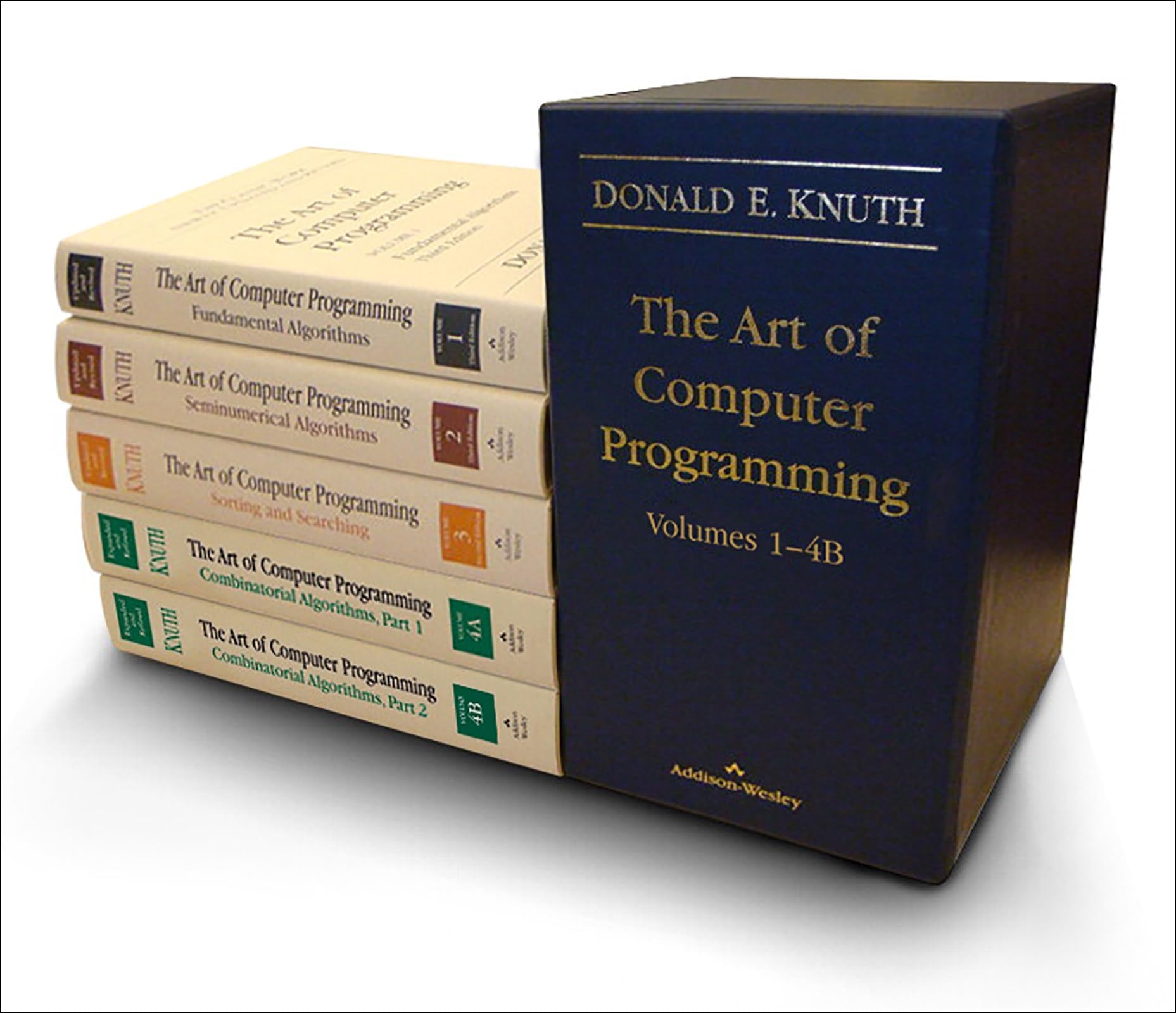
Art of Computer Programming, The, Volumes 1-4b, Boxed Set: Fundamental Algorithms / Seminumerical Algorithms / Sorting and Searching / Combinatorial ... Part 1 / Combinatorial Algorithms, Part 2
Product ID: 494539201
Buy anything from 5,000+ international stores. One checkout price. No surprise fees. Join 2M+ shoppers on Desertcart.
Desertcart purchases this item on your behalf and handles shipping, customs, and support to Uruguay.
Now Includes the Long-Anticipated Volume 4B! Countless readers have spoken about the profound personal influence of Knuth's work. Scientists have marveled at the beauty and elegance of his analysis, while ordinary programmers have successfully applied his "cookbook" solutions to their day-to-day problems. All have admired Knuth for the breadth, clarity, accuracy, and good humor found in his books. Primarily written as a reference, some people have nevertheless found it possible and interesting to read each volume from beginning to end. A programmer in China even compared the experience to reading a poem. Whatever your background, if you need to do any serious computer programming, you will find your own good reason to make each volume in this series a readily accessible part of your scholarly or professional library. These five books comprise what easily could be the most important set of information on any serious programmer's bookshelf. This set now includes Volume 4B, the sequel to Volume 4A, which extends Knuth's exploration of combinatorial algorithms. These algorithms are of keen interest to software designers because ". . . a single good idea can save years or even centuries of computer time." "Donald Knuth may very well be a great master of the analysis of algorithms, but more than that, he is an incredible and tireless storyteller who always strikes the perfect balance between theory, practice, and fun. [ The Art of Computer Programming, Volume 4B, Combinatorial Algorithms, Part 2, ] dives deep into the fascinating exploration of search spaces (which is quite like looking for a needle in a haystack or, even harder, to prove the absence of a needle in a haystack), where actions performed while moving forward must be meticulously undone when backtracking. It introduces us to the beauty of dancing links for removing and restoring the cells of a matrix in a dance which is both simple to implement and very efficient. And it studies the iconic and versatile satisfiability problem and carefully analyses various ingredients of SAT solvers." -- Christine Solnon, Department of Computer Science, INSA Lyon This box set includes the following volumes: The Art of Computer Programming: Volume 1: Fundamental Algorithms, 3rd Edition The Art of Computer Programming, Volume 2: Seminumerical Algorithms, 3rd Edition The Art of Computer Programming: Volume 3: Sorting and Searching, 2nd Edition The Art of Computer Programming, Volume 4A: Combinatorial Algorithms, Part 1 The Art of Computer Programming, Volume 4B: Combinatorial Algorithms, Part 2 Review: Knuth's Humongous Work - TAOCP is a fairly standard series for anyone seeking deep knowledge of algorithms and niche processes like text pattern matching. The book could have been constructed of better materials but we make do with what we get. Review: The classic indispensible work for programmers! - I have always wanted to have these books, and it was only the fact that when the new box set (1-4B) was on desertcart at a *very* good price that I could justify buying it! I won't say what the price was when I pre-ordered, but it was a *lot* cheaper than the £200+ currently being charged! I was at University studying for my Computer Science Degree in the late 80s, and this was a reference book that myself and my fellow CS Undergraduates referred to very often - it was a reference book that could only be used within the library itself, it couldn't be removed! Be warned - as you can see from the images I've included, a certain level of mathematics and programming knowledge is required. I've included the complete algorithm for a Quicksort, and at the end you can see the start of the MIX program for this algorithm. MIX is Knuth's hypothetical computer, with the language used being a machine language. As noted in Vol 1, MIX is considered out of date, and a new version (MMIX, MIX 2009) has been developed, and will be used in the next edition of volumes 1-3 (Vols 4a and 4b already use MMIX). Volume 1: "Fundamental Algorithms" (originally published in 1968, updated and revised 3rd edition 1997 - Mathematical Preliminaries - MIX - Information Structures (Lists, Trees, Multilinked Structures, Dynamic Storage Allocations) Volume 2: "Seminumerical Algorithms" (originally published in 1969, updated and revised 3rd edition 1998) - Random Numbers - Arithmetic (Positional Number Systems, Floating Point Arithmetic, Multiple-Precision Arithmetic, Radix Conversion, Rational Arithmetic, Polynomial Arithmetic, Manipulation of Power Series) Volume 3: "Sorting and Searching" (originally published in 1973, updated and revised 2nd edition 1998) - Sorting (Combinatorial Properties of Permutations, Internal Sorting, Optimum Sorting, External Sorting) - Searching (Sequential Searching, Searching by Comparison of Keys, Digital Searching, Hashing, Retrieval on Secondary Keys) Volume 4a: "Combinatorial Algorithms Part 1" (originally published in 2011, first edition) - Combinatorial Serarching (Zeros and Ones, Generating All Possibilities) Volume 4b: "Combinatorial Algorithms Part 2" (new publication, first edition 2023) - Mathematical Preliminaries Redux - Combinatorial Searching (Generating All Possibilities continued - backtrack programming and satisfiability) If you are a programmer, this is the go-to work for algorithms! Forthcoming in the next few years (hopefully) are: - Volumes 4C, 4D: Combinatorial Algorithms ( Generating all possibilities (continued), Shortest paths, Graph algorithms, Graphs and optimization, Independence theory, Independence structures, Efficient matroid algorithms, Discrete dynamic programming, Branch-and-bound techniques, Herculean tasks (aka NP-hard problems), Near-optimization), Recursion [This will complete Knuth's "Core" work] The remaining Volumes are planned for, and form specialist areas, so not part of the "Core" work: - Volume 5 – Syntactic Algorithms (Lexical scanning (includes also string search and data compression), Parsing techniques) - Volume 6 – The Theory of Context-free Languages - Volume 7 – Compiler Techniques

| Best Sellers Rank | #246,086 in Books ( See Top 100 in Books ) #136 in Programming Algorithms #153 in Algorithms #277 in Introductory & Beginning Programming |
| Customer Reviews | 4.8 out of 5 stars 214 Reviews |
P**E
Knuth's Humongous Work
TAOCP is a fairly standard series for anyone seeking deep knowledge of algorithms and niche processes like text pattern matching. The book could have been constructed of better materials but we make do with what we get.
S**T
The classic indispensible work for programmers!
I have always wanted to have these books, and it was only the fact that when the new box set (1-4B) was on Amazon at a *very* good price that I could justify buying it! I won't say what the price was when I pre-ordered, but it was a *lot* cheaper than the £200+ currently being charged! I was at University studying for my Computer Science Degree in the late 80s, and this was a reference book that myself and my fellow CS Undergraduates referred to very often - it was a reference book that could only be used within the library itself, it couldn't be removed! Be warned - as you can see from the images I've included, a certain level of mathematics and programming knowledge is required. I've included the complete algorithm for a Quicksort, and at the end you can see the start of the MIX program for this algorithm. MIX is Knuth's hypothetical computer, with the language used being a machine language. As noted in Vol 1, MIX is considered out of date, and a new version (MMIX, MIX 2009) has been developed, and will be used in the next edition of volumes 1-3 (Vols 4a and 4b already use MMIX). Volume 1: "Fundamental Algorithms" (originally published in 1968, updated and revised 3rd edition 1997 - Mathematical Preliminaries - MIX - Information Structures (Lists, Trees, Multilinked Structures, Dynamic Storage Allocations) Volume 2: "Seminumerical Algorithms" (originally published in 1969, updated and revised 3rd edition 1998) - Random Numbers - Arithmetic (Positional Number Systems, Floating Point Arithmetic, Multiple-Precision Arithmetic, Radix Conversion, Rational Arithmetic, Polynomial Arithmetic, Manipulation of Power Series) Volume 3: "Sorting and Searching" (originally published in 1973, updated and revised 2nd edition 1998) - Sorting (Combinatorial Properties of Permutations, Internal Sorting, Optimum Sorting, External Sorting) - Searching (Sequential Searching, Searching by Comparison of Keys, Digital Searching, Hashing, Retrieval on Secondary Keys) Volume 4a: "Combinatorial Algorithms Part 1" (originally published in 2011, first edition) - Combinatorial Serarching (Zeros and Ones, Generating All Possibilities) Volume 4b: "Combinatorial Algorithms Part 2" (new publication, first edition 2023) - Mathematical Preliminaries Redux - Combinatorial Searching (Generating All Possibilities continued - backtrack programming and satisfiability) If you are a programmer, this is the go-to work for algorithms! Forthcoming in the next few years (hopefully) are: - Volumes 4C, 4D: Combinatorial Algorithms ( Generating all possibilities (continued), Shortest paths, Graph algorithms, Graphs and optimization, Independence theory, Independence structures, Efficient matroid algorithms, Discrete dynamic programming, Branch-and-bound techniques, Herculean tasks (aka NP-hard problems), Near-optimization), Recursion [This will complete Knuth's "Core" work] The remaining Volumes are planned for, and form specialist areas, so not part of the "Core" work: - Volume 5 – Syntactic Algorithms (Lexical scanning (includes also string search and data compression), Parsing techniques) - Volume 6 – The Theory of Context-free Languages - Volume 7 – Compiler Techniques
M**A
Qualidade e conteúdo impecável.
Sem comentários, uma obra essencial para qualquer profissional e acadêmico da área. Um detalhe que vale comentar é que essa versão possui contracapa, eu particularmente não gosto muito, mas para os compradores de plantão, é um ponto a se observar.
J**L
Excellent Quality and Valuable Content, Though Not Easy to Carry
The set of books arrived in very good condition. The content itself is a real gem, although the collection is somewhat heavy and not very practical to carry around. The production quality is excellent: sturdy box, solid covers, and everything feels well made and durable.
M**N
The Master Work!
The classic masterwork. Fortunately, Amazon had priced this very cheaply at under €50 and free delivery. An offer that I could not turn down, even though I already had the first three parts as a Low Price Edition from a visit to India.
J**N
Damaged
Covers scuffed, outer case was ripped and had to be glued back together.
Trustpilot
3 weeks ago
3 weeks ago