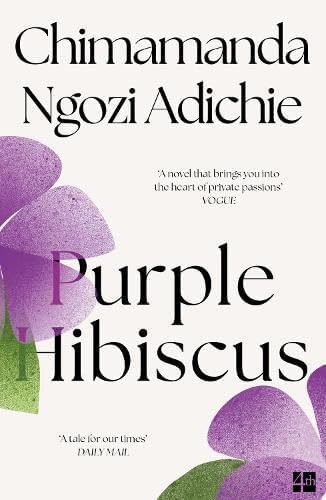
Purple Hibiscus: The extraordinary debut novel from the Women's Prize-winning and global bestselling author, Chimamanda Ngozi Adichie
Product ID: 52600101
⭐4.5/5 from 11,762 reviews
🏆Debut by Women's Prize-winning author
📚Bestseller Rank #7,619
Buy anything from 5,000+ international stores. One checkout price. No surprise fees. Join 2M+ shoppers on Desertcart.
Desertcart purchases this item on your behalf and handles shipping, customs, and support to Uruguay.
📖 Unlock the debut that shaped a literary icon — don’t miss out on Purple Hibiscus!
Purple Hibiscus is the extraordinary debut novel by Chimamanda Ngozi Adichie, a globally bestselling and Women's Prize-winning author. Ranked #7,619 in books with over 11,700 glowing reviews averaging 4.5 stars, this novel offers a masterclass in subtle storytelling, exploring themes of religion, family, and societal challenges through rich character development. A must-read for professionals craving literary depth and cultural insight.


| Best Sellers Rank | 7,619 in Books ( See Top 100 in Books ) 66 in Political Fiction (Books) 679 in Literary Fiction (Books) 2,127 in Contemporary Fiction (Books) |
| Customer Reviews | 4.5 out of 5 stars 11,762 Reviews |
B**T
Underrated but superior debut from a bright young talent.
It was so long ago that I read 'Purple Hibiscus' but it still remains one of my favourite reads of the decade. I felt to write this review since Adichie's follow up 'Half of a Yellow Sun' has garnered so much praise - which I feel is by and large unwarranted in comparison to 'Purple Hibiscus' - whilst her debut remains the strongest indicator of what a formidable writer Adichie can be. So subtle and understated this book is simply far too well written for it to be as easy as it seems. Kambili is at once irritatingly passive and completely sympathy-worthy. The issues addressed here - religion, hypocrisy, coming-of-age, domestic violence - would be derivative and clichéd in the hands of a lesser writer. Yet the author pulls it off - in fact so well that its precisely what makes her debut stand out. Unlike '...Yellow Sun' Adichie does not rely on sensationalist plot devices such as violence, sex and profanity to drive this story along. In fact not a lot happens in regards to plot but so much character development is going on. I found it a lot easier to care and engage with the characters in 'Purple Hibiscus' than the follow up and there seems to be a lot more freedom in the way Adichie writes it, devoid of the self-consciousness and what seemed too much like insincerity that marred 'Half of a Yellow Sun' for me. Purple Hibiscus was a pleasant surprise. Paced well, long enough to get the point across without overstaying its welcome, I highly recommend it. I bought it on a whim and having read it I was chagrined Adichie did not get more recognition for it. It's a prodigiously good debut and her only problem might be matching or surpassing it. I will read '..Hibiscus' again one day to ensure it has not lost its sparkle. The fact 'Hibiscus..' has been eclipsed by Adichie winning the Orange Prize for 'Half of a Yellow...' is a classic example of why people should not wait to be told what to read by the likes of Richard and Judy and the mainstream. In short, we shouldn't fall too often into the trap of literary populism, deciding to like a book based on its exposure regardless of its quality. I think to overlook '...Hibiscus' is to miss what is really special about Adichie as a writer.
D**T
Interesting and thought provoking
Having read other books by this author I was interested to read this one. Generally a number of very thought-provoking insights on Nigeria, the reality of everyday life for the middle classes as well as villagers, the effect of religion and also familial abuse - frankly not that different wherever it takes place. Its not a 5 star because I found the ending rather unsatisfactory - I needed to know more! However, we discussed it at my bookclub and not everyone agreed. We all gave it a positive rating however.
R**.
Once again a great book by Chimamanda
This writer can do no wrong. Every single book I have read has been enthralling. This was not my favourite book by this author but the standards have been exceptionally high after Half of a yellow Sun and Americanah! It took a long time and painful waiting to get to the result I was desperate for in this book but the journey was as ever both informative and enjoyable.
P**T
Beautiful and engrossing
This book made me cry so much my eyes turned red and got so swollen I could hardly see. Purple Hibiscus is a beautiful book, beautiful and terrible at the same time. The setting is perfectly rendered and I felt like I was really there, seeing, tasting and smelling everything. I love it when a writer takes me out of my world. The characters are fantastic as well. The backdrop of the novel is one of conflict as a military coup changes the lives of the characters in devastating ways, threatening the sheltered life of Kambili’s wealthy family. The book is chilling at times especially with the fanatical bouts of violence doled out by Kambili’s father. Some pages were very painful to read. The ending completely floored me. I was not expecting that. I adored Purple Hibiscus.
S**R
I think it is a good read
Beautifully written .this book reflects what's happening in some parts of the world.iIn the name of GOD they fight &kill. Here the a staunch CATHOLIC PHYsically abuses his own children .I don't respect him as a man giving money to the poors yet he dis respects his father cos he is not a CATHOLIC..HIS giving is for name &fame . I enjoyed the book thus far..Although this is fictions I think isherwood is portraying some reality. No religion is better than the other.
G**R
Truly great literature
Vivid characterisations, immersive rich descriptive prose, penetrating social comment, make this truly great literature. Whilst the author’s ‘Half a Yellow Sun’ focuses on tribal conflict, ‘Purple Hibiscus’ focuses on conflict within family. Adichie exposes the distortions of a religion which forces priestly celibacy, which focuses on ritual, doctrine, and obedience, rather than ethics and virtue. In one poignant phrase she deftly dismisses its unethical doctrine of substitutionary atonement, in the words of Jaja on God ‘Why did He have to murder his own son so we could be saved? Why didn’t He just go ahead and save us’ (p189), and then lays the impact of wider human fault on Jaja himself. The family’s father figure is a complex of business success, community contribution, religious bigotry, and evil perpetrator of atrocious domestic violence. He stands as a microcosm of sections of Nigerian society. Perhaps some are simply individual psychopaths flourishing in a society dominated by Nietzsche’s ‘will to power’, but for others, deprivation and suppression generate anger expressed in domestic violence. In contradiction his sister shows exemplary, perhaps too perfective, virtue, but she, like the virtuous priest, leave the country which is thereby further weakened in a vicious downward ethical circle. Adichie’s portrait is all too recognisable. The question is whether there is any salvific social option?
S**H
Beautiful Story Line Poor Characterisation
My sister recommended Purple Hibiscus to me sometime last year. However, I was reluctant to read the book because I was not sure that it could live up to Half a Yellow Sun, Adichie's other book. In hindsight, I was right. The novel is narrated by Kambili Achike, the fifteen-year old daughter of a wealthy Nigerian businessman. The book begins with a description of Kambili's family life: Her wealthy father, Eugene Achike, whom she called Papa, had made good in life; he had numerous factories and a newspaper, which took an uncompromising stand on the corruption of the ruling elite. To cap it all, he was a philanthropist par excellence, supporting many causes. Yes, Papa is the picture of the rewards of industry, thrift and hardwork. Beneath the respectable veneer, however, all is not well. Papa, supporter of all noble causes sacred and secular, was a very violent man. He regularly beat Kambili and her brother, Jaja, at the slightest provocation; failure to say the novenas correctly; eating before Mass; failing to top their high-school class all came in for Papa's lash. Good man that he was, Papa was particularly obsessed with the Catholic religion. Yes, Papa was a good old religious fundamentalist. The result: Kambili's home, despite all the appurtenances of wealth, was a miserable place where Kambili and her brother lived in mortal fear of Papa. Enter Papa's sister, Kambili's Aunt, Ifeoma. Kambili and Jaja spend two weeks at Aunt Ifeoma's house in Nsukka. The experience changes their lives. Aunt Ifeoma, though not as rich as Papa, is lively, smart and tolerant. In short, Aunt Ifeoma is al that Papa is not and then some. After their stay at Nsukka, life cannot be the same again. Kambili meets a dashing Man of the Cloth who takes too keen an interest in the teenager; Jaja and Kambili discover a loving world where children think for themselves and are free to speak their minds. The drama between Papa and his family unfolds against a backdrop of recent Nigerian politics. A corrupt military junta has just seized power in a military coup. The junta will do all in its power to squelch dissent and freedom of the press. Papa's incorruptible paper, The Standard, is pressured to recognise the junta. Papa refuses with the result that the paper's editor is assassinated by the military dictators. So far so good. The story suggests, however, that Ms Adichie liberally plagiarised recent Nigerian history for some of her characters. As a Nigerian, I could see that, Ade Coker, the idealist editor, who is killed by a letter bomb in the novel was actually Dele Giwa; the pro-democracy activist killed using acid was Ken Saro-Wiwa; and the military dictator rumoured to have died between the legs of a prostitute, General Sani Abachi. That Ms Adichie barely disguises these characters is understandable since the novel is primarily about relationships within the Achike family and not about the socio-political situation in the country. To my mind, the novel falls apart due to its superficial - often flat - characterisation. Except for Papa, whose character was fleshed out, all the other characters were two-dimensional. Mama is always amenable and subservient; Kambili always the innocent on-looker; and Aunt Ifeoma always defiant and head-strong. While most of the characters lack depth, others are simply too good to be true. Amaka and Obiora, Kambili's teenage cousins, seem too clever by half. When a friend of Aunt Ifeoma's complains, "The military tyrants continue to reign because the weak cannot resist", 15-year old Obiora responds, "That's just unrealistic pep-rally nonsense". How many 15-year olds can respond to such matters with that kind of depth? Purple Hibiscus succeeds in exposing the hypocrisy of fundamentalist religion. Eugene Achike is the product of the clash - rather the grafting - of Christianity onto an African traditionalist substrate. Papa seemed to spent his whole life trying to resolve that conflict. More importantly, it is the story of a young girl trying to come to terms with her sometimes benign but overly domineering father. Overall, Purple Hibiscus is a good read. Ms Adichie is a gifted writer. Her style is simple yet punchy; it reminds me Chinua Achebe's (Adichie almost tries too hard to be write like the great man). However, for all its strengths and acclaim, the novel's insipid, vapid characterisation did not escape me. The novel never seemed to 'take off' for me. Therefore, to my mind, Purple Hibiscus deserves only 3 stars. Her other novel, Half a Yellow Sun, which won the Orange Prize, is a more mature, more subtle piece. I would recommend it highly to anyone who wants a more nuanced portrayal of Nigerian life.
A**W
Good read
Classic
Trustpilot
1 month ago
1 month ago