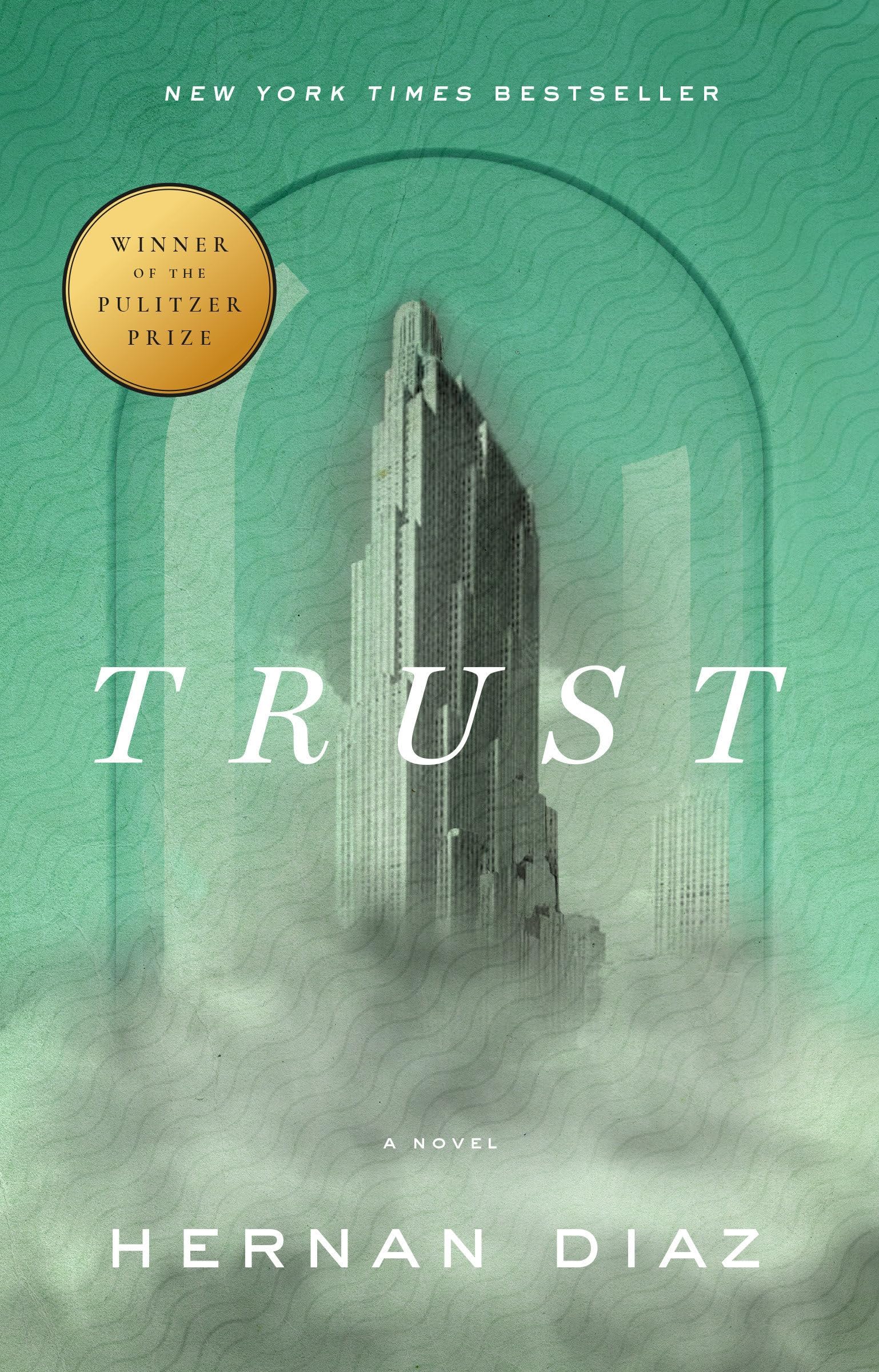
Trust (Pulitzer Prize Winner)
Product ID: 527808678
Desertcart purchases this item on your behalf and handles shipping, customs, and support to Uruguay.
WINNER OF THE PULITZER PRIZE FOR FICTION ONE OF THE NEW YORK TIMES ’S 100 BEST BOOKS OF THE 21ST CENTURY A NEW YORK TIMES BESTSELLER ONE OF BARACK OBAMA'S FAVORITE BOOKS OF 2022 LONGLISTED FOR THE 2022 BOOKER PRIZE An “exhilarating” ( New York Times) and unparalleled novel about money, power, intimacy, and perception, from the bestselling author of the forthcoming novel PLY “Buzzy and enthralling . . . A glorious novel about empires and erasures, husbands and wives, staggering fortunes and unspeakable misery . . . Fun as hell to read.” — Oprah Daily "A genre-bending, time-skipping story about New York City’s elite in the roaring ’20s and Great Depression." — Vanity Fair “A riveting story of class, capitalism, and greed.” — Esquire Even through the roar and effervescence of the 1920s, everyone in New York has heard of Benjamin and Helen Rask. He is a legendary Wall Street tycoon; she is the daughter of eccentric aristocrats. Together, they have risen to the very top of a world of seemingly endless wealth—all as a decade of excess and speculation draws to an end. But at what cost have they acquired their immense fortune? This is the mystery at the center of Bonds , a successful 1937 novel that all of New York seems to have read. Yet there are other versions of this tale of privilege and deceit. Hernan Diaz’s TRUST elegantly puts these competing narratives into conversation with one another—and in tension with the perspective of one woman bent on disentangling fact from fiction. The result is a novel that spans over a century and becomes more exhilarating with each new revelation. At once an immersive story and a brilliant literary puzzle, TRUST engages the reader in a quest for the truth while confronting the deceptions that often live at the heart of personal relationships, the reality-warping force of capital, and the ease with which power can manipulate facts. Review: Storytelling On Wall Street - Herman Diaz's 2023 Pulitzer Prize winning novel "Trust" absorbed me from beginning to end. For several days, I was captivated -- couldn't wait to get to it. This is a rarity for me. "Trust" is largely set in the financial district of New York City in the years surrounding the Great Depression. Here is a bare-bones summary of the story. The main character is a financier and trader, Andrew Bevel, the latest, and last, of a line of traders in his family. The reclusive Bevel amasses a large fortune during the 1920s and also manages to make money during the early stages of the Depression. Bevel's wife, Mildred, is the daughter of another New York State family with wealth and with intellectual interests. While Bevel concentrates on making his fortune, Mildred promotes educational, artistic, and cultural endeavors, particularly the development of 20th Century classical music. When Mildred dies in a Swiss sanatorium, in the 1930s, Bevel carries on but is somewhat less successful than in the days with his wife. After Bevel's death and lengthy wrangling over his estate, his palatial New York City home is turned into a museum. As is pointed out through "Trust", American literature has many works about New York City, the wealthy classes, the financial markets, and the nature of capitalism. This novel brings to it subject a strong sense of perspectivism. Bevel's story is told in four voices by four individuals, each with their own distinct voice and background. Each story has commonalities, but each is also different in terms of what happened and in terms of human relationships. The reader is left to think through the stories to come to an understanding of events and people. Showing and considering different points of view is integral to the humanities, whether history, literature, or philosophy, and to this novel. "Trust" considers city life, capitalism and greed, the arts, marriage, the relationship between imagination and realism, and more within its complex structure. It is challenging and mostly effective. Each of the four storytellers are fascinating both as writers and as themselves. The first, Harold Vanner, was a minor novelist of the day who wrote a heavily fictionalized novella about the Bevels titled "Bonds". It was fascinating to get hints about Vanner through the book and to read his account. The second part, "My Life" was written by Andrew Bevel himself, with help, and tells his story from his perspective and to rebut Vanner's book. The third and longest story is "A Memoir, Remembered" by Ida Partenza. She tells her tale from the standpoint of a 70 year old successful author. Partenza had been raised in poverty in Brooklyn by her father, an anarchist. At the age of 23, Bevel had hired her to help write his Autobiography. Partenza discusses her life with her father, how she came to be hired by Bevel, and how she became fascinated by the writing project and shaped it to her own as well as to Bevel's ends. The final section of the book, "Futures" consists of diary entries by Midred during her time in the Swiss sanatorium just before her death. Midred has a different perspective on the story and on her relationship with Bevel than do the other three storytellers. The reader will be encouraged to think about the world of financial trusts and about whom to trust among the four narrators, with their differing aims and perspectives. In his "Phaedrus", Plato has Socrates say that the written word can be revealing but also narrowing in its fixity. With the many earlier literary antecedents to Diaz's novel, I was reminded most of "Martin Dressler: The Tale of an American Dreamer" by Steven Millhauser which won the 1997 Pulitzer Prize for fiction. Martin Dressler is an American entrepreneur who, unlike Bevel was born to modest means. Dressler reaches the American dream of riches in New York City by founding a series of hotels before his businesses and his personal life come crashing down on his head. The story is a mix of realism and surrealism which captured something of the themes and locations of "Trust" in its own way. Unfortunately "Martin Dressler" has fallen into neglect. It deserves to be read both in it own right and as another voice on the themes of "Trust". "Trust" is a challenging, provocative novel about an aspect of the American dream and the American experience. Robin Friedman Review: captivating - Strange. Got lost a time or two. Not sure I understand this book. What happened? Not really aware … strange


| Best Sellers Rank | #1,202 in Books ( See Top 100 in Books ) #3 in Hispanic American Literature & Fiction #12 in Biographical Historical Fiction #16 in Biographical & Autofiction |
| Customer Reviews | 4.1 out of 5 stars 40,683 Reviews |
R**N
Storytelling On Wall Street
Herman Diaz's 2023 Pulitzer Prize winning novel "Trust" absorbed me from beginning to end. For several days, I was captivated -- couldn't wait to get to it. This is a rarity for me. "Trust" is largely set in the financial district of New York City in the years surrounding the Great Depression. Here is a bare-bones summary of the story. The main character is a financier and trader, Andrew Bevel, the latest, and last, of a line of traders in his family. The reclusive Bevel amasses a large fortune during the 1920s and also manages to make money during the early stages of the Depression. Bevel's wife, Mildred, is the daughter of another New York State family with wealth and with intellectual interests. While Bevel concentrates on making his fortune, Mildred promotes educational, artistic, and cultural endeavors, particularly the development of 20th Century classical music. When Mildred dies in a Swiss sanatorium, in the 1930s, Bevel carries on but is somewhat less successful than in the days with his wife. After Bevel's death and lengthy wrangling over his estate, his palatial New York City home is turned into a museum. As is pointed out through "Trust", American literature has many works about New York City, the wealthy classes, the financial markets, and the nature of capitalism. This novel brings to it subject a strong sense of perspectivism. Bevel's story is told in four voices by four individuals, each with their own distinct voice and background. Each story has commonalities, but each is also different in terms of what happened and in terms of human relationships. The reader is left to think through the stories to come to an understanding of events and people. Showing and considering different points of view is integral to the humanities, whether history, literature, or philosophy, and to this novel. "Trust" considers city life, capitalism and greed, the arts, marriage, the relationship between imagination and realism, and more within its complex structure. It is challenging and mostly effective. Each of the four storytellers are fascinating both as writers and as themselves. The first, Harold Vanner, was a minor novelist of the day who wrote a heavily fictionalized novella about the Bevels titled "Bonds". It was fascinating to get hints about Vanner through the book and to read his account. The second part, "My Life" was written by Andrew Bevel himself, with help, and tells his story from his perspective and to rebut Vanner's book. The third and longest story is "A Memoir, Remembered" by Ida Partenza. She tells her tale from the standpoint of a 70 year old successful author. Partenza had been raised in poverty in Brooklyn by her father, an anarchist. At the age of 23, Bevel had hired her to help write his Autobiography. Partenza discusses her life with her father, how she came to be hired by Bevel, and how she became fascinated by the writing project and shaped it to her own as well as to Bevel's ends. The final section of the book, "Futures" consists of diary entries by Midred during her time in the Swiss sanatorium just before her death. Midred has a different perspective on the story and on her relationship with Bevel than do the other three storytellers. The reader will be encouraged to think about the world of financial trusts and about whom to trust among the four narrators, with their differing aims and perspectives. In his "Phaedrus", Plato has Socrates say that the written word can be revealing but also narrowing in its fixity. With the many earlier literary antecedents to Diaz's novel, I was reminded most of "Martin Dressler: The Tale of an American Dreamer" by Steven Millhauser which won the 1997 Pulitzer Prize for fiction. Martin Dressler is an American entrepreneur who, unlike Bevel was born to modest means. Dressler reaches the American dream of riches in New York City by founding a series of hotels before his businesses and his personal life come crashing down on his head. The story is a mix of realism and surrealism which captured something of the themes and locations of "Trust" in its own way. Unfortunately "Martin Dressler" has fallen into neglect. It deserves to be read both in it own right and as another voice on the themes of "Trust". "Trust" is a challenging, provocative novel about an aspect of the American dream and the American experience. Robin Friedman
T**Y
captivating
Strange. Got lost a time or two. Not sure I understand this book. What happened? Not really aware … strange
T**E
A layered meditation on wealth, division, authorship, power, and erasure of women and working class
During the April matinée, book club members gathered to discuss Trust by Hernan Diaz, the winner of the 2024 Pulitzer Prize for Fiction. What drew the most attention was the novel’s structure. Some oenophiles found the early chapters slow, repetitious, and boring. For me, however, the book truly came alive when the narrative shifted to Ida Partenza’s story. And I found myself entirely captivated once Mildred’s journal began to ramble and resist legibility. In the spirit of Rashomon, Diaz pushes readers into a rabbit hole of ambiguity and encourages them to accept that no single account can capture the full truth. The novel becomes a layered meditation on wealth, division, authorship, power, and the erasure of women and the working class in the official narratives of financial empires. After reading it, the multiplicity of voices lingers, as do the silences surrounding gender, historical truth, moral compromise, and the fading or erasure of the history of immigrant working-class anarchists like Ida's father. His name remained anonymous - a thorough erasure. The novel gains narrative momentum when it turns to the story of Ida Partenza, the young ghostwriter, and her loving father, an aging, anonymous Italian anarchist. Ida’s father embodies a strain of early 20th-century radicalism, evoking real-life revolutionaries such as Errico Malatesta, Luigi Galleani, Carlo Tresca, and Nicola Sacco. His fierce idealism and scorn for compromise sharply contrast with the opulence and cunning of Andrew Bevel’s world—a world of polite robberies cloaked in legitimacy. Readers would not fail to notice the fault line of the ideological divide that Ida must navigate both emotionally and intellectually. Mildred, depicted under the alias Helen Rask (née Helen Brevoort), is rendered with confusion. The only thing we must note is that her private reading list included Transcendentalists like Thoreau, satirists such as Swift, and aphorists like Nietzsche and Karl Kraus—figures who emphasize personal moral clarity over public acclaim. In a world defined by acquisition and spectacle, her alignment with self-esteem and inward freedom marks her both as otherworldly and fatally out of place. Andrew Bevel, the self-styled titan of finance, appears allegedly modeled after Andrew William Mellon - a banker, industrialist, and former U.S. Treasury Secretary. Mellon Bank, a major outlet in transaction processing, provides a plausible historical analogue. Though Diaz offers Andrew a cool indictment of the myth of the financial genius, the story gradually dismantles the machinery that props up Bevel’s legend. It portrays him as both a powerful man and as a curator of his own myth—a myth built on silence, omission, and borrowed insight. The book offers a vivid portrait of the leisure class—their vicarious consumption, conspicuous charity, and their obsessive pursuit of cultural legitimacy. The nouveau riche of the Gilded Age didn’t merely donate books—they built entire libraries. They didn’t attend concerts—they hosted them in their drawing rooms. The creation of the Metropolitan Opera House itself stemmed from exclusion, a riposte to the Academy’s refusal to grant box seats to parvenu, the upstart millionaires, hilariously depicted in the HBO drama series: The Gilded Age. Amidst the backdrop of the Great Depression, while most Americans suffered unimaginable hardship, a few—Jesse Livermore, Floyd Odlum, Joseph Kennedy—turned catastrophe into windfall by shorting the market. These figures serve as silent reminders that Pluto's wealth is rarely innocent. It accumulates not only during booms, but in the wreckage of collapse—when the world burns and opportunists strike. Mildred’s invisible contribution to her husband’s empire is reminiscent of Emily Roebling, who took over the construction of the Brooklyn Bridge after her husband fell ill. Like Roebling, Mildred was the intellectual and strategic force behind the scenes. Yet her influence is effaced, her agency denied. This gendered erasure reflects the broader reality of finance, where women were virtually absent from the upper echelons of investment banking until the 1980s. One can't help but wonder why so many intelligent, beautiful women in literature are doomed to die young. From Millie in Henry James’s The Wings of the Dove to Mildred Bevel in Trust, their deaths feel less like narrative resolution and more like aesthetic sacrifice—tragedies designed to ennoble the male protagonist or deepen the story’s moral tone. While high maternal mortality rates (MMR in short) might offer a partial historical explanation, we must consider other causes such as mental illness, tuberculosis, suicide, and possibly social isolation. We are not far from there. Postscript) The trusts, or investment trusts, in the 19th and early 20th centuries were investment partnerships, essentially like buy-out funds or hedge funds in the post-WWII banking parlance. They were vehicles designed not just to grow capital, but to concentrate influence, deflect scrutiny, and more often than not, rewrite the terms of risk.
P**C
Competent writing with a modest, predictable take on a now-common literary conceit
It will come as no surprise to anyone who has gotten to my review that this book consists of the story of a financially powerful couple told from four perspectives. If you didn't know that, you would figure it out a few pages into the second version of the story. If you're particularly surprised by the fourth and final story, then you should reread the title of the book, which might be retitled "Always Mistrust." Mr. Diaz is a good enough writer that I don't begrudge myself the time spent reading the book, but I found nothing lyrical or passionately revealing or inspiring or innovative in his style. He's an okay storyteller, with characters I guess you can try earnestly to care about enough to deeply engage. Ultimately, I didn't come close to succeeding in that. The fourth version of the story is--by my estimation--the one that is supposed to produce the OMG-response, but I already knew something was coming and that it was going to reshape my view of the central characters and of everything I read before. To miss that going into that last section would be to ignore the previous three versions of the tale. And then, early in that final "diary" section, when we learn of previously trivialized mathematical skills and are given more to chew on about things like musical appreciation with a little Music 101 philosophizing (D F# E A -> A E F# D), it's pretty easy to guess what's coming. That's okay (except to the extent that the diarist sneers at predictability as a mark of lesser minds). It's the way the great reveal happens that bothers me and makes me feel that this is a failed novel. In a diary that is terse, minimalist, merely suggestive, the diarist stops in a couple places to ham-handedly tell OMG counterstory (the one, I assume, most readers decide upon closing the book for the last time to TRUST, given its location in the text and the satisfaction that the final gotcha-putdown of an unsympathetic protagonist provides). The diarist claims that the jarringly different passages that explain exactly what what REALLY happened (in careful expository detail) gives her some relief from pain and discomfort, but it came across to me as a plot device that the author failed to pull off. If you're going to just explain the OMG to me this way, then I'd prefer you stick it in a final explanatory section (Section V: Guess What!) written by an all-knowing author-god-voice. Don't give me: "AM Ouch my back hurts PM Morph AM Powerpoint slide #1: my actual talents, part 1...(a)...slide #2: my pitiful spouse's inadequacies...(a)..." One thing that diary section succeeded in doing was to swap out my feelings about the two central characters. The one who had seemed cold and insensitive gained a sliver of humanity and a quarter teaspoon of sympathy from me. The diarist, who rejoiced in bragging about personal superiority and absolute condescension toward a befuddled, largely incompetent other, lost any positive regard (already at very low simmer) that I had developed in the previous three versions of the story. Maybe that's the point. Don't trust anything you have just spent an entire book reading, including the final section. But if that's the take-away, why should wish to learn more about these people I was misled about? Surely, a good story should leave you with some appetite for more...for something truthier and give-a-damn-ier. These are people I never really cared about. Rather than becoming multidimensional by the retelling of the story, they were one-dimensional four times over. I don't like them (any of them, except maybe the champagne-toting butler: "Two glasses? Very good, sir."). I don't trust them. I feel no regret that they have disappeared into the dustbin of fictional time.
R**C
Interesting…
Beautifully written and often profound. A novel easier to admire than enjoy.
C**Y
Fun book to read
Great story, took me by surprise and loved the way it was told. Such an incredible writing style! Would recommend to others!
J**Y
Thought I would hate it, turns out I loved it!
I'm surprised that I loved the book! When I first read the reviews and the summary of the book, I thought I would hate it. It's hard for me to find books that keep me interested but this was one! I like how the book is written in 4 sections as it's different to what I usually read. I will admit, the first part was a little boring due to all the talk about the stock market, but it gets better in the 3rd and 4th sections. It's confusing in the first two parts, but the 3rd part reveals a lot of twists that I loved and kept me reading!! My favorite parts happened in the third section where a lot of things start to make sense and connect to the first two parts. The last part I think is a nice way to tie everything together. Overall, I think you should give it a shot!
A**G
Not my usual type of book
I almost gave up reading this book halfway through, and at that point I would have rated it two stars. Andrew Bevel's section had me lost. I'm glad I stuck with it, as things made sense in the last two narratives. I could not put the book down at that point. There are still a lot more questions for me than answers, but the book was well written and would make for interesting discourse in a college level literature class.
R**A
Excelente
Compra segura, entrega rápida. Excelente produto!!
A**L
Money, power, misogyny, lies and 'deepfakes'
I can’t see why this book was long listed for the Booker Prize in 2022 or how on earth it won the Pulitzer Prize in 2023. It seems a disjointed, rambling and confusing book about money, power and relationships. But that is a lie – a trick - a bit like Hernan Diaz in this book. On the contrary I think ‘Trust’ is a dazzling cut-diamond of a book. Unlike many novels with a beginning, middle and an end, Trust is constructed like a Russian Matryoshka doll where once the smallest doll – the ‘Futures’ section of the book – is revealed all our questions are answered and we can only sit back and wonder at Diaz’s deft sleight of hand. The author uses four different genres: first is the novel within the novel, then the manuscript, followed by the memoir and finally, the diary. From the first Diaz lulls the reader into a false sense of security. “Bonds” a novel within a novel, written by Harold Vanner in a traditional style, using the third person, lacking in dialogue, tells the story of successful investor Benjamin Rask and his wife in their New York Mansion. Helen Rask was an excellent mathematician with no acceptable outlet in a patriarchal society for her brilliance. Through her philanthropy and sponsorship of artists and musicians, this otherwise reserved woman creates a social bubble in which she feels comfortable and achieves great success. The loss of this richly cultural life hit her hard after the Depression when people blamed her husband for manipulating the markets and making money from other people’s misfortune. Her descent into mental illness was swift. An uppity wife would often find herself despatched to a clinic for experimental treatment and Helen’s fate was not a one-off. The reader learns later that the fictional author, Harold Vanner, had been entirely wrong about Helen aka Mildred. He may have changed the names of the two main protagonists but he was subsequently destroyed by the “real-life” Andrew Bevel because the story was clearly about the Bevels. How shocked Vanner would have been to learn that Mildred Bevel, the de facto victim was actually the brains behind Andrew Bevel’s success. He would have been horrified that he had lost his literary livelihood for such a monumental lie – no one would have suspected that the ‘angel in the Bevel house’, Mildred Bevel, had been capable of such Machiavellian scheming and, let’s face it, shocking brilliance! ‘My Life’, the manuscript of Andrew Bevel’s autobiography, is written in the first person but the writing is more stilted, less fluent than Vanner’s novel and is peppered with copious author’s notes for further research. It eventually stutters to an unresolved end, much as Bevel’s life ended, - suddenly. Bevel employed an inexperienced secretary, Ida Partenza, to not only type up the book but also invent incidents in the life of his late wife – a woman Ida had never met. Today we would say that Ida was a ghost writer, of sorts. The interviews between her and Bevel gave her a chance to develop her obvious talent for creative writing. She had already created a false biography for herself along with a new name. This was a game she would be able to play with inexperienced enthusiasm. With her boss as the only source, writing Mildred’s truth was nigh on impossible. For example on page 286 Bevel instructed Ida as follows: “We wouldn’t want anyone to believe she was arrogant or affected. Keep it simple. Make her love of the arts approachable for the common reader”. That Mildred had sponsored and enjoyed innovative modern classical music was only one of the truths that needed to be buried. Ida realised that the Mildred she was writing about was very different from the one who had decorated her bedroom with minimalist furniture. Ida had even inserted interests and events from her own life into Mildred’s to pad out the text, so she was well aware of the lies contained within its pages. This book is set in the past but Diaz is a contemporary writer. “Trust” may well be a metaphor for the modern world – awash with lies and deepfake news. If he were alive today Andrew Bevel would no doubt have used AI, Chat GPT to write his book and social media to circulate lies about Harold Venner. For example, look at the vitriol addressed to J K Rowling. The more I think about it, the more Bevel’s pride in being able to bend and align reality so that the adjustment looks like truth, the more I read commentary about the present Age. Ida acknowledges in later life (her memoir section written in italics) that she had also been manipulated by him, that money equals power and that power is not always wielded by the most ethical people. Her naivete began to fall away with the realisation that Jack had been spying on her and her father had stolen pages from her bin. She sensed a genuine mystery around the Bevels and her love of crime novels whetted her appetite for finding out the answer to the puzzle of who Mildred really was. However, she conversely admitted that working for Bevel had set her on a solid career path, paid her a good salary, and provided her with independence and a roof over her head as well as paying for her father’s accommodation. Ida Partenza had been regularly subjected to her father’s political rantings and preoccupations until she left home. He even told her that being a Secretary was a demeaning occupation, which promised independence but was actually “another knot in the millenary subjection of women to the rule of men”, failing to recognise the hypocrisy of his words. He would eventually live alone in unhygienic squalor rather than lift a hand to do anything about it. Despite grudgingly admitting that secretarial work was work - and he admired anyone who worked - he did not seem to understand that cooking, laundry, and cleaning was house ‘work’. Ida attempted to make sense of the Bevels by writing a memoir but it was only when she discovered the hidden diary that she discovered Mildred’s truth. Mildred describes her husband, Andrew, as ‘stoically sulky’, which is not surprising as he was constantly jealous of her superior skills in successfully predicting the stock market’s movements while taking all the credit for himself. This was a dark secret Andrew Bevel was determined to take to his grave. On the other hand, Mildred felt guilty that her financial dexterity had financially ruined people. In another extract she writes: “I don’t believe in magic, but the viciousness of cancer after the crash didn’t feel like a coincidence.” In this book financial trust, trust between husband and wife or parents and children is often misplaced. Women are silenced. The men in ‘Trust’ don’t come out of it looking very good. Clearly, this book is as much about the imposed restrictive experience of being a woman as it is about making money. Living in the twenty-first century, as we do, when some people struggle to find words to describe what a woman actually is, it is a salutary reminder that we are human beings first. Despite growing up speaking Spanish and Swedish, Diaz has made no secret of his love for the English language. He writes longhand in notebooks, in English, with a Mont Blanc pen, often in the Centre for Brooklyn History library, close to his home. He is widely read and his academic background contributes to the wealth of previous reading that enriches this novel. I really didn’t want this thoughtful, elegantly-written book to end and would recommend it to others.
D**K
Intriguant
Un livre brillant, parfois un peu ardu mais intriguant. La révélation finale est à demi attendue, mais semble trop improbable jusqu’à ce que l’on en comprenne les détails.
M**Y
Fictional NYC market makers and changers.
Literally liked everything about this book.
C**M
Trust
Top boek!
Trustpilot
2 weeks ago
2 weeks ago