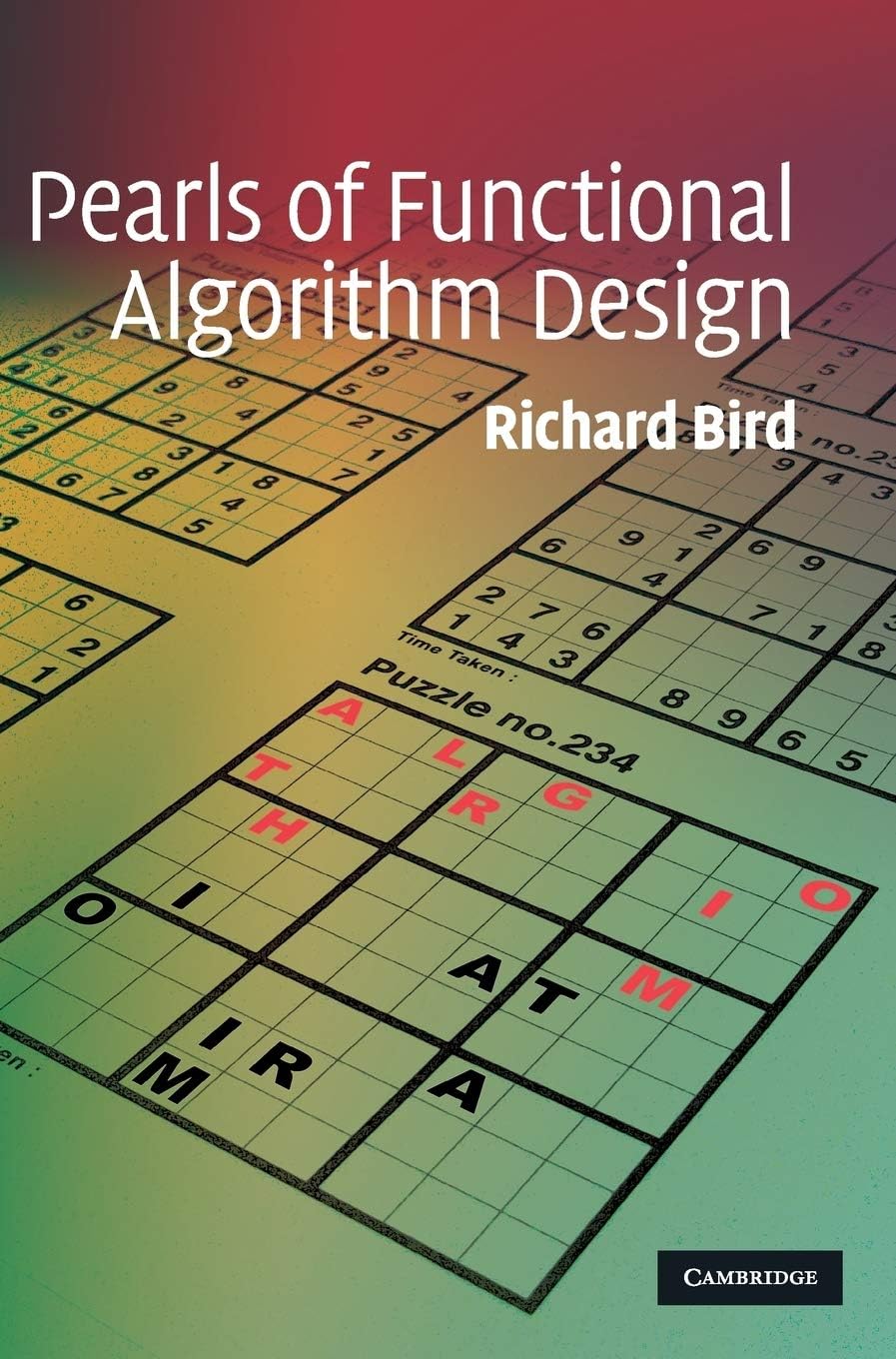
Pearls of Functional Algorithm Design
Product ID: 5585900
Desertcart purchases this item on your behalf and handles shipping, customs, and support to Uruguay.
Pearls of Functional Algorithm Design [Bird, Richard] on desertcart.com. *FREE* shipping on qualifying offers. Pearls of Functional Algorithm Design Review: A book for someone who wants to think - Bird has written a fine book, the functional analogue to Bentley's fine pieces. If there is one thing that's common to the functional attitude in program design, it's an emphasis on proof and logical consistency. Bird goes into detail and carefully shows why algorithms perform, and what their costs must be in terms of time and space complexity. One quibble: the reader, to follow the arguments, will want to write the short code selections for himself, to check Bird's arguments; he'll find himself having to define a number of Unicode mathematical operators, like U-2209, for example. But this isn't hard to do, in Haskell. Each chapter is well-written, to the point, and closely argued. In showing the beauty of Haskell in a clear way, or showing the beauty of concrete maths in a clear way, Bird has done well. Review: Great book that really helps you become a better programmer. - This book really helped me think about problem solving more efficiently. Functional programming is becoming very powerful and books like this show you why. Thanks to this book, I am now writing shorter and more methodical code. Also great for honing your Haskell skills.
| Best Sellers Rank | #819,438 in Books ( See Top 100 in Books ) #51 in Functional Software Programming #949 in Computer Programming Languages #2,084 in Programming Languages (Books) |
| Customer Reviews | 4.5 4.5 out of 5 stars (30) |
| Dimensions | 7.25 x 0.75 x 10.25 inches |
| Edition | Illustrated |
| ISBN-10 | 0521513383 |
| ISBN-13 | 978-0521513388 |
| Item Weight | 1.61 pounds |
| Language | English |
| Print length | 290 pages |
| Publication date | November 1, 2010 |
| Publisher | Cambridge University Press |
J**R
A book for someone who wants to think
Bird has written a fine book, the functional analogue to Bentley's fine pieces. If there is one thing that's common to the functional attitude in program design, it's an emphasis on proof and logical consistency. Bird goes into detail and carefully shows why algorithms perform, and what their costs must be in terms of time and space complexity. One quibble: the reader, to follow the arguments, will want to write the short code selections for himself, to check Bird's arguments; he'll find himself having to define a number of Unicode mathematical operators, like U-2209, for example. But this isn't hard to do, in Haskell. Each chapter is well-written, to the point, and closely argued. In showing the beauty of Haskell in a clear way, or showing the beauty of concrete maths in a clear way, Bird has done well.
G**A
Great book that really helps you become a better programmer.
This book really helped me think about problem solving more efficiently. Functional programming is becoming very powerful and books like this show you why. Thanks to this book, I am now writing shorter and more methodical code. Also great for honing your Haskell skills.
R**H
Was worth calling it the "Pearls"
I was one of those people who had learned the fundamentals of algorithms from the Programming Pearls (2nd edition) by Bentley. I have to say that since that text, many has written books about programming and algorithms in general and not one had the stuff to call it "pearl". I think this one came close to achieving the similar goal as the original one, but in the domain of functional programming. For those of you who have not read the original pearls, these books are almost like a collection of publication papers, but very well explained and throughly put into a programming environment. Another most important feature of this book (and the original pearls) is that each chapter is about a single problem that has a unique characteristic in algorithms. While most other algorithms books are organized by data structure types, these ones are focused in the category of problems. I have to say that this is the most intuitive form for people interested in algorithms. Haskell is a perfect choice of language. However, I don't think this book is just for Haskell programmers. Some of most intriguing problems are covered in very good structure. My favorites are the coverage of saddleback search, last tail, raking suffixes and nexuses. All others topics are really well done, but these were the topics that I had hard time googling for a good explanation. Great work.
D**N
Required reading for any computing scientist
I love this book. Just like Jon Bentley's Pearls books, this rather thin book is quite literally a pearl of programming wisdom. Although it's angled to the functional paradigm (Haskell, which is a pleasure as well), it makes for provocative reading given that other languages like C++ and various scripting languages are increasingly including functional programming facilities. This belongs on every computer scientist's (and software engineer's) bookshelf.
K**N
Focuses more on equational reasoning than algorithms
The book's title is deceptively simple and too inviting for beginners. A better title would be, "Optimizing algorithms with equational reasoning." In this book, a "pearl" means starting with a brute force algorithm, then incrementally rewriting it into an efficient algorithm. Incrementally improving an algorithm sounds intriguing. In practice, the book just starts swapping out parts of the algorithm, accompanied by long descriptions of why it does not change the function's specification. Rarely does the book give reasoning about why the change is being made. After reading several of these pearls, my thought process does not jive with this style. I suspect the author actually wrote the final efficient algorithm first, then the brute force algorithm, and finally went back and crafted intermediate steps. The book has many mistakes in it. Some are simply typos that most readers won't notice. Some mistakes invalidate multiple paragraphs in the proofs. Other times the book simply omits important details. For example, I spent an hour deciphering what the "building a tree with minimum height" algorithm did, but I was not convinced that the algorithm worked. I spent 2 days correcting a part of the proof that was wrong and filling in another important part that the book omitted, before I really believed that the algorithm worked. A published errata could patch up those problems. However, there is no errata on the publisher's website. Nor can I find any way to contact Richard Bird and ask him to start one. I've only read the first 8 pearls, but so far the problems those algorithms solve are definitely esoteric. Having worked 11 years as a professional developer, I have never come across any of those problems on the job or even as interview questions. All that said, reading the book is still improving my functional programming.
B**D
readable and useful
i'm not entirely finished with the "pearls" yet, but so far its interesting and fun. there is a lot of great follow-on discussion for each pearl. a welcome addition to the growing collection of quality texts dealing with haskell and functional programming.
A**7
Great book !
Great book !
E**.
Richard Bird hat mit diesem Buch ein wirklich anspruchsvolles und esthetisches Werk hervorgebracht! Aber ich möchte zu Beginn sagen was man in diesem Buch nicht findet: - Mit Sicherheit keine Einführung in Haskell - Kein thematisch sortiertes Buch mit dem man sich die Grundlagen des Designs von Algorithmen beibringen kann Was man bekommt: - Das Buch ist eine Sammlung von Problemstellungen die in einer sehr dichten und anspruchsvollen Art und Weise gelöst werden - Ein Buch das einen wirklich zwingt sehr genau über Dinge nachzudenken Ich kann nur betonen, dass das Buch wirklich nicht trivial ist. Um ein Kapitel, das heisst ein Problem, durch zuarbeiten nehme ich mir schon mal einen ganzen Tag. Dies liegt zum einen daran, dass zunächst einmal das Problem zu verstehen ist, dann die zugrunde liegende Lösung durch den Haskell Algorithmus und zu guter Letzt, meines erachten der schwierigste Teil, die theoretische Rechtfertigung für die einzelnen Zwischenschritte. Diese Zwischenschritte werden dargelegt in einer mathematischen Beweisführung, dargelegt in Haskell selbst. Abschliessend kann ich sagen dieses Buch ist für die Leute die wirklich Spass am Grübeln haben und ein Buch suchen das sie zum Beispiel abends als anspruchsvolle Alternative zum Fernsehen lesen wollen. Die Tatsache das jedes der Kapitel unabhängig ist erlaubt es einem nach belieben in dem Buch herum zu springen oder es auch mal für eine Woche beiseite zu legen.
W**E
I like the approach of equational reasoning. It's seems natural.
J**E
Best functional book. Master have.
F**M
In dem Buch werden keine trivialien Beispiele, sondern komplexere abgeschlossene Probleme darfestellt und optimiert. Dabei sind die Probleme aus dem "richtigen" Leben genommen und motiviert. Vor der eigentlichen Diskussion werden sie durch eine (ineffiziente) Funktionsdefinition präzise definiert. Anschliessend startet die Diskussion zur Ableitung eines effizienten Algorithmus. Die einzelnen Kapitel sind weitgehend unabhängig voneinander und können je nach Interesse gelesen werden. Das Buch ist sehr lesenswert und gibt sehr schöne Einsichten jenseits der üblichen Einführungsbeispiele in Sprachlehrbüchern. Der Leser sollte sich bereits ein bischen in Haskell ausdrücken. "Pearls of Functional Algorithm Design" ist keine Einführung in Haskell.
S**R
Der Beschenkte bekam seinen Wunsch erfüllt. Ein gutes Buch zur Häskell Programmiersprache. Er war begeistert, da er ein Häskell-Fan ist
Trustpilot
2 weeks ago
1 week ago