We remain fully operational. Our teams are working around the clock to ensure your deliveries continue safely.

DOWNLOAD THE APP


Copyright © 2025 Desertcart Holdings Limited
DOWNLOAD THE APP
Buy anything from 5,000+ international stores. One checkout price. No surprise fees. Join 2M+ shoppers on Desertcart.
Desertcart purchases this item on your behalf and handles shipping, customs, and support to Uruguay.
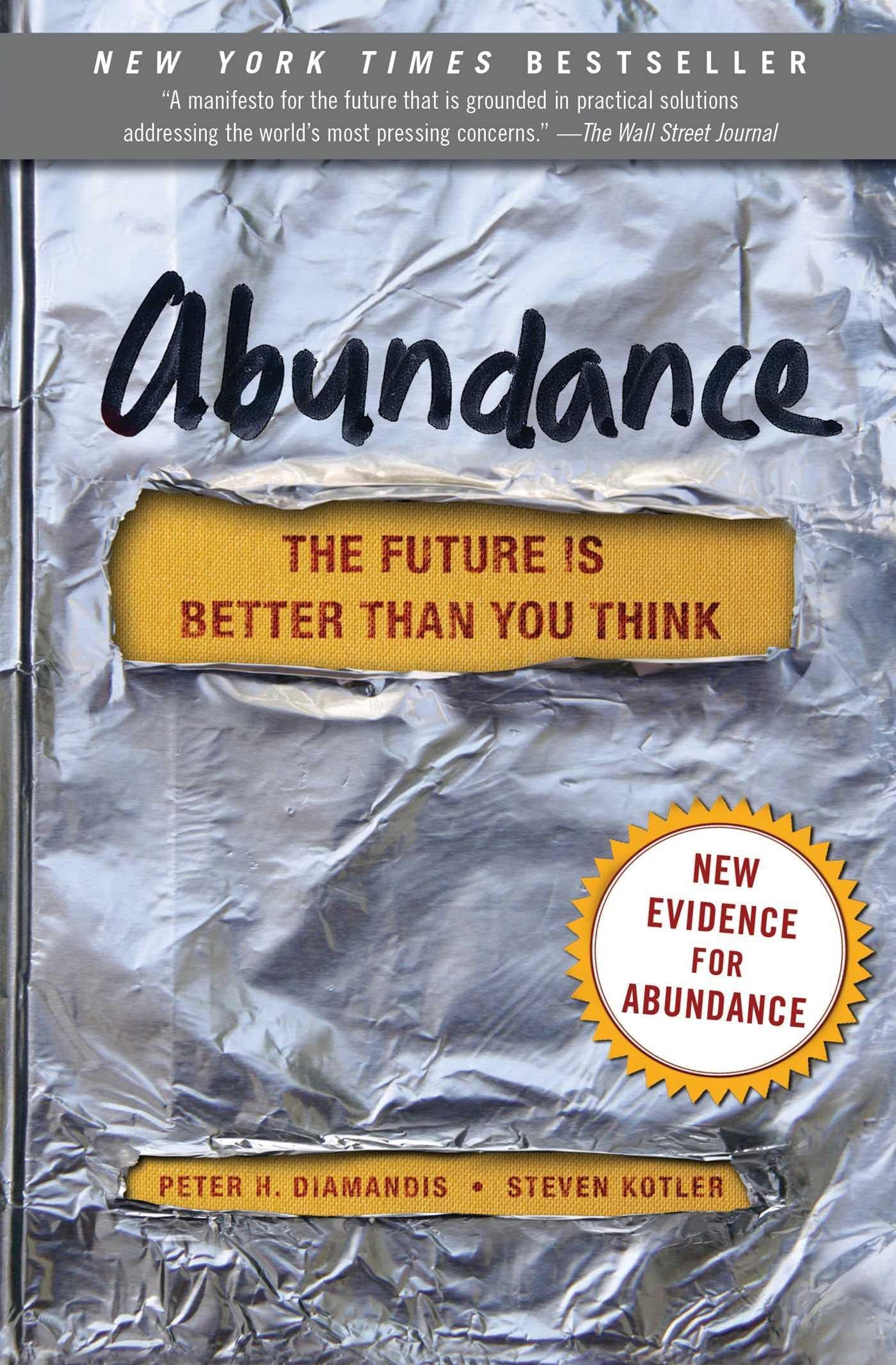
Abundance: The Future Is Better Than You Think (Exponential Technology Series) [Diamandis, Peter H., Kotler, Steven] on desertcart.com. *FREE* shipping on qualifying offers. Abundance: The Future Is Better Than You Think (Exponential Technology Series) Review: Thoughtful, optimistic and exciting look at the future - Abundance is the most enjoyable, exciting and motivating book I have read in a long time. Over the years I have read many books about the future, particularly about the technology of the future and how it will affect our lives. 32 years ago I was sitting here under the skylight of my then unfinished home architectural office reading another book that got me excited about the future: Alvin Toffler's The Third Wave. He was telling me that in the near future, many of us would be working at home "telecommuting" and that there would be a personal mini-computer in most homes, as common as a refrigerator, I think he said. I was all charged up about this wonderful future, then realized it was the middle of a week day, I was in my home office, and there was a computer on my desk, very primitive by today's standards, but a "personal mini-computer" nevertheless. But 1980 was quite a ways back on the still close to flat part of that exponential curve of technological progress that you may have seen in some of the magazine articles about Abundance, the book. I read it as a Kindle application on my iPad, PC, and iPhone seamlessly going from one to the other, depending on whether I was in my office, the kitchen, on the Stairmaster at my club, or in bed. On the PC or my iPad, I could click on any of the many highlighted references and be taken to the appendix and returned to where I had been reading with another click. On the PC, an internet reference in the text or appendix would take me to that external referenced article or graph or website. On the iPad, it would also take me back to where I was reading in the book when finished. This was the most elegant and useful integration of a book with Kindle technology that I have seen to date. Had the publisher chosen to allow desertcart's text to speech feature, I would have used my Kindle too. That may seem a little off-point, but I include it to illustrate just one of the changes we have so adapted to in those 32 years that we just take them for granted. Dr. Diamandis makes a seemingly air-tight case for an exponential acceleration of change to solve the problems that face us now and in the future, whether it is in energy, scarcity of resources, health, education, and even freedom. He seems to share much of the vision of the future of his colleague Ray Kurzweil, who is referenced and quoted in the book, along with many, many other experts. Dr. Kurzweil and Dr. Diamandis are the co-founders of Singularity University. (singularityu.org) There are many excellent talks and other resources on the web by both of them, including a very recent fifteen minute or so talk by Dr. Diamandis at TED (ted.com). Just the existence of Singularity University and TED.com are confirmation of the rapid and impactful changes in communication and education discussed in the book. They include an interesting quote from The Rational Optimist where the author of that book, Matt Ridley compares the cross-pollination of ideas facilitated by communication to the mixing of genetic information in the natural world. There were a couple of things in the book that I frankly wish were not there. Why the authors drag the name of Sarah Palin into a discussion of confirmation bias strikes me as inappropriate and more of an example of their own confirmation bias than hers - but then they would say that is just my confirmation bias. Less annoying but still a negative mark to me was a contradiction in two references to Thor Heyerdahl, the Norwegian explorer who sailed the raft Kon-Tiki across the Pacific in 1947. In the first they refer to Kon-Tiki as a raft, which it was, but in a reference a few pages later they describe the process of building it as if it were a dugout canoe, which it was not. Yes, I know - trivial, but it undermines the credibility, at least to me. But I don't want to make too much of my small disagreements. This is a powerful, optimistic, well documented and well written look at our future. That future is coming, whether we like it or not, so we had better get our minds ready to recognize it as it occurs. I suppose the one concept that keeps reoccurring to me in the days since I finished the book is the thought that the ideas that may change my life in unforeseen ways may come from some kid in Nepal or Siberia or Somalia. He or she may be a part of the bottom billion now, but how many more potential Mozarts or Einsteins or Hawkings or Edisons or Whitneys or Fords or Kamens are out there to be discovered and allowed to blossom? How many will take their dirt-cheap laptop and connect up with the Kahn Academy or something like it and learn to create world-changing products or ideas? As the creator of the X-prize and his many other accomplishments, Peter Diamandis has in my mind reserved a very honorable place in the future history of the world. With this current book, I think he has shown us how exciting and wonderful a history that is likely to be. Review: A Brief Summary and Review - *A full summary of this book is available here: An Executive Summary of Peter Diamandis and Steven Kotler's 'Abundance: The Future Is Better Than You Think' In their new book `Abundance: The Future Is Better Than You Think', Peter Diamandis and Steven Kotler argue that, despite the problems that our technology has recently created (including dwindling resources, global warming, and a population explosion that threatens to confound [and in some cases already does confound] our advances in agricultural production and medicine), we needn't discard our techno-optimism after all. Indeed, according to Diamandis, the world is on the precipice of another explosion in technology that will soon bring refuge from many of our current problems, and abundance to our doorstep. Not content to let the goal or the timeline remain vague, Diamandis is happy to hang a more precise definition on each. When it comes to abundance, Diamandis defines it as "a world of nine billion people with clean water, nutritious food, affordable housing, personalized education, top-tier medical care, and non-polluting, ubiquitous energy" (loc. 317), and, to top it all off, the freedom to pursue their goals and aspirations unhindered by political repression. With regards to the timeline, Diamandis claims that it "should be achievable within twenty-five years, with noticeable change possible within the next decade" (loc. 580). In an attempt to convince us that this goal is achievable (and convincing he is), Diamandis takes us through the latest technological developments (and those that will soon be coming down the pipe) in numerous fields such as water filtration and sanitation (including advancements in water desalination, nano-filtering, sewage recycling, and the smart-water-grid); food production (including the next generation of genetically modified foods, vertical farming, in-vitro meat, and agroecology); education (including personalized education, the OLPC [One Laptop Per Child program], AI education programs, and advancements in educational games, video-games and computer programs); energy (including solar and wind power, the next generation of nuclear energy and algal biofuel, the smart-energy-grid, and battery-encapsulated energy storage); healthcare (including stem cell therapy and organ creation, robotic medical care-givers and surgeons, genomic medicine [based on your individual genome], and Lab-on-a-Chip technology [a diagnostic tool compatible with your cell phone that can instantly analyze samples of saliva, urine and blood]), and many, many more. According to Diamandis, the technological innovations mentioned above are being spurred on by 3 forces in particular these days that are likely to bring us to a state of abundance even quicker than we might otherwise expect, and one that extends to all parts of the world. The 3 forces are (in reverse order as to how they are presented), 1) the rise of the bottom billion--which consists in the fact that the world's poorest have recently begun plugging into the world economy in a very substantial way, both as a consumer and as a producer of goods (largely as a result of the communications revolution, and the fact that cell phones are now spreading even to the world's poorest populations); 2) the rising phenomenon of the tech-philanthropists--a new breed of wealthy individuals who are more philanthropic than ever, and who are applying their efforts to global solutions (and particularly in the developing world); and 3) the rising phenomenon of DIY innovation--which includes the ability of small organizations, and even individuals to make contributions even in the most advanced technological domains (such as computing, biotechnology, and even space travel). With regards to this last force, part of Diamandis' purpose here is to inspire the layperson to enter the fray with their own contributions towards abundance by way of joining one of the numerous open-source innovation projects available on line, or throwing their hand into one of the many incentivized technological prizes in existence, or in some other manner of their own devising. In this regard, the authors are very successful, as the work is both invigorating and inspiring, and I highly recommend it. A full summary of the book is available here: An Executive Summary of Peter Diamandis and Steven Kotler's 'Abundance: The Future Is Better Than You Think'


| ASIN | 145161683X |
| Best Sellers Rank | #165,229 in Books ( See Top 100 in Books ) #9 in Philanthropy & Charity (Books) #41 in Oil & Energy Industry (Books) #66 in Social Sciences Research |
| Customer Reviews | 4.5 4.5 out of 5 stars (2,922) |
| Dimensions | 5.5 x 1.1 x 8.38 inches |
| Edition | Reprint |
| ISBN-10 | 9781451616835 |
| ISBN-13 | 978-1451616835 |
| Item Weight | 12.8 ounces |
| Language | English |
| Part of series | Exponential Technology |
| Print length | 432 pages |
| Publication date | September 23, 2014 |
| Publisher | Free Press |
T**N
Thoughtful, optimistic and exciting look at the future
Abundance is the most enjoyable, exciting and motivating book I have read in a long time. Over the years I have read many books about the future, particularly about the technology of the future and how it will affect our lives. 32 years ago I was sitting here under the skylight of my then unfinished home architectural office reading another book that got me excited about the future: Alvin Toffler's The Third Wave. He was telling me that in the near future, many of us would be working at home "telecommuting" and that there would be a personal mini-computer in most homes, as common as a refrigerator, I think he said. I was all charged up about this wonderful future, then realized it was the middle of a week day, I was in my home office, and there was a computer on my desk, very primitive by today's standards, but a "personal mini-computer" nevertheless. But 1980 was quite a ways back on the still close to flat part of that exponential curve of technological progress that you may have seen in some of the magazine articles about Abundance, the book. I read it as a Kindle application on my iPad, PC, and iPhone seamlessly going from one to the other, depending on whether I was in my office, the kitchen, on the Stairmaster at my club, or in bed. On the PC or my iPad, I could click on any of the many highlighted references and be taken to the appendix and returned to where I had been reading with another click. On the PC, an internet reference in the text or appendix would take me to that external referenced article or graph or website. On the iPad, it would also take me back to where I was reading in the book when finished. This was the most elegant and useful integration of a book with Kindle technology that I have seen to date. Had the publisher chosen to allow Amazon's text to speech feature, I would have used my Kindle too. That may seem a little off-point, but I include it to illustrate just one of the changes we have so adapted to in those 32 years that we just take them for granted. Dr. Diamandis makes a seemingly air-tight case for an exponential acceleration of change to solve the problems that face us now and in the future, whether it is in energy, scarcity of resources, health, education, and even freedom. He seems to share much of the vision of the future of his colleague Ray Kurzweil, who is referenced and quoted in the book, along with many, many other experts. Dr. Kurzweil and Dr. Diamandis are the co-founders of Singularity University. (singularityu.org) There are many excellent talks and other resources on the web by both of them, including a very recent fifteen minute or so talk by Dr. Diamandis at TED (ted.com). Just the existence of Singularity University and TED.com are confirmation of the rapid and impactful changes in communication and education discussed in the book. They include an interesting quote from The Rational Optimist where the author of that book, Matt Ridley compares the cross-pollination of ideas facilitated by communication to the mixing of genetic information in the natural world. There were a couple of things in the book that I frankly wish were not there. Why the authors drag the name of Sarah Palin into a discussion of confirmation bias strikes me as inappropriate and more of an example of their own confirmation bias than hers - but then they would say that is just my confirmation bias. Less annoying but still a negative mark to me was a contradiction in two references to Thor Heyerdahl, the Norwegian explorer who sailed the raft Kon-Tiki across the Pacific in 1947. In the first they refer to Kon-Tiki as a raft, which it was, but in a reference a few pages later they describe the process of building it as if it were a dugout canoe, which it was not. Yes, I know - trivial, but it undermines the credibility, at least to me. But I don't want to make too much of my small disagreements. This is a powerful, optimistic, well documented and well written look at our future. That future is coming, whether we like it or not, so we had better get our minds ready to recognize it as it occurs. I suppose the one concept that keeps reoccurring to me in the days since I finished the book is the thought that the ideas that may change my life in unforeseen ways may come from some kid in Nepal or Siberia or Somalia. He or she may be a part of the bottom billion now, but how many more potential Mozarts or Einsteins or Hawkings or Edisons or Whitneys or Fords or Kamens are out there to be discovered and allowed to blossom? How many will take their dirt-cheap laptop and connect up with the Kahn Academy or something like it and learn to create world-changing products or ideas? As the creator of the X-prize and his many other accomplishments, Peter Diamandis has in my mind reserved a very honorable place in the future history of the world. With this current book, I think he has shown us how exciting and wonderful a history that is likely to be.
A**T
A Brief Summary and Review
*A full summary of this book is available here: An Executive Summary of Peter Diamandis and Steven Kotler's 'Abundance: The Future Is Better Than You Think' In their new book `Abundance: The Future Is Better Than You Think', Peter Diamandis and Steven Kotler argue that, despite the problems that our technology has recently created (including dwindling resources, global warming, and a population explosion that threatens to confound [and in some cases already does confound] our advances in agricultural production and medicine), we needn't discard our techno-optimism after all. Indeed, according to Diamandis, the world is on the precipice of another explosion in technology that will soon bring refuge from many of our current problems, and abundance to our doorstep. Not content to let the goal or the timeline remain vague, Diamandis is happy to hang a more precise definition on each. When it comes to abundance, Diamandis defines it as "a world of nine billion people with clean water, nutritious food, affordable housing, personalized education, top-tier medical care, and non-polluting, ubiquitous energy" (loc. 317), and, to top it all off, the freedom to pursue their goals and aspirations unhindered by political repression. With regards to the timeline, Diamandis claims that it "should be achievable within twenty-five years, with noticeable change possible within the next decade" (loc. 580). In an attempt to convince us that this goal is achievable (and convincing he is), Diamandis takes us through the latest technological developments (and those that will soon be coming down the pipe) in numerous fields such as water filtration and sanitation (including advancements in water desalination, nano-filtering, sewage recycling, and the smart-water-grid); food production (including the next generation of genetically modified foods, vertical farming, in-vitro meat, and agroecology); education (including personalized education, the OLPC [One Laptop Per Child program], AI education programs, and advancements in educational games, video-games and computer programs); energy (including solar and wind power, the next generation of nuclear energy and algal biofuel, the smart-energy-grid, and battery-encapsulated energy storage); healthcare (including stem cell therapy and organ creation, robotic medical care-givers and surgeons, genomic medicine [based on your individual genome], and Lab-on-a-Chip technology [a diagnostic tool compatible with your cell phone that can instantly analyze samples of saliva, urine and blood]), and many, many more. According to Diamandis, the technological innovations mentioned above are being spurred on by 3 forces in particular these days that are likely to bring us to a state of abundance even quicker than we might otherwise expect, and one that extends to all parts of the world. The 3 forces are (in reverse order as to how they are presented), 1) the rise of the bottom billion--which consists in the fact that the world's poorest have recently begun plugging into the world economy in a very substantial way, both as a consumer and as a producer of goods (largely as a result of the communications revolution, and the fact that cell phones are now spreading even to the world's poorest populations); 2) the rising phenomenon of the tech-philanthropists--a new breed of wealthy individuals who are more philanthropic than ever, and who are applying their efforts to global solutions (and particularly in the developing world); and 3) the rising phenomenon of DIY innovation--which includes the ability of small organizations, and even individuals to make contributions even in the most advanced technological domains (such as computing, biotechnology, and even space travel). With regards to this last force, part of Diamandis' purpose here is to inspire the layperson to enter the fray with their own contributions towards abundance by way of joining one of the numerous open-source innovation projects available on line, or throwing their hand into one of the many incentivized technological prizes in existence, or in some other manner of their own devising. In this regard, the authors are very successful, as the work is both invigorating and inspiring, and I highly recommend it. A full summary of the book is available here: An Executive Summary of Peter Diamandis and Steven Kotler's 'Abundance: The Future Is Better Than You Think'
M**R
Privately, through an e-mail posting, I recommended this book, together with "Merchants of Despair," by Robert Zubrin, added to Ayn Rand's Philosophy of Objectivism, and Niall Ferguson's "Civilization" and "The Ascent of Money," describing the road we had to travel to reach the present times, and Seth Andrews' "Deconverted", as the guide to establish a truly peaceful and productive human society that would allow mankind to leave behind the present state of intellectually imposed irrational types of Society to over 200 Readers and/or institutions. Above paragraph suffices to underline the extreme importance of this book. Of course, it remains at the reader of this review's decision to follow my recommendation. If he does, he will enjoy a thoroughly researched, deeply reasoned and highly well written opus.
S**)
Great book to read. Awesome perspective which is positive and just what we need in today's doom and gloom engrossing our assumed-to-be dystopian and pessimistic world. The Authors show how far we as human species have come and how there is lot of work left to be done if we are to achieve an utopian world and society in the coming future. I would urge everybody to take time and read this book as we sometimes get lost in the hubbub of our daily routine. We forget to step back and smell the roses, and to think about how we can change the world and build our future. The book empowers the reader and spur them onto greater consciousness and perspective in life. A truly life changing read.
H**E
This is the first of a 3 book series. Might seem strange to buy a book on the future which is more than 10 years old but Im glad I did. Its a super start to the set. Incrediblt well written and researched and jammed with insights. Only a third way through and already bought the 3rd one.
通**り
日本版の『楽観主義者の未来予測』に興味を持って、上下巻セットよりもKindle版よりも安かったペーパーバックを購入しました。 地球規模で豊かになれるのか、について広い視野で書かれている良書だと思います。 ここで言う豊かさとは水、食料、エネルギーと言った資源が、人口が増えた世界で足りるのか?という内容です。このまま世界全体が北米並みの消費を続けると、地球5個分の資源が必要だそうです。 てことは節約しないと駄目じゃね?とならないと書いてあるのがこの本です。 人口は増えますが、技術もムーアの法則で指数関数的に進歩するので、バイオ技術で植物を必要な場所で効率良く作ったり、ナノ技術で水を安価に濾過したり、スマホで知識を共有したり、通販でを個人でも僻地でもハイテク機器を買ってみんなが発明家になれたり、価格も数年で何分の一になって性能は上がって… と詳細は読んでのお楽しみですが、地球1個で賄うにはどうするべきかがたくさん書いてあります。 日本語タイトルの『未来予測』という受動的な感じよりも、そういう未来を作るための考え方を学ぶ能動的な内容だと感じました。単なるボランティアとか人道支援とかでは無く、自立して持続可能な仕組みを目指しているのも素晴らしいと思います。 第四世代の原子力発電のホープとして、2016年末に話題になった日本の某家電メーカーが記載されていて、感慨深いです。
D**W
Great read opened my eyes on just how fast our world is changing
Trustpilot
3 days ago
3 weeks ago