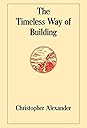


TIMELESS WAY OF BUILDING
Product ID: 64647242
The theory of architecture implicit in our world today, Christopher Alexander believes, is bankrupt. More and more people are aware that something is deeply wrong. Yet the power of present-day ideas is so great that many feel uncomfortable, even afraid, to say openly that they dislike what is happening, because they are afraid to seem foolish, afraid perhaps that they will be laughed at. Now, at last, there is a coherent theory which describes in modern terms an architecture as ancient as human society itself. The Timeless Way of Building is the introductory volume in the Center for Environmental Structure series, Christopher Alexander presents in it a new theory of architecture, building, and planning which has at its core that age-old process by which the people of a society have always pulled the order of their world from their own being. Alexander writes, "There is one timeless way of building. It is thousands of years old, and the same today as it has always been. The great traditional buildings of the past, the villages and tents and temples in which man feels at home, have always been made by people who were very close to the center of this way. And as you will see, this way will lead anyone who looks for it to buildings which are themselves as ancient in their form as the trees and hills, and as our faces are."


| Dimensions | 13.97 x 5.08 x 18.8 cm |
| Importer | Bookswagon, 2/13 Ansari Road, Daryaganj, New Delhi 110002, [email protected], 01140159253 |
| Isbn 10 | 0195024028 |
| Isbn 13 | 978-0195024029 |
| Item Weight | 635 g |
| Language | English |
| Packer | Bookswagon, 2/13 Ansari Road, Daryaganj, New Delhi 110002, [email protected], 01140159253 |
| Part Of Series | Center for Environmental Structure |
| Print Length | 568 pages |
| Publication Date | 10 April 1980 |
| Publisher | OUP USA |
User
Probably the best book ever written.
It's a book about architecture. It describes a new way of looking at design. Breaking down the design problem and attempting to provide a procedure to solve it systematically.It is a companion book to A Pattern Language and The Oregon Experiment.The book is so beautifully written that I sometimes am moved to tears by the profoudness of the thoughts expressed. All architects mist read this book.
User
Am a software developer, so only reading it in ...
Am a software developer, so only reading it in weekends. About half way through and am thoroughly enjoying it. Its a book on 'philosophy of creating new things'. Treasureworthy book.
User
a must
An excellent read. A must for architects & probably many looking to understand design before embarking on any form of building.
User
Five Stars
Excellent set of 3 books, essential reading for architects and anyone building a structure .
User
Worth it.
Worth it.
User
but the quality received was very poor. Bought for a submission hence couldn't return
Delivery was on time, but the quality received was very poor. Bought for a submission hence couldn't return. very disappointed.
User
Libro favoloso
Lo sto ancora leggendo, e già molte volte mi ha fatto scattare delle epifanie su tante cose, dalla musica alla organizzazione delle cose. Anche se il testo prende in esame il linguaggio architettonico, non si deve essere assolutamente degli architetti per comprenderne le idee. Io non lo sono.
User
The Etymology of Software Architecture
I found this book so mesmerizing that I read it twice. During the first pass, I was surprised that the book was so philosophical and poetic in describing architecture. I expected something more technical. Later during the second pass, my goal was to find derivatives and analogies in software architecture. Based on what I found, I think every software architect would enjoy this book.The writing style that I noticed in my first read of the book made me feel like I was reading an architecture bible. I hesitate to describe the book as religious, but the book's description "the power to make buildings beautiful lies in each of us already" and the description of the word "alive" giving architecture "the quality without a name" triggered an epiphany when recalling that the Bible says "In the beginning God created the heaven and the earth." and, "So God created man in his own image." This is why I'd say this book has a primal, sacred aspect, and this is why we like to build. Additionally, the book especially moved me so my mind's eye was opened to see "alive" patterns and to think about the morphology of architecture filling voids and generating towns.On the second pass of reading, I was struck by this software architecture analogy in the table of contents: "16. Once we have understood how to discover individual patterns which are alive, we may then make a language for ourselves for any building task we face. The structure of the language is created by the network of connections among individual patterns: and the language lives, or not, as a totality, to the degree these patterns form a whole." Could this be the guidebook for designing enterprise software architecture?Obviously this book was the inspiration for the philosophy and vocabulary for software architecture, and I thought some of the following excerpts were noteworthy paradigm shifts."The patterns are not just patterns of relationships, but patterns of relationships among other smaller patterns, which themselves have still other patterns hooking them together---and we see finally, that the world is entirely made of all these interhooking, interlocking nonmaterial patterns." This sounds like the difference between patterns of software architecture and object-oriented software design patterns."Each pattern is a three-part rule, which expresses a relation between a certain context, a problem, and a solution." Deja vu for software patterns."You may be afraid that the design won't work if you take just one pattern at a time...There is no reason to be timid...The order of the language will make sure that it is possible." Likewise in software architecture design, as one design pattern is considered at a time to see how it fits needs into the large picture of design. If this pattern is later deemed to be dead, it can be replaced by an "alive" design pattern."Next, several acts of building, each one done to repair and magnify the product of the previous acts, will slowly generate a larger and more complex whole than any single act can generate." This correlates to software refactoring."It is essential, therefore, that the builder build only from rough drawings: and that he carry out the detailed patterns from the drawings according to the processes given by the pattern language in his mind." When I read this, I thought about the metaphor to the software architect's vision and design. The software architect's design needs to be abstract enough to accommodate change easily, but yet simple enough so software programmers can understand it, finish the detailed component design and build the component to fit the architectural whole.
User
Great Book
This has been on my husband's "must read" list for a long time. The book arrived quickly and was in great condition. I also ordered the "Oregon Experiement" and it came with a crushed corder as if it had been dropped quite hard. Both are great books.
User
A brilliant mind-moving essay on human fundamentals, and architecture by the way
Christopher Alexander is one of the seminal thinkers in architecture, but his ideas are also relvant to software architecture, organisation design, customer experience and indeed science genrally. This is a highly challenging, brilliantly written, engaging explanation of his thinking. It stands with such classics as Zen and the Art of Motorcycle Maintenaence as a book that could change your thinking on the nature of quality and the social process of design. I would say the book brings together aspects of Taoism, Whiteheadian physics, Drucker's concern for the customer, and his original thinking. He also confirms Stewart's introduction of value into systems thinking as an objective feature of the system. Entrancing
User
How Architects think.
This has been around a very long time - essential for Architects and those who want to know how Architects think. The Western Feng Shui.
Trustpilot
3 weeks ago
2 days ago