
Desertcart purchases this item on your behalf and handles shipping, customs, and support to Uruguay.
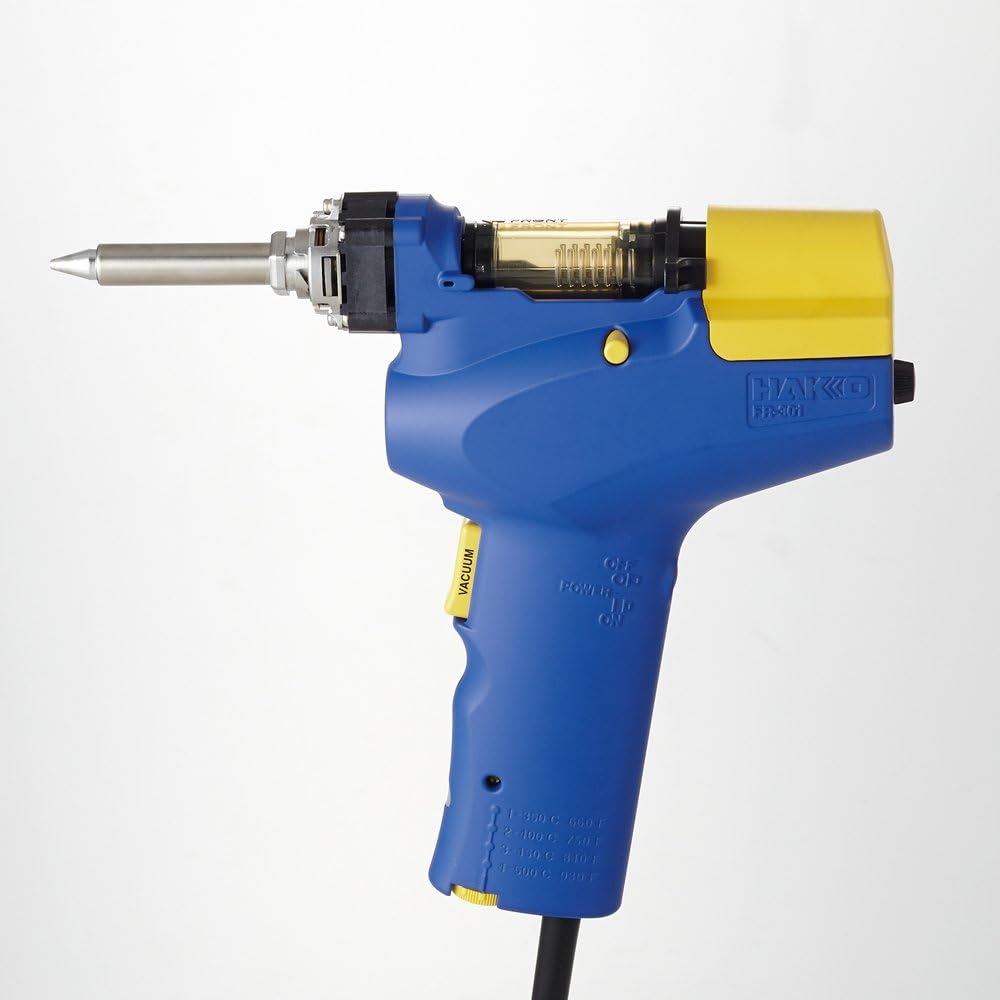
desertcart.com: FR-301 Portable Desoldering Tool : Tools & Home Improvement Review: Good value - Good value for someone who knows what they are getting. Yes, this is the eastern Japanese version. Eastern Japan's electrical grid is 100v at 50hz. Western Japan is 110/120v at 60hz. Two different power grids on one island country. This can be made to safely work here in North America with a simple, cheap mod. It has been listed here in the reviews, a number of electronics websites like eevblog, and even a YouTube video showing a step by step. You can also use an inverter if you have one, but it should be at least 500 watts at a minimum. The nominal wattage value for this version is approximately 100 watts. However during heatup, it can jump more than four times the nominal value. If your inverter can't deliver that, it will keep blowing it's fuses. You get everything in this version that you do with the US version with exception of the manual. Of course you get the Japanese version of that. This unit works very well for its intended purposes. It's a portable/field desoldering tool. It was never intended to be a bench tool. It is heavy compared to bench based desoldering tools. It will fatigue your wrists quickly if you try to desolder several 40 pin dip chips. I use this on arcade machines that getting the boards to the bench is more of a pita. So I can more easily bring this tool to the machine and it's grat for that. I use a couple of pace desoldering machines at the bench. They are night and day better but used in a different environment because it's the bench. You will want to get a couple of different sized tips, cleaning rods, filter packs, and a hakko 633 stand with the money you save getting this version. You can use this as a one and only desoldering tool at the bench, but be ready to learn it's quirks. It requires more frequent cleaning than a bench model, it's heavy at a couple of pounds compared to 6 to 8 oz of a bench model, and it's balanced very poorly because it needs to have the pump in the unit itself. All of this can really irritate the user unless they are aware of these issues up front. The 1.0mm included tip is a wee bit to large for many leads and you will struggle to make it work. Get a 0.8 mm for things like passive components like resistors, and capacitors. This really is a good value, for a good tool. Just mod it or use a good inverter. If you run it off 120v it will slowly overdrive and kill the pump. The single most complex and expensive item to replace. It's great for bringing the tool to the thing your working on when you can't easily work the other way. ***EDIT*** I just thought I would add in the fact that the heating element is the same one on the American model, and doesn't require modding. It can safely run on 100v or 120v. It's the pump that needs a pair of 300ohm resistors to replace the ones already on the circuit board. Or the power inverter. The pump replacement would have to be the Japanese model if you don't do the mod because of the power differences. Review: Significant upgrade over budget 948 desoldering tool - I've upgraded to the Hakko FR-301 from a Yihua 948 (aka WEP 948 etc.) The upgrade is substantial in these key ways: The whole tube is hot enough to keep solder liquefied. I rarely need to even poke through clogs with a pin(using a smaller pin. I find the included pin is too large for the included tip). This contrasts to the most annoying aspect of the 948 where the whole tube cannot get hot enough to keep solder liquified. The tube was also not securly attached. I'd regularly need to drill out solidified solder while holding the tube with pliers. I'd even gotten a second one that quickly ran into the same cycle. Joints are consistently cleared in one go. I can do probably a hundred joints in a row with all of them getting cleared enough to pull the part(I mostly do capacitors). If it doesn't fully clear then the tube just needs to be unclogged with a pin. The 948 was maybe 8 or 9 out of 10 when at its best. It powers through the most stubborn PCBs at lower temps. The aspect governing this might be 'thermal mass'? I normally keep the FR-301 at 350c and have no trouble in most situations to get solder melted thoroughly. I keep the 948 at 400c minimum, but regularly need to pump it further up to overpower joints, particularly on chunky ground planes It comes to temp super fast. I haven't explicitly timed the warm up period, but it feels like its less than a minute in contrast to the 948's 4ish minute warmup period. I always turn it on before fluxing joints and the FR-301 is ready by the time I'm done where I'd usually need to wait around longer for the 948. My workspace is cleaner. I keep the tool on the far side of my workspace. When not in use the cable can be fully out of the way since it just connects backwards to the wall. The 948 has a box station where the tool is plugged in on the front with the power and suction tube connecting it. The wire/tube is always in front of the station so I'd have to try to keep it out of the way or rotate the station to keep my workspace clear. Then theres the fact that the station itself takes up space. The tip connection is better. The latching feature + hot swap thing is neat although I don't really have a need to remove the tip. The important part is the tip doesn't become loose over time. The 948 had a screw on tip assembly that comes loose after some heating cycles and require occasional tightening Don't get me wrong, the Yihua 948 was a significant jump in quality of life over manual desoldering, but I was still blown away by the jump to the FR-301 I performed the resistor mod on this to work with US mains. Definitely worth it for the lower price in my opinion. It was also like a sending off ceremony for my old desoldering tool. Like using old manky scissors to open the packaging of a better, new pair of scissors


| ASIN | B07BKSLLG9 |
| Additional Features | Heavy Duty |
| Best Sellers Rank | #45,648 in Industrial & Scientific ( See Top 100 in Industrial & Scientific ) #104 in Soldering Irons |
| Brand | Hakko |
| Brand Name | Hakko |
| Customer Reviews | 4.2 out of 5 stars 319 Reviews |
| Head Style | Pencil |
| Heating Element | Ceramic |
| Included Components | simple iron holder, carrying case, various nozzles |
| Item Weight | 3 Pounds |
| Manufacturer | AMERICAN HAKKO PRODUCTS, INC |
| Manufacturer Part Number | FR-301 |
| Model Number | FR-301 |
| Number of Items | 1 |
| Power Source | Corded Electric |
| Special Feature | Heavy Duty |
| Specific Uses For Product | Industrial Use |
| Style Name | Pencil |
| UPC | 641328076416 |
| Unit Count | 1.0 Count |
| Upper Temperature Rating | 500 Degrees Celsius |
| Wattage | 98 watts |
K**I
Good value
Good value for someone who knows what they are getting. Yes, this is the eastern Japanese version. Eastern Japan's electrical grid is 100v at 50hz. Western Japan is 110/120v at 60hz. Two different power grids on one island country. This can be made to safely work here in North America with a simple, cheap mod. It has been listed here in the reviews, a number of electronics websites like eevblog, and even a YouTube video showing a step by step. You can also use an inverter if you have one, but it should be at least 500 watts at a minimum. The nominal wattage value for this version is approximately 100 watts. However during heatup, it can jump more than four times the nominal value. If your inverter can't deliver that, it will keep blowing it's fuses. You get everything in this version that you do with the US version with exception of the manual. Of course you get the Japanese version of that. This unit works very well for its intended purposes. It's a portable/field desoldering tool. It was never intended to be a bench tool. It is heavy compared to bench based desoldering tools. It will fatigue your wrists quickly if you try to desolder several 40 pin dip chips. I use this on arcade machines that getting the boards to the bench is more of a pita. So I can more easily bring this tool to the machine and it's grat for that. I use a couple of pace desoldering machines at the bench. They are night and day better but used in a different environment because it's the bench. You will want to get a couple of different sized tips, cleaning rods, filter packs, and a hakko 633 stand with the money you save getting this version. You can use this as a one and only desoldering tool at the bench, but be ready to learn it's quirks. It requires more frequent cleaning than a bench model, it's heavy at a couple of pounds compared to 6 to 8 oz of a bench model, and it's balanced very poorly because it needs to have the pump in the unit itself. All of this can really irritate the user unless they are aware of these issues up front. The 1.0mm included tip is a wee bit to large for many leads and you will struggle to make it work. Get a 0.8 mm for things like passive components like resistors, and capacitors. This really is a good value, for a good tool. Just mod it or use a good inverter. If you run it off 120v it will slowly overdrive and kill the pump. The single most complex and expensive item to replace. It's great for bringing the tool to the thing your working on when you can't easily work the other way. ***EDIT*** I just thought I would add in the fact that the heating element is the same one on the American model, and doesn't require modding. It can safely run on 100v or 120v. It's the pump that needs a pair of 300ohm resistors to replace the ones already on the circuit board. Or the power inverter. The pump replacement would have to be the Japanese model if you don't do the mod because of the power differences.
M**L
Significant upgrade over budget 948 desoldering tool
I've upgraded to the Hakko FR-301 from a Yihua 948 (aka WEP 948 etc.) The upgrade is substantial in these key ways: The whole tube is hot enough to keep solder liquefied. I rarely need to even poke through clogs with a pin(using a smaller pin. I find the included pin is too large for the included tip). This contrasts to the most annoying aspect of the 948 where the whole tube cannot get hot enough to keep solder liquified. The tube was also not securly attached. I'd regularly need to drill out solidified solder while holding the tube with pliers. I'd even gotten a second one that quickly ran into the same cycle. Joints are consistently cleared in one go. I can do probably a hundred joints in a row with all of them getting cleared enough to pull the part(I mostly do capacitors). If it doesn't fully clear then the tube just needs to be unclogged with a pin. The 948 was maybe 8 or 9 out of 10 when at its best. It powers through the most stubborn PCBs at lower temps. The aspect governing this might be 'thermal mass'? I normally keep the FR-301 at 350c and have no trouble in most situations to get solder melted thoroughly. I keep the 948 at 400c minimum, but regularly need to pump it further up to overpower joints, particularly on chunky ground planes It comes to temp super fast. I haven't explicitly timed the warm up period, but it feels like its less than a minute in contrast to the 948's 4ish minute warmup period. I always turn it on before fluxing joints and the FR-301 is ready by the time I'm done where I'd usually need to wait around longer for the 948. My workspace is cleaner. I keep the tool on the far side of my workspace. When not in use the cable can be fully out of the way since it just connects backwards to the wall. The 948 has a box station where the tool is plugged in on the front with the power and suction tube connecting it. The wire/tube is always in front of the station so I'd have to try to keep it out of the way or rotate the station to keep my workspace clear. Then theres the fact that the station itself takes up space. The tip connection is better. The latching feature + hot swap thing is neat although I don't really have a need to remove the tip. The important part is the tip doesn't become loose over time. The 948 had a screw on tip assembly that comes loose after some heating cycles and require occasional tightening Don't get me wrong, the Yihua 948 was a significant jump in quality of life over manual desoldering, but I was still blown away by the jump to the FR-301 I performed the resistor mod on this to work with US mains. Definitely worth it for the lower price in my opinion. It was also like a sending off ceremony for my old desoldering tool. Like using old manky scissors to open the packaging of a better, new pair of scissors
B**N
Great desoldering tool while also being serviceable.
This is the 100V Japanese version with a standard USA 2 prong AC plug. If you have a Variac you can obviously set it to 100V and use without issue. After looking inside and testing, it will run "without issue" using 120V, see disclaimer below. It does not come "used", the standard practice for irons is to put solder on the tip before putting in storage to prevent oxidation. Based on the manual there are 2 major heating element part classes, 100V-127V (35 Ohms) and 220V-240V (160 Ohms). This one obviously has the 100V-127V heater. The only confusing thing about this is the OEM replacement parts list for the heater has individual SKUs for 100-110V, 120V, 127V, 220V. The the other main part is the heater temperature sensor but it is spec'd for 100V-220V so this shouldn't be a problem for using with 120V. The important point is since the heater is temperature controlled along with an available calibration potentiometer, the difference between 100V and 120V is just the duty cycle, time on in order to maintain set temperature. Because of this I don't believe there is any harm done when supplied with 120V. The major caveat is that the vacuum motor RPM does scale with the AC voltage. It's not a lot but you can audibly hear the difference even between 100V vs. 110V, it's a higher RPM. I can't say for certain but it could shorten the motor's life but it might not matter in grand scheme of its lifespan. The flip side is you're getting a little more suction, not that it really needs it. The "power supply" PCB is the "same" board across 100V-220V units with the critical difference being 1 or 2 power resistors and their values. Hakko sells the 120V PCB for an affordable amount so any DIYers could attempt to swap it if desired. The AC cord and motor connection are through-hole soldered while the heater is connectorized. Overall the unit is really nice and Hakko does a great job offering replacement parts for basically everything inside. The only negative thing I'll say about it is the power cord is kind of springy and slippery, however it's not too hard to swap it with a new one if you wanted.
J**A
Removes solder really well
Great heat transfer and excellent suction with the appropriately sized nozzle. Super time savor for cleaning up pads and desoldering components. Great selection of tips for different component sizes. I wish I had purchased it sooner for my toolkit. Replacement parts are easily available and not that pricey. Excellent tool.
J**S
DO NOT BUY IF YOU'RE IN THE UNITED STATES!
THIS IS THE JAPANESE VERSION and is NOT COMPATIBLE with the U.S. energy grid. Hakko USA specifically advises NOT to operate this 100V (98W) version directly from a U.S. 120V outlet. While it will usually power on and work (because both Japan and the U.S. use the standard two-blade plugs), the heater and electronics are subjected to about 20% overvoltage, which will shorten their life. If you do buy this Japanese version, Hakko USA recommends using a quality 120V→100V step-down transformer instead. But they also note that Japanese-market units are not UL-certified for North America and cannot be serviced under Hakko USA's repair program. Don't shoot the messenger, I'm just reporting what Hakko themselves say! DO NOT BUY THIS ONE IF YOU'RE IN THE UNITED STATES! Buy one that says 120V (or 140W). (you can find them on Amazon. They cost a few bucks more and you have to do some digging in the item descriptions, but they're available)
M**S
TOTAL game changer for desoldering work
If you plan to reuse a PCB and/ or do repair work on PCBs, this desoldering tool is a total game changer. I have the pipette-style solder sucker, the one you depress the plunger on and then press the little button to make it POP! and suck up a little bit of solder. And I have a plug in solder sucker with a little ball that you squeeze to create the sucking action on the soldering iron style device. The Hakko desoldering tool blows the other tools away. And I almost did not buy it, because let's face it, this thing seems like a lot of money for a job that does not seem like warrants adding another tool to your work bench. But I was quite wrong, because this tool is sooooo very warranted! It will suck ALL the solder from a board if you want it to and it is quick compared to using the other tool options. It produces a very clean through hole and allows for the most effortless removal of old components that I ever saw. I was able to use this pretty quickly without reading a manual. But look it over and find all the switches on it. The finger trigger is one of three switches. There is also a small push button that actually allows power to the heater--- that small button is on the rear of the pistol handle. And on the very bottom of the handle, there is a dial for setting the heat level of the tool. Removing the capsule on the top of the tool so you can empty out the old solder is a little tricky. Be patient and you will figure it out well enough. The capsule has a rubber-like end to the capsule you pop off to access the interior of the tube and can then dump out the solder you sucked up. The sucking action is intense enough that sometimes little trace legs of old components might get sucked into the metal nozzle. When that occurs, the vacuum action will be reduced and you will need to clean out that metal nozzle and tube. I have raw metal wire sometimes referred to as jewelers wire that is similar in diameter to component legs.... I use a section of the wire to act as a plunger with the desoldering tool heater ON, but with no sucking action engaged. It takes some work and you will likely burn a knuckle or finger til, but that is how I was able to clean obstructions in the nozzle. This is a lengthy description of the tool, I know, but hopefully this will help someone decide on buying it and also figure out how to use it. At this point I would never want to do PCB repair work ever again without this desoldering tool at hand. Like I wrote at the top, this is truly a game changer for me. It is so effective it is almost fun to do the desoldering work which I would never have written about using the other tool options. This is highly recommended if you plan to do desoldering work in any amount. Even swapping out one capacitor or pulling one resistor is enough for me to pull out this desoldering tool for the task at hand.
T**H
Amazing tool. Wish I bought sooner. Everyone on youtube also seem to love this tool.
Make sure you do not buy the Japanese version. The element will last, since you can turn down the heat, but the vacuum pump runs a lot fast. Japanese version rated at 100 volts. US electrical grid is 110-120. keep that in mind. As far as the unit. This thing "sucks" (pun intended). I have using the mechanical ones for years. I wish I would spent the money years ago. Not sure how long this unit has been out, but WOW its very helpful. Speeds things right now. What use to make me angry, I dont mind doing one bit. I love this thing.
M**R
Easy to use, great performance.
This thing is amazing. Some people here complain that this is a Japanese 100v version. Yeah, it is. But, if you are buying a tool this sophisticated, is it safe to assume that you are a tech, and that you should have a Variac in your possession? And at substantial savings over the US version, I certainly wouldn’t complain. It works great, period, and it’s better than any imitations out there.
D**Z
Muy buena herramienta.
Compré la versión japonesa porque es más barata que la de 120 V. Para poder usarla, tuve que abrir la herramienta y cambiar la resistencia de 10 ohms por dos de 270 ohms (3W). Buscando en internet encontré varios videos donde explican el proceso, aunque la mayoría recomienda usar resistencias de 300 ohms. En mi caso preferí usar de 270 ohms, ya que investigando vi que la bomba de succión trabaja a 98 V, y con las de 300 ohms pierde un poco de potencia. Pero igual si prefieren usar resistencias de 300 Ohms funciona ya que son las rresistencias que vienen con la versión original de fabrica de 120 V.
C**T
Japanese import version, do not use this for Canadian workplaces with strict tool policies.
Japanese manual, non-compliant plug, not certified for CSA, but that's typical for a Japanese import item like this. This is not suitable for use in a professional workplace with strict tool policies. That being said, it's very light and portable, genuine Hakko quality, it works great, and it's much cheaper than trying to get the North American equivalent. Worth every penny, zero regrets here.
A**H
Super quality.
I am AJEESH from INDIA , KERALA. Super quality product from Hakko. Build quality is superb.
A**X
Excelente
Excelente equipo funciona súper bien, lo recomiendo esta herramienta me facilita la extracción de soldadura más fácil
E**A
Excellent value.
I know I lucked out with the price. $200 less than retail, but this is the Japanese version, so you have to download the English manual. Still... does what it says and performs amazing.
Trustpilot
2 months ago
2 months ago