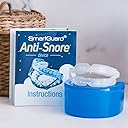
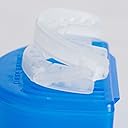
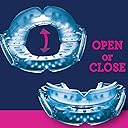
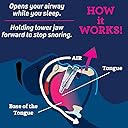
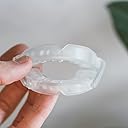
Product Description The SmartGuard Anti-Snoring Mouth Guard works by sweeping your lower jaw, keeping your airway open and reducing snoring while you sleep. The SmartGuard design is uniquely comfortable and effective, so you can open and close it freely while enjoying your mouth protection. The SmartGuard Anti-Snoring Device consists of two independent trays that are moulded into the upper and lower teeth to create a custom fit. Advanced rods connect the top and bottom trays comfortably so the SmartGuard allows the jaw to move while keeping the jaw in the correct position. Directions Instructions attached Safety Warning Do not use in the following situations: You have a serious respiratory disorder, such as asthma or emphysema. You suffer from central sleep apnea. You have serious jaw pain, loose teeth or advanced periodontal discomfort. You have full or partial prosthesis that you can remove at night and leave with a few teeth. At night, you can wear fixed straps or brackets. You had a dental implant in the past 12 months. You are under 18 years old. Review: This is a good MAS splint and costs 10% of the cost of a dentist moulded acrylic splint - I first used a MAS eleven years ago when my obstructive sleep apnoea was confirmed. I stopped using it because it failed to control my OSA, and the splint prevented me from side sleeping (which had been my lifelong treatment). I am now using CPAP but bilateral rotator cuff tears have made side sleeping difficult and I tend to roll out of the lateral position - obstruct and be wakened by the full face mask leaking. This MAS was easy to mould, the combined thermoplastic keeps it shape. The side bars that link the two splints are not too uncomfortable for side sleeping and have not produced any ulceration (but I do use a special pillow with a hollowed area for my mandible). Using the splint has reduced the frequency of being woken due to obstruction, but not eliminated the problem. My only concern is that the splint only covers the first molar, and while it may not need to be lengthened for my remaining two, covering the second molar for everyone would provide a better fit. I have been using the splint now for two months with 3mm of prognathism. Review: This is the best one of these devices. Here's why... - I first tried a more expensive ($120) adjustable mandibular advancement device (MAD), one not sold on desertcart. As soon as I put it into my mouth, it became clear that there would be severe problems with my use of it. Thus I searched desertcart for a device that addressed those problems. I found the SmartGuard and I have used it for just over a month. I am extremely happy with it and I expect to gladly replace it several times a year. I hope that it remains available! I offer these comments in the hope that they will help someone else choose an effective MAD for themselves. In my opinion, the SmartGuard has a unique set of features that address many of the problems with other MADs. First, it is assembled by the user from two separate pieces, a top tray and a bottom tray. The retainers for the upper and lower teeth are thus molded to your teeth separately, so that each can fit the teeth more precisely. This system actually works, especially for those of us with an overbite. I find that the resulting fit to my teeth is very secure. On the other hand, devices which require the upper and lower to be molded at the same time require you to align your teeth vertically during the molding process. For those of us with an overbite, this means you are molding while attempting to hold your jaw in a very unnatural position, making it difficult to get a good mold. Additionally, because there are two separate pieces, the whole assembly can be kept relatively small. In other words, it does not fill your mouth, and that fact allows you to keep your mouth closed while sleeping. Yet you can also open your mouth when needed. These were important criteria in my search. The separation of the upper and lower trays also allows the adjustment of the size of the arch of the upper tray to better fit your teeth. This was not one of my criteria, but it seems like it could help some people. Secondly, it is adjustable for the relative position of the lower jaw with respect to the upper teeth. In the SmartGuard, this adjustment was designed while keeping people with overbite in mind -- that is, the device can be set up with the lower piece not as far forward as the upper piece. This was the most important criterion for my particular search, as I do have an overbite, and where the furthest back position of the first device I tried forced my jaw into a very uncomfortable, too far forward, position. There are some things to be aware of about the SmartGuard: Because the upper and lower trays are molded to your teeth separately, it is important to pay attention to the alignment of each tray to your teeth. The trays each have an alignment notch that is meant to be centered on the middle of your teeth during molding. I suspect that some of the people who have found this device to be uncomfortable have not correctly aligned the trays with their teeth during molding. I know that happened to me the first time I molded it. If the alignment between upper and lower trays is not correct, the device cannot be expected to work properly. It is important to make sure that the soft parts of the upper and lower trays do not contact each other during the molding process. If they do, they will stick together. This is not mentioned in the instructions. While it is easy to assemble the device, it tends to be difficult to disassemble it to change the length of the bars. The instructions advise removing the bars from the lower tray first, and I have found that to be good advice. Update after nearly one year of use: The first unit that I used eventually failed by the soft portion of one of the trays separating from the hard portion. I had already prepared a second unit, and the transition to the second unit was problem free. However, when I prepared a third unit, I ran into a problem -- it did not fit well at all. I then prepared a fourth unit, and that one fit better than the third one, but it was not as comfortable as the first two. I closely examined all of the last three units for physical differences that could explain the comfort results. I did not find anything other than the fact that the fitting process leads to different results on different attempts (at least for me). In fact, I was able to increase the comfort level of the third unit a lot by repeating the fitting process on it. It seems clear to me that the amount of physical jaw advancement will generally differ between units that are assembled with the same numbered adjustment bars; depending on how the fitting process goes. I may get better at getting repeatable fitting results as time goes on, but as it is, I think I am getting about the same advancement with setting 3 on the fourth unit as I am with setting 4 on the second unit. This matters to me because this device is extremely effective at reducing the specific type of sleep apnea that I have, given the appropriate level of jaw advancement, as shown by multiple home sleep studies. I did also find that the manufacturer had increased the thickness of the adjustment bars for the later units -- this was not obvious by eye, but was easily discovered when I tried to interchange the adjustment bars between units.


| ASIN | B0BDGG5X9C |
| Age Range Description | Adult |
| Age range (description) | Adult |
| Brand | SmartGuard |
| Brand Name | SmartGuard |
| Colour | Transparent/Clear |
| Customer Reviews | 3.3 out of 5 stars 1,400 Reviews |
| Included Components | Case, Instructions for Use, Molding Tool, Size Brackets, Snoring Tool Mouthguard |
| Item Dimensions | 9.5 x 5.1 x 15.2 centimetres |
| Item dimensions L x W x H | 9.5 x 5.1 x 15.2 centimetres |
| Manufacturer | Cenyo |
| Manufacturer Part Number | SGASDA |
| Material | Ethylene Vinyl Acetate (EVA) |
| Material Type | Ethylene Vinyl Acetate (EVA) |
| Model Name | SmartGuard Adjustable Anti Snoring Mouthpiece |
| Model Number | SGASDA |
| Model name | SmartGuard Adjustable Anti Snoring Mouthpiece |
| UPC | 866747000389 |
| Unit Count | 1 count |
S**R
This is a good MAS splint and costs 10% of the cost of a dentist moulded acrylic splint
I first used a MAS eleven years ago when my obstructive sleep apnoea was confirmed. I stopped using it because it failed to control my OSA, and the splint prevented me from side sleeping (which had been my lifelong treatment). I am now using CPAP but bilateral rotator cuff tears have made side sleeping difficult and I tend to roll out of the lateral position - obstruct and be wakened by the full face mask leaking. This MAS was easy to mould, the combined thermoplastic keeps it shape. The side bars that link the two splints are not too uncomfortable for side sleeping and have not produced any ulceration (but I do use a special pillow with a hollowed area for my mandible). Using the splint has reduced the frequency of being woken due to obstruction, but not eliminated the problem. My only concern is that the splint only covers the first molar, and while it may not need to be lengthened for my remaining two, covering the second molar for everyone would provide a better fit. I have been using the splint now for two months with 3mm of prognathism.
D**K
This is the best one of these devices. Here's why...
I first tried a more expensive ($120) adjustable mandibular advancement device (MAD), one not sold on Amazon. As soon as I put it into my mouth, it became clear that there would be severe problems with my use of it. Thus I searched Amazon for a device that addressed those problems. I found the SmartGuard and I have used it for just over a month. I am extremely happy with it and I expect to gladly replace it several times a year. I hope that it remains available! I offer these comments in the hope that they will help someone else choose an effective MAD for themselves. In my opinion, the SmartGuard has a unique set of features that address many of the problems with other MADs. First, it is assembled by the user from two separate pieces, a top tray and a bottom tray. The retainers for the upper and lower teeth are thus molded to your teeth separately, so that each can fit the teeth more precisely. This system actually works, especially for those of us with an overbite. I find that the resulting fit to my teeth is very secure. On the other hand, devices which require the upper and lower to be molded at the same time require you to align your teeth vertically during the molding process. For those of us with an overbite, this means you are molding while attempting to hold your jaw in a very unnatural position, making it difficult to get a good mold. Additionally, because there are two separate pieces, the whole assembly can be kept relatively small. In other words, it does not fill your mouth, and that fact allows you to keep your mouth closed while sleeping. Yet you can also open your mouth when needed. These were important criteria in my search. The separation of the upper and lower trays also allows the adjustment of the size of the arch of the upper tray to better fit your teeth. This was not one of my criteria, but it seems like it could help some people. Secondly, it is adjustable for the relative position of the lower jaw with respect to the upper teeth. In the SmartGuard, this adjustment was designed while keeping people with overbite in mind -- that is, the device can be set up with the lower piece not as far forward as the upper piece. This was the most important criterion for my particular search, as I do have an overbite, and where the furthest back position of the first device I tried forced my jaw into a very uncomfortable, too far forward, position. There are some things to be aware of about the SmartGuard: Because the upper and lower trays are molded to your teeth separately, it is important to pay attention to the alignment of each tray to your teeth. The trays each have an alignment notch that is meant to be centered on the middle of your teeth during molding. I suspect that some of the people who have found this device to be uncomfortable have not correctly aligned the trays with their teeth during molding. I know that happened to me the first time I molded it. If the alignment between upper and lower trays is not correct, the device cannot be expected to work properly. It is important to make sure that the soft parts of the upper and lower trays do not contact each other during the molding process. If they do, they will stick together. This is not mentioned in the instructions. While it is easy to assemble the device, it tends to be difficult to disassemble it to change the length of the bars. The instructions advise removing the bars from the lower tray first, and I have found that to be good advice. Update after nearly one year of use: The first unit that I used eventually failed by the soft portion of one of the trays separating from the hard portion. I had already prepared a second unit, and the transition to the second unit was problem free. However, when I prepared a third unit, I ran into a problem -- it did not fit well at all. I then prepared a fourth unit, and that one fit better than the third one, but it was not as comfortable as the first two. I closely examined all of the last three units for physical differences that could explain the comfort results. I did not find anything other than the fact that the fitting process leads to different results on different attempts (at least for me). In fact, I was able to increase the comfort level of the third unit a lot by repeating the fitting process on it. It seems clear to me that the amount of physical jaw advancement will generally differ between units that are assembled with the same numbered adjustment bars; depending on how the fitting process goes. I may get better at getting repeatable fitting results as time goes on, but as it is, I think I am getting about the same advancement with setting 3 on the fourth unit as I am with setting 4 on the second unit. This matters to me because this device is extremely effective at reducing the specific type of sleep apnea that I have, given the appropriate level of jaw advancement, as shown by multiple home sleep studies. I did also find that the manufacturer had increased the thickness of the adjustment bars for the later units -- this was not obvious by eye, but was easily discovered when I tried to interchange the adjustment bars between units.
N**H
This is a very painful and ineffective device
It does not work. It did not stop me from snoring and it left with me such pain in my jaw joints after taking it out that I had to take pain killers every day. I thought that the pain would stop eventually but after two weeks I was taking pain killers three times a day and could not yawn, sneeze or eat without acute pain. I used it on the first setting and it was so uncomfortable that I never tried any of the other settings. After two weeks I stopped using it altogether.
S**D
Not easy to use and not a comfortable feeling
S**N
No recommend waste money
Useles item. Its cannot hold the teeth? Easy out your teeth from position?
Trustpilot
1 week ago
2 weeks ago